App Guides
Reading Games for Kids
How to spot a game that actually helps your child learn to read, the best ones for each stage from letter sounds to first books, and the popular apps that are mostly play.
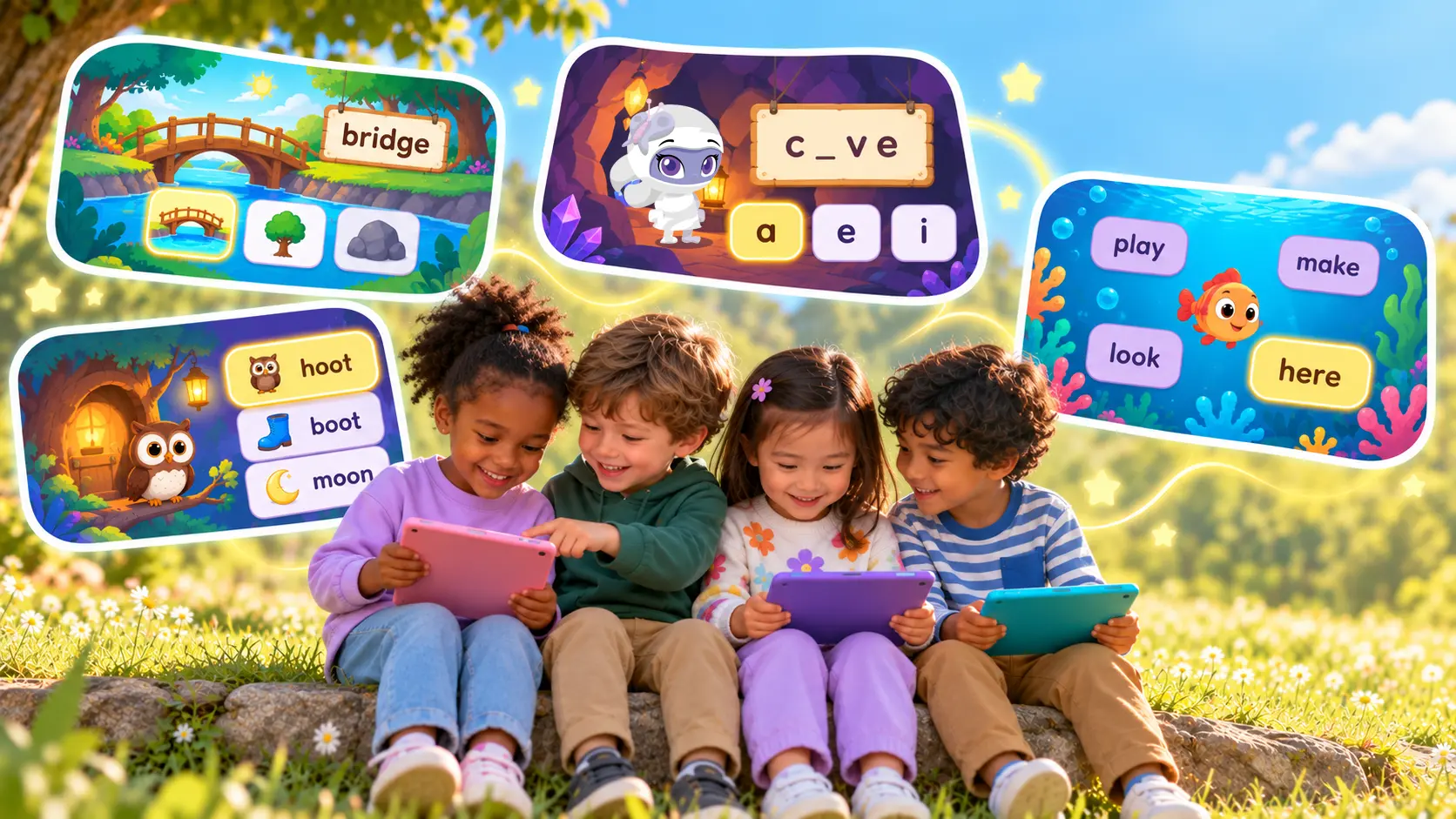
A reading game teaches reading when reading is the move that wins it. Your child sounds out the word to open the door, rather than answering a question to earn a turn at dressing a character. Three games pass it, one of each kind: Wonster Words, an app with games that build new words from sounds your child knows or is learning and play a short animation only once the word is read, and the Super Why games on PBS KIDS, free on the web and in the PBS KIDS Games app. The third needs no screen: build it, read it with magnet letters at the kitchen table.
The winning move changes with age: hearing sounds at 2–4, blending sounds into words in kindergarten, and reading whole words by 5–7. By 6–8, books take over as the main practice.
How we chose these: We make a reading app ourselves, so we know what to look for. We checked each app’s features and price on the company’s own site, help center, or app-store listing.
What makes a reading game actually teach reading?
A reading game teaches reading when the reading is the move that wins the game, not a quiz between rounds of something else. Researchers Jacob Habgood and Shaaron Ainsworth tested this with Zombie Division, a math game for 7- to 11-year-olds. In one version the math was part of the game’s own action, and in the other it was added on top of the play. Children learned more from the first, and given a free choice, they played it seven times longer. The same question applies to any reading game: does reading the word make the game go?
The word “educational” on an app store tells you little. When Meyer and colleagues scored 124 popular “educational” apps for young children on how children learn, they rated 72 of them (58%) lower quality. Free apps scored lower on engagement, which the authors put down to “distracting enhancements”.
You can run four checks in one session:
- Does reading the word move the game? If your child can win without reading, the reading is a toll, not the game.
- Does it say each sound short and clean? Listen for /b/, not “buh”, which makes blending harder.
- Is the feedback about the answer? Meyer and colleagues marked apps down for “excessive rewards (e.g., stars covering the screen) not relevant to the learning goals”.
- Does it go in an order? A game that moves from letter sounds to blending to longer words follows the order phonics skills come in.
A game and a worksheet can practice the same skill, and a child asks to play the game again. That is why gamified reading apps work when the teaching inside them is explicit. To check an app your child already has, try the 10-minute watch from our reading apps by age guide.
Which reading games are best at each age?
The best reading game at each age is one whose winning move is the skill your child is learning now. If you are not sure which stage your child is at, our reading check-in finds the first skill that is not yet solid.
| Age | The winning move | Games on a screen | A game at the table |
|---|---|---|---|
| 2–4 | Hearing a sound, matching it to a letter | Wonster Words, Khan Academy Kids, PBS KIDS Games | Robot talk |
| 4–6 and kindergarten | Blending sounds into a word | Wonster Words, Duolingo ABC, Reading Eggs, Starfall Learn to Read | Build it, read it |
| 5–7 | Reading a whole word, heart words included | Wonster Words, Sight Words - Pre-k to 3rd | Word bingo |
| 6–8 | Reading books, with games for what is still hard | A game for one stuck skill | Read a part each |
Ages 2–4: games about sounds and letters
At 2–4, a reading game should ask your child to hear a sound or match it to a letter, with pictures standing in for words.
- Wonster Words, the award-winning early reading app, with 4.6★ on the App Store from 31,000+ ratings, cues each letter sound with pictures of familiar things at its earliest levels, so a child who cannot read yet can play on their own. It asks for a letter’s sound before its name.
- Khan Academy Kids is free, with no ads, for ages 2–8. Its Learning Path rotates reading among math, science, and other subjects, starting with letter recognition and letter sounds. It suits a family that wants one free app for more than reading.
- PBS KIDS Games is free, with 280+ games for ages 2–8 across many subjects, so open the reading ones by name. PBS says Super Why’s Comic Book Adventures was designed with the science of reading in mind, with games built on letter sounds, phonological awareness, and phonics. Super Letter Race is one. It suits a child who already loves the PBS KIDS shows.
For games with no screen, see our ABC games and hearing sounds in words guides.
Ages 4–6 and kindergarten: phonics games that blend
In kindergarten, a phonics game should ask your child to blend sounds into a word: /c/ /a/ /t/ into “cat”.
- Wonster Words has your child blending wherever words are on screen, hearing each sound on its own, said short and clean. You choose the skill your child works on, such as a short vowel or the sh digraph, and the lessons inside it run in teaching order.
- Duolingo ABC is free, with no ads or in-app purchases, and teaches “explicit, systematic phonics” in its own words, in over 700 short lessons. In our use, a section opens on a letter, runs through tracing and phonics, and ends on a book as a reward, with the same few activity types each time. It suits a child who does well with a steady routine.
- Reading Eggs combines phonics lessons, sight words, an e-book library, and a parent progress dashboard, for pre-K to second grade. It costs $13.99 a month or $99.99 a year for up to 4 children, with a 30-day trial. In our use, its narration has a strong Australian accent, most noticeable on r-controlled vowels such as ar and or, and an American setting changes only some of it. Listen to a lesson first. It suits a family that wants lessons and a book library in one subscription.
- Starfall Learn to Read is free and needs no internet connection. In Starfall’s words, children “develop their phonics skills through the use of CVC (consonant-vowel-consonant) words, sight words, and vowel teams”. It suits a family that wants a free app for a trip.
Ages 5–7: games with whole words
At 5–7, a reading game should ask your child to read a whole word, in a game where guessing does not win. That includes heart words, common words with a part that cannot be sounded out, such as the “ai” in “said”.
- Wonster Words has a Sight Words section built on the Dolch list, in five lesson sets from pre-K to third grade, with games that give feedback as your child plays. A parent can also enter their own word list, such as the week’s school spelling list, and the app builds its games from those words.
- Sight Words - Pre-k to 3rd (Learn to Read: Kids Games on Google Play) is free, with no ads, and covers the Dolch list in eight game modes. In one, Listen & Match, your child hears a word and finds it written. It suits a child who is already reading words.
Most sight words can be sounded out, so drill only the heart words by sight. Our sight word games guide explains which those are, and sight word apps compares more apps.
Ages 6–8: where games stop and books take over
At 6–8, the best reading practice is reading books, and a game is for the word-level skill your child still finds hard. Games help less with comprehension, and both comprehension and fluency grow from reading books. For the skill that is still hard, Wonster Words lets you open a section by topic, such as Blend Phonics or Sight Words, and focus on that one skill.
How do the reading game picks compare?
Seven reading game apps, side by side.
| App | Best for | Ages | Method | Price | Trial |
|---|---|---|---|---|---|
| Wonster Wordsour app | Games where reading the word is how your child wins | 2–8 | Letter sounds, blending, phonics, and sight words, opened by topic | $10.99/mo · $59.99/yr (up to 4 children) | 7 days |
| Duolingo ABC | A free phonics path through short lessons | 3–8 | Explicit, systematic phonics in over 700 short lessons | Free | Not needed |
| Reading Eggs | Phonics lessons with a book library and a progress dashboard | Pre-K–2nd grade | Phonics lessons, sight words, and an e-book library | $13.99/mo · $99.99/yr (up to 4 children) | 30 days |
| Starfall Learn to Read | Free CVC word practice that works without internet | 0–5 (App Store band) | CVC words, sight words, and vowel teams | Free | Not needed |
| Khan Academy Kids | A free app that teaches reading alongside other subjects | 2–8 | Early reading on a Learning Path that also covers math and more | Free | Not needed |
| PBS KIDS Games | Free letter and phonics games with show characters | 2–8 | 280+ games across subjects; Super Why games for reading | Free | Not needed |
| Sight Words - Pre-k to 3rd | Free Dolch word games once your child is reading words | Pre-K–3rd grade | Dolch words in eight game modes | Free | Not needed |
Do Toca Boca, Lingokids, and Kiddopia teach reading?
Toca Boca World does not try to teach reading, and Lingokids and Kiddopia cover many subjects by their own descriptions: literacy is one of Lingokids’, and language is one of Kiddopia’s. Lingokids’ own word is “edutaining”.
Toca Boca World is built for open-ended play and storytelling. Its App Store listing says it “is all about open-ended play. There are no rules”, and that its “touch-first controls make it usable for all reading abilities”. It does not ask a child to read. Keep it as play time.
Lingokids is a broad early-learning app. Its listing describes “more than 4000 interactive games, songs, and shows” covering “math, literacy, science, engineering, art, music, and more”, with Disney, Marvel, and Pixar activities and no ads. Reading is one subject among many.
Kiddopia is a broad library of preschool games for ages 2–7. Its listing describes “3000+ preschool games” covering “Math, Language, Creativity, Self-expression, Roleplaying”, with no ads or in-app purchases. Language is one area among several.
In a broad app, test the reading activities yourself. Watch whether your child has to read a word to win. If not, keep the app for play and add a phonics game for reading.
Are there good free reading games?
Yes, and who pays for a free game decides what else is on the screen. Free reading games are paid for in one of three ways:
- By a nonprofit or public broadcaster. Starfall Learn to Read is free because, in Starfall’s words, “Members fund our free Learn-to-Read program”. Khan Academy Kids comes from Khan Academy, a nonprofit. PBS KIDS says corporate sponsors and public support pay for its free games.
- By a company that earns its money elsewhere. Duolingo ABC is made by Duolingo, which says the app “does not display advertising of any kind”.
- By advertisers. Free game websites such as ABCya, Turtle Diary, and Funbrain say in their own policies that they show ads. Our guide to ad-free reading apps compares what each kind of free site shows a child.
Meyer and colleagues found free apps scored lower than paid ones on engagement. Before a free game becomes a habit, play a round yourself and see whether your child would have to read a word to win. See free phonics apps and resources for more, and what to use after a free reading app for when one stops being enough. When your child is ready for more, Wonster Words has a 7-day free trial, and one subscription covers up to 4 children.
Are reading games better on a tablet or at the table?
A reading game on a tablet and one at the table each do something the other cannot, so which to use depends on the evening. A tablet game says every sound the same way every time and keeps going when no adult is free. A game at the table has you in it, to hear your child and explain a mistake. Apps rarely provide that: Meyer and colleagues found that 87% of the 124 apps they studied “failed to promote opportunities for social interaction”.
Use the table game when someone has 15 minutes, and the screen game when nobody does. On screen time itself, the American Academy of Pediatrics no longer recommends a number of minutes, and asks what the screen time is replacing.
Which reading games can you play without a screen?
The best screen-free reading games use the same winning move as the screen ones: your child reads, hears, or builds the word to take a turn. Here are one or two for each stage:
- Ages 2–4: robot talk. Say a word in separate sounds, /s/ /u/ /n/, and your child says the word. Our guide to blending sounds into words has more on it.
- Kindergarten: build it, read it. Say a short word such as “map”. Your child builds it with magnet letters and reads it back. Swap one letter to make “mop”, and your child reads again. Our CVC words list has more.
- Ages 5–7: word bingo. The printable Word Bingo boards on our kindergarten sight words and first grade sight words pages use only heart words, and our long vowel words page has a Sound Bingo game. Our guide has more heart-word games.
- Ages 6–8: read a part each. Pick a short book with two voices, or a joke book, and take turns reading the parts. Then swap parts and read it again.
That last game is rereading with an adult listening, the practice the National Reading Panel found improves fluency. For spelling games, see spelling games for 1st and 2nd graders.
Do reading games help with comprehension and fluency?
Reading games help most with letters and phonics, and less with vocabulary and comprehension. Across 36 studies of educational apps for children from preschool to third grade, Kim and colleagues found larger effects on constrained skills, the ones a child can master, such as letter sounds, than on unconstrained skills such as vocabulary and comprehension.
Fluency comes from rereading real text with someone listening. The National Reading Panel found that guided repeated oral reading had “a significant and positive impact on word recognition, fluency, and comprehension across a range of grade levels”. Comprehension grows from reading books and talking about them. Our guide to choosing between apps and books covers how the two fit together.
Can a reading game tell you how your child is doing?
Some reading games report what your child played and how accurately, and none of them replaces hearing your child read. Wonster Words emails you a daily and a weekly report with how many words your child practiced, how many games they played, and how accurate they were. You can also see their progress by skill area on the website. Reading Eggs has a parent progress dashboard, and Starfall says “individualized tracking and reports are not provided by Starfall”.
A report cannot tell you whether your child reads the word on paper. Every few weeks, write 3 words from the game on a scrap of paper, plus 1 new word with the same sounds, and listen as your child reads them. A new word read without help is the sign the game is doing its job.
Frequently asked questions
What age are phonics games most effective for?
Phonics games do the most when a child is learning to match sounds to letters and blend them into words, usually from about 4 to 6. In a meta-analysis of 36 studies, Kim and colleagues (2021) found larger app effects for preschoolers than for children from kindergarten to third grade, and on letters and phonics more than on vocabulary and comprehension.
Are mobile phonics games effective for early readers?
Yes, modestly. Across 36 studies, Kim and colleagues (2021) found that educational apps for children from preschool to third grade improved literacy and math skills by about a third of a standard deviation on average.
Can games help children learn without worksheets?
Yes. A game and a worksheet can practice the same skill, and a child asks to play the game again. In one study of a math game, children given a free choice played the version where the learning was the move seven times longer than the other.
How to incorporate learning games into a child's daily routine?
Tie a short game, about 10 minutes, to a time that already exists, such as after breakfast or before bath. Pick one game for the skill your child is learning now, and stop while they still want to keep going. With siblings, one Wonster Words subscription covers up to 4 children.
Are there phonics games suitable for children with dyslexia?
Phonics games can give a child with dyslexia extra practice with the same sound patterns, alongside structured, explicit teaching from a teacher, tutor, or reading specialist, not in place of it. If you are seeing signs of dyslexia, talk to your child's teacher or pediatrician about an evaluation.
What reading games work for a child who resists reading practice?
Choose a game where reading the word is what makes something happen, keep it short, and let your child win more often than they lose at first. Wonster Words is built this way: a short animation plays once your child has read the word, with no countdown timers, streaks, or rewards a child loses by stopping. If your child cannot yet sound out simple words, check that skill before adding more games.
How much time should my child spend on reading games?
The American Academy of Pediatrics no longer recommends a number of minutes. Its January 2026 policy statement asks parents to consider the child, the quality of the content, and what the screen time replaces. For a reading game, that means a short session on a skill your child is learning now.
Related guides
Last updated