
Teach your child to read
Resources
One skill at a time. Guides and word lists from the specialists behind Wonster Words.
How-toExplainerFeaturedIs My Child on Track With Reading?A five-minute check you can do at home tonight, what is typical at each age, and what to do about what you find.Foundations
All resources
ExplainerWhat the group is, how RTI and MTSS tiers work, how the school decides when it ends, and how to help at home without repeating the lesson.FoundationsReading help
ExplainerWhat the three numbers on a kindergarten, first or second grade reading report mean, the placement ranges by grade, and what to practice when a skill row is low.FoundationsReading help
ExplainerWhat a RIT score is, the average kindergarten–second grade reading scores from NWEA's 2025 norms, and how MAP Reading Fluency differs from MAP Growth.FoundationsReading help
ExplainerWhat to watch for at 4, 5, 6 and 7, how to tell dyslexia from a late start, how schools screen and evaluate, and what helps.FoundationsReading help
How-toWhere to start, the order the skills come in, what a daily routine looks like, and what to do when it stalls.Foundations

ExplainerGuideWhat each kindergarten subtest asks your child to do, what the benchmark goals actually mean and why the test uses made-up words on purpose.FoundationsReading help
How-toExplainerFind out which reading skill your child needs next, how to help at home, and when to check progress.Foundations

How-toGuideThe eight things that matter before school starts, a 10-minute check you run, and a guide and a worksheet to practice whatever comes next or needs work.FoundationsPhonics

ExplainerA plain-English guide for parents: what the research found, why schools are changing, and what it means at home.FoundationsPhonics

How-toExplainerThere is no single research-proven order for teaching letters. Here is the sequence we use, why we chose it, and a five-minute way to assess any program.FoundationsABC & lettersApp guides

WorksheetsHow-toLooking for something to do with your kid this fall that is not a screen? October makes it easy. Pumpkins, costumes, spooky decorations and long dark walks give kids plenty to see, hear and talk about. Most of what is on this page needs no paper at all.FoundationsPhonics

GuideHandwriting Without Tears is our top pick for most children from pre-K to 2nd grade. What each program does well, what it costs, and why a writing order is not a reading order.ABC & lettersApp guides
How-toExplainerStart with lowercase, form letters from the top down, and expect b and d to get mixed up for longer than you think.ABC & lettersFoundations
WorksheetsHow-toExplainerReversing b and d is normal into second grade, it is not a dyslexia sign on its own, and a cue your child can check does more than correcting them.ABC & lettersFoundations
WorksheetsHow-toExplainerWhich letters to start with, how to say each sound, and what to do when they are not sticking.ABC & lettersPhonicsFoundations

WorksheetsHow-toExplainerThe whole alphabet in both cases, free to print, plus what to do with it once it is on the table.ABC & lettersFoundations
How-toExplainerType your child's name and print a sheet with it on. The name stays in your browser.ABC & lettersFoundations
How-toExplainerAll 26 letters with the picture that names each sound, plus two desk strips and a blank chart to draw your own.ABC & lettersPhonics
WorksheetsHow-toExplainerGames you can start in the next minute, and the one thing that separates an ABC game that teaches reading from one that teaches the alphabet song.ABC & lettersPhonicsApp guides
WorksheetsHow-toExplainerWhy a picture beside a letter works, and the free printables that use one.ABC & lettersPhonicsFoundations
How-toWhat CVC words and word families are, when your child is ready, and a six-step way to teach them that goes past the family.Phonics
ExplainerWhat made-up words like mip and zot are for, why most children do not need extra practice with them, and how to use them well with a child who does.Phonics
Word listWorksheetsNonsense words are made-up words like mip and zot that a child can only read by sounding out. Most typically developing readers do not need them, though they can help at times with segmenting and blending sounds. They are most useful for children who struggle to blend sounds, and for children with articulation difficulties or other speech-sound issues. Start with the quick check below; if your child sounds out those real words, they do not need nonsense words.Phonics
How-toExplainerWhy children guess at words instead of sounding them out, a two-minute check for which kind of guessing you are seeing, and what to do about each.Phonics

How-toExplainerThe six stages phonics runs through, what to look for at each one, and how to tell when your child is ready to move on.PhonicsFoundations

How-toExplainerWhat phonemic awareness is, what is normal at each age, and the five-minute spoken games that build it at home.Phonics

WorksheetsExplainerThe standard count is 44. Our phonics engine teaches 50. Every one of the six is accounted for below, including the three we do not teach.Phonics
ExplainerWhy unstressed vowels turn into a quick ‘uh,’ why that makes spelling hard, and when a child is ready to learn it.PhonicsFoundations
Word listWorksheetsAn r-controlled vowel is a vowel followed by r, where the r changes the vowel's sound so it is neither short nor long. Parents and teachers call it bossy r. There are five spellings (ar, or, er, ir and ur) but only three sounds, because er, ir and ur all say the same thing.PhonicsSpelling
Word listWorksheetsThe schwa is the quiet "uh" in the weak beat of a word, and it is the most common vowel sound in English. What makes it hard is that any vowel letter can spell it, so these words cannot be worked out by ear. They have to be seen.PhonicsSpelling
How-toExplainerThe most common place children get stuck learning to read. Why it happens, and the techniques that fix it.Phonics

How-toExplainerTwo letters that spell one vowel sound, the teams your child meets first, and why when two vowels go walking is only half true.Phonics
ExplainerOne beat, one vowel sound, and the skill that turns a word too long to sound out into two or three pieces a child can read.Phonics
How-toExplainerWhat each type does to its vowel, which of the two splitting patterns is worth trusting, and why the rules you will see online are only half right.Phonics
How-toExplainerThe words a child can sound out alone, grouped by the pattern inside them rather than alphabetically, in the order those patterns are taught.Phonics
How-toExplainerTwo whole words joined into one, why they are the first long words a child can read, and how to teach them in three minutes a day.Phonics
Word listWorksheetsA compound word is two whole words joined into one, like sun plus flower making sunflower. They are the easiest long words for a child to read, because both halves are words they already know. The lists below start with the shortest and build up, each with its own worksheets, and the last one is a set you can do with pictures alone.Phonics
Word listWorksheetsA two-syllable word has two beats, like rab-bit and nap-kin. The lists below are grouped by what the first syllable does to its vowel, because that is what decides whether your child can read the word yet. Compound words come first, then the three patterns, each with its own worksheets.Phonics
Word listWorksheetsA three-syllable word has three beats, like ba-na-na and el-e-phant. The easiest place to start is with the long words your child already says out loud, because the only new work is seeing them in print. The lists below are for children in kindergarten through second grade.Phonics
WorksheetsHow-toExplainerOne box for each sound in a word, chips before letters, and how to use them with a five-year-old at the kitchen table.PhonicsSpelling

WorksheetsHow-toExplainerThe five short vowel sounds with a picture word for each, which two children mix up, and how to teach them without saying the letter's name.Phonics
How-toGuideRhyming games you can play with nothing at all, why songs do so much of the work, and what to look for in one that runs on a screen.Phonics
WorksheetsHow-toExplainerThe five long vowel sounds, the four ways English spells each one, and how to teach them once your child has the short vowels.PhonicsSpelling
How-toExplainerThree letters, one sound. The three a young child actually meets are tch, dge and igh, and two of them follow the same rule.Phonics
Word listWorksheetsTwo words rhyme when they sound the same from the vowel onward, like cat, hat and bat. Rhyming is something a child hears before they can read, so the words here are grouped by their ending and the worksheets use pictures and cards rather than writing.Phonics
Word listWorksheetsShort a is the sound at the start of ant and apple and in the middle of cat, map and bag. It is the first vowel sound most children learn, and these are the words to learn it on.Phonics
Word listWorksheetsShort e is the sound at the start of egg and in the middle of bed, hen and net. It is the vowel children most often swap with short i, and it is the one with the fewest words of its own.Phonics
Word listWorksheetsShort i is the sound at the start of in and igloo and in the middle of pig, lid and six. It is the vowel most often confused with short e, and telling the two apart is what this page is really for.Phonics
Word listWorksheetsShort o is the sound in hot, pot and mop, and at the start of octopus. It is the roundest of the five short vowels, said with the mouth open and the jaw dropped.Phonics
Word listWorksheetsShort u is the sound at the start of up and umbrella and in the middle of bug, sun and cup. It is the shortest and most relaxed of the five short vowels, and usually the last one taught.Phonics
Word listWorksheetsShort vowel words are the first words a child can sound out, and the five vowels are what they have to tell apart to do it. Here are the words by vowel, with free worksheets and no signup.Phonics
Word listWorksheetsA silent final e reaches back over one consonant and makes the vowel say its own name. Four vowels do it all the time (a_e, i_e, o_e and u_e), and e_e is real but rare.PhonicsSpelling

Word listWorksheetsTwo letters, two sounds. The voiced th (/ð/) buzzes in this and mother, and the unvoiced th (/θ/) is only air in thin and bath. Each sound has its own word list and three worksheets, and a mixed review sorts the two.Phonics
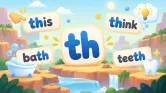
Word listWorksheetsSh is a digraph, two letters that spell one sound. Ship has four letters and three sounds. Below are the words that start with sh and the words that end with it, each with its own worksheets, and a mixed review that sorts them by where the sh sits.Phonics
Word listWorksheetsCh is a digraph, two letters that spell one sound. Chip has four letters and three sounds. Below are the words that start with ch and the words that end with it, each with its own worksheets, plus the words where ch says something else entirely.Phonics
Word listWorksheetsWh is a digraph, two letters that spell one sound, and for most American speakers that sound is simply w. Below are the wh words to read and spell, the four where wh says h instead, and free worksheets for both.Phonics
Word listWorksheetsPh is a digraph, two letters that spell one sound, and that sound is f. Phone starts the way fish does. Below are the ph words at the start, in the middle and at the end of a word, with free worksheets and the reason English spells them this way.Phonics
Word listWorksheetsCk is two letters for one sound, the same sound as k, and it goes straight after a short vowel. Duck, back, sock. Below are the ck words by family, the rule in one line, free worksheets and the games that make it stick.Phonics
Word listWorksheetsTch is three letters for one sound, the same sound as ch, and it goes straight after a short vowel. Catch, fetch, itch. Below are the tch words by family, the rule in one line, the words that break it, and free worksheets.Phonics
Word listWorksheetsDge is three letters for one sound, the same sound as j, and it goes straight after a short vowel. Badge, fudge, bridge. Below are the dge words by family, the rule in one line, the dge-or-ge choice, and free worksheets.Phonics
Word listWorksheetsAn ending blend is two consonants run together at the end of a word, with both sounds still heard: hand, tent, jump, nest, desk, gift, belt, wolf, milk. They are harder to hear than the blends at the start of a word, and they are where most of a child's spelling mistakes live. Below are the words family by family, free worksheets, and why nk and ng are taught differently.PhonicsSpelling
Word listWorksheetsAn L blend is a consonant followed by l, and both letters keep their sound: bl, cl, fl, gl, pl and sl. Blue, clap, flag, glue, plug, sled. Below are the words family by family, the reason children drop the l, and free worksheets for each.Phonics
Word listWorksheetsAn R blend is a consonant followed by r, and both letters keep their sound: br, cr, dr, fr, gr, pr and tr. Bread, crab, drum, frog, grass, press, train. Below are the words family by family, why this family is the hardest of the three, and free worksheets for each.Phonics
Word listWorksheetsAn S blend starts with s and a second consonant, and both letters keep their sound: sc, sk, sm, sn, sp, st and sw. Star, stop, snake, spoon, swing, smoke, scarf. The s can be stretched out for as long as you like, which is what makes this the easiest family to start with. Below are the words family by family, the three-letter blends that come later, and free worksheets.Phonics
Word listWorksheetsA vowel team is two letters that spell one vowel sound, so rain has four letters and three sounds. The lists below are grouped by SOUND rather than by spelling, because the choice between two spellings of the same sound is the part a child actually has to learn.PhonicsSpelling
Word listWorksheetsLong a is the sound in cake, rain and day: the letter a saying its own name. English writes it at least five ways, and choosing between them is the part a child has to learn.PhonicsSpelling
Word listWorksheetsLong e is the sound in feet, leaf and happy: the letter e saying its own name. It has more spellings than any other long vowel, and the two commonest, ee and ea, cannot be told apart by any rule.PhonicsSpelling
Word listWorksheetsLong i is the sound in bike, light and my: the letter i saying its own name. It is the only long vowel spelled with three letters for one sound, and the only one commonly spelled with no i at all.PhonicsSpelling
Word listWorksheetsLong o is the sound in bone, boat and snow: the letter o saying its own name. One of its spellings, ow, also spells a completely different sound, which is the mix-up this page sorts out.PhonicsSpelling
Word listWorksheetsLong u is two sounds, not one. It is the /yoo/ in cube and music and the /oo/ in blue and moon, and both are called long u. Knowing that is what stops a child stalling on blue.PhonicsSpelling
Word listWorksheetsA long vowel says its own name, and English writes each one several ways. These lists group the words by the SOUND you hear, so cake, rain and day sit together even though nothing about them looks alike.Phonics
How-toExplainerTwo letters that spell one sound, the six your child will meet first, and how to teach them without turning ship into s-h-i-p.Phonics
How-toExplainerThe four steps in order, why rhyming is not a gate in front of phonics, and what to do when your child can hear a rhyme but cannot make one.Phonics
Word listWorksheetsCVC words are three-sound words with a short vowel in the middle, like cat, pen and sun, and they are the first words a child can sound out alone. Here they are by vowel and by word family, with free worksheets and no signup.Phonics
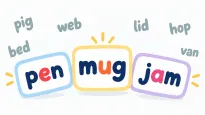
How-toExplainerTwo letters, both sounds still audible: st in stop, fl in flag. Which blends to teach first, how to teach them, and where the word lists are.Phonics
How-toExplainerWhy words your child knew last week slip away, the seven usual causes, and what to change for each one.Sight wordsPhonics
How-toExplainerThe few common words with a part that breaks the spelling rules, which part to learn by heart, a six-step routine for teaching one, and every heart word on our lists.Sight words
Word listWorksheetsAll 220 Dolch sight words, from the pre-primer and primer lists for kindergarten up to third grade. Each level is split into the words to sound out and the heart words to learn by heart, with worksheets for both. Only 49 of the 220 are heart words.Sight words
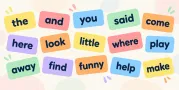
Word listThe Fry list ranks the 1,000 most common words in English in groups of a hundred. This page lists the first 300, sorted into the words your child can sound out and the 70 heart words to learn by heart, with free word cards. The other 229 follow spelling patterns a child learns in phonics.Sight words
Word listWorksheetsFry words 26 to 100, the next 75 most common words in English, sorted for a first grader: 54 to sound out and only 21 to learn by heart, with worksheets for both.Sight words
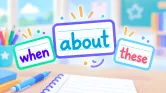
Word listWorksheetsFry words 101 to 200, sorted for a second grader: by the end of the year 78 of them follow patterns your child has been taught, and only 22 have to be learned by heart.Sight words
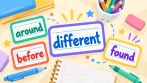
Word listWorksheetsFry words 201 to 300, sorted for a third grader: 81 follow patterns your child has been taught by the end of second grade, and only 18 have to be learned by heart. If your school uses the Dolch list instead, its third grade words are on the Dolch page.Sight words
Word listWorksheetsThe 25 most common words in English, from the Fry list, sorted for a kindergartner: 16 to sound out and only nine to learn by heart, with worksheets for both.Sight words
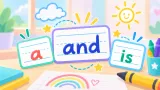
ExplainerWhich words on the list need memorizing, how many your child needs by grade, and which list your school uses.Sight words
How-toHow to sort the list your school sent, which words actually need memorizing, and what five minutes a day should look like.Sight wordsPhonics

How-toNine no-prep games you can play tonight, which words belong in them, and how often to play without it turning into a chore.Sight words
How-toExplainerType this week's spelling words and print the sheets. Your list stays in your browser.Spelling
Word listWorksheetsThe words a kindergartner learns to spell, grouped by skill from two-letter words to sh, ch and th, with free spelling and writing worksheets for every group.Spelling
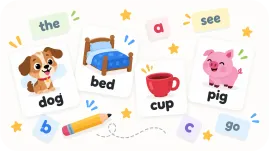
Word listWorksheetsThe words a first grader learns to spell, grouped by the five patterns of the year, with free worksheets for each group.Spelling
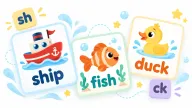
Word listWorksheetsThe words a second grader learns to spell, grouped by the patterns of the year, with free worksheets for each group.Spelling
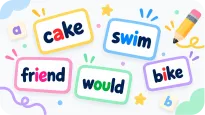
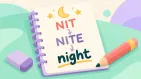
ExplainerWhat age spelling starts, the five stages it arrives in, and why nite for night is a good sign.SpellingFoundations
ExplainerThe handful of rules that are worth teaching, roughly when each one lands, and the ones to handle with caution.SpellingPhonics
GuideThe seven things that matter, what to watch while your child practices, and how to pick the best one for you.SpellingApp guides
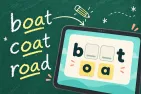
How-toWhy spelling is harder than reading, the five-minute routine that works, and what to do when your child gets a word wrong.SpellingPhonics

How-toSeven games you can play tonight with nothing but a pencil, why they beat worksheets, and how to tell a spelling game from a reading one.SpellingPhonics
How-toExplainerWhat struggling spelling looks like, why writing a word out ten times does not fix it, and the multisensory techniques that do.SpellingReading help

WorksheetsHow-toExplainerWhat vocalic r is, why the r after a vowel is hard to learn, the age most children say r, a 2-minute picture check, how to practice at home, and word lists for all six vocalic r sounds with free picture cards.SpeechPhonics
How-toExplainerWhat a lisp is, the four types and how to tell them apart, when a lisp usually goes away, what causes one, how a speech-language pathologist treats it, and how to help at home.Speech
How-toExplainerWhat a speech delay and autism each mean, what doctors look at to tell them apart, why a child can have both, and how to ask for an evaluation, which you can do yourself.Speech
How-toExplainerWhat home practice is for, a 10-minute routine, games for any sound, ideas for toddlers, how to choose online speech therapy or an app, and when to go back to the speech-language pathologist.Speech
How-toExplainerWhat a speech delay is, the signs at 18 months, 2 and 3, when to wait and when to ask, what causes one, how to get a free evaluation, and how to help a late talker at home.Speech
WorksheetsHow-toExplainerWhen babies coo, babble, say a first word and start putting words together, the CDC's talking milestones by age, how many words to expect at 18 months, 2 and 3, how to encourage talking, and when to ask the pediatrician.Speech
WorksheetsExplainerThe patterns children use to simplify words while they learn to talk, the age each one usually goes away, and the difference between an articulation and a phonological speech problem.Speech
WorksheetsHow-toExplainerPairs of words that differ by one sound, sorted by the speech pattern they practice, with a 2-minute picture check, home games and the age each pattern usually goes away.Speech
WorksheetsHow-toExplainerWhen a child leaves off the last sound of words, when it usually stops, and the pairs, word lists and games that help them close the word.SpeechPhonics
WorksheetsHow-toExplainerWhat stopping is, when it usually stops for each sound, a quick check you can do at home, and how to help: long and short sounds, stopping minimal pairs, games and free picture cards.Speech
WorksheetsHow-toExplainerWhat cluster reduction is, when it usually stops, a quick check you can do at home, and how to help: the two-sounds-apart cue, cluster minimal pairs, word lists by blend family, games and free picture cards.SpeechPhonics
WorksheetsHow-toExplainerWhat it means when a child leaves off the first sound of words, why it is worth an early check, what it does and does not say about autism, and first-sound games, pairs and free picture cards.Speech
WorksheetsHow-toExplainerWhat fronting is, when it usually stops, a quick check you can do at home, and how to help: the k sound, k and t and g and d minimal pairs, games and free picture cards.Speech
WorksheetsHow-toExplainerWhy children mix up s and sh, when both sounds usually arrive, a quick check you can do at home, the smile-and-round-lips cue that teaches the difference, and s and sh, s and z and sh and ch minimal pairs with free picture cards.SpeechPhonics
WorksheetsHow-toExplainerWhy children swap f, s or t for th ("fink", "sink" or "tink" for think), when th usually arrives, a quick check you can do at home, the tongue-out cue, and th and f, th and s and th and t minimal pairs with free picture cards.SpeechPhonics
WorksheetsHow-toExplainerWhat gliding is, why it is usually the last pattern to go, a quick check you can do at home, and how to help: l and r cues, r and w and l and w minimal pairs, games and free picture cards.Speech
WorksheetsHow-toExplainerInitial, medial and final s words with pictures, the z words that go with them, which words to start with, how to practice at home, and free picture cards.Speech
How-toExplainerWhat number sense is, the order its parts grow in from age 3 to first grade, a two-minute check-in, and everyday ways to build it at home.Math · Counting & Number Sense
WorksheetsHow-toExplainerWhat subitizing is, the two kinds, what age children do each, and how to practice it at home, with free dot cards to print.Math · Counting & Number Sense
WorksheetsHow-toExplainerOne-to-one correspondence, the five counting principles, why a child can count to 20 but not say how many, and counting activities for preschool.Math · Counting & Number Sense
WorksheetsHow-toExplainerWhen kids learn it, how to teach it, counting by 10s, why kids stop at 29, and counting backwards, with free worksheets.Math · Counting & Number Sense
WorksheetsHow-toExplainerFilled, blank, and missing-number charts with answer keys, and five minutes a night of ways to use one with your child.Math · Counting & Number Sense
WorksheetsHow-toExplainerWhat the signs mean, a way to remember them that names them too, when children learn them, and how to teach comparing at the kitchen table.Math · Counting & Number Sense
WorksheetsHow-toExplainerWhat each pair means, when children learn it, and how to move a child from counting to find the answer to knowing it.Math · Counting & Number Sense
WorksheetsHow-toExplainerFree sheets for 0–9 and 10–20, what age children write numbers, how to teach each one, and why 3s and 7s come out backwards.Math · Counting & Number Sense
WorksheetsHow-toExplainerFirst to tenth in a table, how ordinal numbers differ from counting numbers, when children learn them, and five minutes of practice with toys already in the house.Math · Counting & Number Sense
How-toExplainerWhat the research says, when children usually stop, and how to move from counting every finger to seeing groups of five.Math · Counting & Number Sense
WorksheetsHow-toGuideWhich board games build number sense and why, the best ones for ages 3 to 8, how to play so the numbers count, and a free number path game to print.Math · Counting & Number Sense
How-toExplainerWhy math is taught differently now, the same problems solved the old way and the new way, when the standard algorithm arrives, and how to help with tonight's homework.Math · Math Models Explained
WorksheetsHow-toExplainerWhat an area model is, how to multiply with one step by step, how it lines up with the carrying method parents learned, which grade uses it, and free worksheets with an answer key.Math · Math Models Explained
WorksheetsHow-toExplainerWhat a tape diagram is and why it has three names, which grade uses it, how to draw one step by step, and why schools teach it, with a free blank template and word problems.Math · Math Models Explained
WorksheetsHow-toExplainerWhat a number bond is, why schools draw it, what grade children learn it, and how to teach it at home, with a free blank template and worksheets.Math · Math Models Explained
WorksheetsHow-toExplainerWhat a ten frame is, why schools use one instead of counting by ones, what each grade does with it, and how to make ten at the kitchen table.Math · Math Models Explained
WorksheetsHow-toExplainerWhat the units, rods, and flats stand for, how to show a number and a regroup with them, and free to-scale blocks to cut out, a mat, and practice sheets with answer keys.Math · Math Models Explained
WorksheetsHow-toExplainerWhat a number line is and why it starts at 0, which grade uses one, how to add and subtract by jumps, and free printable lines from 0–10 to 0–100, blank and open.Math · Math Models Explained
WorksheetsHow-toExplainerWhat the bead rack on your child's homework is, why schools use it instead of counting by ones, which grades use it, and how to use one at home, with a free paper rekenrek.Math · Math Models Explained
WorksheetsHow-toExplainerWhat an array is, how it shows multiplication, which grade uses it, why schools teach it before the times tables, and how to explain it at home, with free array worksheets.Math · Math Models Explained
How-toExplainerWhat a math manipulative is, what the research says makes one work, which ones fit which age, how to make them at home, and how to use them so they lead to written numbers.Math · Math Models Explained
ExplainerWhat happens when you hear your child is behind in reading, what that means, and what you can do about it.Reading helpFoundations

GuideHow to choose help for a struggling reader in kindergarten through second grade, ranked by how much teaching each option provides.Reading helpApp guides
ExplainerWhy children resist reading practice, which part of it to change first, and when to stop pushing.Reading helpFoundations

ExplainerHow to tell whether practice is working, when a flat month matters, and what to change in the minutes.Reading helpFoundations

How-toGuideFive practical checks for ads, purchases, and privacy, plus what COPPA means for your child's data.App guides

GuideWhat comes with free videos and reading games, what paying removes, and where to find reading practice without ads.App guides

GuideHow to choose a phonics program for home, including homeschool: what each format asks of you, six things to check in any program, and the most popular programs compared.App guidesPhonics

GuideWhat to use after Khan Academy Kids or Duolingo ABC, based on where each free app stops and what your child needs next.App guides

GuideThe useful question is not which app is best. It is which one fits your child right now.App guidesFoundations

GuideAn honest comparison from a phonics app developer, including where our own app falls short.App guides

GuideWhat a child needs from a reading app changes sharply between 3 and 7. What each age needs, what to avoid, and which apps fit.App guides

WorksheetsHow-toGuideIf your child uses Lexia, i-Ready, or Amplify at school, you can usually use the same program at home, help during its lessons, and practice the skills it teaches in about 10 minutes.App guidesReading help

How-toGuideA ranking of the three tablet platforms for a child aged 2–8, from a developer that ships a children's app on all three app stores.App guides
How-toGuideSome kids' learning apps work offline as a whole, and some keep an offline corner. How to tell the difference, a five-minute airplane-mode test, and what each app says about itself.App guides
ExplainerGuideWhat reading apps do well, where they fall short, and how to tell if one can help your child.App guidesFoundations

GuideYou can teach a child to read without paying anything. What is worth using, and the one point at which paying starts to make sense.App guidesPhonics

GuideABCmouse is built as a broad early-learning program. We compare it with reading-focused alternatives by price, teaching approach, engagement, and the kind of practice each one does best.App guides

GuideNo app is certified as following the science of reading. Here is what the research asks for, what each app says about its own method, and the checks you can run yourself in 10 minutes.App guides

GuideSight words take weeks of practice, so the app has to be one your child comes back to. How each kind works, who it suits, and where we fit in.App guidesSight words
