
Math
Greater Than, Less Than Signs
What the signs mean, a way to remember them that names them too, when children learn them, and how to teach comparing at the kitchen table.
Grades: pre-K to grade 2 · Common Core: K.CC.C.6, K.CC.C.7, 1.NBT.B.3, 2.NBT.A.4 · Texas: K.2(E), K.2(G), K.2(H), 1.2(D), 1.2(E), 1.2(G), 2.2(C), 2.2(D) · Texas PreK: PK4.V.A.8 · Related: Texas 1.2(F)
The greater than sign, >, means the number on its left is larger, and the less than sign, <, means the number on its left is smaller. Read aloud, 8 > 5 is “8 is greater than 5”, and 3 < 7 is “3 is less than 7”. The open side of the sign always faces the larger number and the point faces the smaller one. The equal sign, =, means the two numbers are the same. Read a comparison left to right, the way you read words.
Children compare amounts before they use the signs. Kindergartners compare groups of objects and say which has more, and the symbols are a first-grade standard in the Common Core. Teach the words “greater than” and “less than” first, so the sign names something your child already knows. Free comparing numbers worksheets, from pictures to two-digit numbers, and sign cards to cut out are at the end of this guide.
What do the greater than and less than signs mean?
The greater than sign, >, means the first number is larger than the second, and the less than sign, <, means the first number is smaller. Each sign compares exactly two numbers, the one on each side of it. The equal sign, =, says the two numbers are the same amount.
| Symbol | Name | Example | Read it as |
|---|---|---|---|
| > | greater than | 9 > 4 | ”9 is greater than 4” |
| < | less than | 2 < 6 | ”2 is less than 6” |
| = | equal to | 5 = 5 | ”5 is equal to 5” |
A comparison is a sentence, and it reads left to right like one. The sentences 4 < 9 and 9 > 4 say the same thing about the same two numbers from opposite ends: “4 is less than 9” and “9 is greater than 4”. A child who can read both aloud and hear that they agree understands the signs, which is more than knowing which way they point.
Equal pairs belong in practice from the start. When every pair a child sees has a winner, = becomes a sign they never have to choose, and the first 6 = 6 on a school worksheet looks like a trick question.
Children say “bigger” and “smaller”. Worksheets and the standards say “greater than” and “less than”, and those words are the names of the signs, so they are the ones to teach.
How do you remember greater than and less than (the alligator trick)?
The best-known trick for the greater than and less than signs is the alligator: the sign is an open mouth, and the hungry alligator always eats the bigger number. Between 3 and 8, the mouth opens toward the 8, which gives 3 < 8.
The alligator fixes the direction of the sign, and that is all it does. It does not tell a child what the sign is called, which is the question a worksheet or a teacher asks next. It has no story for =. And it lets a child read the sentence from the wrong end: the sign in 3 < 8 is drawn correctly, but the child calls it “greater than”, because the alligator is eating the 8.
A rule that names the sign works better. Read left to right, and the end of the sign you meet first gives you its name. Meet the wide, open end first and the sign says “greater than”, as in 9 > 4. Meet the point first and it says “less than”, as in 2 < 6. A second trick comes from PrepScholar: tilt < a little and it looks like a slanted L, for “less than”.
Keep the alligator if your child likes it, and add the left-to-right rule on top, so your child can say the sentence as well as draw the sign.
What age do kids learn greater than and less than?
Children learn greater than and less than in two stages: comparing amounts in words in kindergarten, and writing the symbols in first grade. The Common Core kindergarten standard K.CC.C.6 asks a child to tell whether one group of objects is “greater than, less than, or equal to” another, “by using matching and counting strategies”, for groups of up to 10. K.CC.C.7 adds comparing two written numbers between 1 and 10. Neither standard names a symbol. The first that does is first grade’s 1.NBT.B.3, which compares two-digit numbers by their tens and ones, “recording the results of comparisons with the symbols >, =, and <”.
| Grade | What children do | Common Core | Texas (TEKS) |
|---|---|---|---|
| Pre-K | Say which small group of objects has more, fewer, or the same | None | PK4.V.A.8, sets up to 10 |
| Kindergarten | Compare groups up to 10 by matching and counting, and numerals 1–10, in words | K.CC.C.6, K.CC.C.7 | K.2(E), K.2(G), K.2(H), up to 20 |
| 1st grade | Compare two-digit numbers by tens and ones, and write >, <, and = | 1.NBT.B.3 | 1.2(D), 1.2(E), 1.2(G), up to 120, with the symbols to 100 |
| 2nd grade | Compare three-digit numbers with the symbols | 2.NBT.A.4 | 2.2(C), 2.2(D), up to 1,200 |
In Texas, kindergartners compare groups and numbers up to 20 rather than 10 (TEKS kindergarten math), and second graders compare numbers up to 1,200 (TEKS grade 2). The symbols arrive in first grade in both: Texas standard 1.2(G) asks a child to “represent the comparison of two numbers to 100 using the symbols >, <, or =” (TEKS grade 1). The Texas Prekindergarten Guidelines start a year earlier, with 4-year-olds comparing sets of up to 10 objects “using comparative language”.
A kindergartner who says “this pile has more” is doing the kindergarten skill exactly, and a kindergartner who does not know the sign yet is on time. The skill matters early: the Common Core introduction to kindergarten names “representing and comparing whole numbers, initially with sets of objects” as the first of the year’s two critical areas. Place value and subtraction later build on it.
The next step after “which is greater?” is one more and one less, the same comparison read the other way round.
How can parents help children compare numbers at home?
Teach comparing at home in the order the standards follow: real objects first, then the words, then numerals, and the sign last. Ten minutes with things already in the kitchen is enough for a session.
The words matter as much as the objects. The What Works Clearinghouse practice guide Assisting Students Struggling with Mathematics (2021) is written for intervention teachers, and its recommendation on clear mathematical language is rated as having strong evidence. Its table of terms to replace swaps “bigger, smaller” for “greater than, less than”. The same swap works at a kitchen table.
Put two groups of real things side by side
Line up two rows of spoons, crackers, or toy cars, one opposite one, so the extra ones stick out at the end of the longer group. Your child can see which group has more before counting anything. Then count both groups together.
Say the comparison in words
Say the whole sentence: seven is greater than five, five is less than seven. Use greater and less, and when your child says bigger, say the sentence back with greater in it.
Move to numerals
Write the two numbers under the two groups, then compare written numbers with no objects at all. When your child is unsure, bring the objects back and check.
Add the sign last
Once your child can say which number is greater, show the sign that records it, with the open side toward the greater number. Have your child read the whole sentence aloud, left to right.
Mix in equal pairs
About one pair in six should be the same number, so that equal to is a real choice. A child who never meets an equal pair learns that one side always wins.
Lining the two groups up one opposite one is the matching the kindergarten standard names, and it lets a child see “more” before they can count far. After the five steps, everyday life supplies the pairs:
- Plates. Whose plate has more grapes? Line them up to check.
- Pages. Which page number comes later in the book, 24 or 42?
- Ages. Who is older, and is 7 greater than or less than 9?
- Scores. After a game, say the sentence: “Your 6 is greater than my 4.”
How do you compare two-digit numbers?
To compare two-digit numbers, compare the tens first, and look at the ones only when the tens are the same. That is the method in first grade’s 1.NBT.B.3, which compares numbers “based on meanings of the tens and ones digits”, and Texas’s 1.2(G) asks for the same comparisons up to 100.
- 42 and 38. The number 42 has 4 tens and 38 has 3 tens, so 42 > 38, even though 8 is more than 2.
- 46 and 64. The same two digits in different places: 4 tens against 6 tens, so 46 < 64.
- 57 and 53. Both have 5 tens, so the ones decide, and 7 is more than 3: 57 > 53.
Ask “how many tens?” before “which is bigger?”. A child who can say “42 is greater because it has more tens” understands the comparison, and a child who says “because 4 is bigger” has only noticed the first digit. In second grade, 2.NBT.A.4 applies the same rule to three-digit numbers, starting with the hundreds.
How do you compare numbers on a number line?
On a number line, the number farther to the right is the greater one. Point to both numbers and ask which is farther along: 14 sits to the right of 11, so 14 > 11. The What Works Clearinghouse practice guide makes the number line one of its six recommendations for teaching children who struggle with math. On a line, the size of a number is a distance a child can see.
A hundreds chart settles the same arguments. Along a row, the number to the right is greater, and down a column each number is 10 more than the one above it.
What common mistakes do children make when comparing numbers?
Children’s mistakes with greater than and less than are of two kinds: a sign written or read wrongly after a correct comparison, and a comparison made on the wrong thing. Each one below ends with its fix.
- Reading the sign from the wrong end. The sign in 3 < 8 is right, but the child reads it “greater than”, starting from the 8. The fix is to read every comparison aloud, left to right, every time.
- Pointing the open side at the smaller number. The child guessed the direction. Have them say which number is greater first, then draw the sign opening toward the number they just named.
- Comparing the ones digit first. Between 29 and 31, the child sees that 9 is more than 1 and says 29 is greater. Ask how many tens each number has: 2 tens against 3 tens, so 29 < 31.
- Going by how a number looks. A child picks 9 over 12 because 9 is the biggest digit on the page, or picks the numeral printed larger. Go back to tens: 12 is a ten and 2 more, and 9 is not yet a ten.
- Thinking a spread-out row has more. Lay out two rows of 6 buttons and spread one row out, and a 4- or 5-year-old will often say the longer row has more. Match the two rows one opposite one, as in step 1, so the child sees nothing is left over.
- Never choosing =. A child who has only met pairs with a winner assumes one side always wins. Mix equal pairs into every practice set.
Greater than less than games
Greater than and less than games need only a deck of cards or a pair of dice, and each one ends with your child saying the comparison aloud.
- Greater wins. This is the card game War with a sentence added. Use the cards from ace (1) to 10. Each player turns over a card, the greater card takes both, and the winner says “7 is greater than 4”. Equal cards mean each player turns over another.
- Roll and say. Write <, >, and = on three scraps of paper. Roll two dice, put one on each side of a gap, and have your child choose the sign and read the sentence.
- Hidden number. Think of a number up to 20. Your child guesses, and you answer with a sentence: “My number is greater than 12.” Your child narrows it down until they find it.
- Two-digit war. Each player turns over two cards and makes the greatest two-digit number they can, so a 3 and a 7 become 73. The greater number wins, and the winner says why, in tens.
Free greater than less than worksheets
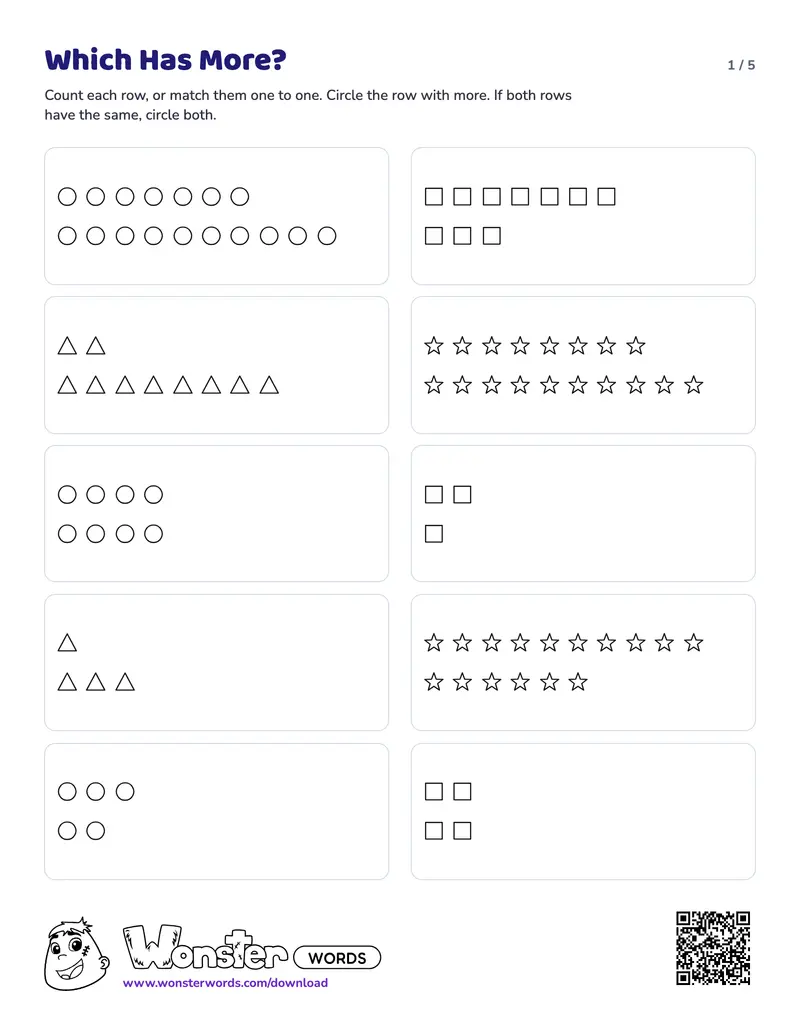
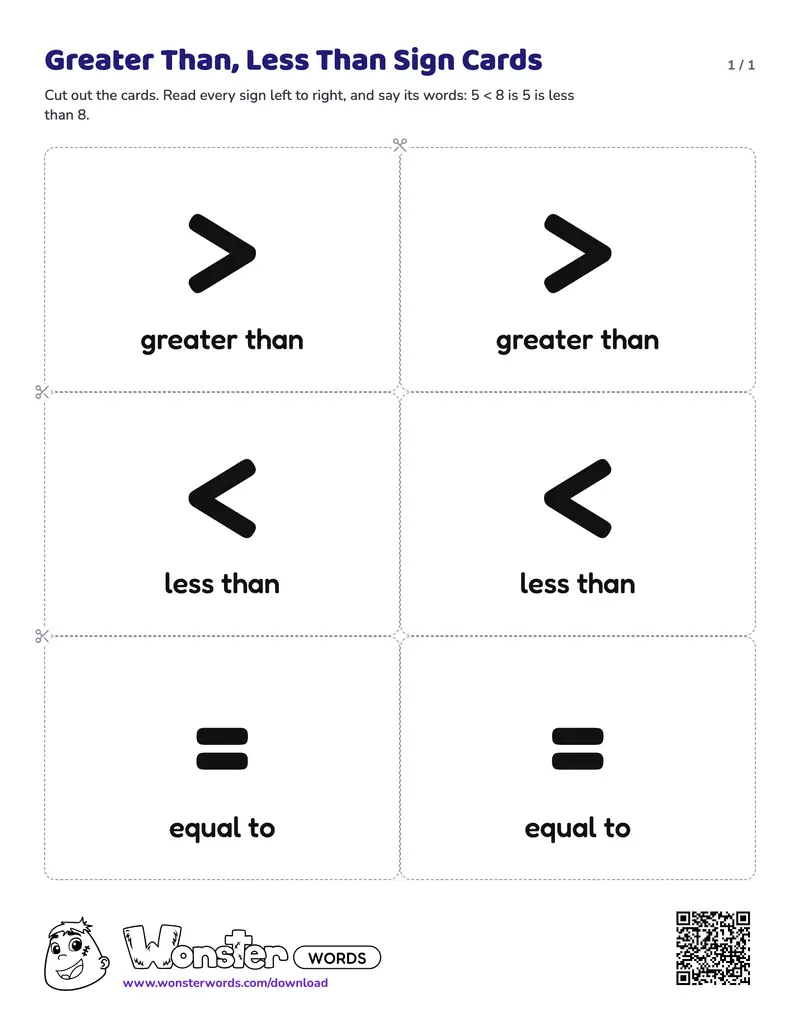
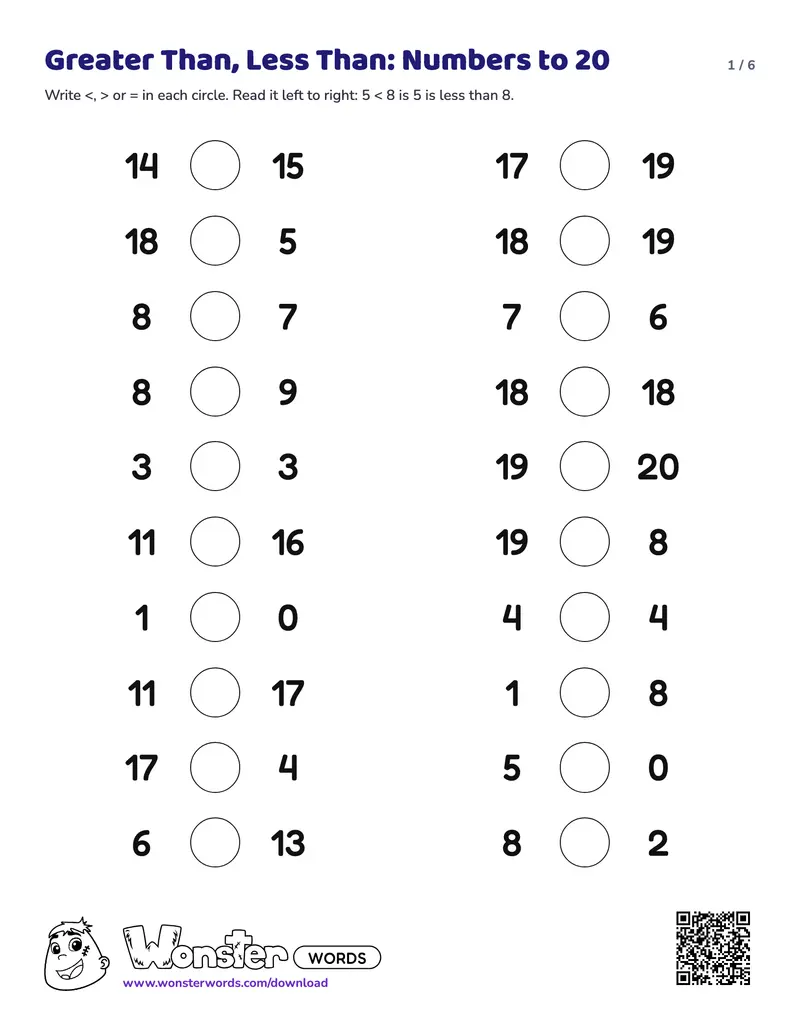
Our free comparing numbers worksheets come as three PDFs, in the order a child learns to compare, so you can print the one that matches what your child does now. Which Has More? is pictures: two rows of up to 10 shapes, and your child circles the row with more, or both when they are the same. It has no symbols, and it suits pre-K and kindergarten. The sign cards are large <, >, and = cards to cut out, each with its words printed on it, so “greater than” travels with > wherever the card goes. Greater Than, Less Than puts the signs to work in two levels. The first is numbers to 20, with a circle between each pair where your child writes <, >, or =, for kindergarten and first grade. The second is two-digit numbers, with the first rows split into tens and ones, for first and second grade.
None of the problems is numbered, so a child counting shapes or comparing two numbers meets no third number on the page. Each answer key is laid out like the page it answers, so every answer sits in the same place as its problem. Start a sheet below where you think your child is, and move on once a whole page goes right.
Free PDF · no sign-up
Free greater than, less than worksheets
Three free PDFs in black and white, with no account and no email, in teaching order: circle the row with more, then the sign cards, then comparing numbers to 20 and two-digit numbers with the signs. Start with the one your child can already do. Both worksheets have their answer keys at the back.
- Which Has More? (PDF)40 comparisons · answer key included · 6 pages
Preview page 1Preview
- Greater Than, Less Than Sign Cards (PDF)6 cards · 2 pages
Preview page 1Preview
- Greater Than, Less Than (PDF)72 comparisons · answer key included · 7 pages
Preview page 1Preview
Frequently asked questions
What does '<' and '>' mean?
The sign < means less than and the sign > means greater than. Each compares the two numbers on either side of it, read left to right, so 3 < 7 is read 3 is less than 7 and 8 > 5 is read 8 is greater than 5. The open side always faces the larger number.
How do you remember less than greater than?
Read the comparison left to right and name the sign by the end you meet first. If you meet the wide open end first, the sign says greater than. If you meet the point first, it says less than. The alligator trick, where the open mouth eats the bigger number, fixes which way the sign points, and this rule adds its name.
What is the best age to start teaching children number comparisons?
Children can start comparing small groups of objects as preschoolers, saying which group has more, fewer, or the same. Kindergarten standards ask children to compare groups and numbers up to 10 in words, and the greater than and less than symbols are a first-grade standard in the Common Core. Start with objects and words, and add the symbols last.
Why is comparing numbers important for young children?
Comparing amounts is one of the first things children do with numbers once they can count. The Common Core names representing and comparing whole numbers as the first critical area of kindergarten math, and later skills such as place value and subtraction build on knowing which of two amounts is greater and by how much.
Why do students struggle with greater than and less than comparisons?
Children struggle when they learn the sign before the comparison. A child who has not yet decided which number is greater is guessing at the sign's direction, and a child taught only a direction trick may draw the sign correctly but read it from the wrong end. Comparing objects first, then saying the sentence, then adding the sign fixes both.
What is ≤ and ≥?
The sign ≤ means less than or equal to, and ≥ means greater than or equal to. The line under the sign adds equal to as a second possibility. Neither appears in the Common Core standards for kindergarten through second grade, which use only greater than, less than, and equal to.
Is it greater than or more than?
Greater than is the name of the sign, and it is the term worksheets and math standards use for numbers. More than means the same thing in everyday speech and is the right word for comparing groups of things, such as more crackers. Teach your child both, and use greater than when reading a sign aloud.
Related guides
Last updated