
Math
How Children Learn to Count
One-to-one correspondence, the five counting principles, why a child can count to 20 but not say how many, and counting activities for preschool.
Grades: pre-K to kindergarten · Common Core: K.CC.B.4, K.CC.B.5 · Texas: K.2(C) · Texas PreK: PK3.V.A.2, PK3.V.A.3, PK4.V.A.2, PK4.V.A.3 · Related: Common Core K.CC.A.1; Texas K.2(A); Texas PreK PK3.V.A.1, PK4.V.A.1, PK4.V.A.6
Children learn to count in two halves that grow at different speeds. Saying the numbers in order, called rote counting, comes first and runs ahead. Counting things comes later and takes two more ideas. One-to-one correspondence means one number for each object, touching each one once. Cardinality means knowing that the last number you say tells how many there are. The psychologists Rochel Gelman and C. R. Gallistel named five counting principles in 1978, and together they describe what the second half takes.
A 4-year-old who recites to 30 but correctly counts only about 10 toys is exactly where the Texas Prekindergarten Guidelines expect a 4-year-old to be. The most useful thing to do at home is to say the last number again when your child finishes counting: “one, two, three, four, five. Five cars.” Then ask for a number (“Can you give me five?”) as well as “how many?”. Free counting worksheets with answer keys are in this guide too.
What is one-to-one correspondence?
One-to-one correspondence is matching each thing in one group with exactly one thing in another. In counting, it means saying one number word for each object and counting each object once. The Common Core kindergarten standard K.CC.B.4 describes it as “pairing each object with one and only one number name and each number name with one and only one object.”
A preschooler meets one-to-one correspondence in two places. The first is matching, before any counting: a cup for each child at the table, a sock for each foot, a lid for each jar. The second is counting: touching each toy as you say its number. Matching is also how young children first compare two groups, by lining them up one opposite one to see which has some left over.
Other names for it are “one-to-one counting” and, in the Texas Prekindergarten Guidelines, “one count per item”.
When one-to-one correspondence is missing, the number words and the pointing finger move at different speeds. A child says “one, two, three, four” while touching only two toys, or touches one car twice, and the count comes out wrong even though every number was said in order. Moving each counted toy to one side fixes most of these slips.
The five counting principles: what “knowing how to count” really means
Children learning to count have to work out five rules, which the psychologists Rochel Gelman and C. R. Gallistel set out in The Child’s Understanding of Number (1978).
- One-to-one. One number for each thing, and each thing counted once. At the table, that is one number per grape.
- Stable order. The numbers always come in the same order. A child who always counts three things as “two, one, three” has stable order but has not yet learned the usual list.
- Cardinality. The last number said tells how many there are: “one, two, three, four. Four grapes.” Cardinality is the technical word, and the rest of this guide says “how many”. Which one in a line is a different question, answered by ordinal numbers such as first and third.
- Abstraction. Anything can be counted: claps, jumps, sounds, and things of different kinds. In a 1990 study by the psychologist Karen Wynn, 2- and 3-year-olds counted objects best, but most could count actions and sounds too, at least in part.
- Order irrelevance. Starting from any object gives the same total. Count the cars from the left, then from the right, and there are still five.
Common Core puts four of the five into one kindergarten standard, K.CC.B.4: say the numbers “in the standard order”, one number per object, and understand that “the last number name said tells the number of objects counted”, whatever their arrangement or the order of counting. Kindergarten standard K.2(C) of the Texas TEKS asks for the same with sets of up to at least 20.
Every later skill that starts from counting, such as comparing two groups or adding by counting on, assumes these five are in place. Counting is one strand of number sense, alongside seeing small amounts at a glance and comparing them.
”My child can count to 20 but cannot tell me how many”: rote counting vs. cardinality
Rote counting is saying the numbers in order, like a song, without counting anything. It comes first, and it runs ahead of counting objects for years.
The 2022 Texas Prekindergarten Guidelines build that gap in. They expect a 3-year-old to rote count “from 1 to 10” and to count “up to 5 objects with one-to-one correspondence”. At 4, they expect rote counting “from 1 to 30” and counting “up to 10 objects”, with the child saying how many: a three-to-one gap, written into the same year.
Knowing that the last number answers “how many?” is a separate discovery from saying the numbers. In Karen Wynn’s 1990 study, 2- and 3-year-olds were asked “how many?” after they had counted. Only the older children, whose average age was about 3½, gave the last number they had said most of the time. The What Works Clearinghouse practice guide Teaching Math to Young Children (2013) describes the same child: “when asked how many they just counted, some children count again or just guess.”
Three things to try at home show which half your child is on:
- Count five toys together and ask “how many?”. Does your child say “five”, or count again?
- Put out a pile and ask “Can you give me five?”. Does your child count out five and stop, or grab a handful?
- Count the same five toys from the other end. Does your child expect five again before counting?
“Give me five” tells you more than “how many?”. In 2008, the psychologists Barbara Sarnecka and Susan Carey found that many 2- to 4-year-olds answer “how many” with the last word used in counting, “despite not understanding how counting works”. A child can learn that “how many?” is answered with the last word before knowing what that word means. Handing over exactly five cannot be done that way.
To help, start with sets of 1–3, which children can see without counting. Count them, then say the last number again with emphasis: “One, two, three. Three blocks.” Then cover them and ask how many are hiding, which is the What Works Clearinghouse’s Hidden Stars game. Move to sets of 4–10 once that is easy. The number sense check-in covers counting alongside the other early number skills.
What age do children learn to count?
Children recite numbers before they count things, and they count about 5 objects at 3, about 10 at 4, and up to 20 in kindergarten, by the Texas preschool guidelines and the kindergarten standards. Each row is a range from a named source, not a deadline.
| Age | Saying the numbers | Counting things | Source |
|---|---|---|---|
| 2–3 | Runs through a count of objects, actions, and sounds | On request, gives one item, sometimes two, without counting | Wynn (1990) |
| 3 | To 10 | Up to 5 objects, one count each, and says how many | Texas PreK PK3.V.A.1–3 |
| 4 | To 30 | Up to 10 objects, and says how many | Texas PreK PK4.V.A.1–3 |
| Kindergarten | To 100 by ones and tens | Answers “how many?” for up to 20 things in a line or 10 scattered, and counts out up to 20 on request | Common Core K.CC.A.1, K.CC.B.5; TEKS K.2(C), K.5 |
Common Core starts at kindergarten, with K.CC.B.5, so the preschool rows come from Texas, which puts numbers on counting at 3 and at 4. Reciting on to 100 is its own skill, covered in counting to 100. The table also answers a common question: a 2-year-old who says “one” to “ten” is reciting, which is normal, and counting 10 objects comes about two years later.
How to teach one-to-one correspondence and counting
Teach counting with real objects, a few minutes at a time, starting from sets so small that your child already knows the answer. That order comes from the first recommendation of the What Works Clearinghouse practice guide, to teach number through a developmental progression, which the guide rates as having moderate evidence. Six steps, each built from a handful of spoons:
Start with one, two, or three
Put out 1, 2, or 3 spoons, amounts your child can see at a glance, and count them anyway. Then say the last number again: "One, two, three. Three spoons." Because your child already knows there are three, they can hear that the count ends on the answer.
Touch and move each one
Slide each object to a counted side as you say its number, so nothing is counted twice or skipped. With pictures, cross each one off. An egg carton or an ice cube tray gives every object its own place.
Line them up first, scatter them later
Count objects in a straight row before a scattered pile, which is harder to keep track of. The Common Core kindergarten standard asks for up to 20 things in a line but only 10 scattered.
Say the last number again
Every time a count ends, repeat the last number with the thing named: "four, five. Five spoons." This is how a child learns that the last number counted is the answer to how many.
Ask for a number
Ask "Can you give me three grapes?" and let your child count them out of a bigger pile. Counting out a number is the second half of the kindergarten standard, and it shows whether your child knows what the number means.
Change the thing and the order
Count claps, jumps, and stairs, and count the same toys again starting from the other end. Your child learns that anything can be counted and that the order of counting does not change the answer.
Fingers count too. A finger per number is one-to-one correspondence on the hand, and the Texas Prekindergarten Guidelines list “each finger represents one count” among the signs of a child counting with one-to-one correspondence. Counting on fingers is a tool, not a crutch.
Keep sessions short and frequent: a few minutes on most days.
Free counting worksheets: count and match, count and color, and ten frame counting
Our three free counting worksheets practice counting a set of pictures, counting out a number, and counting a ten frame, in black and white. Print the one that matches what your child does now:
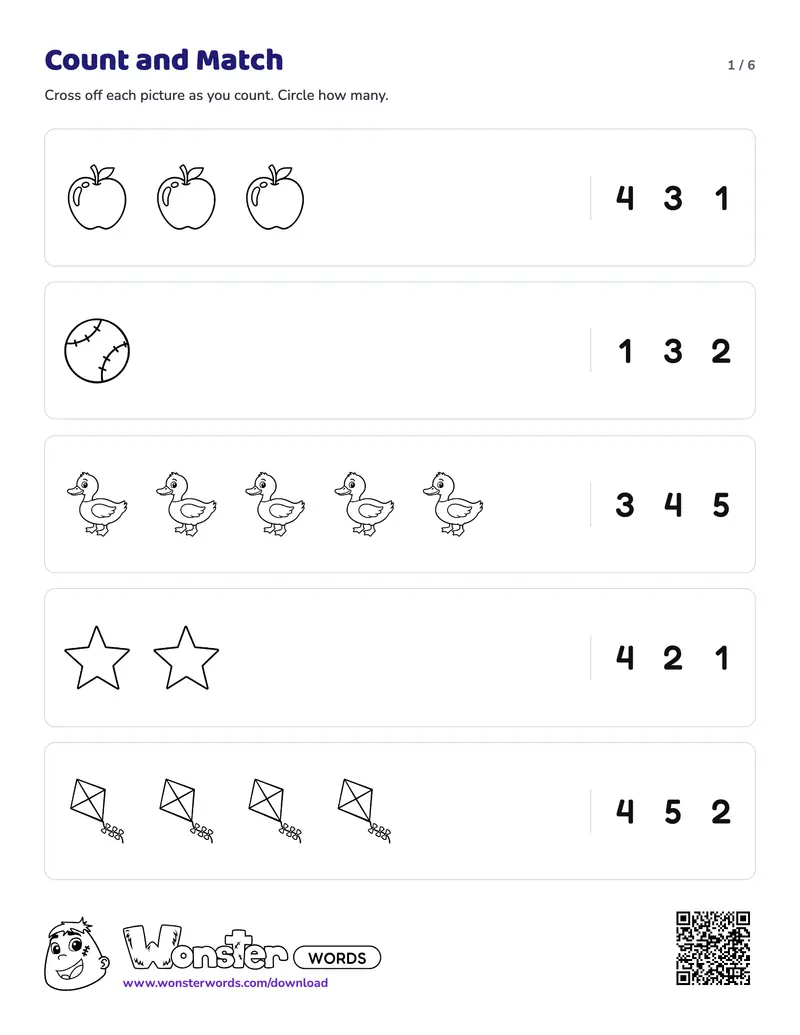
- Count and Match, for a child learning to count a set and say how many. Your child counts a row of pictures and circles the matching number from three: up to 5 in a line, then 6–10 in two rows, then up to 10 scattered, then all of them mixed. Every number from 1 to 10 comes up more than once, and the answer key is at the back.
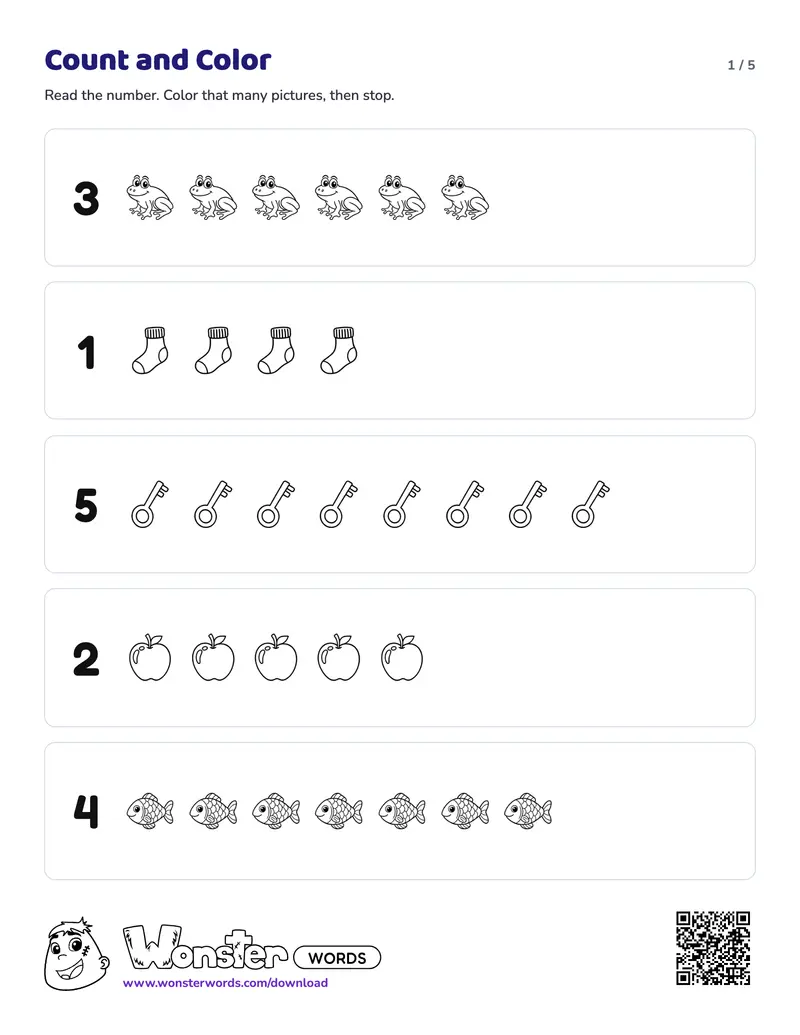
- Count and Color, the same skill the other way round. Each row starts with a number and shows more pictures than that, and your child colors exactly that many, which is “Can you give me five?” on paper. Any four pictures are a right answer to a 4, so this one needs no key.
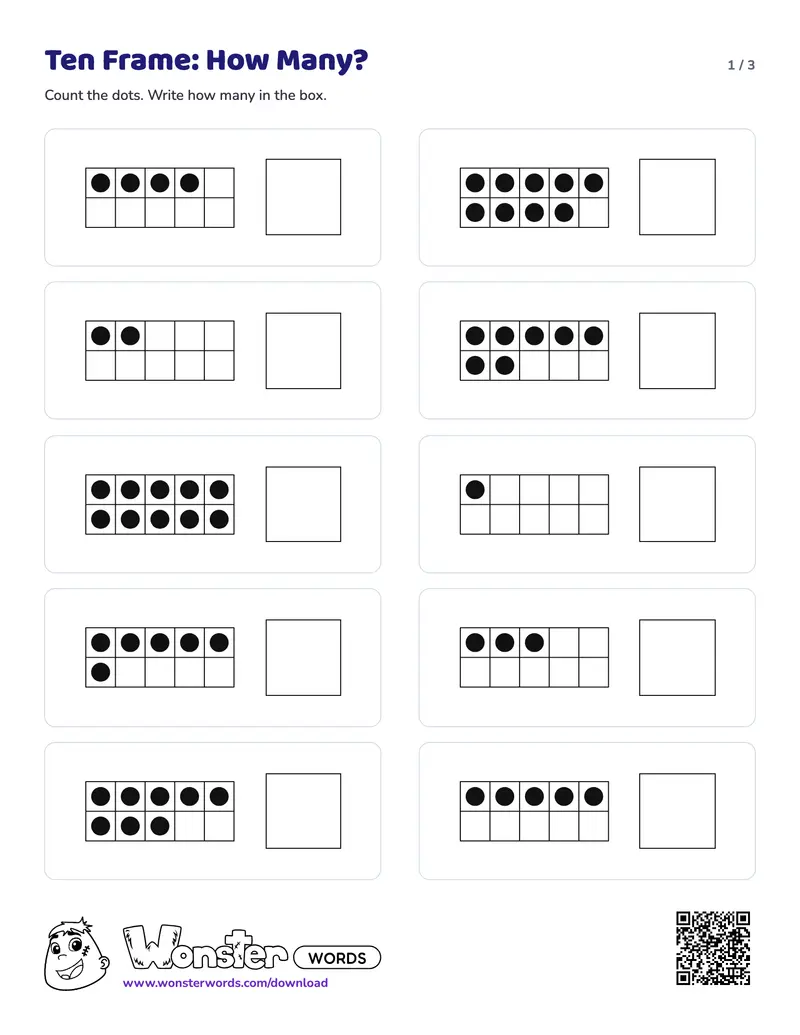
- Ten Frame: Count and Write, for a child who counts to 10 and is ready to write the number. A ten frame is two rows of five boxes, one object in each. Your child counts the dots and writes the number, then draws dots to show a number, filling the top row first. For forming the numbers, use the number tracing worksheets.
Have your child cross off each picture as it is counted, the paper version of moving counted objects aside. A worksheet practices what your child has already done with real objects; it does not replace them.
Free PDF · no sign-up
Free counting worksheets: count and match, count and color, and ten frame counting
Three free PDFs in black and white, with no account and no email, in teaching order: count a row of pictures and circle how many; color just the number shown; then count the dots in a ten frame and write the number, and draw the dots for a number. Start with the one your child can already do. Count and Match and the ten frame sheet have their answer keys at the back.
- Count and Match (PDF)38 counting rows · answer key included · 11 pages
Preview page 1Preview
- Count and Color (PDF)25 rows to color · 6 pages
Preview page 1Preview
- Ten Frame: Count and Write (PDF)40 ten-frames · answer key included · 7 pages
Preview page 1Preview
Counting activities for preschoolers using everyday objects
The best counting activities for preschoolers use things already in the house, sets of 4–10, and moments that are happening anyway, with no lesson to set up.
Around the house
The kind of counting talk matters. In a 2011 study, Elizabeth Gunderson and Susan Levine found that parents’ talk about counting or labeling sets of objects that were present and visible was linked to children’s later understanding of how many. Other number talk was not. Talk about sets of 4–10 was the most strongly linked. Moments that put a set of 4–10 in front of your child:
- Setting the table. A fork for each plate is matching. Then count the plates.
- Snack. Count the crackers, eat one, and ask how many are left.
- Stairs. One number per step, up and down.
- Tidying up. “Put five cars in the bin.”
- Socks. Match them into pairs, then count the pairs.
- Buttons. Count them as you fasten a coat.
- Laundry. Count the shirts going into the drawer.
- A walk. Count the dogs, the red cars, or the mailboxes.
Counting books and songs
Counting songs and counting books practice different halves of counting. Songs and rhymes practice saying the numbers in order. Books with pictures to point at practice counting things. When you read a counting book together, have your child point to and count the pictures on each page rather than only reading the number printed there.
Games that need one count per thing
These three counting games need nothing beyond the house, and each one depends on one count per thing.
- One for you, one for me. Share out a handful of crackers between two plates, one at a time, and count each plate at the end.
- Roll and take. Roll one die and take that many blocks from a pile. Your child counts the dots, then counts out the blocks.
- Hide and count. Count up to 10 small toys together, cover them with a cloth, and ask how many are hiding. Peek to check.
Board games, card games, and dice games have their own page: math board games.
What common mistakes do children make when learning to count?
The What Works Clearinghouse practice guide lists five common counting mistakes, all normal while counting is new, and each one has a fix.
| Mistake | What it sounds like | What to do |
|---|---|---|
| Skipping or repeating numbers | ”One, two, three, six, ten” | Practice saying or singing one to ten, then the numbers past ten |
| Counting one object twice, or pointing at one and not counting it | ”Five, six” on the last toy | Slow down; each thing gets one number |
| Losing track | Counts a toy already counted | Move each counted object aside; cross off pictures |
| Waving a finger over the group | ”One, two, three…” without touching anything | Count together, one touch per number |
| Counting again when asked how many | Recounts, or guesses | Count small sets, say the last number again, then hide them and ask how many |
The teen numbers cause their own slips: the practice guide notes that fifteen and thirteen are commonly skipped because they are irregular. Counting past 20 has the fixes for the longer sequence.
Two parent habits get in the way: counting for the child at speed, so the child only watches, and only ever asking “how many?”, which a child can answer with the last word before understanding it. Let your child do the touching, and ask for a number as often as you ask how many.
When counting is hard: is my child behind?
A 3-year-old who cannot yet count 5 objects is not behind. The Texas guidelines set 5 objects as the goal for 3-year-olds and 10 for 4-year-olds, and the kindergarten standards expect counting to 20 by the end of kindergarten. When counting is hard, make it easier: use smaller sets, real objects instead of pictures, and a finger per count.
Ask the teacher if, near the end of kindergarten, your child cannot count out 10 objects on request or cannot say how many are in a small set they have just counted. Ask too if counting is one of several worries about how your child is learning. For a child not yet in school, the pediatrician is the person to ask.
Going further: number rods and seeing groups
Two programs add an idea to counting by ones: Montessori’s number rods and RightStart’s groups of five. Montessori classrooms use number rods: ten rods “progressing in 10 equal steps from 10 cm to 1 meter”, in alternating red and blue units, as Nienhuis, the Montessori materials maker, describes them. A quantity becomes a length a child can see and compare.
Joan Cotter, who designed RightStart Mathematics, argues that children should see quantities in groups of five rather than count them by ones: “We want our children to be able to visualize, not count, to learn their facts.” Our advice is to do both. Teach counting, and teach seeing groups, such as five and three more, alongside it.
The next steps after counting a set are counting beyond 20 and one more and one less.
Frequently asked questions
What is the difference between rote counting and one-to-one correspondence?
Rote counting is saying the numbers in order from memory, like a song, without counting anything. One-to-one correspondence is matching one number word to each object, touching each thing once. A child can rote count to 30 and still skip or double-count toys, because the two skills grow separately. Rote counting comes first, and the Texas Prekindergarten Guidelines expect a 4-year-old to recite to 30 but count only 10 objects.
What are the five principles of counting?
The five counting principles, set out by Rochel Gelman and C. R. Gallistel in 1978, are one-to-one (one number for each thing), stable order (the numbers always come in the same order), cardinality (the last number said tells how many), abstraction (anything can be counted, including sounds and actions), and order irrelevance (starting from a different object gives the same total).
Is it normal for a 2-year-old to be counting to 10?
Yes, as reciting. A 2-year-old who says one to ten is saying the numbers in order from memory, which comes well before counting things. Counting 10 objects and saying how many there are is a 4-year-old expectation in the Texas Prekindergarten Guidelines, about two years later. Enjoy the reciting, and count small sets of real things alongside it.
What age should children start learning one-to-one correspondence?
Children start matching and touch-counting small sets of real objects around ages 2–3. The Texas Prekindergarten Guidelines expect a 3-year-old to count up to 5 objects with one-to-one correspondence and a 4-year-old up to 10, and the Common Core kindergarten standards expect up to 20 things in a line.
How can parents teach counting at home to preschoolers?
Count real things during routines that are already happening: plates at dinner, stairs, crackers at snack time, toys going back in the bin. Touch or move each object as you say its number, say the last number again at the end, and sometimes ask for a number, such as five grapes, instead of asking how many. A few minutes on most days is enough.
Counting activities vs. counting apps for preschoolers: which is better?
Start with real objects. A preschooler learning to count needs to touch, move, and set aside each thing as it is counted, and objects on a screen cannot be picked up or slid to one side. Hands-on counting with things at home teaches the one-to-one habit that pictures and screens rely on later. A screen can add practice once a child counts real objects reliably.
How to gauge if preschoolers understand counting concepts?
Try three things at home. Count five toys together and ask how many: does your child say five, or count again? Put out a pile and ask for five: does your child count out five and stop, or grab a handful? Count the same toys from the other end: does your child expect the same total? Asking for a number shows the most, because a child can learn to answer how many with the last word before understanding it.
Related guides
Last updated