
Math
Number Tracing Worksheets 0–20
Free sheets for 0–9 and 10–20, what age children write numbers, how to teach each one, and why 3s and 7s come out backwards.
Grades: pre-K to grade 1 · Common Core: K.CC.A.3 · Texas: K.2(B) · Texas PreK: PK4.V.A.5 · Related: Common Core 1.NBT.A.1; Texas PreK PK4.IX.B.1
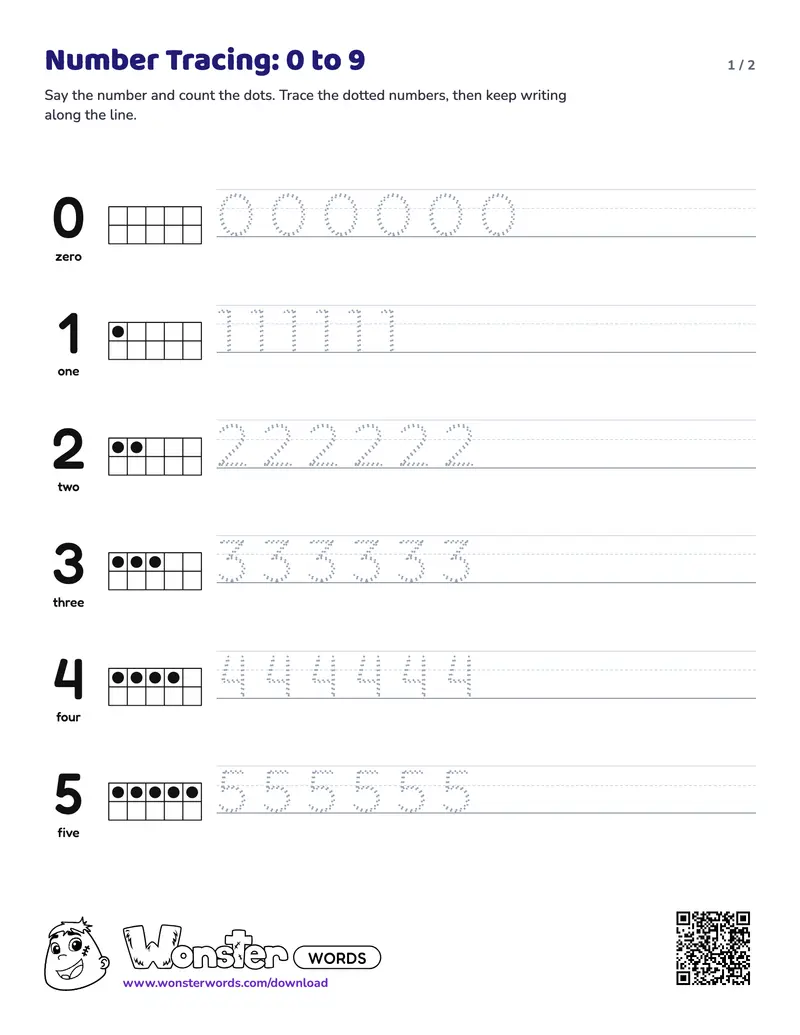
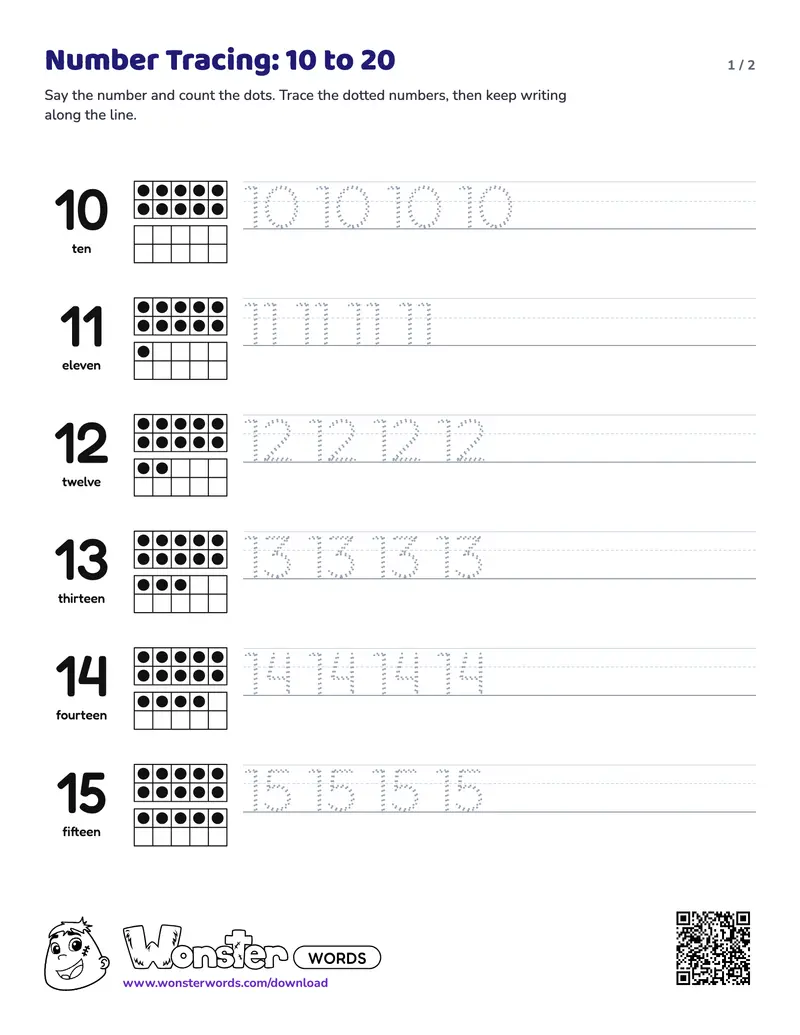
These number tracing worksheets cover 0–20, free, with no email and no account. There are two downloads, 0–9 and 10–20, and every row is built the same way: the number set large at the start with a ten frame showing how many and the number word under it, then dotted copies to trace, then the rest of the line left empty.
The one instruction that matters most: trace a few, then write the rest of the line without the dots. A child who only traces has practiced following a path. The empty half of the line is where the writing happens.
Children learn to recognize numbers before they write them. The Texas Prekindergarten Guidelines ask a 4-year-old to recognize the numbers 0–10, and both Common Core and the Texas kindergarten standards put writing 0–20 in kindergarten. The 0–9 sheet suits a preschooler who traces a few and names them, and the 10–20 sheet is kindergarten work.
Free printable number tracing worksheets, 0 to 9 and 10 to 20
The number tracing sheets come as two separate downloads, and every row has the same four parts.
- Number Tracing 0–9: one number per row, for preschool and kindergarten.
- Number Tracing 10–20: the teen numbers and 20, for kindergarten and first grade.
- Every row: the number in solid type at the start, a ten frame showing that many dots, the number word printed small underneath, dotted copies on a ruled writing line, then the rest of the line left blank.
A ten frame is a box of ten squares in two rows of five. On the 0–9 sheet it shows the count beside each number, and 0 is an empty frame, because zero means no objects. On the 10–20 sheet there are two frames, one always full, so 14 reads as one full ten and four more. The number word is there to be read, not traced.
The two ranges are split because a two-digit number is two characters to write, which is a bigger job for a small hand than one digit. A parent of a preschooler can print 0–9 and stop there.
The writing line is the three-line kind: a solid top line, a dashed midline and a solid baseline. Every number starts at the top line and finishes on the baseline, the same ruling as the letter tracing worksheets, so a child who uses both sees one set of lines.
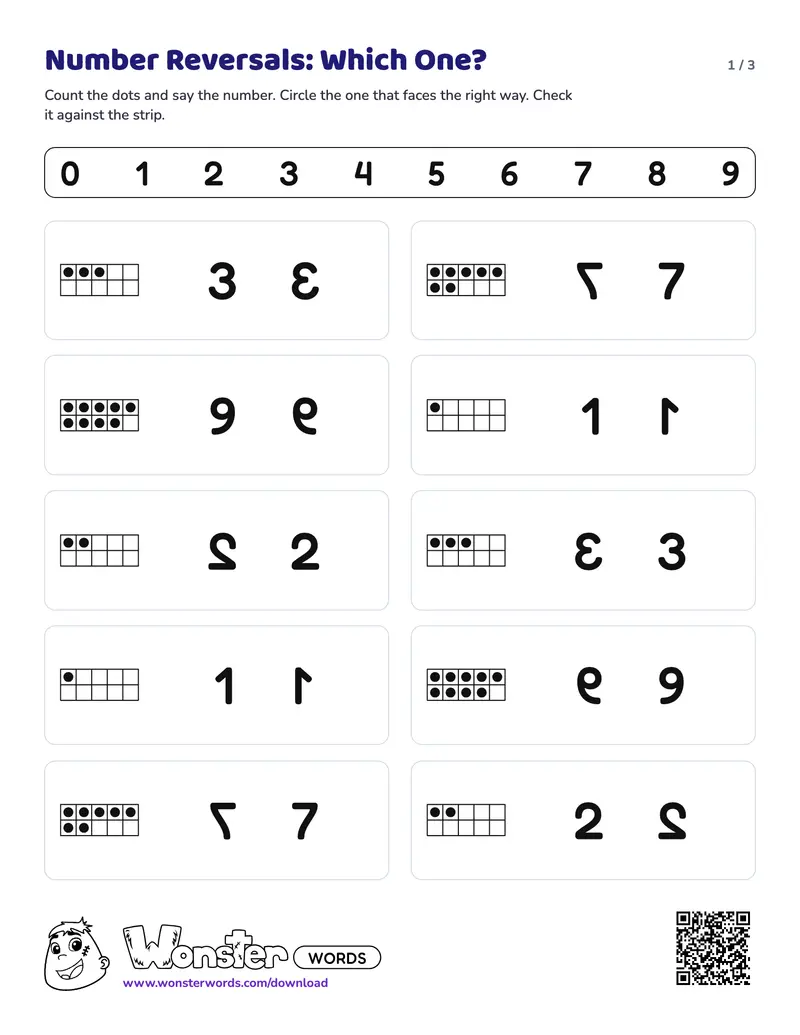
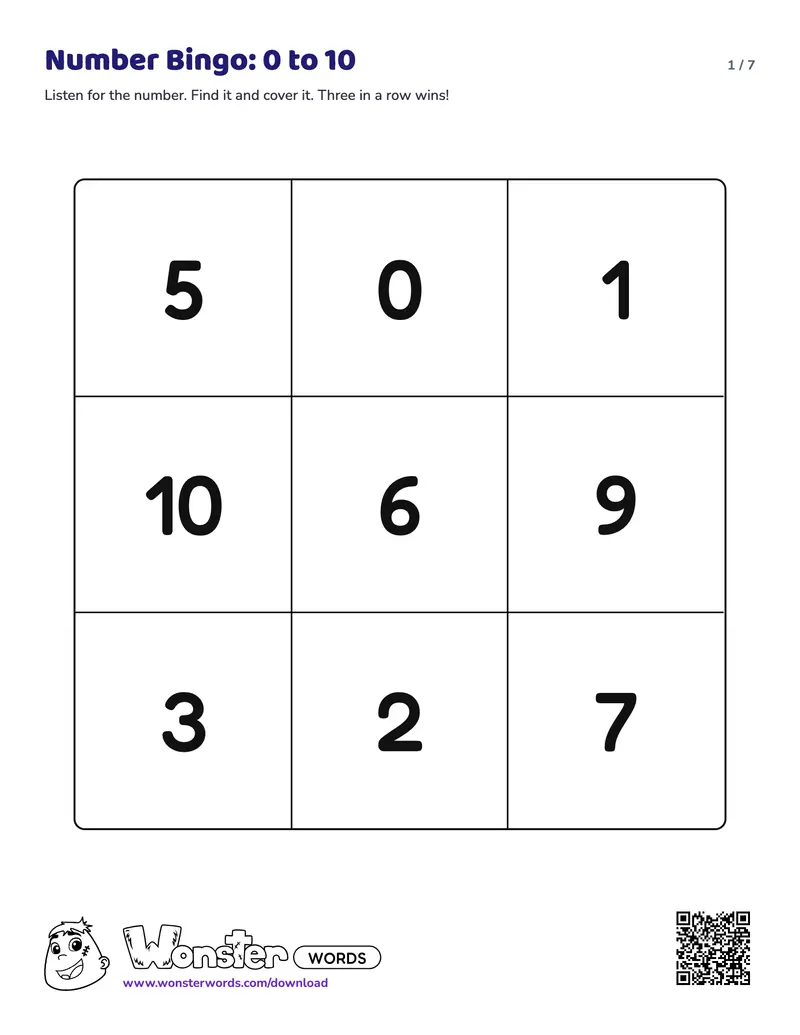
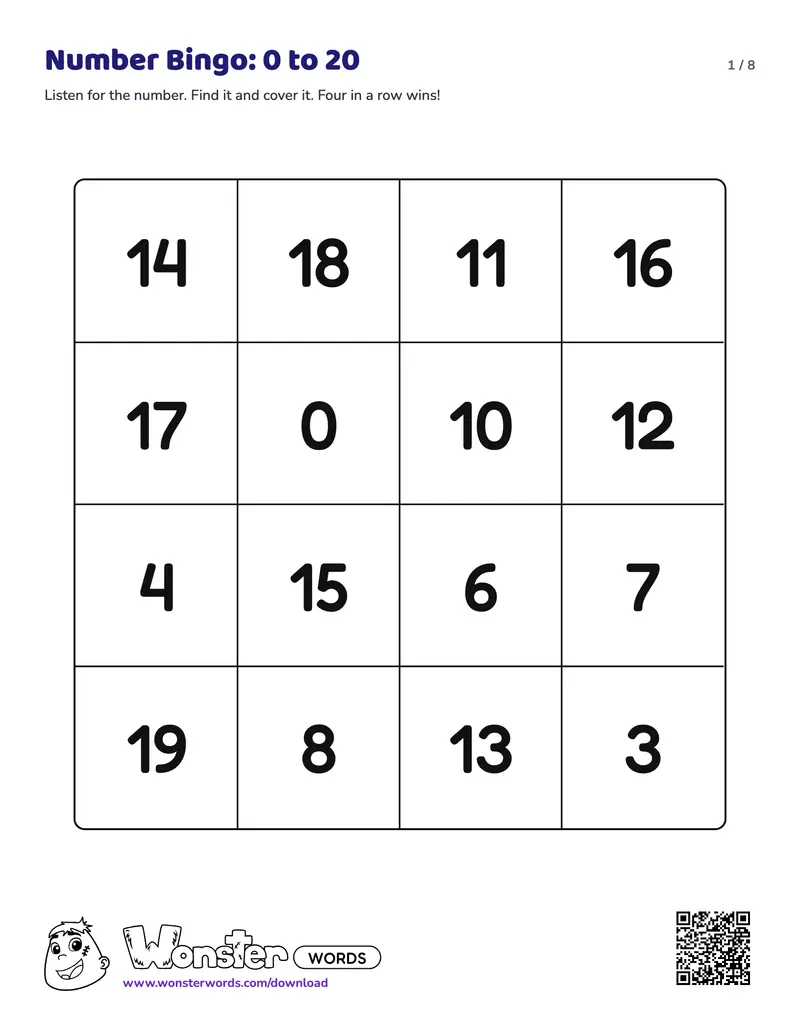
Two more sheets sit beside the tracing packs. Number Reversals: Which One? is a check sheet for the digits children write backwards most, and Number Bingo comes in 0–10 and 0–20, for recognizing numbers by name.
Free PDF · no sign-up
Free printable number tracing worksheets
Five free PDFs in black and white, with no account and no email. Trace 0 to 9 first, then 10 to 20, then use the reversal check if your child flips a digit. The two bingo games practice reading the numbers rather than writing them.
- Number Tracing 0-9 (PDF)10 numbers · 3 pages
Preview page 1Preview
- Number Tracing 10-20 (PDF)11 numbers · 3 pages
Preview page 1Preview
- Number Reversals: Which One? (PDF)5 digits · answer key included · 7 pages
Preview page 1Preview
- Number Bingo 0-10 (PDF)11 numbers · 8 pages
Preview page 1Preview
- Number Bingo 0-20 (PDF)21 numbers · 9 pages
Preview page 1Preview
What age do children learn to write numbers?
Children usually learn to write numbers in kindergarten, at 5–6, after a year or more of learning to recognize them. The Texas preschool guidelines set the recognition half and the kindergarten standards set the writing half:
| Age | What the standards expect | What to do with the sheets |
|---|---|---|
| 3 | Recognize numbers 0–5 (Texas PreK, age 3) | Name the number at the start of a row; trace one if your child wants to |
| 4 | Recognize numbers 0–10 (Texas PreK, PK4.V.A.5) | Trace a few on the 0–9 sheet and say each number |
| 5–6, kindergarten | Write numbers 0–20 (Common Core K.CC.A.3, Texas K.2(B)) | Both sheets, and the empty line becomes the point of the row |
Recognition comes first. The 2022 Texas Prekindergarten Guidelines from the Texas Education Agency state the outcome for a 4-year-old as “Child recognizes numerals 0-10”, and no outcome in them asks a preschooler to write numbers.
Writing comes in kindergarten. Common Core’s standard K.CC.A.3 reads “Write numbers from 0 to 20. Represent a number of objects with a written numeral 0-20 (with 0 representing a count of no objects).” The Texas kindergarten standard, TEKS K.2(B), asks children to “read, write, and represent whole numbers from 0 to at least 20”. A preschooler who cannot write numbers yet is not behind. They are early.
Both kindergarten standards tie the written number to an amount, which is why each row puts a ten frame beside the number. A child who writes 6 and can show six fingers knows something a child who only copies the shape does not.
How do you teach a child to write numbers?
Teach each number from the top down, with the amount beside it, a few minutes at a time. These five steps follow one row of the sheet:
Say the number and show how many
Point at the number at the start of the row, say it together, and show that many with fingers or small objects. The ten frame beside the number shows the same amount, so the written number always sits next to the count it stands for.
Start at the top
Every number starts at the top. Put a finger on the top of the model and trace the path in the air before the pencil touches the paper.
Trace a few, then write the rest of the line
Trace two or three of the dotted copies, then keep writing the number along the empty line without the dots. The empty line is where your child finds out whether the shape is theirs yet.
Keep it short
One or two numbers is a session for a preschooler. Stop while it is still going well. No research supplies a number of minutes, so a few minutes on most days is the honest guide.
Correct by pointing at the model
When a number comes out wrong, point at the model at the start of the row and ask your child to check theirs against it, rather than saying it is wrong.
If counting the objects in step 1 is the shaky part, start with how children learn to count.
Letters or numbers first? Neither. Schools teach them alongside each other, and the habits on this page (start at the top, trace a few, then write without the dots) are the same ones how to teach letter formation sets out for letters.
If your child cannot yet hold a pencil steadily enough to stay near a line, more tracing will not fix the grip. The play that builds it, such as cutting, threading and playdough, is in what to do before a child is ready to trace.
Number formation rhymes: how to form each number
Every number from 0 to 9 starts at the top. Schools use short rhymes to say each path aloud, and the words vary from one classroom to the next. The plain directions below describe the same shapes:
| Number | Where to start | The path |
|---|---|---|
| 0 | At the top | Curve down and around to the left, and come back up to close at the top |
| 1 | Near the top, a little left | Slant up to the top, then pull straight down to the line |
| 2 | At the top, a little left | Curve up and around to the right, slant down to the line, then go straight across |
| 3 | At the top, a little left | Curve around to the middle, then curve around again down to the line |
| 4 | At the top | Pull down to the middle and go straight across. Lift, start at the top again to the right, and pull straight down |
| 5 | At the top | Pull down to the middle, curve around the belly to the line. Lift and draw the hat across the top |
| 6 | At the top | Curve down to the line, then around and up to close a small loop |
| 7 | At the top | Go straight across, then slant down to the line |
| 8 | At the top, a little right | Curve left and down to the middle, cross over, curve around the bottom and go back up to the start |
| 9 | At the top | Draw a small circle around to the left and back to the start, then come down to the line, curving a little at the bottom |
The words matter less than using the same ones every time. Ask your child’s teacher which words the class uses for each number, and use those at home, so your child hears one path rather than two.
Why do kids write numbers backwards?
Children write numbers backwards because a young child sees a mirror image as the same shape, and it is normal. Understood, the learning-differences nonprofit, calls it “developmentally appropriate for kids under 7.” A dog facing left is the same dog facing right, but a 3 facing the other way is not a 3. Neuroscientist Stanislas Dehaene and colleagues point to the likely reason: the part of the brain that learns to recognize written words and letters treats mirror images as one shape. Learning to write means unlearning that rule for a handful of symbols.
The digits children reverse most are 1, 2, 3, 7 and 9, the ones that face left. Psychologist Jean-Paul Fischer, in a study of 367 children aged 5 and 6, found that these digits were reversed more often than 4, 5 and 6. His explanation is a rule children pick up without being taught: writing runs to the right, so a child who is unsure which way a digit goes turns it to face right. A 3 or a 7 turned that way comes out backwards, while a 4, 5 or 6 already faces the way the child guesses. The same study found that a child’s writing hand made little difference, so a left-handed child is not more likely to reverse.
| Digits | Which way they face | How often children reverse them |
|---|---|---|
| 1, 2, 3, 7, 9 | Left | Most often |
| 4, 5, 6 | Right | Less often |
| 0, 8 | Neither (the same both ways) | Cannot be reversed |
Numbers and letters get reversed for the same reason, with one difference. A letter has a sound
to check against, which is what the
letter reversals guide uses for b and d. A number has no sound
that tells you which way it faces, so the check for a number has to be something your child can see.
Is writing numbers backwards a sign of dyslexia or dyscalculia?
Writing numbers backwards is not, on its own, a sign of dyslexia or of a math difficulty. Understood is direct about the math half: reversing numbers “doesn’t mean kids are ‘bad at math.’” On dyslexia, it notes that “some kids with dyslexia write letters backwards, and some don’t.” For letters, a study that followed 130 children found that reversals did not predict which children later struggled to read, and the guide to letter reversals and dyslexia covers that study.
Dyscalculia is a difficulty with number sense, such as knowing how many is in a small group or which of two numbers is bigger, not with the direction of a written number.
Two signals are worth raising with your child’s teacher:
- Reversals are still frequent after about age 7, once your child has a strip of numbers to check against.
- Reversals come with trouble recognizing numbers or counting, such as not knowing which number is 6, or losing track when counting a small pile.
How do you stop number reversals?
The way to stop number reversals is to give your child something to check against, not to correct each one. Four habits do it:
- Put a 0–9 strip where your child writes, on the table or at the top of the page, and have them check each number against it before and after writing. The reversal sheet prints one at the top of every page.
- Start every number at the top. The start point fixes the direction for 2, 3, 7 and 9: a 3 that starts at the top left and curves right cannot come out backwards.
- Praise the ones facing the right way, then ask for the odd one out. “Which of these 3s is facing the wrong way?” teaches your child to check. “That one is backwards” makes writing a test.
- A few minutes on most days while the reversals are active, then stop. Once your child is getting most of them right, go back to ordinary writing. The reversals that remain fade with use.
The Number Reversals: Which One? sheet in the free number tracing worksheets practices exactly this. On its first two pages, each item shows a digit beside its mirror image and asks your child to circle the one that faces the right way. The next two mix 4, 5 and 6 in with the five left-facing digits and ask your child to cross out the backwards ones and write each correctly.
Number recognition: games and activities for 0 to 20
Number recognition means naming a written number on sight and finding it among other numbers. It is a different skill from counting a pile of objects, and it comes before writing numbers: the Texas Prekindergarten Guidelines set recognizing 0–10 as the outcome for a 4-year-old. Games build it better than flashcards, because a game makes your child find the number among others, where a flashcard shows one number at a time. Four games need almost nothing:
- Number I Spy. “I spy a 7.” Your child finds it on a clock, a car plate or a cereal box. The Texas guidelines list playing games “to find ‘hidden’ numerals” as an example of the skill.
- Number bingo. You say a number aloud and your child finds it on their board and covers it. Never show the caller card: if your child sees the number, the game becomes matching a shape instead of recognizing a number by its name.
- Match the number to the pile. Write a few numbers on scraps of paper and have your child put each one beside a pile with that many objects.
- Number hunt. Find every number from 1 to 10 on a calendar, a phone keypad or the doors on your street, in order.
Once 0–20 are familiar, a hundreds chart shows how the same ten digits keep going to 100.
Frequently asked questions
What age should children start using number tracing worksheets?
Around 4, once your child can name a few numbers and hold a pencil near a line. Start with 0–9 and expect a 4-year-old to trace a few and name the number, not to fill the row. Common Core and the Texas standards both put writing numbers 0–20 in kindergarten, so a preschooler who is not writing numbers yet is not behind.
What age do most children begin writing numbers correctly?
Kindergarten, at 5–6, is when children are expected to write the numbers 0–20: it is a kindergarten standard in both Common Core and the Texas TEKS. Some numbers will still face the wrong way at that age. Understood calls writing numbers backwards developmentally appropriate for children under 7.
Should parents teach writing numbers before or after writing letters?
Neither comes first. Schools teach numbers and letters alongside each other, and the same handwriting habits serve both: start at the top, trace a few, then write without the dots. Follow your child's interest, and if they want to write the number on their birthday cake before the letters of their name, that is good practice too.
How often do children typically outgrow writing numbers backwards?
Usually by about age 7. Understood describes reversals as developmentally appropriate for children under 7, and they fade as a child writes more and the direction of each number becomes a habit. Children who are still reversing numbers frequently after 7 may need extra help learning to write them, and the class teacher is the person to ask first.
Why is my 7-year-old still writing numbers backwards?
Usually because the right-facing habit has not fully set for a few numbers, most often 1, 2, 3, 7 and 9, which face left. A study of 367 children aged 5 and 6 found these are the digits children reverse most. Give your child a 0–9 strip to check against, and mention it to the teacher if the reversals are frequent or come with trouble reading numbers or counting.
Does dyslexia cause you to write numbers backwards?
Not on its own. Children with and without dyslexia write numbers backwards while they are learning, and for letters, a study that followed 130 children found that reversals did not predict which children later struggled to read. Dyslexia is a difficulty with reading and spelling words, so the signs that matter are about words, not about which way a 3 faces.
Are number tracing apps as good as worksheets?
They do different jobs. A screen can say a number aloud and tell a child instantly whether they found the right one, which helps with recognizing numbers. Paper gives the pencil: the grip, the resistance and a mark that stays on the page. For writing numbers, the pencil matters, so use a screen for naming numbers and paper for writing them.
How can parents support number recognition at home?
Play finding games rather than drilling flashcards. Ask your child to spot a number on a clock, a calendar, a phone keypad or a house door, play number bingo where you say the number and your child finds it, and match a written number to a small pile of objects. A few minutes a day of finding numbers among other numbers builds recognition faster than showing one card at a time.
Related guides
Last updated