
Math
Free Printable Hundreds Chart (1–100 and 1–120)
Filled, blank, and missing-number charts with answer keys, and five minutes a night of ways to use one with your child.
Grades: kindergarten to grade 2 · Common Core: K.CC.A.1, K.CC.A.2, 1.NBT.A.1, 1.NBT.C.5, 2.NBT.A.2 · Texas: K.2(A), K.5, 1.5(A), 1.5(B), 1.5(C) · Related: Common Core 1.NBT.B.2, 2.NBT.B.8; Texas 1.2(B), 2.7(B)
These free printable hundreds charts come in both ranges, 1–100 and 1–120, as filled charts, blank charts, and missing-number puzzles with answer keys. Every sheet prints in black and white, and none needs an account or an email.
A hundreds chart is the numbers 1–100 in ten rows of ten, so every number in a column ends in the same digit and the number straight below any number is ten more. That layout is what makes a chart worth more than a list of numbers. A number line shows how far apart numbers are; a hundreds chart shows how numbers are built from tens.
Print the filled 1–100 chart first for a kindergartner, the 120 chart for a first grader, and the missing-number puzzles once counting to 100 is easy.
Free printable hundreds charts: 1–100 and 1–120
The hundreds charts come as three PDFs, one for each job a chart does: reading from it, filling it in, and solving it.
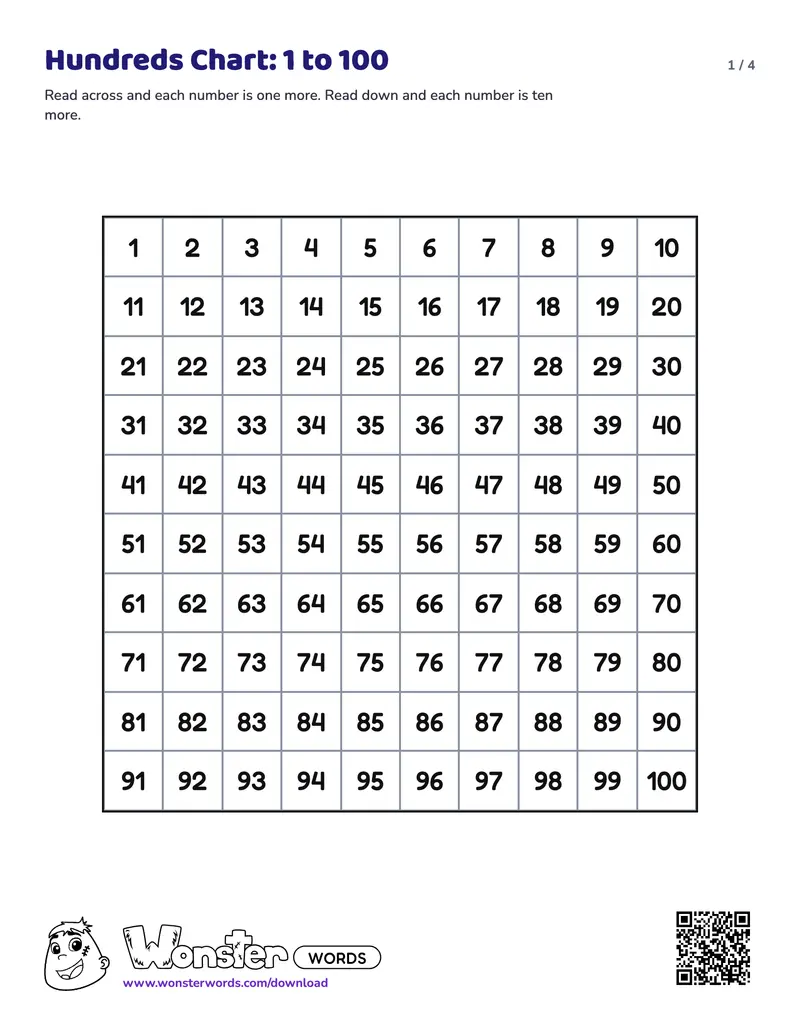
- Hundreds Chart, 5 pages. A filled 1–100 chart, a filled 1–120 chart, and two 1–100 charts, one with the tens column outlined and one with every multiple of 5 ringed. Print this one if your child is learning to count to 100 or 120, or by tens or fives.
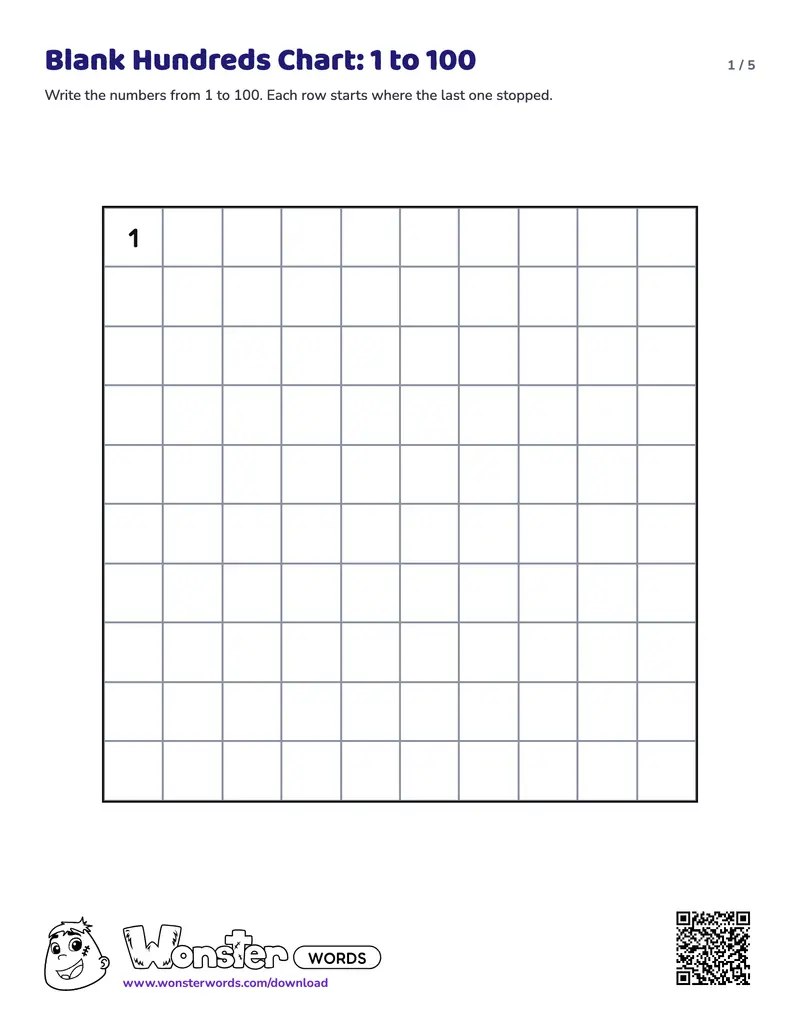
- Blank Hundreds Chart, 6 pages. Blank 1–100 and 1–120 grids, first with only the 1 printed and then with the first column (1, 11, 21, and on down), plus the filled 1–120 chart as the answer key. Print this one once your child can write numbers to 20.
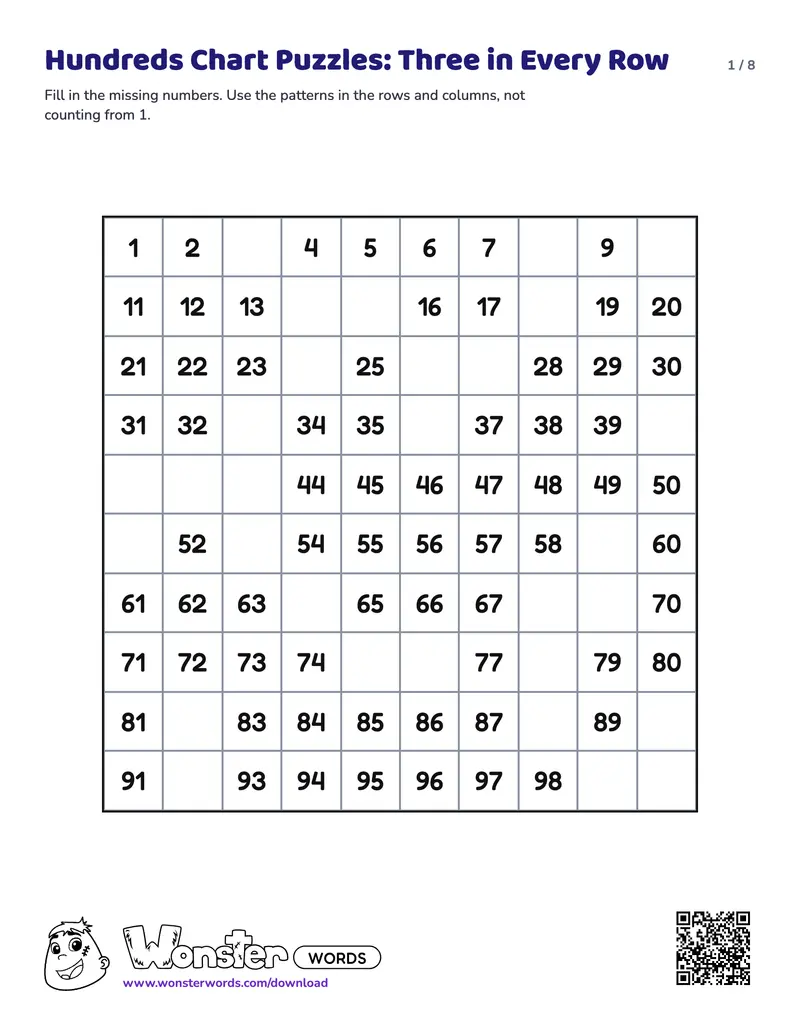
- Hundreds Chart Puzzles, 17 pages. Two of each puzzle: three missing numbers in every row; a missing row and column, such as 51–60 and 7, 17, 27, and on to 97; a 120 chart with the gaps bunched around 100; and chart pieces to fill with one more, one less, ten more, and ten less. Each puzzle page has its own answer key. Print this one when counting to 100 is easy.
The tens column is marked with a heavy outline and the fives with rings, never with color alone, so every pattern prints on a home printer low on color ink. Each PDF ends with a page for grown-ups on what the chart practices and how to use it.
Free PDF · no sign-up
Free printable hundreds charts
Three free PDFs in black and white, with no account and no email: the filled charts to read from, the blank charts to fill in, and the missing-number puzzles with their answer keys. Print the filled chart first.
- Hundreds Chart (PDF)120 numbers · 5 pages
Preview page 1Preview
- Blank Hundreds Chart (PDF)120 numbers · answer key included · 6 pages
Preview page 1Preview
- Hundreds Chart Puzzles (PDF)200 missing numbers · answer key included · 17 pages
Preview page 1Preview
What is a hundreds chart?
A hundreds chart is a grid of the numbers 1 to 100 in ten rows of ten, with 1 in the top left square and 100 in the bottom right. Across a row, each number is one more than the one before it; down a column, each is ten more than the one above it. It is also called a hundred chart, a 100 chart, or a number chart.
A child can check three patterns with a finger:
- Every column shares a ones digit. The 7 column is 7, 17, 27, 37, and on to 97.
- The last column is the tens: 10, 20, 30, and on to 100.
- The rest of a row shares a tens digit. The fourth row is 31–39, then 40.
Schools use the chart because counting past a ten becomes the jump from the end of one row to the start of the next. Ten more and ten less become one square down or up, which is how a child meets the Common Core first-grade standard to find 10 more or 10 less than a number “without having to count”. In 47, the 7 names the column and the 4 counts the full rows of ten before it, which is the start of tens and ones.
How to use a hundreds chart with your child
Print the filled chart, find a handful of dried beans or coins, and spend about 5 minutes on one routine. The five routines follow the order the standards teach them, kindergarten to second grade. Stay on one routine for a few nights before moving on.
Count along and point
Your child puts a finger on each square and says its number, to 20 first, then to 50, then to 100. The finger and the spoken number move together, so a skipped square shows straight away.
Start anywhere and count on
Say "Put your finger on 34 and count to 45." Counting forward from a number other than 1 is a kindergarten standard in Common Core (K.CC.A.2), and it is the step a child skips when they always start again at 1.
Count by tens down a column
Count down the last column: 10, 20, 30, and on to 100. Then start at 4 and count down that column: 4, 14, 24, 34. Counting to 100 by ones and by tens is the kindergarten standard K.CC.A.1.
Find ten more and ten less
On a hundreds chart, ten more is one square straight down and ten less is one square straight up. Find 46: one square down is 56, and one square up is 36. Ask why the ones digit stayed the same. Finding ten more or ten less without counting is first grade (Common Core 1.NBT.C.5).
Skip count by fives and twos with counters
Put a bean on 5, 10, 15 and every fifth number after, then look at the two columns that fill. Clear the chart and do it by twos: five columns fill. Skip counting by fives is second grade in Common Core (2.NBT.A.2) and first grade in Texas, which adds twos (TEKS 1.5(B)).
Counting on, the second routine, is the one worth coming back to. Elida Laski and Robert Siegler had kindergartners play a 0–100 number board game. Children who counted on from their piece’s square improved their number line estimates, numeral reading, and counting on; children who counted from 1 each turn learned considerably less. A hundreds chart gives a child the same move: a finger on any square, then keep going.
Counting backward works on the same chart: start at 100 and go back along the rows. The first three routines are taught step by step in counting to 100, and the fourth in ten more and ten less.
Hundreds chart games and puzzles
Each hundreds chart game below uses a sheet on this page and keeps the chart fresh once the routines feel familiar.
- Missing numbers. Work through the puzzle pages in order, easiest first, and ask your child how they found each number. “It is one more than 42” or “it is under 35” is the skill; counting from 1 to reach it is not.
- Chart pieces. Each piece is a small cross or L of the chart with one number printed, and your child fills in the squares around it: one more and one less to the right and left, ten more below, and ten less above.
- Cut-apart chart. Cut a filled chart into 6–8 pieces along the grid lines for your child to put back together, using the column patterns to fit them.
- Mystery number. “I am ten more than 36 and one less than 47. What am I?” Your child finds 46 on the filled chart, then makes one up for you.
- Race to 100. Two counters on the filled chart and one die. Each player rolls and counts on aloud from their square, and the first to reach 100 wins.
The 120 chart: why first grade counts past 100
A 120 chart is a hundreds chart with two more rows, 101–120. First grade counts, reads, and writes numbers to 120: the Common Core standard is to “Count to 120, starting at any number less than 120”, and Texas asks first graders to recite numbers forward and backward from any number between 1 and 120 (TEKS 1.5(A)).
The two extra rows show that the pattern keeps going after 100: the 7 column still ends in 7 (107, 117), and ten more than 95 is still one square down, at 105.
Watch how your child writes 101. A child who writes “1001” is writing the number the way it sounds, a hundred and then a one. Show them 101 under 91 on the 120 chart: it has three digits, like 100, and its last digit matches the column.
If your first grader counts to 100 and stops there, print the 120 chart.
What age is a hundreds chart for?
A hundreds chart is for children from kindergarten to second grade, and the grade, not the birthday, decides which sheet to print. The table matches the Common Core and Texas standards to the sheets.
| Grade | Common Core | Texas (TEKS) | On this page |
|---|---|---|---|
| Kindergarten | Count to 100 by ones and by tens (K.CC.A.1); count on from any number (K.CC.A.2) | Count forward and backward to at least 20 (K.2(A)); recite to 100 by ones and tens from any number (K.5) | The filled 1–100 chart; routines 1–3 |
| First grade | Count to 120 from any number (1.NBT.A.1); 10 more and 10 less without counting (1.NBT.C.5) | To 120 forward and backward (1.5(A)); skip count by 2s, 5s, and 10s (1.5(B)); 10 more and 10 less to 120 (1.5(C)) | The 120 chart, the blank charts, the puzzles |
| Second grade | Count within 1,000; skip count by 5s, 10s, and 100s (2.NBT.A.2) | 10 or 100 more or less, to 1,200 (2.7(B)) | The fives chart, then counting past the chart |
Texas asks for two things sooner than Common Core does: counting backward in kindergarten, which no Common Core standard names, and skip counting by 2s and 5s in first grade, a year before the Common Core standard for counting by 5s.
A 4-year-old with no use for the chart yet is not behind: no Common Core standard asks for counting to 100 before kindergarten.
Hundreds chart vs. number line: which is better?
Neither a hundreds chart nor a number line is better, because each shows something the other hides. A number line shows size as distance: 80 sits much farther from 0 than 8 does. Robert Siegler and Julie Booth found that between kindergarten and second grade, children’s estimates of where numbers go on a 0–100 line shifted from bunching the larger numbers together to spacing them evenly.
A hundreds chart breaks the line into rows of ten, which puts 10 and 11 on opposite sides of the page but lines up the tens in columns, as a number line cannot.
| Reach for | When the question is |
|---|---|
| The hundreds chart | Counting by tens, ten more and ten less, and the patterns in tens and ones |
| The number line | Which number is bigger, how far apart two numbers are, and adding by jumps |
The greater than and less than page covers comparing numbers.
Common hundreds chart mistakes
Counting from 1 every time. A child who finds 64 by counting squares from 1 is using the chart as a list. Have them go down the 4 column by tens instead: 4, 14, 24, and on to 64.
Moving one square to the right for ten more. Ten more is one square down. If your child moves right, have them count on from 46 to 56 one square at a time: the count wraps to the next row and lands straight under 46.
Losing the place at the end of a row. After 30 comes 31, at the left edge of the next row. Show your child the finger sweep back to the left edge, the same move as reading a line of text.
Getting confused when “up” means less. On a standard chart, bigger numbers go down the page, the opposite of a stack of blocks. Jennifer Bay-Williams and Graham Fletcher, writing for the National Council of Teachers of Mathematics, argue for a chart with 1 at the bottom so that more goes up. A 2023 study by Helena Osana and colleagues gave kindergartners and first graders word problems to solve on an on-screen chart. On a top-down chart they counted by tens more often, and the direction made no difference to their place-value knowledge. Use the chart your child’s class uses.
Handing over a blank chart too early. A blank chart is 99 numbers to write, and a child still slow at writing two-digit numbers spends the session on handwriting. Start with the blank chart that has the first column printed, and if writing the numbers is the hard part, practice on number tracing worksheets first.
What if the hundreds chart is too much for my child?
Make a hundreds chart smaller instead of giving it up. Each of these keeps the same routines on less of the chart:
- Cover all but one row with a sheet of paper and work a row at a time.
- Fold the chart so only 1–20 or 1–50 shows.
- Use counters instead of writing, so the chart is for pointing and placing.
- Go back to counting objects, such as spoons, and bring the chart back when counting to 20 out loud feels easy.
If counting to 20 is still hard after a few weeks of short practice, mention it to your child’s teacher, who can say what comes next.
When the hundreds chart is easy: what comes next
Once the hundreds chart is easy, the next step is numbers past it. A child who fills the blank 120 chart without help can keep writing rows of ten on squared paper, from 121 to 200, with each column still ending in the same digit.
Then three-digit numbers start to read as hundreds, tens, and ones: 153 is one hundred, five tens, and three ones. Second grade counts within 1,000 and skip counts by 100s (Common Core 2.NBT.A.2), which is where a number line to 1,000 takes over from the chart.
Some programs use a 0–99 chart, which starts each row on a multiple of ten so a whole row shares its tens digit. Use it if your child’s class does.
Frequently asked questions
What age group is best for learning with a hundreds chart?
From kindergarten to second grade, which is where the standards put the skills the chart shows. Kindergarten counts to 100 by ones and by tens, first grade counts to 120 and finds ten more and ten less, and second grade skip counts by 5s and 10s. A preschooler can point and count along the first two rows, but no Common Core standard asks for counting to 100 before kindergarten.
Differences between blank and filled hundreds charts
A filled hundreds chart has every number printed and is for reading from, counting along, and spotting patterns. A blank hundreds chart has empty squares for a child to write the numbers in, which practices writing two-digit numbers and checks whether the child knows the order. Start with the filled chart. Move to the blank one when your child can write numbers to 20 without help, and use a blank chart with the first column printed as the step in between.
Hundreds chart with missing numbers vs. complete hundreds chart
A complete hundreds chart is the reference a child counts and reads from. A hundreds chart with missing numbers is a puzzle that asks the child to work out each gap from its neighbors, using one more across a row and ten more down a column instead of counting from 1. Use the complete chart while your child is learning the order, and the missing-number chart once counting to 100 is easy.
Hundreds chart vs. number line: Which is better for number sense?
Neither is better, because they show different things. A number line shows how far apart numbers are, which helps a child judge which number is bigger and by how much. A hundreds chart breaks the line into rows of ten so the tens line up, which helps a child count by tens and find ten more or ten less without counting. The two work well side by side, one for tens and one for size.
How can parents use hundreds charts for math practice at home?
Print a filled chart, find a handful of beans or coins, and spend about five minutes on one routine. Count along and point, then count on from any number, then count down a column by tens, then find ten more and ten less by moving straight down or up, then put a bean on every fifth number. Missing-number puzzles and a simple race to 100 with a die keep it fresh.
Are there interactive hundreds chart resources available?
Yes. Several free websites offer an online hundreds chart where a child taps a square to shade it, which suits skip counting. A printed filled chart and a handful of beans do the same job, and a printed chart can be written on, folded, and cut into puzzle pieces.
How to create your own printable hundreds chart from scratch
Draw a grid ten squares wide and ten squares tall, write 1 in the top left square, and fill each row left to right so the row ends on a multiple of ten. A printable blank hundreds chart saves the ruler work. For a 120 chart, add two more rows, which end on 110 and 120.
Are color-coded hundreds charts better than standard ones?
Color can make one pattern stand out, such as the tens column, but a chart that relies on color loses that pattern when it prints in black and white. A heavy outline around the tens column or a ring around each multiple of five shows the same pattern in any ink. A child can also color a chart themselves, which makes the pattern their own discovery.
Related guides
Last updated