
Math
Counting to 100 (and 120)
When kids learn it, how to teach it, counting by 10s, why kids stop at 29, and counting backwards, with free worksheets.
Grades: kindergarten to grade 1 · Common Core: K.CC.A.1, K.CC.A.2, 1.NBT.A.1 · Texas: K.2(A), K.5, 1.5(A) · Related: Common Core 1.NBT.B.2, 1.NBT.C.5; Texas 1.5(B), 1.5(C); Texas PreK PK4.V.A.1
Children learn to count to 100 in kindergarten. “Count to 100 by ones and by tens” is the first Common Core kindergarten math standard, K.CC.A.1, and Texas asks the same (TEKS K.5). First graders go on to 120.
Counting to 100 is learning a pattern, not a hundred words. The numbers one to nine repeat inside every ten. The parts that take practice are the decade names (twenty, thirty, forty) and the change at every 9, from 29 to 30. The most useful thing to practice is those changes (29, 30; 39, 40) and counting by tens, rather than the whole count from 1 again.
Saying the numbers in order is a different skill from counting a pile of things. Free counting by 10s, missing-number, and counting-backwards sheets with answer keys are in the counting to 100 worksheets, and a 1–100 grid is on the printable hundreds chart page.
When do kids learn to count to 100?
Children learn to count to 100 in kindergarten, by ones and by tens, and to 120 in first grade. Common Core and the Texas standards agree on both. Texas adds a preschool step: the Texas Prekindergarten Guidelines expect a 4-year-old to rote count, saying the numbers in order from memory, from 1 to 30, and a 3-year-old from 1 to 10.
| Grade | What children do | Common Core | Texas (TEKS) |
|---|---|---|---|
| Pre-K (age 4) | Say the numbers in order to 30 | None (Common Core starts at kindergarten) | PK4.V.A.1, “rote counts from 1 to 30” |
| Kindergarten | Count to 100 by ones and by tens; count on from any number | K.CC.A.1, K.CC.A.2 | K.5, to 100 by ones and tens from any number; K.2(A), forward and backward to 20 |
| 1st grade | Count to 120 from any number; read and write the numbers | 1.NBT.A.1 | 1.5(A), forward and backward from any number to 120 |
Texas also asks kindergartners to count backward from 20 and to count by tens from any number, and first graders to count backward from any number up to 120; Common Core does not list counting backward.
A 4-year-old who counts to 30 is right where the Texas guidelines expect, and a kindergartner still working toward 100 in the spring is on time. The kindergarten standard describes the end of the year. The count matters beyond itself: it is what a child uses to count on from a number, to count groups of objects past 20, and later to see tens and ones. It is one strand of number sense.
How to help your child learn to count to 100
Help your child learn to count to 100 by practicing the pattern in the order it is built: the teens, the decade names, counting on, and the change at each 9, then the whole way. A few minutes on most days is enough.
Get 1 to 20 solid first
Count to 20 out loud together until it is easy, teens included. The teens are where English breaks the pattern: it says eleven and twelve rather than ten-one and ten-two, and in fourteen it says the four before the ten.
Learn the decade names in order
Count by tens together: ten, twenty, thirty, and on to one hundred. These are the words that come after each 9, so a child who knows them in order always knows where the count goes next.
Count on from anywhere
Say a number and have your child keep going: "Start at 46 and count to 55." A child who can only start at 1 has learned a song. The kindergarten standard asks children to count forward from a given number "instead of having to begin at 1".
Practice only the changes
Say "27, 28, 29" and let your child say the next number, then stop. Do the same at 39, 59, and 89. A full count to 100 meets each change once; a minute of this meets it ten times.
Then count the whole way
Count a little further each day with something to look at, such as a written number strip or a hundreds chart, and stop while it is still going well. No research supplies a number of minutes, so a few minutes on most days is the honest guide.
The teens come first because English hides the pattern there. Psychologist Kevin Miller and colleagues compared preschoolers in China and the United States and linked the difference in how the two groups learned to count to the number words themselves: the base-ten structure of number names is “less obvious in English than in Chinese”. In Chinese, eleven is said as “ten-one”.
Something to look at helps at every step. A written number strip, or a hundreds chart where each ten is one row, lets your child see that 30 comes straight after 29, as well as hear it.
Counting by 10s: what it means and how to teach it
Counting by 10s means saying every tenth number, 10, 20, 30 and on to 100, where each word stands for one more group of ten. It is kindergarten work in both Common Core (K.CC.A.1) and Texas (K.5). In the counting trajectory by Douglas Clements and Julie Sarama of the University of Denver, “Skip Counter by 10s to 100” is the level just before “Counter to 100”, counting to 100 by ones. A parent does not have to wait for counting by ones to be finished before starting the tens.
Make the tens real before the chant.
- Bundle ten things, such as ten straws in a hair tie or ten pennies in a cup. Count the bundles, “10, 20, 30”, then check one bundle by counting it by ones.
- Count fingers by tens. Each person holds up ten fingers, and three people make 30.
- Count by tens from a number that does not end in 0, such as 4, 14, 24, 34. Texas asks for this in kindergarten (K.5, “beginning with any given number”), and it leads to finding ten more than a number, a first-grade standard (Common Core 1.NBT.C.5).
Three mistakes show up when a child counts by tens, each with its fix:
| What you hear | What it means | The fix |
|---|---|---|
| ”10, 20, 30” with nothing behind it | The tens are a chant, not groups | Count real bundles, then ask how many straws there are in all |
| ”Onety” or “fivety” | Your child is building the names from the pattern, which English breaks | Say the real names in order; “twenty” and “thirty” have to be learned |
| Stopping at 90, or saying “ten-ty” | The tenth ten has its own name | Count ten bundles: nine tens and one more ten make one hundred |
On a hundreds chart’s last column, the tens line up from 10 to 100. Counting by 5s and 100s is skip counting, a second-grade standard in Common Core (2.NBT.A.2), and Texas puts counting by 2s and 5s in first grade (1.5(B)). It belongs with place value.
Why kids get stuck at 29 (and how to help)
Children often stop counting at 29 because the next number needs a new word. After 29 comes thirty, a decade name the child has to know, rather than one more of the ones they have been repeating. Stopping at 29, 39, or 109 is a known step. Clements and Sarama define their “Counter to 100” level by it: a child at that level counts by ones to 100 across each change of ten, starting at any number.
English makes the step harder. “Twenty”, “thirty”, and “fifty” do not sound like two, three, and five, and the teens reverse the order of the tens and ones.
What you will hear tells you where the count breaks:
- “Twenty-nine, twenty-ten”: your child knows the ones repeat but not the next ten’s name.
- “Twenty-nine, twenty, twenty-one”: the count loops back to the start of the decade.
- “Thirty-nine, fifty”: a decade name is missing.
- Stopping in the teens, where the words do not follow the pattern yet.
Practice the change on its own. Say “27, 28, 29” and wait. If the next word does not come, count by tens together to find it (“ten, twenty, thirty: so after 29 comes 30”), then try the change again from 27. On a number strip, your child can see 30 right after 29.
If counting to 20 is still hard at the end of kindergarten, talk to your child’s teacher.
How to teach counting backwards
Counting backwards means saying the numbers in reverse, 10, 9, 8 and down to 1, and it is harder than counting forward. To count back, a child has to find the number before. A young counter finds even the number after only by counting up from 1, which is how Clements and Sarama describe their “Counter (10)” level. Their trajectory gives “Counter Backward from 10” a level of its own. Counting backward is a Texas kindergarten standard, to 20, and not a Common Core one.
Teach it in this order:
- Countdowns from 10, such as a rocket launch or the last ten seconds of a timer.
- Take one away and say what is left. Line up ten blocks, remove one at a time, and count down.
- From 20 to 0, which is the Texas kindergarten goal.
- Backward across a ten, such as 42, 41, 40, 39. This is the hard spot, the change at 9 read in reverse, so practice it the way you practice 29 to 30.
Later, counting back becomes one of the first ways children subtract.
Counting to 120 in first grade
First graders count to 120, starting at any number, and read and write the numbers to 120 (Common Core 1.NBT.A.1). Texas asks for the same range, forward and backward (TEKS 1.5(A)). Counting past 100 shows the pattern carrying on: 101–109, then the same change at 9 to 110, then 111–119, and 120.
Watch how your child writes 101. A child who writes “1001” is writing the number the way it sounds, a hundred and then a one. Show them 101 on a 120 chart: it has three digits, like 100, and it sits straight under 91.
If writing the numbers is the hard part, practice writing numbers 0–20 first.
Counting to 100 games and everyday practice
Counting to 100 games need nothing you would have to buy, and each one practices one part of the count.
- What comes next? Say a number, and your child says the next three. It practices counting on.
- Count the stairs on a walk or at home, and start tomorrow’s count where today’s stopped. It practices counting on from a number other than 1.
- Hundred collections. Ten bags of ten small things, counted by tens and then checked by ones. It practices counting by tens. Many US schools mark the 100th day of school, which makes a natural moment for this one.
- Countdown. Count backward from 20 before anything your child is waiting for. It practices counting backward.
- Race to 100. Two counters on a hundreds chart and one die. Each player rolls and counts on aloud from their square, and the first to reach 100 wins. It practices counting on across each ten.
More games on a numbered track are on the math board games page.
Free counting to 100 worksheets
The counting to 100 worksheets come as three PDFs, one for each part of the count: by tens, the changes at each 9, and backwards. Each prints in black and white, and each has its answer key on the last page.
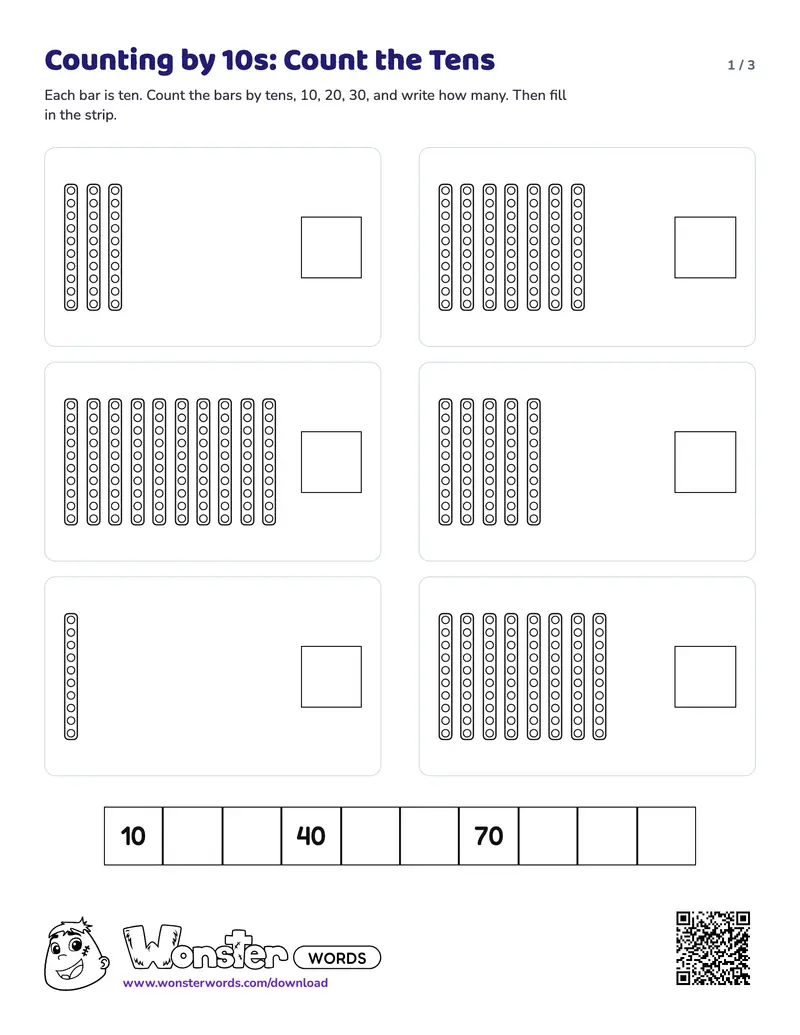
- Counting by 10s. Groups of ten-bars, from one bar to ten, where your child counts by tens to write the total, then a 10–100 strip to fill in, and strips that count on by tens from a number that does not end in 0 (3, 13, 23). The last strips go past 100, for first grade. Print this one first.
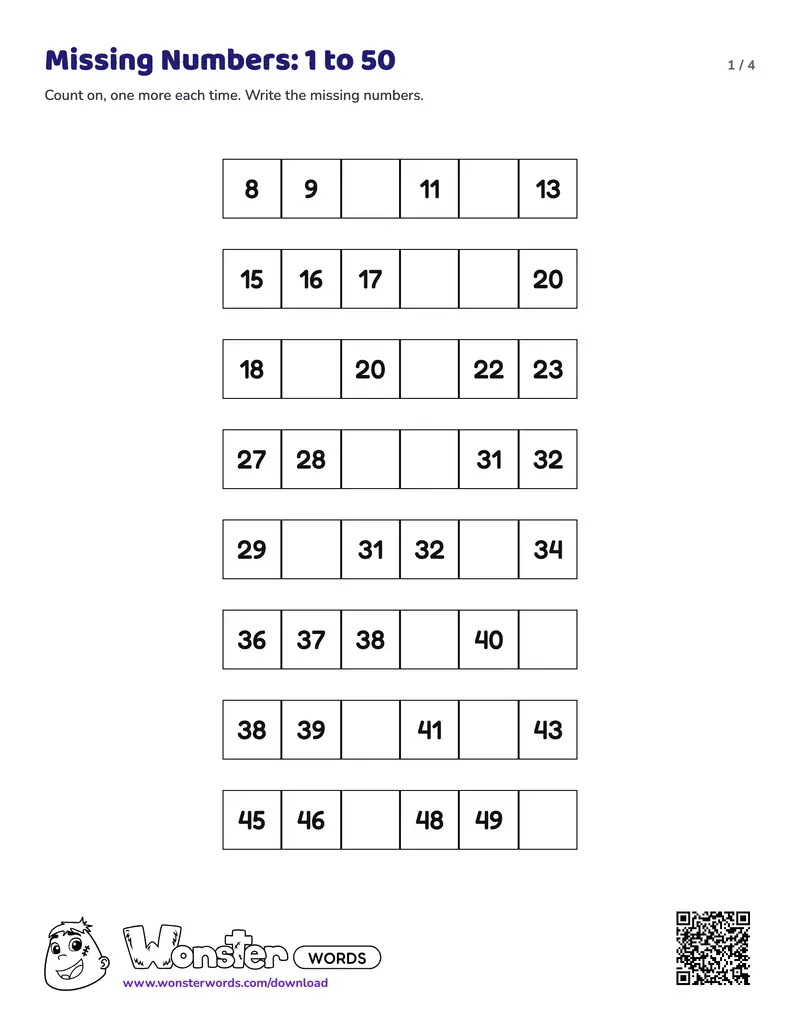
- Missing Numbers to 120. Strips of six numbers with two missing, and every strip crosses a ten, such as 27–32 or 107–112. It drills exactly the change at 9. Print it once counting by tens is steady.
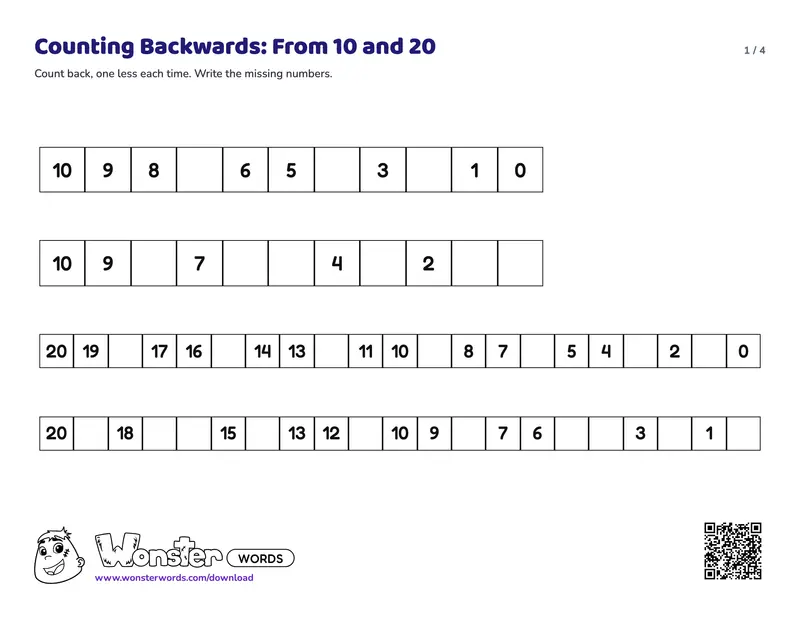
- Counting Backwards. Strips that count down from 10 and from 20, then backward across tens within 100, then backward from 120 and across 100. Print it last.
All three are strips, not grids. A blank or filled 1–100 grid is on the hundreds chart page.
Free PDF · no sign-up
Free counting to 100 worksheets
Three free PDFs in black and white, with no account and no email, in teaching order: counting by tens, then missing numbers across each ten up to 120, then counting backwards from 10, 20, and 120. Start with the one your child can already do. Each has its answer key at the back.
- Counting by 10s (PDF)64 numbers to write · answer key included · 7 pages
Preview page 1Preview
- Missing Numbers to 120 (PDF)48 missing numbers · answer key included · 5 pages
Preview page 1Preview
- Counting Backwards (PDF)64 missing numbers · answer key included · 5 pages
Preview page 1Preview
When counting to 120 is easy: what comes next
Once counting to 120 is easy, the next step is the same pattern further on. A child can write the next strip, 121–200, and say where each change at 9 falls. Second grade counts within 1,000 and skip counts by 100s (Common Core 2.NBT.A.2).
The other step is seeing tens instead of counting by ones. A child who looks at a bundle of ten and four loose straws and says “14” without counting them is seeing a ten and four ones. RightStart Math emphasizes “grouping in 5s and 10s” for this reason: two rows of ten and 4 more make 24, which “does not need to be counted”. The same idea starts smaller, with seeing groups of five, such as 5 and 3 more.
Frequently asked questions
What age is appropriate for teaching children to count to 100?
Kindergarten, at 5–6, is when children are expected to count to 100: it is the first Common Core kindergarten math standard, and the Texas kindergarten standards ask the same. A preschooler can start on the way there, and the Texas Prekindergarten Guidelines expect a 4-year-old to say the numbers in order to 30. First graders go on to 120.
Why is counting to 100 important for children?
Saying the numbers in order is what children use next to count on from any number, to count groups of objects past 20, and to see a number as tens and ones. Counting to 100 is also where a child first meets the pattern of the number system: the numbers 1 to 9 repeat inside every ten, and each ten has a name.
What does it mean to count by 10s?
Counting by 10s means saying every tenth number, 10, 20, 30 and on to 100, where each word stands for one more group of ten. Bundles make it concrete: ten straws in a hair tie, three bundles, thirty straws. It is a kindergarten standard in Common Core and in Texas.
Counting by 10s vs counting by 5s: which is better for young learners?
Tens come first. Counting to 100 by tens is a kindergarten standard, and the tens are the decade names a child needs to count to 100 by ones. Counting by 5s comes later: first grade in Texas and second grade in Common Core.
What songs can help kids learn to count to 100?
Any counting song helps a child learn the order of the number words. A song always starts at 1, though, and the kindergarten standard asks children to count on from any number. Use the song for the order, then practice starting in the middle: say 46 and have your child keep going without the music.
Best counting apps for children to learn up to 100
A counting app can say the numbers and show them in order, and that helps with the sequence. A screen cannot hear where your child stops, which is the part that needs a parent: when the count breaks at a change such as 29 to 30, a minute on that one change is the practice that helps. Use an app for listening and a person for the stops.
One-to-one correspondence vs. rote counting: what is the difference?
Rote counting is saying the numbers in order from memory, the way a child counts to 100. One-to-one correspondence is matching one number word to each object while counting a group, so that every object gets one count and only one. A child needs both: the order of the words, and the match between each word and each thing.
Related guides
Last updated