
Math
Math Board Games for Kids
Which board games build number sense and why, the best ones for ages 3 to 8, how to play so the numbers count, and a free number path game to print.
Grades: pre-K to grade 1 · Common Core: K.CC.A.1, K.CC.A.2, 1.NBT.A.1 · Texas: K.2(A), K.2(B), K.5, 1.5(A) · Texas PreK: PK4.V.A.1, PK4.V.A.5 · Related: Common Core K.CC.B.4, K.CC.C.7; Texas K.2(H)
The best math board games for young children put the numbers on a straight path and have your child say each number as the piece moves. In a 2008 study by Geetha Ramani and Robert Siegler, preschoolers played a simple board game numbered 1 to 10 for about an hour, in four 15–20 minute sessions. They got better at counting, reading numerals, and judging which number is bigger, and the gains lasted nine weeks. Children who played the same game with colored squares and no numbers did not improve.
For ages 3–5, try Chutes and Ladders, Hi Ho! Cherry-O, or Count Your Chickens!; for ages 5–8, Shut the Box, dominoes, or Mancala. With any game you already own, one rule turns it into number practice: name the squares, not the hops. A piece on the 5 that moves 2 says “6, 7”, not “1, 2”. A free printable number path game, with a 1–10 board and a 1–100 board, is on this page.
What makes a board game good for math?
A number board game builds number sense when its squares are numbered in a straight line and the child says each number while moving the piece. In a 2008 study by Ramani and Siegler, 124 Head Start preschoolers aged 4 to 5½ played “The Great Race” about 20 times over two weeks. Its board was ten squares numbered 1 to 10 from left to right. The children improved on all four measures: counting, naming numerals, saying which of two numbers is bigger, and placing numbers on a number line. Classmates who played the identical board with colors in place of numbers improved on none. The What Works Clearinghouse rated the study “consistent with WWC evidence standards” and called it “a well implemented randomized controlled trial”.
The board has to be straight. In a follow-up, Siegler and Ramani (2009) gave 88 preschoolers the same game on a straight board or a circular one. The straight board improved comparing numbers and placing them on a number line more than the circle did. The two boards differed only in shape: on the straight one, a bigger number is also farther along, so the distance the piece travels agrees with the count. Reading numerals improved on both boards.
The same 2008 paper found that 80% of middle-income preschoolers had played a board game outside preschool, against 47% of the Head Start children. Children who played more board games at home also knew more about numbers. That is a correlation, not proof that the games caused it.
Check any game against five things:
- Numbered squares in a straight or clearly continuous line.
- Moves of 1–3 squares for a preschooler. The study’s spinner had only a 1 and a 2.
- The child names the squares aloud as the piece moves.
- A game short enough to finish in a few minutes. The study’s games took 2–4 minutes.
- A result decided by luck, so a 4-year-old can beat an adult fairly.
The studies tested a homemade 1–10 game, played one-on-one with a trained adult, by low-income 4- and 5-year-olds. A boxed game on a Saturday afternoon is not the same experiment. Number sense, the wider skill these games feed, is on the number sense page. The number line the children were tested on is explained, with free printable lines, in our number line guide.
The best math board games for kids, by age
We chose these by checking each game’s own rules against the five-point checklist for a number board game, and the ages are the publisher’s. None of them is the game the studies used, which was homemade. We list no prices, affiliate links, or ratings.
Ages 3–5
- Chutes and Ladders: best first numbered board. Hasbro’s board numbers its squares 1 to 100, is for ages 3 and up, and needs no reading. Ramani and Siegler name it as a linear number board game. Watch for the board winding back and forth every ten squares, and for the chutes and ladders that jump: have your child name the squares on every move. Snakes and ladders is the same game without a brand.
- Hi Ho! Cherry-O: best for counting real things. A child spins, then picks one to four pieces of fruit off a tree, and the first to get all 10 into the basket wins. Hasbro rates it for ages 3 and up. It counts objects rather than squares on a path, so play it beside a path game, not instead of one.
- Count Your Chickens!: best cooperative game for a 3-year-old. Everyone works together to bring the chicks home before the hen reaches the end, and each move ends with counting chicks into the coop. The spinner shows pictures, not numbers, so the counting does the number work, not the squares.
Ages 3–8
- Tiny Polka Dot: best single deck that grows with a child. Math for Love’s card deck comes with 16 games for ages 3–8, with each number from 0 to 10 shown several ways, from numerals to dot patterns. It is a card game, not a board, so it suits seeing amounts at a glance more than counting along a path.
Ages 5–8
- Shut the Box: best for adding to 12. Roll two dice and flip down the numbered tiles that add up to the roll. It is a traditional game, sold by many makers and easy to play on paper.
- Dominoes: best for matching amounts. Matching the dots on one end to the next is counting and comparing in one move.
- Mancala: best for counting one at a time. Each turn drops seeds one per pit, so the count and the objects move together.
Games for multiplication and strategy, for older brothers and sisters, belong on a different list.
How to play a board game so it builds number sense
Play any number board game so that your child says the number of each square the piece lands on, starting from where it is. These five steps come from the way the researchers ran their games, and they turn a game you already own into number practice.
Start on a short path
Use a path numbered 1 to 10 for a 3- or 4-year-old, and 1 to 100 for a kindergartner or first grader who can already count to 100.
Move 1 or 2 squares at a time
Use a spinner with a 1 half and a 2 half, the kind the studies used, or flip a coin: heads moves 1 square, tails moves 2. Small moves give a young child a short count to say on every turn.
Say the numbers on the squares, not the hops
A child on the 4 who spins a 2 says "5, 6" while moving the piece, not "1, 2". Counting the hops is a common mistake, and the researchers corrected it every time it happened: name the squares yourself and have your child say them again.
Count on from your square
Start each count from the square the piece is on and never go back to 1. Counting forward from a number other than 1 is a kindergarten standard in Common Core (K.CC.A.2).
Ask one question a game
After a move, ask "Who is closer to 10?" or "How many more to get to the end?" Comparing two places on the path is the number-size thinking a straight board improved more than a circular one.
Counting on, step 4, matters as much as naming the squares. In a 2014 study by Elida Laski and Robert Siegler, kindergartners played a 0–100 number board game. Those who counted on from their square improved their number line estimates and their numeral reading more than children who used “the standard count-from-1 procedure”. The step matches the Common Core kindergarten standard K.CC.A.2: count forward from a given number “instead of having to begin at 1”. Play the path backward too, from 10 down to 1: counting backward to 20 is a kindergarten standard in Texas.
The question in step 5 is the same comparison taught on the greater than and less than page. Counting to 100 itself is on the counting to 100 page, and Race to 100 on a printed chart is one of the games on the hundreds chart page.
Free printable number path game: 1 to 10 and 1 to 100
The free number path game comes as two boards, both straight lines of numbered squares, the kind of board the research tested.
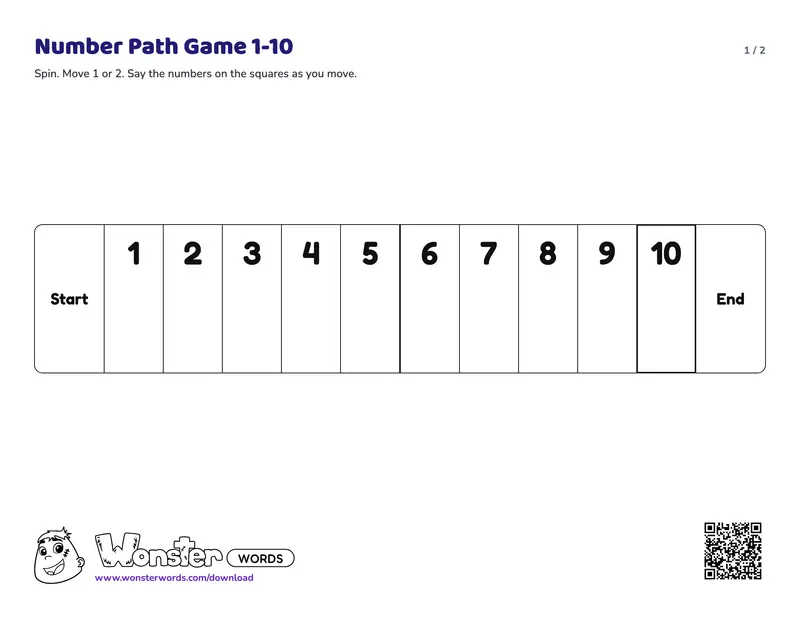
- Number Path Game 1–10, for pre-K and kindergarten: one row of ten squares numbered 1 to 10 from left to right, with Start and End at each end, printed sideways on the page. A second page has playing pieces and a spinner with a 1 half and a 2 half, which turns on a paper clip held by a pencil. Without a spinner, flip a coin: heads moves 1, tails moves 2.
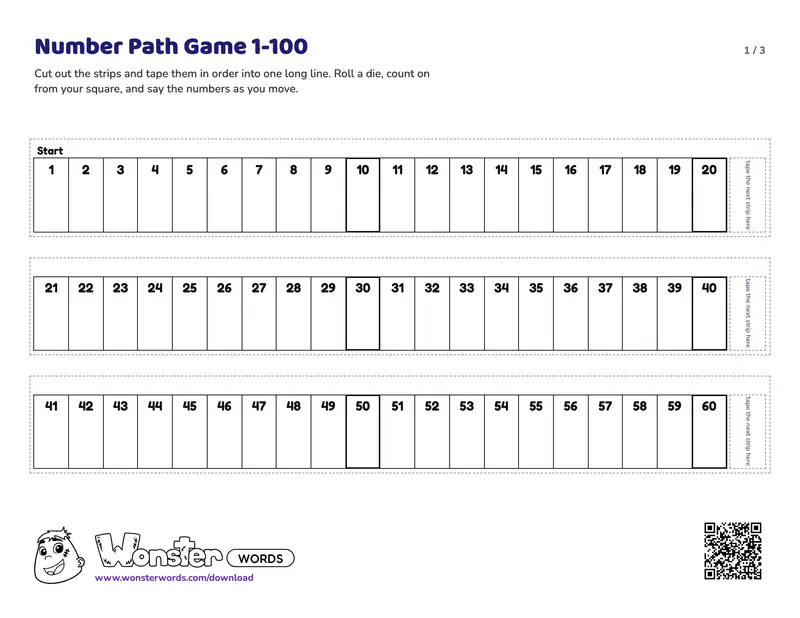
- Number Path Game 1–100, for kindergarten and first grade: five strips of 20 squares that tape end to end into one straight line, long enough for a table or the floor. Every tenth square has a heavy outline. Play it with a die and count on; the last page has playing pieces and a 1-to-3 die to fold, for younger players.
The rules are printed on each board in a line or two. Both print in black and white: the numbers do the work, and the colors on the study’s board were decoration. Your child can play the first strip of the 1–100 board, 1 to 20, on its own.
Free PDF · no sign-up
Free printable number path game: 1 to 10 and 1 to 100
Two free board games in black and white, with no account and no email, the short path first: a 1 to 10 path with fold-over pieces and a 1-and-2 spinner, then a 1 to 100 path in strips that tape into one line, with pieces and a 1-to-3 die. Start with the 1 to 10 board for a preschooler. Say the numbers on the squares as you move.
- Number Path Game 1-10 (PDF)10 numbers · 3 pages
Preview page 1Preview
- Number Path Game 1-100 (PDF)100 numbers · 4 pages
Preview page 1Preview
Counting games with dice, cards, and things you already have
Counting games need no board: a deck of cards, a die, and a few things from the kitchen make five of them. Each one has your child say the numbers aloud.
- War. Use the cards from ace (1) to 10. Each player turns over a card, the greater one takes both, and the winner says “8 is greater than 5”.
- Roll and count out. Roll a die and count that many crackers or buttons onto a plate, touching each one once. The first plate to reach 20 wins.
- Floor path. Number ten sticky notes 1 to 10 in a line on the floor. Your child is the piece: roll, then step and say each number.
- Snap with dots. Make cards with numerals and cards with dots. Turn them over two at a time, and say “snap” when the numeral matches the number of dots.
- Roll two, cover the sum. Write 2 to 12 in a row on paper. Roll two dice, add, and cover that number with a coin. For ages 5–7, this is Shut the Box on paper.
A counting activity with no turns and no winner, such as counting the stairs, is covered on the how children learn to count page, which also explains touching each object once.
Cooperative or competitive: which math games work for family game night?
Cooperative and competitive math games both work for family game night, as long as every player says the numbers aloud. In a cooperative game, everyone plays against the game, so a 4-year-old does not lose to an older sibling every time. In a competitive game decided by luck, such as Chutes and Ladders, a 4-year-old can win fairly. The number board game studies did not compare the two, so neither has the evidence on its side.
With mixed ages, give the younger child the 1–10 path and the older one the 1–100 path, side by side at the same table, and take turns.
Are board games better than math apps for young kids?
The research on number board games tested a physical board, with the child moving the piece and saying the numbers to an adult. A board gives three things to look for in a screen game: the adult hears every number, catches the “1, 2” mistake, and the distance the piece moves is real. A screen game can practice numerals too. Judge one by the same test as a board: does your child count on from where they are, and does anyone hear them say the numbers?
How do you adapt a game for a younger child or one who finds it hard?
Make the game smaller rather than stopping it. Each of these keeps the numbers said aloud:
- Shorten the path. Cover every square past 5 or past 10 with paper.
- Use the 1-or-2 spinner instead of a die.
- Play cooperatively, with one shared piece.
- Let your child move your piece and say your numbers as well as their own.
- Play one game a day for a week rather than five in one sitting. The study’s children played about 20 games over two weeks.
If counting to 10 is still hard after a few weeks of short games, go back to counting objects, one touch for each number. Mention it to your child’s teacher too.
Frequently asked questions
How do math board games help kids learn?
A number board game has a child say the numbers in order while moving a piece along a path, so a bigger number is farther along, takes more moves, and takes longer to reach. In a 2008 study, preschoolers who played a 1-to-10 numbered board game for about an hour got better at counting, reading numerals, comparing numbers, and placing numbers on a number line. The gains lasted nine weeks.
What age groups benefit from math board games?
The first studies of number board games were done with 4- and 5-year-olds on a path numbered 1 to 10, and a later one found that a 0-to-100 board game helped kindergartners. First graders can play to 100 and beyond. A 3-year-old can play a short numbered path with an adult, and children of 7 and 8 move on to games with adding, such as Shut the Box.
What are classic counting games for children under six?
Chutes and Ladders, and snakes and ladders, the same game without the brand, put the numbers 1 to 100 on the board. Hi Ho! Cherry-O has a child count fruit off a tree into a basket. Dominoes, card games such as War, and a homemade path of numbered squares need nothing special. Each works best when the child says every number aloud.
Math card games for kids vs. math board games
A board game shows numbers in order along a path, so a child sees and says how far along each number is. A card game shows numbers one at a time, which suits recognizing numerals, matching amounts, and comparing two numbers. The number board game studies tested boards, not cards, so a board is the better start for a preschooler and cards are a good second game.
What are some DIY math board games for kids?
Draw a row of ten equal squares on paper, number them 1 to 10 from left to right, and play with two coins as pieces and a spinner with a 1 half and a 2 half. Sticky notes numbered 1 to 10 on the floor make a path your child walks along. For older children, tape five strips of 20 squares into one long 1-to-100 path.
Best cooperative math games for family game night
In a cooperative game, everyone plays against the game and wins or loses together, so a young child does not lose to an older sibling every time. Count Your Chickens! is a cooperative counting game for ages 3 and up. Any numbered path game can be played the same way, with all the players racing one shared piece to the end before a timer runs out.
What online resources offer free counting games for kindergarten?
Free websites offer counting games a kindergartner can tap and play alone. The number board games in the studies were played at a table with an adult, who heard every number the child said and corrected a mistake straight away. An online game works best as a second kind of practice.
Related guides
Last updated