
Math
What Is Subitizing?
What subitizing is, the two kinds, what age children do each, and how to practice it at home, with free dot cards to print.
Grades: pre-K to grade 1 · Texas: K.2(D), 1.2(A) · Texas PreK: PK3.V.A.4, PK4.V.A.4 · Head Start: P-MATH 2 · Related: Common Core K.CC.B.4, K.CC.B.5
Subitizing is knowing how many things are in a small group at a glance, without counting them. Hold up 3 fingers or roll a die: a child who says “three” straight away is subitizing. There are two kinds. Perceptual subitizing is seeing a very small amount at once, up to about 4. Conceptual subitizing is seeing the parts of a bigger group and putting them together, such as seeing 5 and 2 and knowing 7.
The Texas Prekindergarten Guidelines expect a 3-year-old to see up to 3 at a glance and a 4-year-old up to 6, and Head Start’s early learning framework expects up to 5 by age 5. Free printable dot cards for 1–10, in dice patterns and scattered patterns, print in black and white with no sign-up, and they are the second section of this guide.
What is subitizing?
Subitizing is recognizing how many things are in a small group straight away, without counting them one by one. The learning trajectory by Clements and Sarama defines it as “quickly recognizing and naming the number in a group without counting.” The word comes from the Latin for “sudden” and was first used by psychologists in 1949. Outside the US it is spelled subitising, and classroom games for it go by names such as “quick images” and “dot talks.”
There are two kinds of subitizing, and children learn them in this order, as the mathematics educator Douglas Clements set out in 1999 for the National Council of Teachers of Mathematics:
- Perceptual subitizing is recognizing a small number without using any other math: a child looks at 3 crackers and says “three.” Clements notes that 2-year-olds show this ability clearly.
- Conceptual subitizing is seeing a group as parts and putting the parts together. A person who “just knows” an eight-dot domino sees each half as a 4 and the whole as two 4s, which make 8.
The Common Core Standards Writing Team describes the same two kinds in its progression for counting and cardinality, with the example of a child who sees a set as two 2s and says “four.”
Both 3s can be seen at once without any math, which is perceptual subitizing. The 7 drawn as 5 and 2 is seen as two parts put together, which is conceptual subitizing. The scattered 7 has no parts to see, so most young children count it.
Perceptual subitizing shows up on its own, closer to a sense than a skill. Conceptual subitizing is learned, and Clements argues that it “must be learned and therefore be fostered, or taught,” which is what a few minutes with dot cards does.
Free printable subitizing dot cards
The free subitizing dot cards are one PDF in three sets, built in the order a child uses them: dice patterns, then scattered dots, then numerals.
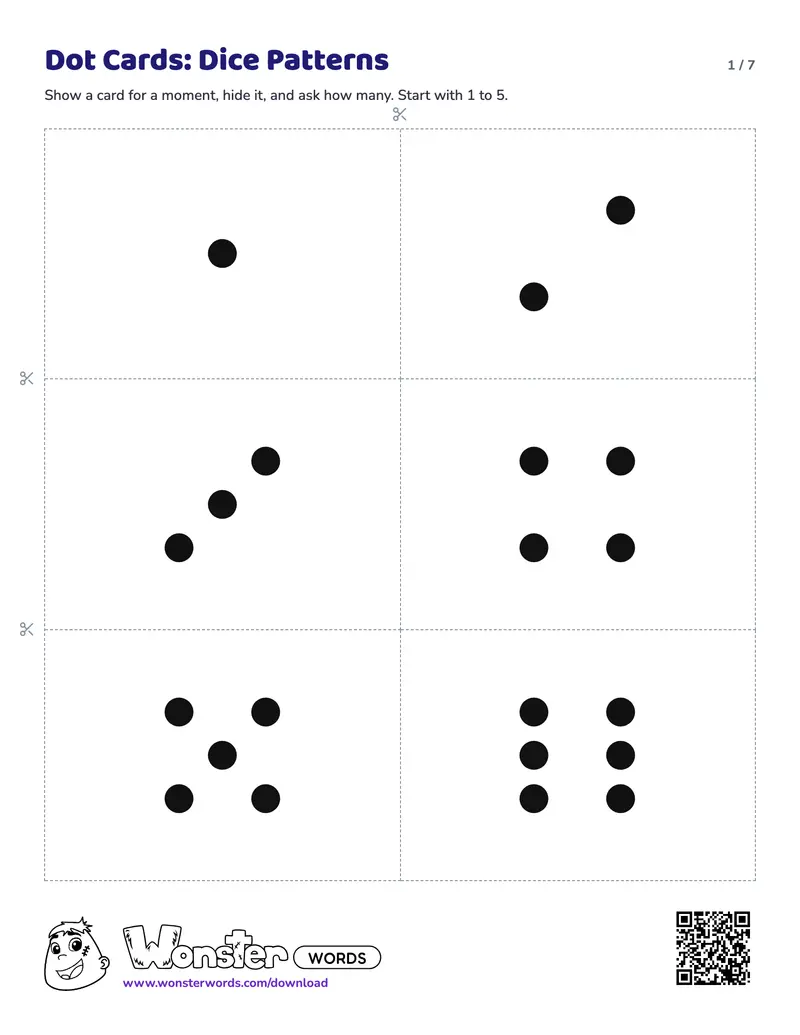
- Dice-pattern cards, 1–10. The cards for 1–6 are die faces, and the cards for 7–10 are two familiar groups with a gap between them: 7 is 5 and 2, 8 is 4 and 4, 9 is 5 and 4, and 10 is 5 and 5. Start here, with 1–5.
- Scattered cards, 1–10. The same numbers with the dots spread out in no pattern. Move to these once your child names the dice patterns at a glance.
- Numeral cards, 1–10, for the matching and memory games below.
Each set ends with two blank cards for making your own. After the cards comes a key that shows every dot card’s number, so you can check a scattered card without counting it in front of your child, and the last page explains the cards for grown-ups. No dot card carries a numeral, because a child who reads numerals would read the number instead of seeing the dots. Naming a written numeral is a separate skill, practiced on our number tracing worksheets.
The dots are plain black circles of one size, on purpose. Clements’ guidelines for pictures meant to be subitized call for plain, same-shape dots with no picture around them, regular and symmetrical arrangements first, and strong contrast. In his account, pictures and mixed shapes make a group harder to see at once and push a child back to counting. Plain black dots also print well on any printer. Ten frame flash cards are the step after these.
Free PDF · no sign-up
Free printable subitizing dot cards
One free PDF in black and white, with no account and no email, in the order your child uses the cards: dice-pattern cards from 1 to 10, the same numbers as scattered dots, then numeral cards for the matching games, each set with two blank cards. Start with the dice patterns for 1 to 5. After the cards come a key with every dot card's number and a page for grown-ups.
- Dot Cards (PDF)30 cards · answer key included · 8 pages
Preview page 1Preview
Subitizing vs. counting: what is the difference?
Subitizing and counting both answer “how many?”, but counting finds the answer one object at a time and subitizing finds it all at once. When a child counts, they touch or look at each object once while saying one number for it, which is called one-to-one correspondence. The last number they say tells how many. How children learn to count covers that skill. Subitizing skips the one-by-one step, so it works only for small groups or for groups made of small parts.
Subitizing and counting are partners, not rivals. In Clements’ account, young children use perceptual subitizing to pick out the single things they count. Their first meanings for number words may be labels for small groups they saw at once, even when they found those labels by counting. Counting and pattern work then build conceptual subitizing, and seeing a group as parts helps a child move from counting everything from 1 to counting on. Some math programs teach children to see groups instead of counting by ones; Clements has each skill building the other, which is a reason to teach both from pre-K.
You can tell which one your child used by watching:
| What you see | What your child did |
|---|---|
| Eyes or a finger moving from dot to dot, lips moving | Counted |
| An answer before there was time to count | Subitized |
| ”I saw 4 and 2” | Conceptual subitizing |
A counted answer is a right answer by a different route. Praise it, then try the same card again a little faster.
Why is subitizing important?
Subitizing matters because it is how a child first learns that a number word means an amount, and seeing parts is where adding begins.
- It gives numbers their meaning. Clements notes that a child’s first meanings for “two” and “three” may be small groups they saw at once.
- Seeing parts is the start of adding. The Common Core Standards Writing Team writes that using conceptual subitizing “in adding and subtracting small numbers” progresses toward single-digit fluency in grades 1–3. A child who sees 5 and 2 as 7 is already adding without counting.
- It is why school models are built in fives and tens. Ten frames, fingers, and the bead rack called a rekenrek all show numbers as groups of 5 and 10, so a child can see 8 as 5 and 3 instead of counting 8 things.
- The same skill carries a long way. The subitizing trajectory by Clements and Sarama has twelve levels, and the last two come after “Conceptual Subitizer to 20”: “Conceptual Subitizer with Place Value” and “with Multiplicative Thinking.”
What age do children learn to subitize?
Texas expects children to see up to 3 at a glance at age 3, and Texas and Head Start expect up to 5 or 6 by the end of pre-K. Seeing bigger groups as parts comes later, from kindergarten on.
| Age or grade | What children do | Where it comes from |
|---|---|---|
| About 2 | See a very small group at once | Clements (1999) |
| 3 (36–48 months) | Recognize up to 3 objects without counting | Texas PreK PK3.V.A.4; Head Start ELOF P-MATH 2 |
| 4 (to 60 months) | Up to 6 objects (Texas), up to 5 (Head Start) | Texas PreK PK4.V.A.4; Head Start ELOF P-MATH 2 |
| Kindergarten | Small groups “in organized and random arrangements” | Texas TEKS K.2(D) |
| 1st grade | ”Structured arrangements,” such as ten frames | Texas TEKS 1.2(A) |
The 2022 Texas Prekindergarten Guidelines expect a 4-year-old to recognize “up to 6 objects without counting (subitizes),” for example by saying the number of dots on one side of a domino. The Early Learning Outcomes Framework from Head Start expects “up to five objects” by 60 months. The two differ by one, and both are normal. In kindergarten and first grade, the Texas math standards (TEKS kindergarten, TEKS grade 1) ask children to “recognize instantly” how many objects they see: in “organized and random arrangements” in kindergarten, and in “structured arrangements” in first grade.
Common Core has no subitizing standard. The nearest Common Core kindergarten standards, K.CC.B.4 and K.CC.B.5, are about counting to tell how many, including up to 10 things “in a scattered configuration.” The progression its authors wrote for those standards describes both kinds of subitizing as part of learning to count and add.
Conceptual subitizing comes later. Clements reports that most preschoolers count larger groups one by one, and in the studies he reviews, first graders’ limit for scattered dots was about 4 or 5. A 4-year-old who counts 6 scattered dots is therefore on track. The number sense guide puts subitizing in order with the other early number skills.
How to teach subitizing at home
Teach subitizing in a minute or two at a time, starting with small dice patterns, then groups made of parts, then scattered dots. The steps follow the order Clements recommends, because “rectangular and dice arrangements are easiest for young children initially.”
Notice small amounts every day
Name small amounts as you see them: two shoes, three strawberries, the dots on a die in a board game. Ask "How many?" before your child starts to count, and accept a counted answer as well as a seen one.
Flash the dice-pattern cards from 1 to 5
Show a card long enough to look at it but not long enough to count, then hide it and ask "How many did you see?" Douglas Clements calls this game quick images.
Ask how they saw it
Ask "How did you know it was 5?" and listen for an answer such as "four on the corners and one in the middle." Saying how they saw a group is what builds conceptual subitizing, so ask after most cards.
Move to bigger numbers made of parts
Use the 6–10 dice-pattern cards, two hands of fingers, or a domino. Listen for answers such as "I saw 5 and 2," which mean your child is putting parts together instead of counting.
Then use the scattered cards
Go back to small numbers on the scattered cards, because a scattered group is harder to see at once than a pattern. Add bigger scattered numbers as the small ones become instant.
Five things get in the way of practice:
- Showing a card so long that your child can count it.
- Starting with scattered dots or busy pictures instead of plain dice patterns.
- Going past 5 before the small patterns are instant.
- Telling the answer instead of asking how your child saw it.
- Treating a counted answer as wrong. It is right, by a different route.
Subitizing games with dot cards, dice, and dominoes
Subitizing games turn the dot cards, a die, or a set of dominoes into a few minutes of play once the flash routine feels familiar. All but the last come from Clements’ quick-image variations.
- Quick look. Flash a dot card and race to say the number first. Let your child win often.
- Match it. Match each dot card to its numeral card, then match a dice-pattern card to the scattered card with the same number: two arrangements, one amount.
- Memory. Lay dot cards and numeral cards face down and take turns finding the pairs.
- Odd one out. Lay out 3 cards of one number and 1 of another, and ask which card is different.
- One more. Flash a card and ask for the number that is one more than it. The one more, one less guide takes that skill further.
- Dice and dominoes. Any board game with a die is subitizing practice when your child says the roll without counting the dots, and dominoes can be matched end to end by sight. Our math board games page has more.
When your child sees 10 at a glance: what comes next
Once the dot cards are easy, the next step is the ten frame, a grid of two rows of five that shows 8 as a full row of 5 and 3 more. Two ten frames take the same seeing up to 20, with 13 as a full ten and 3 more, which is the trajectory’s “Conceptual Subitizer to 20.” Finger patterns do the same job on two hands: showing 7 as 5 and 2 is conceptual subitizing, and counting on fingers explains why that helps.
Frequently asked questions
What is subitizing in math?
Subitizing is knowing how many things are in a small group at a glance, without counting them. A child who sees 3 dots on a die and says "three" straight away is subitizing. In math it is one of the first ways a child connects a number word to an amount. Seeing a bigger group as parts, such as 5 and 2 making 7, is an early step toward adding.
Can you give me an example of subitizing?
Roll a die that lands on 3 and ask your child how many dots there are. A child who says "three" at once, without touching or counting the dots, is subitizing. A harder example is a domino with 4 dots on each half: a child who says "eight, because it is four and four" is putting two small groups together, which is called conceptual subitizing.
What age do kids typically subitize?
Children as young as 2 can see a very small group at a glance. The 2022 Texas Prekindergarten Guidelines expect 3-year-olds to recognize up to 3 objects without counting and 4-year-olds up to 6, and Head Start's early learning framework expects up to 5 by 60 months. Seeing bigger groups as parts, such as 5 and 2, is learned later, mostly in kindergarten and first grade.
How can parents help their children subitize at home?
Name small amounts during the day, such as two shoes or three grapes, and ask "how many?" before your child counts. Then flash dot cards or dice patterns from 1 to 5, hide them, and ask how many your child saw and how they knew. Move to bigger numbers made of two groups, then to scattered dots. A minute or two at a time is enough.
How to make dot cards for subitizing activities at home
Use index cards and round stickers of one size and color, or draw dots with a thick marker. Make 1–6 as die faces, then 7–10 as two groups with a gap between them, such as 5 and 2 for 7. Keep the dots plain, with no pictures, so the group is easy to see at once. Write the numerals 1–10 on separate cards for matching games.
Are there any online resources or apps for teaching subitizing?
Yes. Many websites and apps flash a dot pattern on a screen and ask how many, and some classrooms use online quick-image slides. A screen does the same job as a card in your hand, showing a group briefly and then hiding it. Whichever you use, ask your child how they saw the number, because explaining the parts is what builds the skill.
How to assess children's understanding of subitizing?
Watch rather than test. Show a dot pattern briefly and notice whether your child answers at once or counts, with eyes or a finger moving across the dots. Note the largest number they name instantly in dice patterns and in scattered dots, and ask how they saw it. Subitizing is one part of number sense, and a wider check of number sense covers counting and comparing too.
Can subitizing activities be adapted for special needs education?
Yes. Use smaller numbers, the dice patterns only, longer looks, and games with dice and dominoes, which Douglas Clements recommends for building familiarity with regular patterns. He also advises helping with counting early, because seeing groups as parts often depends on accurate counting. If counting a small group is still hard at school age, ask your child's teacher or a specialist.
Subitizing vs. number recognition: which is more effective?
Neither, because they are different skills that children need both of. Subitizing is seeing how many things are in a group without counting. Number recognition is naming a written numeral, such as reading the symbol 7 as seven. A child can subitize three dots before they can read the numeral 3, and matching dot cards to numeral cards practices the two together.
Related guides
Last updated