
Math
One More, One Less, Ten More, Ten Less
What each pair means, when children learn it, and how to move a child from counting to find the answer to knowing it.
Grades: pre-K to grade 1 · Common Core: K.CC.A.2, K.CC.B.4c, 1.NBT.C.5 · Texas: K.2(F), 1.5(C) · Related: Common Core 1.OA.C.5, 2.NBT.B.8; Texas 2.7(B); Texas PreK PK4.V.A.8, PK4.V.B.1, PK4.V.B.2
One more is the number that comes right after another, so one more than 7 is 8, and one less is the number right before, so one less than 7 is 6. Ten more and ten less are the same idea with tens: ten more than 46 is 56 and ten less is 36. The tens digit goes up or down by one while the ones digit stays the same. Children first find these answers by counting, and the goal is to know them without counting. One more and one less with small numbers is kindergarten work, and ten more and ten less is a first-grade standard in both the Common Core and Texas. The most useful question to practice is “what comes after 7?”, answered without counting up from 1. Free worksheets, from dots in ten frames to two-digit numbers, with answer keys, are at the end of this guide.
What is the meaning of one more and one less?
One more means the next counting number, and one less means the number just before it. As an amount, one more is the same group with one thing added, and one less is the group with one thing taken away. The Common Core kindergarten standard K.CC.B.4c describes the first half: “each successive number name refers to a quantity that is one larger.”
Three examples cover what a homework sheet asks:
- Between two blanks. On a number track,
__ 5 __needs 4 before and 6 after. - At ten. One more than 9 is 10, the first number written with two digits.
- In the teens. One less than 20 is 19. Both digits change, so a child who has been changing only the last digit gets stuck here.
The word “more” does two jobs in early math. “One more than 7” names a number, 8. In “7 is more than 5”, the word compares two numbers, and that comparison and its signs are explained in our guide to greater than and less than.
What age do kids learn one more, one less, ten more, and ten less?
Children learn one more and one less with small numbers in pre-K and kindergarten, and ten more and ten less with two-digit numbers in first grade. The Common Core has no kindergarten standard that says “one more” or “one less”. Its nearest are K.CC.B.4c and K.CC.A.2, which asks a child to count forward “beginning from a given number”, and neither asks for one less. Texas is the only one of the two that asks kindergartners for one less as well as one more, up to 20 (TEKS kindergarten math, K.2(F)). It takes ten more and ten less to 120 in first grade (TEKS grade 1, 1.5(C)).
| Age or grade | What children do | Common Core | Texas (TEKS) |
|---|---|---|---|
| Pre-K (about 4) | Find the number after by counting from 1; one more or one fewer with a small group of objects | None | None names it; PK4.V.A.8 and PK4.V.B.1–2 are related |
| Kindergarten | One more as the next number and one larger; count on from a given number | K.CC.B.4c, K.CC.A.2 (no one less) | K.2(F): one more and one less, to at least 20 |
| 1st grade | Ten more and ten less for two-digit numbers, without counting | 1.NBT.C.5 | 1.5(C): to 120 |
| 2nd grade | 10 or 100 more or less for three-digit numbers | 2.NBT.B.8, 100–900 | 2.7(B): to 1,200 |
The Texas Prekindergarten Guidelines name neither pair. Their nearest outcomes compare sets up to 10 and add to and take from sets up to 5.
A 4-year-old who answers “what comes after 4?” by counting “1, 2, 3, 4, 5” is on time. In Douglas Clements and Julie Sarama’s counting learning trajectory, that child is at the level they call Counter (10), which the authors place at about age 4. Saying “five” at once comes at a later level, Counter from N, where a child “immediately determines numbers just after or just before”. The trajectory places that level in first and second grade. These are typical levels, not deadlines. Our number sense guide covers the other skills growing alongside this one.
How to teach one more and one less
Teach one more and one less by moving from things your child can see to numbers your child knows without counting: objects first, then a ten frame, then the number words alone, with one less after one more. Ten minutes with spoons or counters is enough for a session.
Make it with things
Put five spoons in a row, add one, and ask how many there are now. Watch for your child counting all six again from 1. That is the earlier stage, not a mistake. Next time, cover the five with a cloth, say there are five under it, add one in view, and ask again.
Use a ten frame or an egg carton
Fill a ten frame or an egg carton with counters, one to a square, filling the top row first. One more fills the next empty square and one less empties the last full one, so your child sees the new amount without counting.
Ask for the number after, without the count
Ask "What comes after 7?" and then "What comes before 7?" with nothing to count. Watch for a running start, "5, 6, 7, 8". It is fine for now, and it fades as the number after becomes something your child knows.
Teach one less second
One less needs counting backward, which children learn after counting forward. Count down from 10 together before asking for one less. Watch for your child giving one more when you asked for one less. Before is the harder direction, so say the question again slowly and point back along a number track.
Cross the tens
Ask for one more than 9, 19, and 29, and one less than 10, 20, and 30. Watch for answers such as "twenty-ten" or 110 for one more than 19. That is the boundary between the teens and twenty, not carelessness, so count across it together a few times.
A child who recounts the whole group from 1 is still learning that the last number counted tells how many, which our guide to how children learn to count explains. Our ten frame guide has printable mats for step 2. Counting backward from 10 has its own practice on the counting to 100 page. The number track in step 4 is a numbered path, and the number line page shows how a line differs from one.
Everyday life supplies more questions than any worksheet:
- The table. One more plate for a guest: how many plates now?
- Stairs. You are on step 6. What step is one more?
- Books. This is page 23. What page comes next, and what page came before?
- Birthdays. You are 5. How old will you be one year from now?
How to explain ten more and ten less to kids
Ten more means adding one ten, so the tens digit goes up by one and the ones digit stays the same: ten more than 46 is 56, and ten less is 36. Show it in three steps, in this order.
- Bundles. Make 46 from four bundles of ten sticks and six loose sticks. Add a bundle and count the bundles: five tens and six ones, 56. The six loose sticks never moved. Base ten blocks do the same job, with a rod for each bundle.
- A hundreds chart. Ten more is one square straight down and ten less is one square straight up. Our printable hundreds chart page has the chart and puzzles built on that move.
- The digits alone. Ask for ten more than 23, 58, and 71 with nothing on the table.
The goal is the one the Common Core sets in 1.NBT.C.5: find 10 more or 10 less “without having to count”. A child who counts on ten by ones, “47, 48, 49…”, gets the right answer the slow way. The bundle shows that a two-digit number is tens and ones, which is place value, and that is what makes the tens digit the shortcut.
Watch for three slips.
- Changing the ones digit. Ten more than 46 becomes 47. Go back to the bundles and ask which pile grew.
- Ten less in the teens. Ten less than 15 is 5, a one-digit answer, which surprises a child who expects two digits.
- Past 100. Ten more than 95 is 105. Texas takes this to 120 in first grade, and the Common Core has first graders count to 120.
Why does one more, one less matter?
One more is counting understood as a pattern, and it is the first step toward adding. Each number is one larger than the one before, and a child who knows that can find the next number without counting from 1. Plus-one facts are the first addition facts children know, and counting on is how first graders first add: the Common Core standard 1.OA.C.5 asks children to “relate counting to addition and subtraction (e.g., by counting on 2 to add 2).” Ten more and ten less are the first step into place value, because finding them without counting means knowing what the tens digit stands for.
One more, one less games
One more and one less games need only a deck of cards, a die, or a handful of counters, and each ends with your child saying the answer aloud.
- One more wins. Use the cards from ace (1) to 10. Each player turns over a card, and if one card is one more than the other, its player takes both and says “8 is one more than 7”. Otherwise both cards go to the bottom of the piles.
- Roll and say. Roll a die. Your child says one more and one less than the number rolled and takes a counter for each right answer. First to 10 counters wins.
- Ten more or ten less. For a first grader, turn over two cards to make a two-digit number, so a 3 and a 4 make 34. Roll a die: odd means ten less, even means ten more. Your child says the sentence, “Ten more than 34 is 44.”
A board game with a numbered track gives a child one more on every move, and our guide to math board games has some to play.
Free one more, one less and ten more, ten less worksheets
The one more, one less worksheets are five activities in the order a child learns the skill, each on two pages, followed by three answer key pages and a page for grown-ups. Print the pages that match what your child does now:
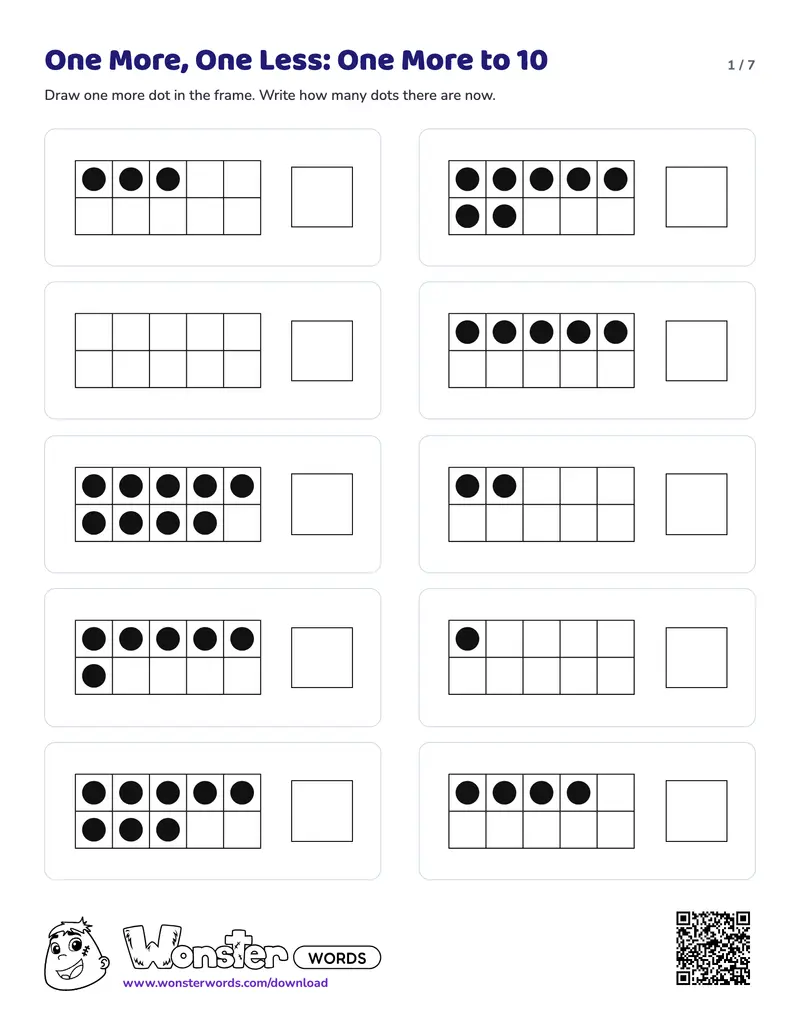
- One more, to 10. A ten frame with dots in it; your child draws one more dot and writes how many. For pre-K and kindergarten.
- One less, to 10. A ten frame with dots; your child crosses one out and writes how many, down to 0. For pre-K and kindergarten.
- Before and after, to 20. A number with a blank box on each side, for the number just before it and the number just after, across 10 and up to 20. For kindergarten.
- Ten more, ten less, pictured. A two-digit number drawn as ten-sticks and dots; your child writes ten less and ten more. For first grade.
- Ten more, ten less, to 120. The same boxes with numerals only, some of them across 100. For first grade.
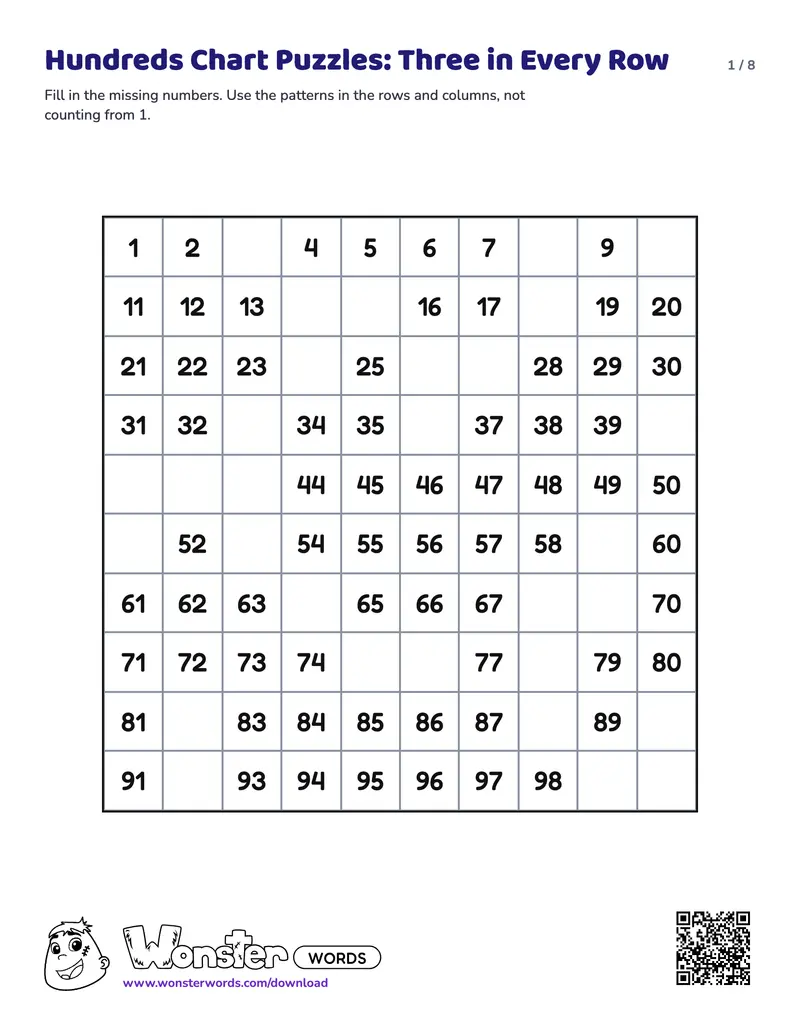
The dots sit in ten frames so the amount is seen rather than counted, and every page prints in black and white. For one more, one less, ten more, and ten less on the chart itself, the hundreds chart puzzles from our hundreds chart page are below too. Their last puzzle is pieces of the chart to fill in. The first two answer key pages cover the six one more, one less and before-and-after pages, and the third covers the four ten more, ten less pages. Each shows its worksheets in small, with every answer where your child writes it.
Free PDF · no sign-up
Free one more, one less and ten more, ten less worksheets
Two free PDFs in black and white, with no account and no email. The first is ten pages in teaching order, each activity twice: one more and one less with ten frames to 10, before and after to 20, then ten more and ten less with ten-sticks and to 120. Start with the pages your child can already do; the answer keys follow, then a page for grown-ups. The second is our hundreds chart puzzles, with answer keys, which end with chart pieces to fill in.
- One More, One Less (PDF)160 numbers to write · answer key included · 14 pages
Preview page 1Preview
- Hundreds Chart Puzzles (PDF)200 missing numbers · answer key included · 17 pages
Preview page 1Preview
Frequently asked questions
What does "1 more" mean?
One more means the number that comes right after a number when you count, so 1 more than 7 is 8. As an amount, it is the same group with one more thing added. Its partner, one less, is the number right before, so 1 less than 7 is 6.
What is one more, one less, ten more, ten less?
They are four ways of finding a number near another one. One more is the next counting number and one less the number before it, so one more than 46 is 47 and one less is 45. Ten more and ten less change the tens digit by one and leave the ones digit alone, so ten more than 46 is 56 and ten less is 36.
What age should children learn ten more ten less?
Ten more and ten less are first-grade work. The Common Core standard 1.NBT.C.5 asks first graders to find 10 more or 10 less than a two-digit number without having to count, and Texas asks for the same up to 120. One more and one less with small numbers come first, in pre-K and kindergarten.
What are common mistakes children make with the one more, one less concept?
Four come up at home. A child counts from 1 every time to find the next number, which is an earlier stage rather than an error. A child gives one more when asked for one less, because counting backward is harder. A child says twenty-ten for one more than 19. And with ten more, a child changes the ones digit instead of the tens, so ten more than 46 becomes 47.
How does one more and one less tie into basic addition and subtraction?
One more is adding 1 and one less is taking 1 away, so the plus-one facts are the first addition facts a child knows. Counting on from a number, rather than from 1, is how first graders first add, and the Common Core standard 1.OA.C.5 names it, asking children to relate counting to addition and subtraction, such as by counting on 2 to add 2.
What comes after ten more and ten less?
In second grade, children find 10 more, 10 less, 100 more, and 100 less for three-digit numbers. The Common Core standard 2.NBT.B.8 asks for this with numbers from 100 to 900, and Texas asks for it up to 1,200. It is the same move, one place to the left.
Related guides
Last updated