
Math
Ordinal Numbers for Kids
First to tenth in a table, how ordinal numbers differ from counting numbers, when children learn them, and five minutes of practice with toys already in the house.
Grades: pre-K to kindergarten · Head Start: P-MATH 4 · Related: Common Core K.CC.B.4, K.G.A.1; Texas PreK PK4.V.C.3
Ordinal numbers are the numbers that tell position: which one in a line or a list. The first ten are first, second, third, fourth, fifth, sixth, seventh, eighth, ninth, and tenth, written 1st, 2nd, 3rd, 4th, 5th, 6th, 7th, 8th, 9th, and 10th. A cardinal number, the kind used for counting, tells how many, as in “three ducks”. An ordinal number tells which one, as in “the third duck”.
A place in line only means something once you know where the line starts, so show your child the front of the line before you ask for a place. Head Start’s early learning framework expects children to pick out the first and second object in a row at 3–4, and to use first to tenth by 5. The Common Core does not list ordinal numbers as a standard of their own. Free picture worksheets, first to tenth, are at the end of this guide.
What are ordinal numbers?
Ordinal numbers are numbers that tell position or order: which one comes first, which comes next, and which comes last. Each of the first ten comes from a counting number, and the short form writes the numeral with the last two letters of the word.
| Numeral | Ordinal word | Counting number it comes from |
|---|---|---|
| 1st | first | one |
| 2nd | second | two |
| 3rd | third | three |
| 4th | fourth | four |
| 5th | fifth | five |
| 6th | sixth | six |
| 7th | seventh | seven |
| 8th | eighth | eight |
| 9th | ninth | nine |
| 10th | tenth | ten |
First, second, and third do not sound like one, two, and three, so a child learns them as new words. From fourth on, English adds -th to the counting word, with three spelling changes: five becomes fifth, eight gains only an h in eighth, and nine drops its e in ninth.
Ordinal names come later than counting names. Psychologists Kevin Miller and colleagues note that “ordinal number names are typically learned later than cardinal names”. They found that school-age children in China and the US learned ordinal names differently, in line with how regular each language makes them.
Children meet ordinal numbers every day: the 1st child in line at school, the 2nd place in a race, and the date on a birthday card, such as June 3rd.
What is the difference between cardinal and ordinal numbers?
Cardinal numbers tell how many; ordinal numbers tell which one. “Three ducks” is a cardinal number, a group of three. “The third duck” is an ordinal number, one duck, found by counting from the front of the line.
| Question | Number type | Example |
|---|---|---|
| How many? | Cardinal | 3 ducks |
| Which one? | Ordinal | the 3rd duck |
A parent can test the difference in a minute. Line up five toys and ask “give me three”, then line them up again and ask “give me the third one”. A child who hands over three toys both times can count, and has not yet learned that “third” asks for a single place.
That child is on the usual path. Psychologists Colomé and Noël (2012) gave 3-, 4-, and 5-year-olds matching counting and position tasks, and “the children performed cardinal tasks significantly better than ordinal ones”. They concluded that “cardinality precedes the development of ordinality”. Children learn how many first, and which one after it.
Some numbers are neither. The 7 on a soccer jersey or the number on a bus names the thing and tells neither how many nor which place.
When do children learn ordinal numbers?
Children learn ordinal numbers in preschool, starting with first and second at about 3 and reaching first to tenth by 5. That is the progression in Goal P-MATH 4 of the Head Start Early Learning Outcomes Framework, which sets out what children should know by the time they start kindergarten.
| Age | What the child does (Head Start ELOF wording) |
|---|---|
| 3–4 (36–48 months) | “Identifies the first and second objects in a sequence” |
| 4–5 (48–60 months) | “Uses numbers related to order or position” |
| By 5 (60 months) | “Identifies and uses numbers related to order or position from first to tenth” |
The Common Core and the Texas standards do not list ordinal numbers as a standard of their own. The nearest kindergarten standards are counting, where the last number said tells how many, and position words. Common Core’s K.G.A.1 asks children to describe where objects are with terms such as “in front of, behind, and next to”. Texas listed “verbal ordinal terms” in its 2015 prekindergarten guidelines, and the 2022 revision dropped the item, as TEA’s side-by-side comparison shows. Ordinal numbers come up in daily routines and preschool rather than as a graded skill on a report card.
Ordinal numbers still matter at home. Order words are how a child follows the steps of a task, takes turns, and reads the calendar. Knowing that “third” names one place is also part of number sense, a child’s understanding of what numbers mean.
How can parents help children learn ordinal numbers at home?
Teach ordinal numbers at home with a line of five toys, and fix the front of the line before you ask for any place. Five minutes is a whole session. The steps put the easier task first: Colomé and Noël found that children named the position of an object more accurately than they picked out “the object in the nth position”, so naming a place comes before finding one.
Show the front of the line first
Line up five toys facing the same way and point to the one at the front: "This one is first." Every question afterwards starts from there, so keep the front in the same place until your child is sure of it.
Name a place before finding one
Point to a toy and ask "Which place is the bear in?" before you ask "Can you find the fourth one?" Saying the position of a toy you point to comes before picking out the toy in a given position.
Start with first, second, and last
Use first, second, and last until your child answers without counting, then add third. Grow the line one toy at a time toward ten, and add a new word only when the ones before it are easy.
Contrast it with counting on purpose
Ask "Give me three" and then "Give me the third one." The first asks how many and the second asks which one, and hearing the two side by side shows a child that they are different questions.
Turn the line around
Once your child is sure, turn every toy to face the other way and ask again. The same toy is now in a different place, because the front of the line has moved.
After the five steps, daily routines supply the practice:
- Turns. Who is first in the bath, second at the door, last to the table?
- Races. A toy-car race has a 1st, 2nd, and 3rd place.
- Steps. Getting dressed or making toast has a first step, a second step, and a last step.
- Dates. “Today is the 3rd” on the calendar.
- Stories. Retell the three little pigs as “the first pig, the second pig, and the third pig”.
Two games need nothing but toys. In line-up and swap, your child shuts their eyes while you swap two toys, then says which places changed. In I am thinking of the fourth one, you name a place and your child points to it. A math board game adds ordinal words to every turn: who goes first, second, and third.
Three things trip children up, and each has a fix:
- Answering how many when asked which one. “Give me the third” gets three toys. Ask the two questions side by side, as in step 4.
- Counting from the wrong end. The child starts at the back of the line. Point to the front again, as in step 1, and turn the line around once it is easy.
- Saying “oneth”, “twoth”, or “fiveth”. The child has taken the -th rule from fourth, sixth, and seventh and applied it to every number. Miller and colleagues describe children working out ordinal names by generalizing from the early examples they hear. Say the right word back: “Yes, the fifth one.”
Ordinal numbers after tenth: 11th, 12th, 21st, and the calendar
After tenth, the ending of an ordinal number follows the last word you say. A number whose last word is one, two, or three takes st, nd, or rd: 21st, 22nd, 23rd, 31st. Eleventh, twelfth, and thirteenth take th, because their last word is eleven, twelve, or thirteen. Every other number takes th, and the tens change y to ieth: twentieth, thirtieth.
A calendar month runs these ordinals:
- 11th–20th: eleventh, twelfth, thirteenth, fourteenth, fifteenth, sixteenth, seventeenth, eighteenth, nineteenth, twentieth
- 21st–31st: twenty-first, twenty-second, twenty-third, twenty-fourth, and on to thirtieth and thirty-first
The 12th is “twelfth”, never 12nd, because nobody says “twelve-second”. Fourth to tenth, and almost every ordinal after them, end in the th sound your child may be learning to read and spell, the same sound as the words ending in th on our th words list.
Free ordinal numbers worksheets, first to tenth
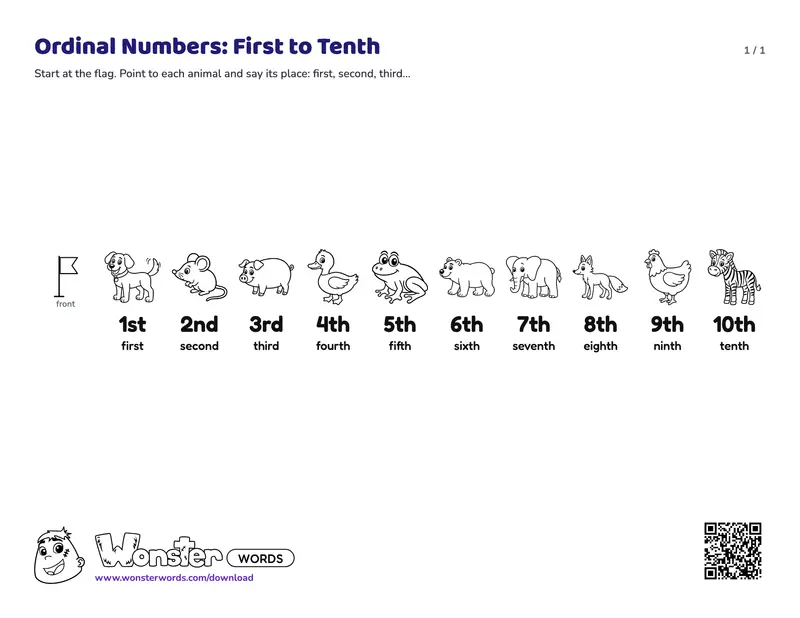
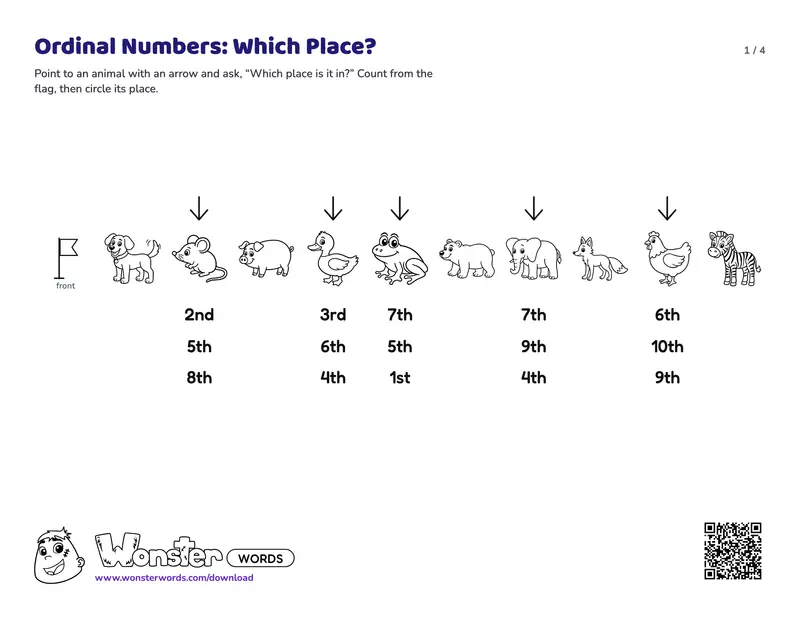
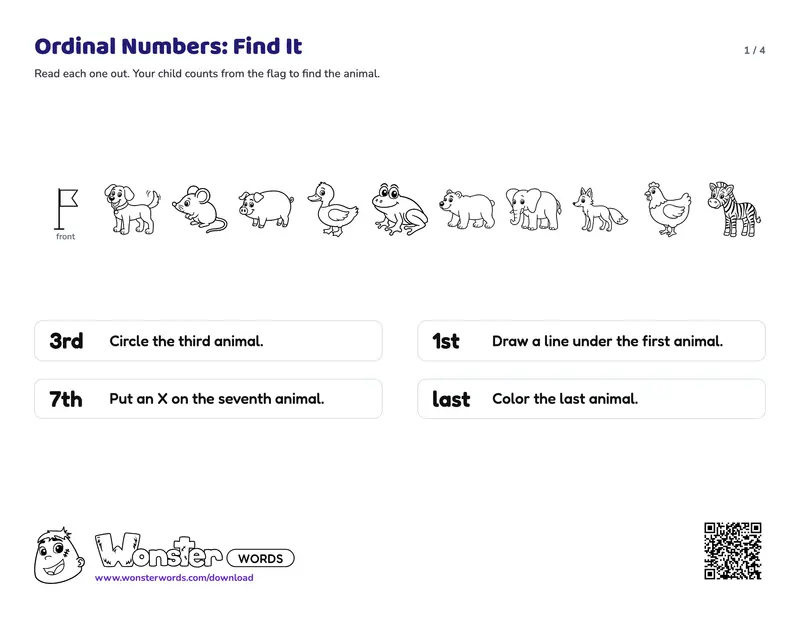
The free ordinal numbers worksheets are four picture PDFs that teach positions, easier task first: see the line, name a place, find a place, then tell how many from which one. The first three show the same ten animals in a row, all facing the front, with a start flag at the front on the left. Every page has the flag, so each PDF works on its own.
- The line. One page: the ten animals, each labeled under it with “1st” and “first”, to point at and say together.
- Which place? The same line without labels, on three pages. Arrows mark five animals a page, and your child circles the right ordinal from three under each one. Every place from first to tenth comes up.
- Find it. Three pages of prompts you read aloud, such as “Circle the third animal” and “Put an X on the seventh animal”, and your child finds each one, from the first animal to the tenth and the last.
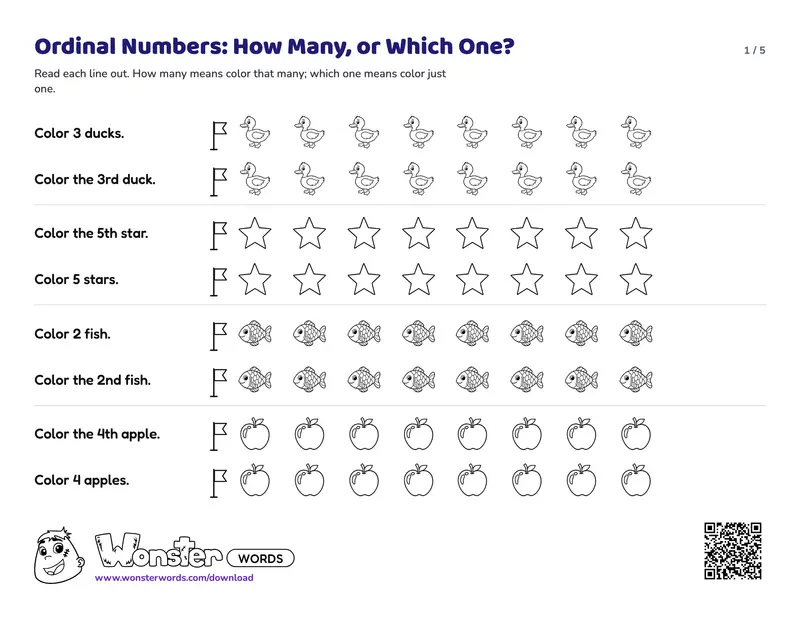
- How many, or which one? Three pages of rows of the same picture, each row starting at a flag, with two kinds of prompt side by side: “Color 3 ducks” and “Color the 3rd duck”, for every place from first to tenth.
The first three suit pre-K and kindergarten, and the last suits kindergarten. Start where your child already answers easily, and move on when a whole page goes right. Each practice PDF has its answer key at the back, and each answer sits where its question does on the page.
Free PDF · no sign-up
Free ordinal numbers worksheets, first to tenth
Four free picture PDFs in black and white, with no account and no email, in teaching order: the line of ten animals labeled first to tenth, which place is this animal in, find the animal in a place, then color 3 ducks against color the 3rd duck. Start where your child already answers easily. The three practice PDFs have their answer keys at the back.
- Ordinal Numbers: First to Tenth (PDF)10 places · 2 pages
Preview page 1Preview
- Ordinal Numbers: Which Place? (PDF)15 places to name · answer key included · 5 pages
Preview page 1Preview
- Ordinal Numbers: Find It (PDF)12 places to find · answer key included · 5 pages
Preview page 1Preview
Frequently asked questions
What are ordinal numbers and how are they used?
Ordinal numbers are the numbers that tell position or order, such as first, second, and third, written 1st, 2nd, and 3rd. Children meet them in a line at school, in a race, in the steps of a recipe, and in a date such as May 3rd. They answer the question "which one?", where counting numbers answer "how many?".
What is the difference between ordinal and cardinal numbers?
A cardinal number tells how many and an ordinal number tells which one. Three ducks is a cardinal number and the third duck is an ordinal number. The cardinal three names a group of three ducks, and the ordinal third names one duck, found by counting from the front of the line.
What is the best age to start teaching ordinal numbers?
Start at about 3 with first and second, which is the first step in the Head Start Early Learning Outcomes Framework. By 5, the same framework expects a child to use first to tenth. Ordinal words come up naturally in daily routines, so a child who hears "you are first in the bath" is already learning them.
Why are ordinal numbers important in early education?
Ordinal numbers are the words children use to follow steps in order, take turns, describe a race, and read a date on the calendar. Knowing that "third" names one item in a line, and not a group of three, is also part of understanding what numbers mean.
What are some common mistakes children make in understanding ordinal numbers?
Children often answer how many when they are asked which one, so "give me the third" gets three toys. They also count from the wrong end of the line, and they say words such as oneth, twoth, and fiveth by adding -th to every counting word. Fix the front of the line, contrast the two questions, and say the right word back.
What are the ordinal numbers from 1 to 20?
First (1st), second (2nd), third (3rd), fourth (4th), fifth (5th), sixth (6th), seventh (7th), eighth (8th), ninth (9th), tenth (10th), eleventh (11th), twelfth (12th), thirteenth (13th), fourteenth (14th), fifteenth (15th), sixteenth (16th), seventeenth (17th), eighteenth (18th), nineteenth (19th), and twentieth (20th).
How can I teach ordinal numbers to my kindergartener?
Line up five toys, show your child which one is at the front, and ask which place a toy is in before asking them to find a place. Then mix in "give me three" and "give me the third" so your child hears the difference between counting and position.
Related guides
Last updated