
Math
What Is a Fact Family?
What a fact family is, how it helps a child subtract, what grade uses it, the fact family house and triangle, and how to teach it at home, with free worksheets.
Grades: kindergarten to grade 2 · Common Core: 1.OA.B.4, 1.OA.C.6, 1.OA.D.8 · Related: Common Core K.OA.A.5, 1.OA.B.3, 2.OA.B.2, 3.OA.B.6; Texas 1.3(D), 1.5(F), 1.5(G), 2.4(A), 3.4(J)
A fact family is three numbers and the four addition and subtraction facts they make. The numbers 3, 5, and 8 give 3 + 5 = 8, 5 + 3 = 8, 8 − 5 = 3, and 8 − 3 = 5. The biggest number, 8, is the whole, and the other two are its parts. A fact family lets a child solve a subtraction with an addition they already know: 8 − 5 asks what goes with 5 to make 8. First-grade standard 1.OA.B.4 asks children to think of subtraction this way.
The most useful thing to do at home is to cover one of the three numbers and ask which fact finds it. Children write fact families in first grade, within 10 and then within 20, and know the facts from memory by the end of second grade. Free fact family house worksheets with an answer key, and fact family triangle cards, are in this guide.
What is a fact family?
A fact family is a whole and the two parts that add up to it, with the four facts those three numbers make: two additions and two subtractions. The whole is the sum, the biggest of the three numbers, and it comes first in both subtraction facts. The smallest family of three different numbers is 1, 2, and 3: 1 + 2 = 3, 2 + 1 = 3, 3 − 2 = 1, and 3 − 1 = 2.
| Fact family | Whole | Parts | The four facts |
|---|---|---|---|
| 1, 2, 3 | 3 | 1 and 2 | 1 + 2 = 3, 2 + 1 = 3, 3 − 2 = 1, 3 − 1 = 2 |
| 3, 5, 8 | 8 | 3 and 5 | 3 + 5 = 8, 5 + 3 = 8, 8 − 5 = 3, 8 − 3 = 5 |
| 4, 9, 13 | 13 | 4 and 9 | 4 + 9 = 13, 9 + 4 = 13, 13 − 9 = 4, 13 − 4 = 9 |
Not every three numbers make a family. The numbers 3, 5, and 7 do not, because 3 + 5 is 8, not 7. To check any three numbers, add the two smaller ones: if they make the biggest, the three are a family.
A doubles family has only two facts. The family 4, 4, and 8 gives 4 + 4 = 8 and 8 − 4 = 4, because turning the parts around makes the same fact again. A family with 0 uses only two different numbers and still makes four facts: 5 + 0 = 5, 0 + 5 = 5, 5 − 0 = 5, and 5 − 5 = 0. First graders learn the doubles as a strategy of their own.
A number bond is the same family drawn as a picture: the whole in one circle, joined by lines to a circle for each part. “Fact family” is the name schools and worksheets use, and neither the Common Core nor the Texas standards use it. The Common Core’s first-grade standard 1.OA.C.6 calls it “the relationship between addition and subtraction”, and the Common Core’s progressions document never uses the words either. Multiplication and division have fact families too, from third grade.
How do fact families help kids subtract?
A fact family helps a child subtract by turning the subtraction into an addition they already know. First-grade standard 1.OA.B.4 asks children to “understand subtraction as an unknown-addend problem”, and gives its own example: “subtract 10 − 8 by finding the number that makes 10 when added to 8.”
Take 12 − 8. A child thinks 8 + ? = 12, and knowing 8 + 4 = 12 gives the answer, 4. That is the example in standard 1.OA.C.6: “knowing that 8 + 4 = 12, one knows 12 − 8 = 4”. Teachers call the strategy think addition, and the fact family is the reason it works. The Common Core Standards Writing Team, which wrote the standards’ progressions, says that thinking of a subtraction this way “makes subtraction as easy as addition (or even easier)”.
The family’s two additions are turnaround facts: 3 + 5 and 5 + 3 make the same 8. A child who knows one knows the other, which nearly halves the addition facts to learn. The Common Core lists this as a property of operations in standard 1.OA.B.3. Subtraction does not turn around: 8 − 3 is 5, and 3 − 8 is not a first-grade fact at all.
Researchers have tested teaching subtraction this way. In a 12-week randomized trial, Paliwal and Baroody taught 81 children from kindergarten to third grade, most of them second and third graders. One group was taught why a known addition answers a subtraction, such as using 7 + 4 = 11 to solve 11 − 4. On subtractions they had never practiced, more of those children used a related addition as a shortcut than children who practiced the same subtractions or learned a different strategy. In a 2019 conference poster on the same trial, Paliwal, Baroody, and Das report that about three in four of the taught children showed they knew the strategy, against about half of the others.
A fact family is the route to memorized facts, not a replacement for them. The same standards ask that by the end of second grade children “know from memory all sums of two one-digit numbers” (2.OA.B.2). Texas asks second graders to “recall basic facts to add and subtract within 20 with automaticity” (2.4(A), TEKS grade 2). The family is how a child works out a subtraction fact on the way to knowing it.
What grade do kids learn fact families?
Children write fact families in first grade, within 10 and then within 20, and know the facts from memory by the end of second grade. Kindergartners do the same work with objects, and third graders meet fact families for multiplication and division.
| Grade | What children do | Common Core | Texas (TEKS) |
|---|---|---|---|
| Kindergarten | Act out and solve adding and taking away within 10; add and subtract within 5 fluently | K.OA.A.5 (related) | K.3(A)–(C) |
| 1st grade | Fact families: subtraction as a missing addend, the relationship between addition and subtraction within 20, the missing number in any position | 1.OA.B.4, 1.OA.C.6, 1.OA.D.8 | 1.3(D), 1.5(F), 1.5(G) (related) |
| 2nd grade | Know all sums of two one-digit numbers from memory, so the families within 20 become recall | 2.OA.B.2 | 2.4(A) |
| 3rd grade | Fact families for multiplication and division | 3.OA.B.6 | 3.4(J) |
Texas, like the Common Core, never uses the words “fact family”. Its first graders find the unknown in an addition or subtraction equation “when the unknown may be any one of the three or four terms in the equation” (1.5(F), TEKS grade 1). That is the question a complete-the-family sheet asks. Neither framework names the fact family house or the triangle; both are worksheet formats that schools use to practice the relationship.
A kindergartner who knows that 2 and 3 make 5, and that taking 2 away leaves 3, is doing the work a family writes down. The written house is a first-grade sheet. A pre-K child does not need fact family worksheets, because acting out the stories with objects is the pre-K version. The Texas Prekindergarten Guidelines ask 4-year-olds to show adding up to 5 objects and taking objects away from a set of 5 (PK4.V.B.1 and PK4.V.B.2).
What is a fact family house?
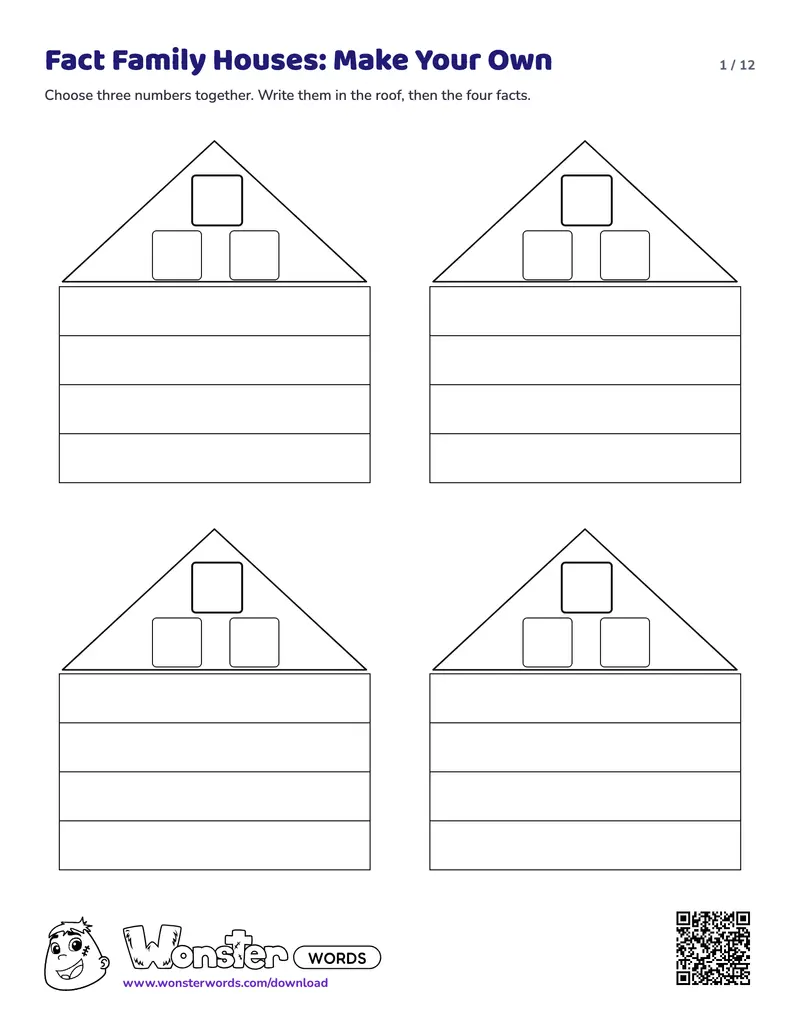
A fact family house is a worksheet drawing of one fact family: the three numbers in the roof, and the four facts on the floors below, two additions and two subtractions. On ours, the whole sits at the peak of the roof and the two parts below it. That is the layout the Common Core’s progressions document gives its part-whole and number bond diagrams, with “the total at the top and the addends at the bottom” (p. 16). Our first page of houses and the complete the family pages leave the roof blank for your child to fill. Every roof holds one whole and two parts.
The whole, 8, sits at the peak of the roof. Both additions put the parts together, and both subtractions start from the whole.
To fill in a fact family house:
- Find the whole first: the biggest number in the roof.
- Write the two additions, part plus part: 3 + 5 = 8 and 5 + 3 = 8.
- Write the two subtractions, each starting from the whole: 8 − 3 = 5 and 8 − 5 = 3.
- Read each fact aloud, and check that it is true.
A fact family house, a fact family triangle, and a number bond are three drawings of the same whole and two parts. The house is the one that asks for all four facts in writing.
What is a fact family triangle?
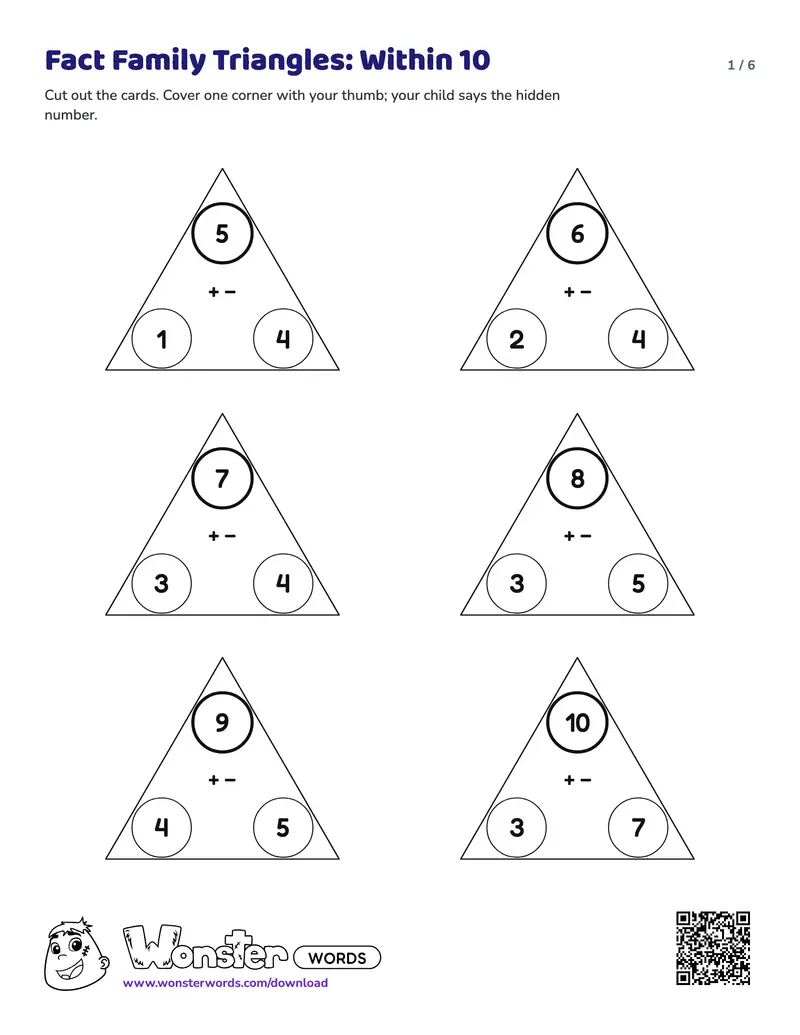
A fact family triangle is the same three numbers at the corners of a triangle, one corner for the whole and one for each part. On our cards the whole is at the top corner in a heavier circle, the parts are at the two bottom corners, and ”+” and ”−” sit in the middle.
The heavier circle marks the whole. Cover the 8 and the answer is 3 + 5; cover the 3 and the answer is 8 − 5.
A fact family triangle is a drawing of a fact family, not a different idea, and it does not ask for the four facts to be written. It is used as a card. Cover one corner, and the child says the hidden number and the fact that finds it: with the 8 covered, 3 + 5 = 8, and with the 3 covered, 8 − 5 = 3. The house practices writing the family, and the triangle practices the move the family is for, finding one missing number.
The triangle has one mistake of its own. With the 3 covered, a child adds the two numbers left, 8 + 5, and answers 13 instead of 3. The circled top corner is there to stop that: the two numbers that add are always the two at the bottom. Start with the whole covered, so the first answers are additions, and then cover a part. The cut-out triangle cards, 24 printed and 6 blank, are with the free fact family worksheets.
How to teach fact families at home
Teach fact families at home with objects first, then a drawing, then numbers alone. The What Works Clearinghouse practice guide Assisting Students Struggling with Mathematics (2021) is written for intervention teachers, and it rates using concrete objects and drawings, connected to written numbers, as having strong evidence. These five steps adapt that approach for a kitchen table, about 10 minutes at a time.
Make the family with objects
Push 3 red blocks and 5 blue blocks together and count them: 3 and 5 make 8. Say which number is the whole, 8, and which are the parts, 3 and 5.
Turn it around
Swap the two groups so the blue blocks come first: 5 and 3 still make 8. Those are the family's two addition facts, 3 + 5 = 8 and 5 + 3 = 8.
Take a part away
From the 8 blocks, take the 5 blue ones away and 3 are left. Put them back, take the 3 red ones away, and 5 are left. Those are the two subtraction facts, 8 − 5 = 3 and 8 − 3 = 5, and each one starts from the whole.
Write the family
Write 8, 3, and 5 in the roof of a blank fact family house, with the whole at the top. Your child writes the four facts on the floors and reads each one aloud.
Hide one number
Cover the 5 and ask, "3 and what make 8?" Then ask, "What is 8 take away 3?" It is one question asked two ways, and answering it is what a fact family is for.
Step 5 is also the check. A child who can name the hidden number for a family they have not practiced understands fact families. On a homework night, ask for the whole before any writing, then have your child read each fact aloud.
Everyday life is full of fact families:
- The table. Put out 3 forks and 5 spoons: together they make 8, and taking the 5 spoons away leaves 3 forks.
- Breakfast. Two kinds of cereal in one bowl: 4 rings and 2 flakes make 6.
- The park. Two children on the swings and 3 on the slide make 5 children.
Work through the families within 5 first, then within 10, then the families past 10 that use making ten, such as 8, 5, and 13. One family a night is enough. Blocks, buttons, and dried beans all work as counters, and math manipulatives covers which ones suit which age.
Fact family games and activities
Each of these five fact family games needs only paper, a deck of cards, two dice, or the triangle cards, and each ends with your child saying the hidden number or the whole family aloud.
- Cover the corner. Hold up a fact family triangle card and cover one corner with your thumb. Your child names the hidden number and the fact that finds it. Then your child holds the card and you answer.
- Is it a family? Use the cards from ace (1) to 9. Deal three. If two of them add up to the third, your child says all four facts and keeps the cards. If not, your child says why: 3, 5, and 7 are not a family, because 3 + 5 is 8.
- Story swap. Tell an addition story with a family’s numbers: “There were 3 ducks on the pond and 5 more came, so now there are 8.” Your child tells a subtraction story with the same numbers: “There were 8 ducks on the pond and 5 flew away.”
- Roll a family. Roll two dice, and the two numbers are the parts. Your child writes the whole in the roof of a blank house and fills in the four floors. A double, such as two 4s, makes a family of two facts.
- Fold-a-flap house. Fold a sheet of paper into a house with four flaps. Write the family’s three numbers on the roof and one fact under each flap. Your child says a fact, then opens the flap to check it.
Common fact family mistakes
When a child writes 3 − 8 on a fact family house, they have put the subtraction in the wrong order: the whole, 8, comes first, so the facts are 8 − 3 = 5 and 8 − 5 = 3. The sheet is not teaching negative numbers. Taking 8 away from 3 has no answer in first-grade numbers, and negative numbers come in sixth grade (6.NS.C.5). Two habits cause the mistake: copying the roof from left to right, and turning the subtraction around the way the two additions turn around. The Common Core’s progressions document puts the rule plainly: in a subtraction, the total goes “to the left of the minus sign”. To fix it, point to the peak of the roof, or put out 3 blocks and ask, “Can you take 8 away from 3?”
These four mistakes also show on the sheet, and each one has a fix you can make at the table.
- Adding the whole and a part. On a house with 3, 5, and 8, the child writes 5 + 8 = 3. Ask “which number is the whole?” before any writing: the two numbers that add are always the two smaller ones.
- Filling the house by pattern. All four facts are right, and the child cannot say what 8 − 3 means. Have your child read every fact aloud, and act one out with blocks.
- Thinking any three numbers make a family. Given 3, 5, and 7, the child writes 3 + 5 = 7. Check the addition before writing anything else.
- Writing four facts for a doubles family. For 4, 4, and 8, the child writes 4 + 4 = 8 twice. A doubles family has two facts, and two is the right answer.
When fact families are hard, go back to objects and to the families within 5, and do one family a night. Try the triangle cards before the house, because one hidden number is easier than four written lines. When the writing is the struggle, your child can say the four facts aloud while you write them down: the relationship is the skill, and the handwriting is not. If subtraction within 10 is still guesswork by the end of first grade, talk to your child’s teacher.
Going further: multiplication and division fact families
Multiplication and division fact families work the same way, and children meet them in third grade. The numbers 3, 6, and 18 give 3 × 6 = 18, 6 × 3 = 18, 18 ÷ 6 = 3, and 18 ÷ 3 = 6. The standard reads like first grade’s unknown-addend standard with the operation changed: third graders “understand division as an unknown-factor problem” (3.OA.B.6). Texas third graders find a quotient “using the relationship between multiplication and division” (3.4(J), TEKS grade 3). The two multiplication facts are a turnaround, which an array shows when it is turned on its side.
Free fact family worksheets: houses and triangle cards
Our free fact family worksheets come as two PDFs: fact family houses to write in, and fact family triangle cards to play with.
Fact Family Houses is 12 pages, four houses to a page. It opens with a page of blank houses for a family you choose together. Then come two pages each of families within 5, within 10, and within 20, and two pages of complete the family, where one fact is given and your child writes the roof and the other three. Only four families with two different parts fit within 5, so the second within-5 page has the same four in a new order. The within-20 houses include families past 10 such as 8, 5, and 13. Two answer key pages show every practice page in miniature with the facts written in, and the four facts may be in any order. Start the houses in late kindergarten, with the families within 5.
Fact Family Triangle Cards is 6 pages, six cards to a page: two pages within 10, two within 20, and a page of blank cards for your own families. Each card is 64 mm on a side, with the whole at the top in a heavier circle and every corner big enough to cover with a thumb. The cards suit first and second grade, and they come before the house when writing is what holds a child back. They have no answer key, because every card prints all three numbers.
A fact family sheet asks for the relationship between facts, where a page of sums asks for each sum on its own. For plain practice by range, the addition and subtraction worksheets run within 10 and within 20. The houses are not numbered, and the key matches each answer to its house by position. Every page prints in black and white, with no account and no email.
Free PDF · no sign-up
Free printable fact family worksheets
Two free PDFs in black and white, with no account and no email, in teaching order: fact family houses from families within 5 to complete the family, with an answer key, then fact family triangle cards within 10 and within 20 to cut out. Both PDFs end with a page of instructions for grown-ups on why, what for, and how to use it.
- Fact Family Houses (PDF)36 fact family houses · answer key included · 12 pages
Preview page 1Preview
- Fact Family Triangle Cards (PDF)30 cards · 6 pages
Preview page 1Preview
Frequently asked questions
What is a fact family example?
The numbers 3, 5, and 8 are a fact family. They make four facts, 3 + 5 = 8, 5 + 3 = 8, 8 − 5 = 3, and 8 − 3 = 5. The biggest number, 8, is the whole, and it comes first in both subtraction facts. Two more examples are 1, 2, and 3, the smallest family of three different numbers, and 4, 9, and 13.
Can you write a fact family for 3, 5, and 7?
No. Three numbers make a fact family only when the two smaller ones add up to the biggest, and 3 + 5 is 8, not 7. The nearest families with 7 as the whole are 2, 5, and 7, and 3, 4, and 7. The first makes 2 + 5 = 7, 5 + 2 = 7, 7 − 5 = 2, and 7 − 2 = 5, and the second makes 3 + 4 = 7, 4 + 3 = 7, 7 − 4 = 3, and 7 − 3 = 4.
Why might a child write 3 − 8 incorrectly in math?
On a fact family house, 3 − 8 is a mistake of order, not a lesson about negative numbers. The whole, 8, comes first in every subtraction, so the facts are 8 − 3 = 5 and 8 − 5 = 3. The child has copied the numbers in the order they appear, or turned the subtraction around the way the two additions turn around. Point to the whole and start the subtraction there.
Fact family versus number bonds: what is the difference?
A number bond is a drawing of a whole and its two parts, such as 8 in one circle joined by lines to 3 and 5. A fact family is the four facts those three numbers make, 3 + 5 = 8, 5 + 3 = 8, 8 − 5 = 3, and 8 − 3 = 5. Every number bond has a fact family, and a fact family house or triangle draws the same three numbers another way.
What are the fact families of 10?
The fact families of 10 are 1, 9, and 10; 2, 8, and 10; 3, 7, and 10; 4, 6, and 10; and 5, 5, and 10. Each of the first four makes four facts, such as 3 + 7 = 10, 7 + 3 = 10, 10 − 7 = 3, and 10 − 3 = 7. The family of 5, 5, and 10 is a doubles family with two facts, 5 + 5 = 10 and 10 − 5 = 5. With 0 there is one more, 0, 10, and 10, whose facts are 0 + 10 = 10, 10 + 0 = 10, 10 − 0 = 10, and 10 − 10 = 0.
How to explain fact families to first graders?
Start with objects. Push 3 blocks and 5 blocks together to make 8, take each group away again, and say the four facts as you go. Then write the three numbers in the roof of a fact family house, the whole at the top, and have your child write and read the four facts. Finish by covering one number and asking which fact finds it.
What property is fact family?
The two addition facts in a fact family use the commutative property of addition, so the order of the parts does not change the sum, and 3 + 5 and 5 + 3 both make 8. The two subtraction facts use the relationship between addition and subtraction, that 8 − 5 = 3 because 3 + 5 = 8. Subtraction has no commutative property, which is why the whole always comes first.
How can a fact family help you subtract?
A fact family turns a subtraction into an addition you already know. To find 12 − 8, think of 8 plus what makes 12, and knowing 8 + 4 = 12 gives the answer, 4. The Common Core asks first graders to understand subtraction this way, as an unknown-addend problem.
What age should children start learning about fact families?
Children write fact families in first grade, at about 6 or 7, starting within 10 and moving on to within 20. Kindergartners do the same work with objects, such as seeing that 2 and 3 make 5 and that taking 2 away leaves 3. Multiplication and division fact families come in third grade, at about 8.
Related guides
Last updated