
Math
Free Addition and Subtraction Worksheets
Six PDFs within 10, within 20, and within 100, each with an answer key, which one each grade needs, and how to use a worksheet so it shows how your child thinks.
Grades: kindergarten to grade 2 · Common Core: K.OA.A.2, K.OA.A.5, 1.OA.C.6, 1.OA.D.8, 1.NBT.C.4, 1.NBT.C.6, 2.OA.B.2, 2.NBT.B.5 · Texas: K.3(A), K.3(C), 1.3(A), 1.3(D), 1.5(F), 2.4(A), 2.4(B) · Related: Common Core K.OA.A.1, 1.OA.C.5, 1.OA.B.4, 2.NBT.B.7, 3.NBT.A.2; Texas K.3(B), 1.3(E)
These free printable addition and subtraction worksheets come in three ranges, within 10, within 20, and within 100, as six PDFs with answer keys. Every sheet prints in black and white, and none needs an account or an email.
Print by grade: kindergarten works within 10, first grade within 20, and second grade on mixed facts within 20 and two-digit numbers within 100.
A range is what a worksheet practices; a strategy is what a child is taught. These sheets mix the facts in each range with no strategy named, so your child chooses how to find each answer. Teach the strategies first, such as counting on, doubles, and making ten, then hand over the sheet.
Do the first row together and ask “How did you get that?” The answer tells you more than the score does: counting every dot, counting on, and using a fact your child knows are three different routes to the same answer.
Free printable addition and subtraction worksheets
The addition and subtraction worksheets come as six PDFs, one range and one kind of problem each, in the order a child meets them.
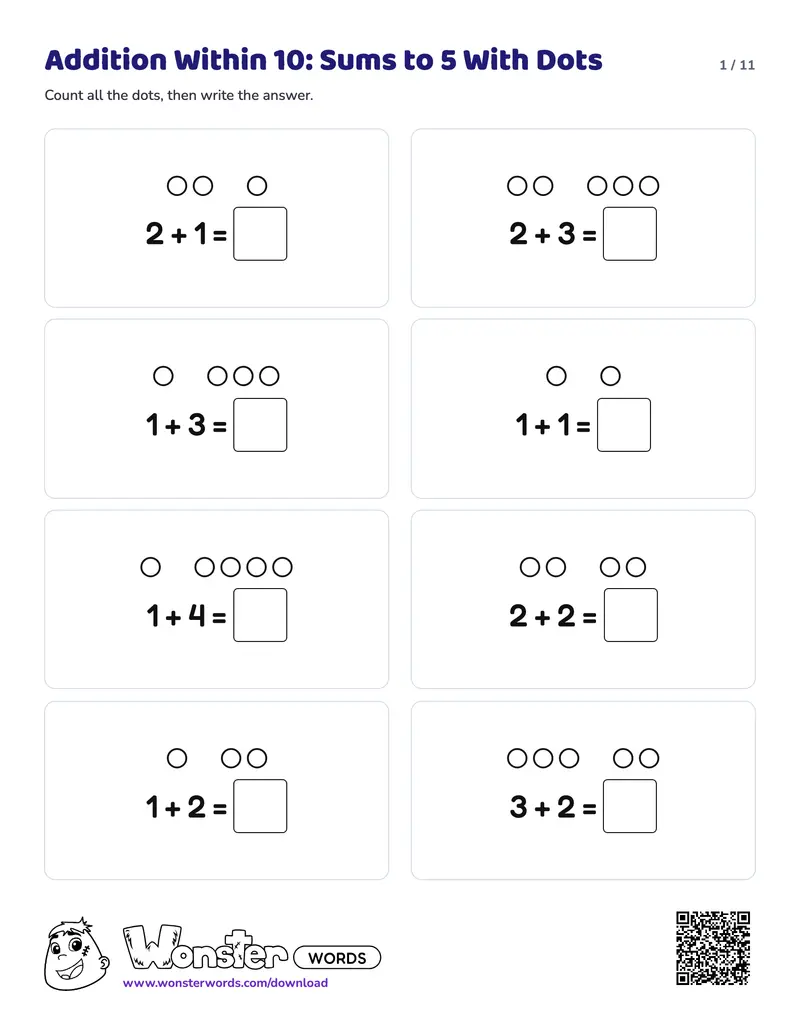
- Addition Within 10, 11 pages. Sums to 5 with dots to count, sums to 5 in numerals, sums from 6 to 10, then mixed facts within 10, with adding 0 and both orders of a pair, such as 3 + 4 and 4 + 3. Print this one for a kindergartner.
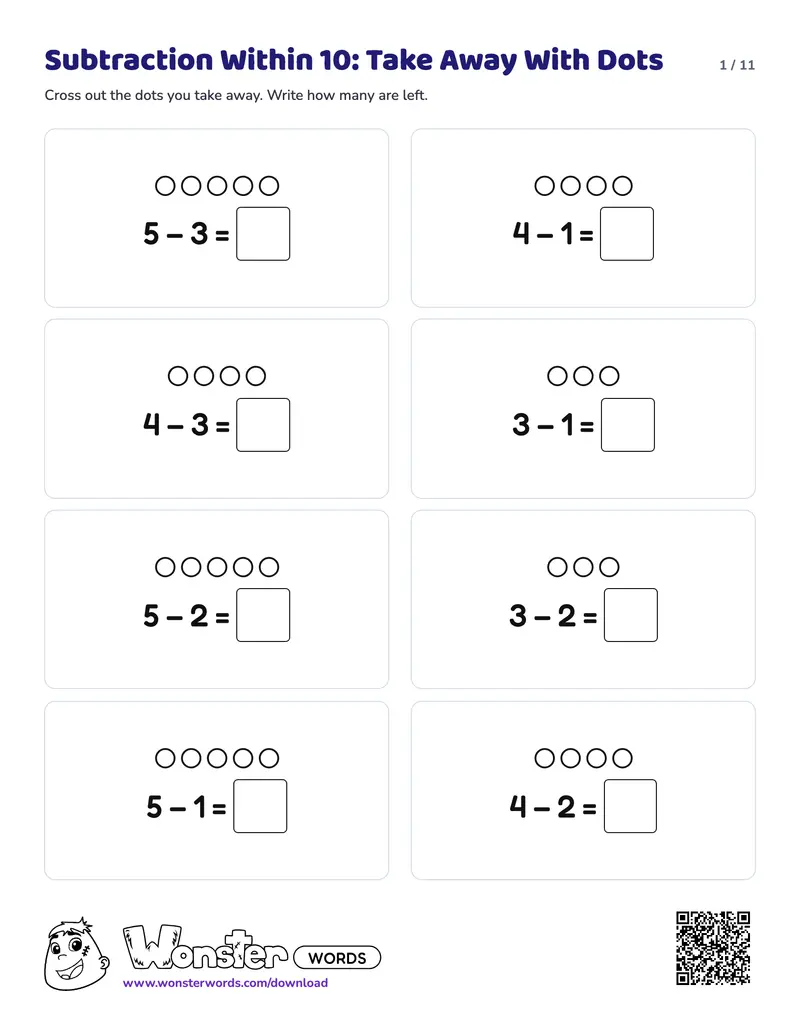
- Subtraction Within 10, 11 pages. Taking away within 5 by crossing out dots, within 5 in numerals, starting from 6 to 10, then mixed facts, with taking away 0 and a number minus itself. Print this one beside Addition Within 10.
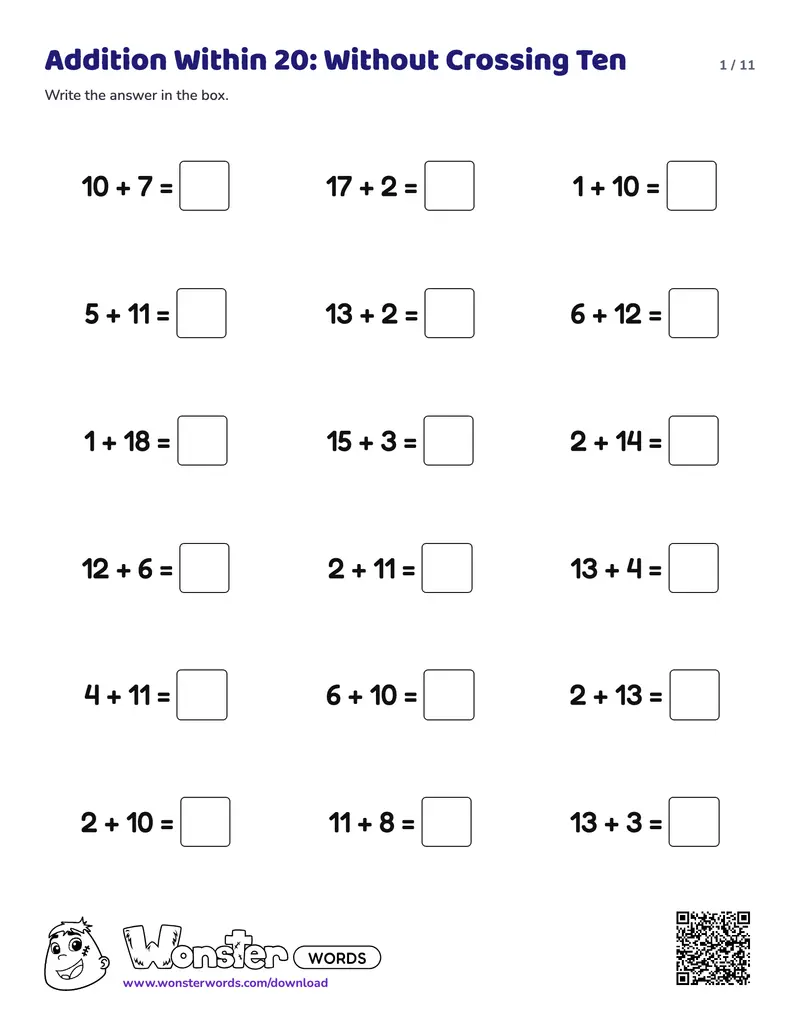
- Addition Within 20, 11 pages. Teen sums that do not cross ten, such as 13 + 4; sums that do, such as 8 + 4 and 9 + 6; mixed facts within 20; then the missing number, such as 9 + ☐ = 16. Print this one for a first grader.
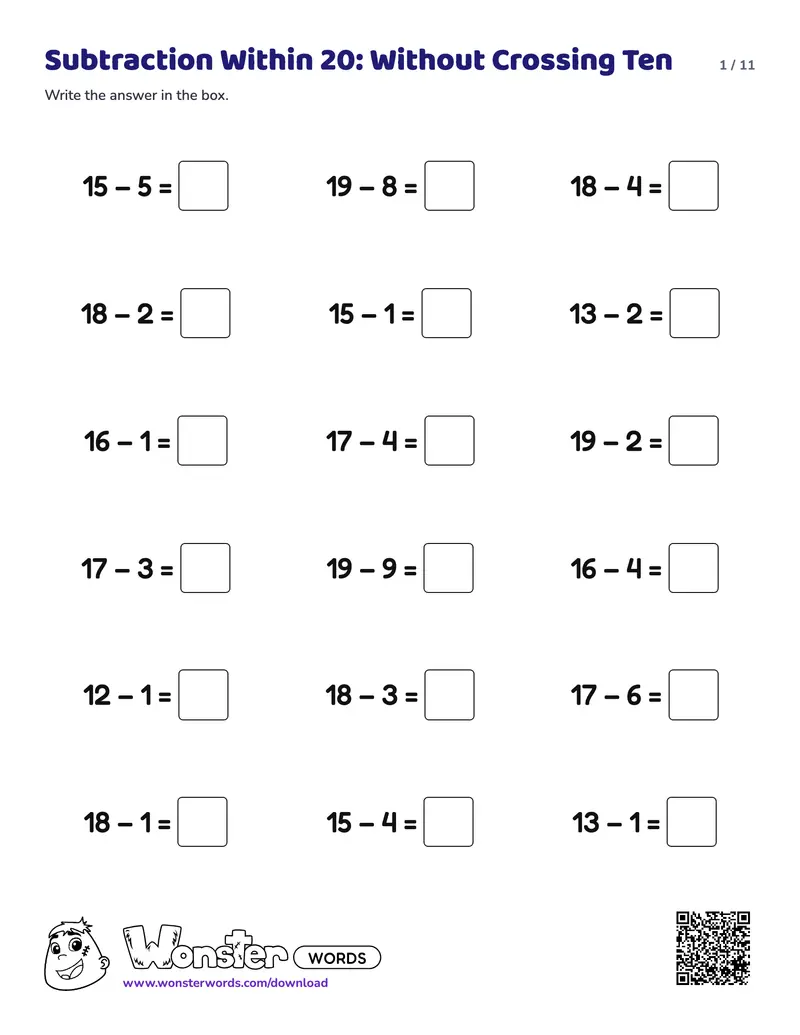
- Subtraction Within 20, 11 pages. The same four steps, taking away: 17 − 3, then 12 − 7, then mixed facts, then 14 − ☐ = 12 and ☐ − 8 = 9. Print this one beside Addition Within 20.
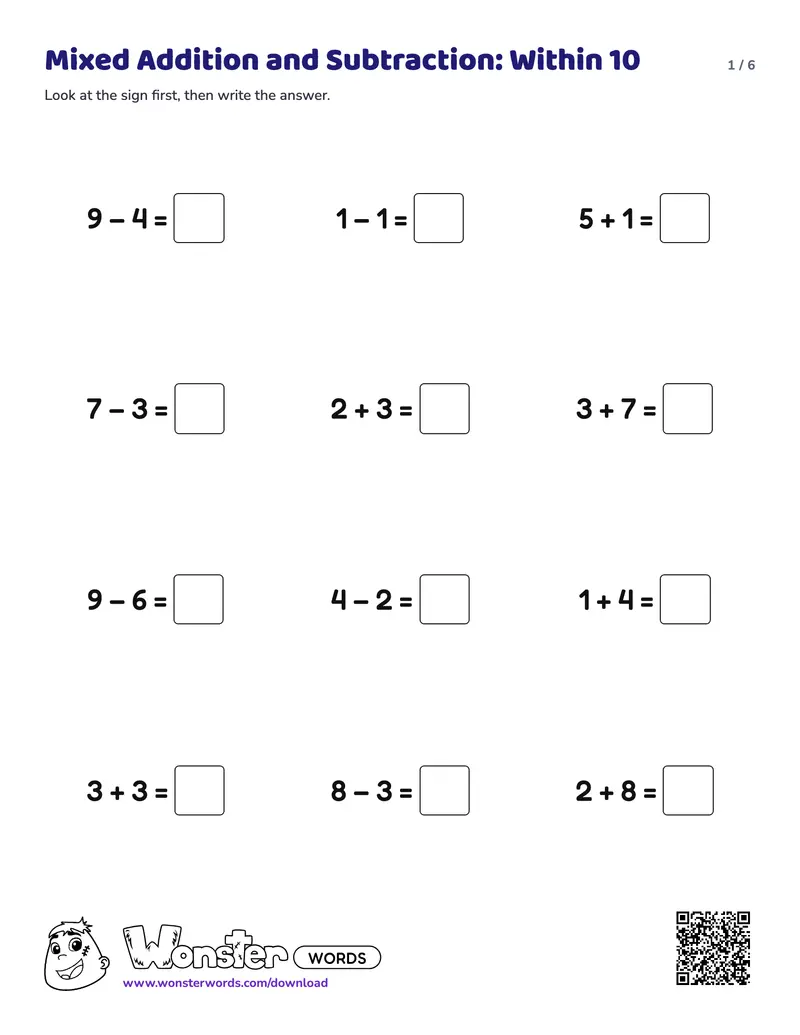
- Mixed Addition and Subtraction, 6 pages. Two pages within 10 and two within 20, both signs shuffled on every page, and no problem repeated across pages. Print this one to check that your child reads the sign, from the end of kindergarten to second grade.
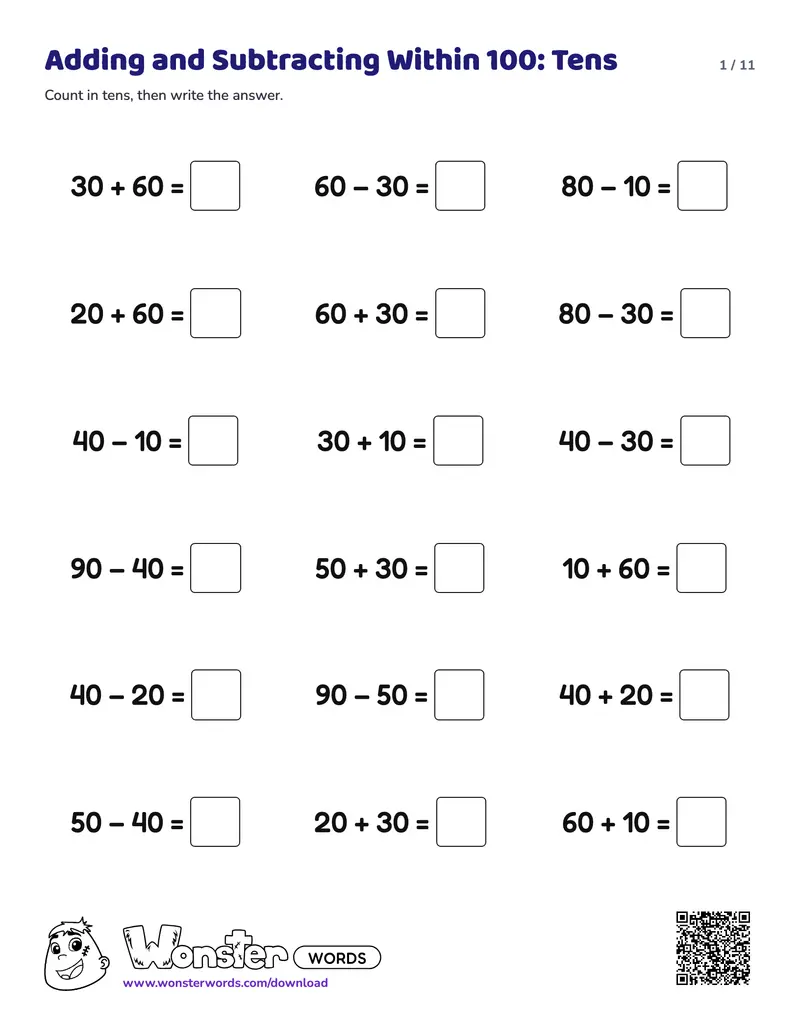
- Adding and Subtracting Within 100, 11 pages. Tens, such as 30 + 60; adding ones or tens, such as 32 + 6 and 73 + 10; taking away ones or tens, such as 46 − 3 and 45 − 30; then two-digit numbers, such as 22 + 53 and 78 − 25. No problem needs regrouping. Print pages 1–6 for a first grader and pages 7–8 for a second grader.
Each activity prints twice, the second page the same facts in a new order, except on the mixed sheet, where all four pages are different problems. The within-10 pages hold 12 problems (8 on the dot pages) and the within-20 and within-100 pages hold 18, each with a box wide enough for a two-digit answer.
The problems are not numbered, because a printed 3 beside a sum looks like part of it. The order is mixed, so no run of answers gives the next one away. The answer key follows the worksheet pages, every answer written in red where your child writes it. The last page is for grown-ups, on what the sheet practices and how to use it. Nothing on a page depends on color, so every sheet prints on a black-and-white printer.
Free PDF · no sign-up
Free printable addition and subtraction worksheets
Six free PDFs in black and white, with no account and no email, in teaching order: addition and subtraction within 10, within 20, mixed facts, then within 100. Each ends with its answer key and a page for grown-ups. Below them are the two practice sheets from our number line page, which practice the same ranges on a printed line and an open one.
- Addition Within 10 (PDF)88 problems · answer key included · 11 pages
Preview page 1Preview
- Subtraction Within 10 (PDF)88 problems · answer key included · 11 pages
Preview page 1Preview
- Addition Within 20 (PDF)144 problems · answer key included · 11 pages
Preview page 1Preview
- Subtraction Within 20 (PDF)144 problems · answer key included · 11 pages
Preview page 1Preview
- Mixed Addition and Subtraction (PDF)60 problems · answer key included · 6 pages
Preview page 1Preview
- Adding and Subtracting Within 100 (PDF)144 problems · answer key included · 11 pages
Preview page 1Preview
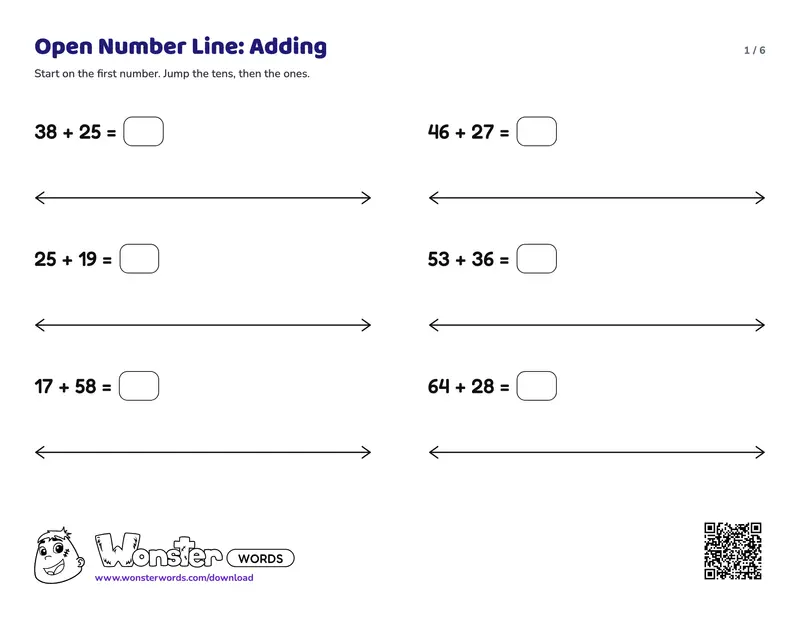
- Open Number Line (PDF)24 problems · answer key included · 6 pages
Preview page 1Preview
Which addition and subtraction worksheet for which grade?
Addition and subtraction worksheets match a grade by the range of numbers the standards expect children to work in, not by age. The table sets each grade’s Common Core and Texas standards beside the sheets that practice them.
| Grade | What children are expected to do | Common Core | Texas (TEKS) | |
|---|---|---|---|---|
| Kindergarten | Add and subtract within 10, with objects, fingers, or drawings; within 5 fluently | K.OA.A.2, K.OA.A.5 | K.3(A)–(C): sums up to 10 and differences within 10, and explain the strategy; no fluency target | Addition Within 10, Subtraction Within 10 |
| First grade | Add and subtract within 20 using strategies such as counting on and making ten; within 10 fluently; find a missing number; add tens and ones within 100 | 1.OA.C.6, 1.OA.D.8, 1.NBT.C.4, 1.NBT.C.6 | 1.3(A), 1.3(D) “including making 10”, 1.5(F); no fluency target | Addition Within 20, Subtraction Within 20, then pages 1–6 of Within 100 |
| Second grade | Add and subtract within 20 fluently, and know all sums of two one-digit numbers from memory; within 100 fluently | 2.OA.B.2, 2.NBT.B.5 | 2.4(A) “with automaticity”, 2.4(B) | Mixed Addition and Subtraction, pages 7–8 of Within 100, then the regrouping sheets |
| Third grade | Add and subtract within 1,000 fluently | 3.NBT.A.2 | Texas reaches 1,000 in second grade, in word problems (2.4(C)–(D)) | The three-digit regrouping sheets |
Texas asks kindergartners and first graders to solve and explain, not to be fast. Its first fluency standard is second grade’s: to “recall basic facts to add and subtract within 20 with automaticity”. Common Core asks for fluency a little at a time, within 5 in kindergarten and within 10 in first grade. Building that recall is the subject of the math facts page.
A kindergartner who still counts on fingers within 10 is doing what kindergarten asks. Common Core’s kindergarten standard K.OA.A.1 names fingers among the ways to show adding and taking away. A preschooler is not expected to do written sums. The Texas Prekindergarten Guidelines ask a 4-year-old to show adding and taking away up to 5 with objects, pictures, or a spoken story problem (PK4.V.B.1–2). Objects on the table are the tool at that age, and the number sense check-in shows what a preschooler can already do.
How to use a worksheet so it teaches, not just tests
A worksheet practices what your child has been taught, and a few minutes with you beside them shows how your child thinks. These five steps work on every sheet on this page, from the dot pages to within 100.
Teach the strategy first, then hand over the sheet
A worksheet practices what a child has already been shown; it does not teach it. Show counting on, doubles, or making ten with objects first, and hand over the sheet once your child can do a few problems that way with you.
Do the first row together, out loud
Work the first row side by side and ask "How did you get that?" after each answer. Counting every object, counting on from the bigger number, and using a fact your child already knows are three different routes to the same answer.
Let your child use tools
Fingers, objects, a ten frame, or a number line are allowed on every page. The aim is fewer tools over the weeks, not none tonight.
Mark it straight away, together, with the answer key
Check each answer against the key while the problems are fresh, and let your child fix the wrong ones. The same wrong answer twice is a pattern worth a conversation.
Move up a range when your child is accurate and calm
Move on when your child gets nearly every answer right and no longer counts each one from 1, not when a page is finished. Timing comes last: only once your child is accurate, and only against their own last time.
The strategies in step 1 are set out in the order children learn them on the addition and subtraction page, and doubles and making ten have their own step-by-step strategy worksheets. For step 3, the printable ten frame cards and number lines are free too.
The three routes in step 2 are the methods children use for single-digit problems. The Common Core Standards Writing Team lists them in its 2011 progression for operations and algebraic thinking: “Level 1. Direct Modeling by Counting All or Taking Away”, “Level 2. Counting On”, and “Level 3. Convert to an Easier Problem” (p. 6). Working 8 + 6 as 8 + 2 + 4 is the third. The document describes children moving to “increasingly sophisticated computation methods”, and the question in step 2 shows which method your child is using today.
A timed sheet comes after accuracy, never before it. The What Works Clearinghouse guide Assisting Students Struggling with Mathematics (2021), written for intervention teachers, gives its recommendation on timed activities a strong evidence rating, from 27 studies. It adds them “once students have been working on a concept over many lessons”. It also says “Do not use timed activities to introduce and teach mathematics concepts and operations” (p. 51). It suggests goals to “meet or beat” a previous score (p. 53), and “accuracy is the goal; not how many problems were attempted” (p. 55). Its panel also “does not recommend merely giving students timed worksheets” (p. 51): a sheet is one part of practice, not all of it.
No research sets a number of minutes. A few minutes on most days, stopping while it is going well, is enough for one sheet.
Four mistakes are worth watching for on these sheets, each with a quick fix:
- Counting the starting number. For 3 + 4, your child counts “3, 4, 5, 6” and writes 6. Counting on starts at the next number: “4, 5, 6, 7”.
- Adding on a subtraction row. Your child did not read the sign, which is what the mixed sheet is for. Ask your child to touch the sign before each answer.
- Writing 13 as 31. Thirteen says its 3 first, so a child writes the 3 first. Say “one ten and three ones” and write the ten first.
- Taking the smaller digit from the larger in every column, so 52 − 17 becomes 45. That is a regrouping problem, and none of these sheets has one: the subtraction with regrouping worksheets teach it.
If a range stays hard, go back one range and put objects on the table. If adding and subtracting within 10 is still hard at the end of first grade, talk to your child’s teacher.
Worksheets or games? Use both
Worksheets and games do different jobs, so a week of practice can use both. A worksheet gives quiet practice and a record you can look back at. A game gives talk, and talk is where “How did you get that?” gets asked without anyone planning it. Flash cards are for recall, the facts a child can already work out but slowly, and the addition and subtraction flash cards print each answer on the back. A screen can check an answer the moment it is typed; paper keeps the working.
Four games that use the sheets or a deck of cards:
- Roll for a row. A within-20 or within-100 page has six rows of three problems. Your child rolls a die and does that row next, until every row is done. On a within-10 page, which has four rows, roll again on a 5 or a 6.
- Race the grown-up. You do every other problem, slowly and out loud, and your child marks yours with the answer key. Get one wrong on purpose now and then.
- Card sums. Take the face cards out of a deck, with aces as 1. Each player turns over two cards and adds them, and the bigger sum keeps all four. For subtraction, take the smaller card from the bigger.
- Hide the answer. Put a coin over one answer on the answer key. Your child finds the problem in the same place on the worksheet, says the answer, then lifts the coin to check.
More card and dice games for the kitchen table are on the math board games page.
Two- and three-digit addition and subtraction worksheets
Two-digit adding and subtracting starts in first grade, with tens and ones. Common Core 1.NBT.C.4 asks first graders to add within 100, “including adding a two-digit number and a one-digit number, and adding a two-digit number and a multiple of 10”. Pages 1–4 of Adding and Subtracting Within 100 practice that, with problems such as 32 + 6 and 34 + 20 that make no new ten, and pages 5–6 take ones or tens away in the same way. Pages 7–8 are second grade’s two-digit numbers, such as 36 + 33, still with no regrouping (2.NBT.B.5).
The same first-grade standard ends “sometimes it is necessary to compose a ten”, and that is regrouping. Column addition with regrouping, then three digits (2.NBT.B.7 and 3.NBT.A.2), is on the addition with regrouping page, and subtraction with regrouping, across zeros included, on the borrowing page. The base ten blocks regrouping sheet draws each trade.
Before those, check two things: your child adds and subtracts within 20 without counting every one, and reads a two-digit number as tens and ones.
Addition and subtraction worksheets by skill
Each addition and subtraction skill below has its own worksheets, on the page that teaches it. Find the skill your child is stuck on:
| Skill | Worksheets | Grades | Where |
|---|---|---|---|
| Strategies | Doubles Facts, Near Doubles Facts, Make Ten Facts, Take From Ten | Kindergarten–Grade 2 | Doubles and make ten |
| Fact families | Fact Family Houses, Fact Family Triangle Cards | Kindergarten–Grade 2 | Fact families |
| Facts and fluency | Addition Flash Cards, Subtraction Flash Cards | Kindergarten–Grade 2 | Addition and subtraction facts |
| Facts and fluency | Addition Chart, Blank Addition Chart | Kindergarten–Grade 2 | Addition chart |
| Turnaround facts | Turnaround Facts | Grades 1–2 | Properties of addition |
| With a model | Number Bonds, Ways to Make a Number | Kindergarten–Grade 2 | Number bonds |
| With a model | Ten Frame Cards, Double Ten Frame Cards | Pre-K–Grade 1 | Ten frames |
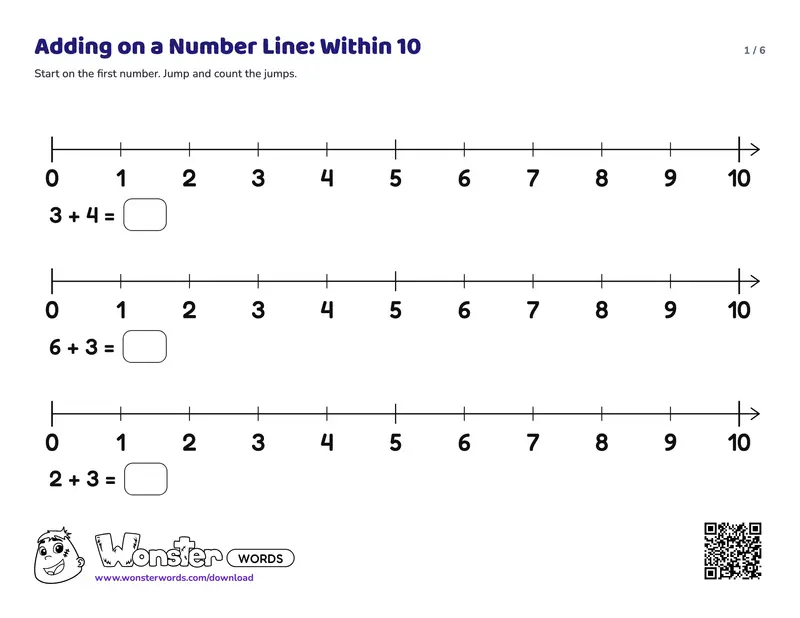
| With a model | Adding and Subtracting on a Number Line, Open Number Line | Kindergarten–Grade 2 | Number line |
| With a model | Base Ten Blocks: Regrouping | Grades 1–2 | Base ten blocks |
| Word problems | Tape Diagram Word Problems | Grades 1–3 | Tape diagrams |
| Regrouping | Addition with Regrouping | Grades 1–3 | Addition with regrouping |
| Regrouping | Subtraction with Regrouping | Grades 2–3 | Subtraction with regrouping |
When the worksheets are easy: what comes next
When the addition and subtraction worksheets are easy, the next step is working sums in the head. Three ways in, each with its own page:
- Within 100 on an open number line. A child works 47 + 25 as a jump of 20 to 67, then a jump of 5 to 72, drawn on an open number line.
- Splitting a number to make a ten. A child works 38 + 7 as 38 + 2 + 5, which is 45, in the head without paper.
- Seeing the parts first. Thirteen is 10 and 3, and it is also 9 and 4, so a child who sees those parts knows 9 + 4 without counting. The number bond is the picture for that.
Number Talks is a short classroom routine of the same kind: children work one problem in their heads and explain how they got the answer.
Frequently asked questions
What age group is best suited for single-digit addition worksheets?
Kindergarten and first grade. Common Core asks kindergartners to add and subtract within 10, with objects, fingers, or drawings, and to be fluent within 5. First graders add within 20 and are fluent within 10. A sheet with dots to count suits the start of kindergarten, and numerals alone suit the end of it. A 4-year-old does the same work with real objects, adding and taking away up to 5, before any written sum.
Do the addition worksheets have answer keys?
Yes. Each of the six PDFs has its answer key after the worksheet pages: two key pages on the 11-page sheets and one on the 6-page mixed sheet. The key shows every worksheet page in small, in the same order, with each answer written in red in the box where your child writes it. The last page of every PDF is a page for grown-ups on what the sheet practices and how to use it.
Single-digit addition worksheets vs. flashcards: which is better for learning?
Neither is better, because they do different jobs. A worksheet gives a child time to work each answer out, by counting, by a known fact, or by a strategy such as making ten. It also leaves a record. A flash card asks for the answer at once, so it practices recall of facts a child can already work out. Use worksheets while your child is still working facts out, and add flash cards for the facts they get right but slowly.
Are online subtraction worksheets more effective than printed ones?
The format matters less than the practice: facts your child has been taught, a few minutes at a time, with quick feedback on wrong answers. An online sheet can check each answer the moment it is typed. A printed sheet keeps your child's working, such as crossed-out dots and tally marks, so a grown-up can see how each answer was found, and it needs no screen.
How can color-by-number worksheets improve subtraction skills?
The picture is the reward and the problems are the practice. A child solves each subtraction to find the color for a space, and the picture appearing is the reason to finish the page. A child who loves coloring can get the same reward from a plain worksheet. Draw a strip of boxes, one for each row on the page, and let your child color a box for every row finished.
How do I create my own free printable addition worksheets?
Pick one range, such as sums to 10, and list the facts in it. Mix the order so no run of answers gives the next one away. Leave out problem numbers, because a printed 3 beside a sum looks like part of the problem. Write the answer key before your child starts, make each answer box wide enough for two digits, and give the page one short instruction, such as "Write the answer in the box."
How many addition problems should a first grader practice daily?
No research sets a daily number. A row or a page on most days, a few minutes at a time, is plenty for a first grader. Stopping while it is going well matters more than finishing. A first-grade page of the worksheets here is 18 problems. If wrong answers start to pile up, stop and come back to the page tomorrow.
Should I prioritize speed or understanding in first-grade addition worksheets?
Understanding first. Common Core asks first graders for fluency within 10 and strategies within 20. Texas sets no fluency target in first grade: it asks children to solve problems and explain how. Once your child gets nearly every answer right without counting each one from 1, timing can come in, against their own last time and never against another child's.
What topics in addition should first graders focus on?
Four things, from the Common Core first-grade standards. Adding and subtracting within 20 using strategies such as counting on and making ten. Knowing the facts within 10. Finding a missing number, such as 8 + ☐ = 13. Adding tens and ones within 100, such as 32 + 6 and 34 + 20. Texas asks for the same work, with making 10 named in its standard.
Addition vs. subtraction: Which is easier for young learners?
Addition is usually easier at first, because counting forward is the direction a child already counts in, but schools teach the two together from kindergarten. Subtraction gets easier once a child sees it as a missing part: 13 − 5 asks what goes with 5 to make 13, which is an addition fact they may already know. Practice the two side by side, then mixed on one page, so your child has to read the sign.
Related guides
Last updated