
Math
Subtraction With Regrouping (Borrowing), Step by Step
Two-digit, three-digit, and subtracting across zeros, the grade each one belongs to, the mistakes that leave a recognizable wrong answer, and a free worksheet whose answer key shows every regroup mark.
Grades: grade 2 to grade 3 · Common Core: 2.NBT.B.5, 2.NBT.B.7, 3.NBT.A.2 · Texas: 2.4(B), 3.4(A) · Related: Common Core 1.NBT.C.6, 2.NBT.B.9; Texas 2.4(C)
Subtraction with regrouping is what most parents learned as borrowing: when the top digit in a column is too small, one from the next place is traded for ten of this one. In 52 − 27, the 2 ones cannot give 7, so one of the 5 tens becomes ten ones. Now 52 is 4 tens and 12 ones, which is still 52. The ones give 12 − 7 = 5 and the tens give 4 − 2 = 2, for an answer of 25.
Nothing is borrowed and nothing is paid back: the top number is only renamed, which is why schools now say “regroup”. Across a zero the idea is the same with one more step, because a zero has nothing to give and the next place gives first. Children learn it in second grade, within 100 and then within 1,000, and third graders do it fluently. Regrouping in addition, the old carrying, is on our addition with regrouping page. A free subtraction with regrouping worksheet, across zeros included, comes with an answer key.
What is subtraction with regrouping?
Subtraction with regrouping is column subtraction that trades one of the next place for ten of this one whenever a top digit is too small. Regrouping and borrowing are the same method under two names. “Borrow” is the older word, and “regroup”, “trade”, and “decompose” are the words on homework now. The marks on the page are the same under every name: a crossed-out digit with its new value written above it.
Regrouping 52 − 27: one of the 5 tens becomes ten ones, so 52 is written as 4 tens and 12 ones before anything is subtracted.
The word changed because nothing is borrowed. “Borrow” suggests the ten is given back later, and it never is. The 52 is written as 4 tens and 12 ones, and it is still 52. The Common Core’s second-grade standard 2.NBT.B.7 says that “sometimes it is necessary to compose or decompose tens or hundreds”. The standards never use the words “borrow” or “regroup” at all. “Regroup” is the classroom word: a 2021 teaching guide from the What Works Clearinghouse suggests “regrouping” in place of “borrowing or carrying”.
A subtraction needs regrouping when a top digit is smaller than the digit below it. In 58 − 23 every top digit is big enough, and no column regroups. In 52 − 27 the ones need it, and in 425 − 278 both the ones and the tens do. The same trade runs the other way in addition, where ten ones become one ten, and what regrouping means in general is on its own page.
Subtraction with regrouping, step by step
Subtraction with regrouping means checking every column first, regrouping where it is needed, and only then subtracting. The five steps for 52 − 27:
Line up the places and check every column
Write the top number above the bottom one, ones under ones and tens under tens. Before subtracting anything, look at each column and ask whether the top digit is big enough to take the bottom one away. In 52 − 27 the tens column can, and the ones column cannot.
Regroup where needed, before subtracting anything
The 2 ones cannot give 7, so trade one of the 5 tens for ten ones. Cross out the 5 and write 4 above it, then cross out the 2 and write 12 above it. The top number is now 4 tens and 12 ones, which is still 52.
Subtract each column
Subtract the ones, 12 − 7 = 5, and then the tens, 4 − 2 = 2.
Read the answer
The answer is 2 tens and 5 ones, which is 25.
Check by adding
Add the answer to the number taken away: 25 + 27 = 52, the number you started with. If the sum does not match, look for a column that was not regrouped, or one regrouped and then forgotten.
Regrouping before subtracting is the order the Common Core’s own writers show. The Common Core Standards Writing Team draws it in its progression document for place value, in a figure titled “Subtraction: Decomposing where needed first”. Its caption explains that “all necessary decomposing is done first, then the subtractions are carried out”. Done that way, the document says, the method “can help to inhibit the common error of subtracting a smaller digit on the top from a larger digit” (p. 10). The method most parents learned regroups one column at a time, as it goes, and reaches the same answer.
Three-digit subtraction with regrouping works the same way, one place further. The progression document’s own example is 425 − 278. The ones need a ten and the tens need a hundred, so one hundred becomes ten tens and one ten becomes ten ones. Now 425 is 3 hundreds, 11 tens, and 15 ones. Then 15 − 8 = 7, 11 − 7 = 4, and 3 − 2 = 1, for 147, and the check is 147 + 278 = 425.
The tens become 11 because they gain ten and lose one. The 2 tens lend one ten to the ones and take ten from the hundreds. Only the final value, 11, is written above them. Either trade can come first: the document starts from the left “because many students prefer to operate in that order”.
How do you subtract across zeros?
Subtracting across zeros means regrouping through a place that has nothing to give. In 403 − 158, the ones need a ten, and the tens place holds none. The hundreds give first: one hundred becomes ten tens, and then one of those tens becomes ten ones. Now 403 is 3 hundreds, 9 tens, and 13 ones, and it is still 403. Then 13 − 8 = 5, 9 − 5 = 4, and 3 − 1 = 2, for 245. On paper, the 4 is crossed out for a 3, the 0 becomes 10 and is crossed out again for a 9, and the 3 becomes 13. A column cannot take 5 from 0, which is exactly why the zero is regrouped before anything is subtracted.
With two zeros, the trades run the same way. In 300 − 127, the 300 becomes 2 hundreds, 9 tens, and 10 ones. Then 10 − 7 = 3, 9 − 2 = 7, and 2 − 1 = 1, for 173. In 500 − 246, the 500 becomes 4 hundreds, 9 tens, and 10 ones, and the answer is 254.
A shortcut does both trades at once. Read 403 as 40 tens and 3 ones. Take one ten, and 40 tens become 39 tens: the 4 and the 0 turn into 3 and 9 in a single step, and the ones become 13. A child who uses it writes the same 3, 9, and 13 as the two-trade route, without the 10 in between.
Done in the head, 400 − 158 is the same as 399 − 157. Taking 1 from both numbers keeps the difference the same, and 399 − 157 needs no regrouping at all: 242. The trick helps only when the top number ends in zeros. It is a mental strategy, not the column method a worksheet asks for.
Two mistakes belong to zeros, and each leaves a wrong answer you can recognize.
- Skipping the middle trade: 403 − 158 = 255. The child takes from the 4 straight into the ones and works 13 − 8 = 5, then meets 0 − 5 in the tens and does 5 − 0 instead.
- Turning the ones around: 403 − 158 = 305. The child does 8 − 3 = 5 in the ones, writes 0 for 0 − 5 in the tens, and leaves the 4 for 4 − 1 = 3.
The fix for both is to say the two trades aloud before subtracting: hundreds to tens, then tens to ones.
Three-digit subtraction is second grade, and problems across zeros come last in it and again in third grade. The second-grade standard 2.NBT.B.7 covers subtraction within 1,000, and third grade’s 3.NBT.A.2 asks children to “fluently add and subtract within 1000”. Neither standard mentions zeros. In Eureka Math, the second-grade lessons on decomposing tens and hundreds to subtract end with subtracting “from multiples of 100 and from numbers with zero in the tens place”. Its third-grade Module 2 returns to “three-digit minuends with zeros in the tens or ones place”. Worksheets for across zeros are labeled anything from second to fourth grade.
Start without regrouping, then two-digit, then three-digit
Practice subtraction without regrouping first, then two-digit problems that mix both kinds, then three-digit, and zeros last. A problem such as 78 − 23 needs no trade, so a child learns to line up the places and subtract column by column before the trade arrives. Two-digit problems come next, some needing a regroup and some not, mixed on purpose. The progression document advises problems “requiring two, one, and no decompositions” (p. 11). It puts second-grade fluency on “the two cases of one decomposition (e.g., 73 − 28) or no decomposition (e.g., 78 − 23)”.
Mixing matters because a child who regroups every problem has learned a routine, not a decision. The decision is one question for each column: can the top digit give the bottom one? The What Works Clearinghouse advises mixing too: once regrouping is introduced with double-digit subtraction, “include some problems that do not require regrouping, so students do not overgeneralize regrouping to all problems”. Subtraction with regrouping is harder than subtraction without it, because it adds both that decision and the trade. Three-digit problems follow, with one regroup and then two, and zeros come last, since a zero needs two trades in a row.
That is the order of our subtraction with regrouping worksheet, whose first two pages need no regrouping at all. For more two-digit practice without it, the Within 100 sheet on the addition and subtraction worksheets page has problems such as 78 − 25 that never need a trade.
What grade do kids learn subtraction with regrouping?
Children learn subtraction with regrouping in second grade, within 100 and then within 1,000, and third grade makes it fluent. The grades in the Common Core and in Texas:
| Grade | What children do | Common Core | Texas (TEKS) |
|---|---|---|---|
| 1st grade | Two-digit subtraction only with multiples of 10, such as 60 − 30, and finding 10 less | 1.NBT.C.5, 1.NBT.C.6 | None: 1.3(B)–(F) work within 20, 1.3(A) is addition, and the only two-digit subtraction is finding 10 less (1.5(C)) |
| 2nd grade | Subtract within 100 fluently by place value, then within 1,000 with models or drawings and a written method, decomposing “tens or hundreds” | 2.NBT.B.5, 2.NBT.B.7, 2.NBT.B.9 | 2.4(B), subtracting two-digit numbers “using mental strategies and algorithms”; 2.4(C), word problems within 1,000 |
| 3rd grade | Subtract within 1,000 fluently, “using strategies and algorithms based on place value”, across zeros included | 3.NBT.A.2 | 3.4(A) |
| 4th grade | The standard algorithm, by name | 4.NBT.B.4 | 4.4(A) |
A first grader who cannot do 52 − 27 is on time, because first grade does not ask for it. The Common Core Standards Writing Team’s progression document says “first graders are not expected to compute differences of two-digit numbers other than multiples of ten” (p. 7). Second grade then teaches two-digit subtraction with and without regrouping in close succession. The document says this helps children avoid taking the smaller digit from the larger in every column, the error that turns 82 − 45 into 43. First grade’s other subtraction is within 20, with the strategies on the subtraction page.
Subtraction with regrouping vs. traditional subtraction methods
The column method on homework is the borrowing method most parents learned, with “regroup” in place of “borrow”. A second grader may meet 52 − 27 three ways, and all three are the same subtraction:
| Way | What your child does | Answer |
|---|---|---|
| The column method | Regroups a ten first: 5 tens and 2 ones become 4 tens and 12 ones, then 12 − 7 = 5 and 4 − 2 = 2 | 25 |
| Base ten blocks | Starts with 5 rods and 2 units, trades one rod for ten units, and takes away 2 rods and 7 units | 25 |
| An open number line | Counts up from 27: a jump of 3 to 30, 20 to 50, and 2 to 52 | 3 + 20 + 2 = 25 |
The blocks version is drawn step by step on the base ten blocks page, and the number line version beside the old way on the number line page.
The column method is the standard algorithm, and schools still teach it. The Common Core requires it by name in fourth grade: children “fluently add and subtract multi-digit whole numbers using the standard algorithm” (4.NBT.B.4). Texas asks for it in fourth grade too (TEKS 4.4(A)). The blocks and the number line come first because they show why its marks work: the crossed-out 5 is the rod that was traded. Whether children still learn to carry and borrow is answered on the guide to regrouping, and our guide to new math sets out the standard algorithm’s grades.
Borrowing is place value at work. A child who knows that the 5 in 52 means 5 tens can see why one of them becomes 10 ones and not 1. A child who reads 52 as a 5 and a 2 has no reason to trade at all, and takes the smaller digit from the larger instead.
Common subtraction with regrouping mistakes and how to fix them
Most subtraction with regrouping mistakes leave a wrong answer you can recognize, and each one has a fix.
- Taking the smaller digit from the larger: 82 − 45 = 43. The right answer is 37. The child sees 2 and 5 in the ones and does 5 − 2, because taking the smaller from the larger feels like the rule. It is the progression document’s own example, and 52 − 27 = 35 is the same mistake. Fix: regroup before subtracting any column, and ask “can the top give the bottom?” column by column.
- Regrouping and forgetting the ten is gone: 74 − 38 = 46. The right answer is 36. The child turns the 4 ones into 14 and works 14 − 8 = 6, then does 7 − 3 in the tens as though no ten had moved. Fix: cross out and rewrite the digit every time, and check by adding: 46 + 38 is 84, not 74.
- Forgetting to regroup after subtracting the ones: 425 − 278 = 267. The right answer is 147. After 15 − 8 = 7, the child moves to the tens, sees a 1 on top and a 7 below, and writes 6. The progression document describes exactly this child, who writes 6 “because they are in subtraction mode” (p. 10). Fix: do all the regrouping first, before subtracting any column.
- Regrouping when it is not needed: 78 − 23. A child who regroups anyway turns 78 into 6 tens and 18 ones, gets 15 ones, and is stuck with a two-digit number in the ones column. Fix: the mixed pages on the worksheet, where the child decides before each problem.
- Two mistakes with zeros: 403 − 158 = 255 or 305. Both skip a trade, and the path to each is set out under subtracting across zeros.
Each of these mistakes treats the digits as separate numbers instead of tens and ones. Subtraction makes it harder than addition, because the top number is rewritten before the answer is found. When the same mistake keeps coming back, go back to blocks or a drawing for the same problem. Then check that your child knows the subtraction facts within 20 without counting: a child counting back on fingers for 12 − 7 loses track of the place. If subtraction with regrouping is still hard at the end of second grade, talk to your child’s teacher.
How to help your child with subtraction with regrouping at home, and games to play
Help at home with ten minutes, a few problems, a handful of straws, and the words tens and ones. The What Works Clearinghouse recommends “a well-chosen set of concrete and semi-concrete representations”, meaning real objects and drawings, in its 2021 guide for teachers of children who struggle with math. These routines adapt it for home:
- Keep it to ten minutes and a few problems. Three problems talked through show you more of your child’s thinking than a page done in silence.
- Say it in place value. Say “4 tens and 12 ones”, not “cross out the 5”. The words are what give the marks their meaning.
- Build one. Bundle straws in tens with hair ties, or cut out the paper blocks from the base ten blocks page, and untie a bundle for the trade.
- Ask your child to explain one problem. Second graders are expected to “explain why addition and subtraction strategies work” (2.NBT.B.9), and saying why the 5 became a 4 is that skill.
- Check by adding. Add the answer to the number taken away, and the sum should be the number you started with.
Three games practice the trade with dice, cards, or the same straws:
- Race to zero. Each player starts with 10 bundles of ten straws, which is 100. Roll two dice and take away that many straws, untying a bundle when there are not enough loose ones. Say the number left after every turn, and the first player with no straws left wins.
- Make the biggest difference. Each player draws four cards from the ace to the 9, with an ace as 1, and makes two two-digit numbers from them. Subtract the smaller from the larger, and the bigger difference wins. Then each player says whether the problem needed a regroup.
- Regroup or not? Write subtraction problems on cards, some needing a trade and some not. Flip one, and your child says “regroup” or “no regroup” before working it, then checks the answer by adding.
More card and dice games for the kitchen table are on the math board games page.
Free subtraction with regrouping worksheets
Our free subtraction with regrouping worksheet is one PDF of 14 pages: five activities, each printed twice, three answer key pages, and a page for grown-ups. Start your child where they are:
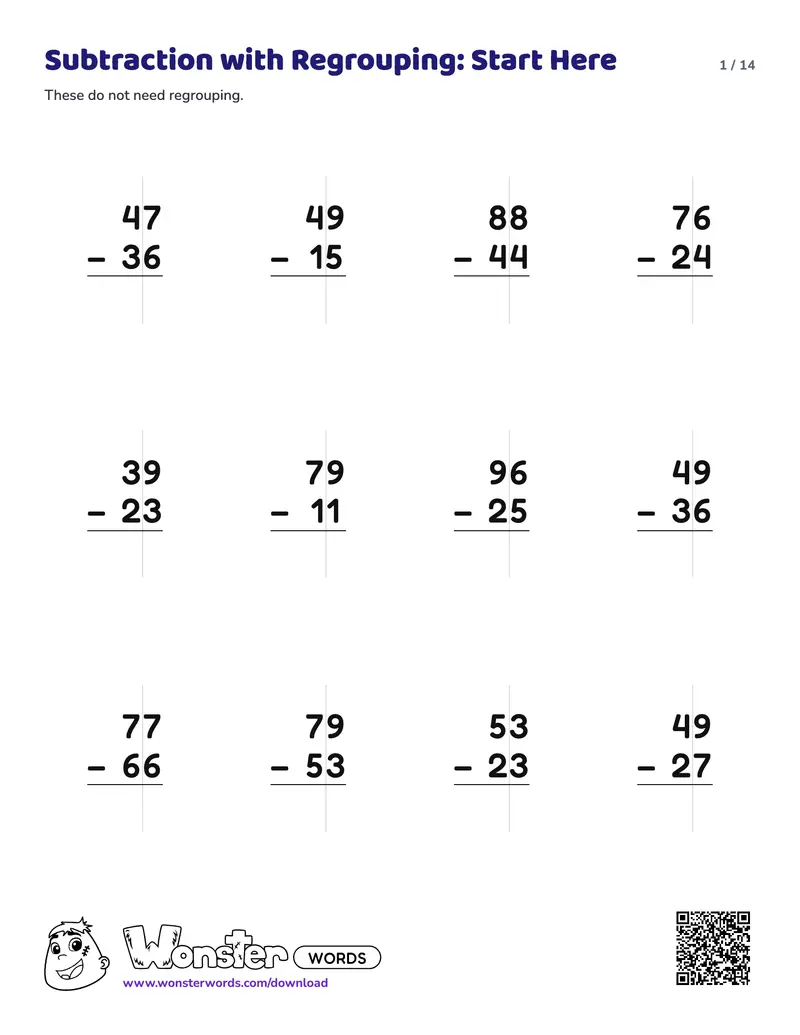
- Pages 1–2, Start Here. Two-digit problems that need no regrouping, such as 79 − 53, 12 to a page. Start here if your child has not regrouped yet.
- Pages 3–4, Regroup a Ten. Two-digit problems, two in three needing a regroup, with near pairs side by side, such as 82 − 45 beside 85 − 42. Only the first needs a trade, and the second’s answer, 43, is the first one’s wrong answer. Tens on top, such as 70 − 26 and 90 − 47, are here too. Print these for second grade.
- Pages 5–6, Three-Digit. Problems with one or two regroups, such as 652 − 318 and 425 − 278, mixed with three that need none, 9 to a page.
- Pages 7–8, A Zero in the Tens. Problems such as 403 − 158 and 702 − 345, every one regrouped across the zero.
- Pages 9–10, Zeros in the Tens and Ones. Problems such as 300 − 127 and 500 − 246. Pages 7–10 suit the end of second grade and third grade.
Each activity’s second page has the same problems in a new order, with the near pairs still side by side. Every problem is set in columns with the places lined up, and pages 1–4 have light lines between the places. Above every top number is room for a crossed-out digit and its new one, two levels high on the zero pages. The problems are not numbered, and each page has one line of instructions, such as “Subtract. Regroup first when the top digit is too small.”
The answer key shows the regroup marks as well as the answers. Every worksheet page appears in miniature, four to a key page, with each difference and each mark in red where your child writes it: the crossed-out digit, and its new digit above. Across a zero, the 0 becomes 10 and then 9. A digit that lends and then borrows is written once with its final value, so in 425 − 278 the 2 tens become 11. The last page, for grown-ups, says why schools say regroup and how to use the sheet.
For a child who needs to see the trade first, the Regrouping sheet among the base ten blocks printables has two-digit subtractions where your child trades a rod for ten units. The addition with regrouping worksheet is on the addition with regrouping page. Every sheet prints in black and white, with no account and no email.
Free PDF · no sign-up
Free printable subtraction with regrouping worksheets
One free PDF of 14 pages in black and white, with no account and no email, in teaching order: no regrouping, regrouping a ten, three-digit problems, a zero in the tens, and zeros in the tens and ones, each printed twice. Three answer key pages show every answer and regroup mark where your child writes it, and the last page is for grown-ups on why, what for, and how to use it.
- Subtraction with Regrouping (PDF)102 problems · answer key included · 14 pages
Preview page 1Preview
Frequently asked questions
How are regrouping and borrowing different in math?
They are not different: regrouping and borrowing are two names for the same method. When a top digit is too small to subtract from, one ten is traded for ten ones, so in 52 − 27 the 52 becomes 4 tens and 12 ones. Borrowing is the older word. Schools say regrouping because nothing is paid back, and the top number is only written a different way.
What is subtraction by regrouping called?
Subtraction by regrouping is also called borrowing, trading, or decomposing. Borrowing is the name most parents learned. The Common Core standards say a child will sometimes need to decompose tens or hundreds, homework often says regroup or trade, and in fourth grade the written column method is named the standard algorithm.
When is borrowing necessary in subtraction?
Borrowing is necessary when a digit on top is smaller than the digit below it in the same column. In 52 − 27, the 2 ones cannot give 7, so a ten is regrouped. In 58 − 23, every top digit is big enough, and nothing needs borrowing. Check every column before subtracting, because a three-digit problem can need it in two columns, one, or none.
What grade do kids learn subtraction with regrouping?
Children learn it in second grade. The Common Core asks second graders to subtract within 100 fluently and within 1,000 with models and a written method. Texas asks them to subtract two-digit numbers using mental strategies and algorithms. Third graders subtract within 1,000 fluently, across zeros included. In first grade, the only two-digit subtraction is with multiples of 10, such as 60 − 30, and finding 10 less than a number.
What is the rule for subtracting with zeros?
Regroup across the zero before subtracting anything. A zero has nothing to give, so the next place gives first. In 403 − 158, one hundred becomes ten tens, and then one of those tens becomes ten ones, so 403 is 3 hundreds, 9 tens, and 13 ones. Then each column subtracts: 13 − 8 = 5, 9 − 5 = 4, and 3 − 1 = 2, for 245.
Can we subtract 5 from 0?
Not in a second-grade subtraction column, which is why a zero on top is regrouped first. In 403 − 158, the tens column reads 0 − 5. A hundred is traded for ten tens, one of them goes to the ones, and the column becomes 9 − 5 = 4. Taken below zero, 0 − 5 is −5, a negative number, which children meet in sixth grade.
What are common mistakes made when subtracting across zeros?
Two mistakes are common, and each leaves a wrong answer you can spot. In 403 − 158, a child who skips the middle trade takes from the 4 straight into the ones, then does 5 − 0 in the tens, and writes 255. A child who turns the ones around does 8 − 3, writes 0 for 0 − 5, and writes 305. The right answer is 245. Saying both trades aloud fixes each mistake.
Related guides
Last updated