
Math
Halves, Thirds, and Fourths
What makes parts equal, how to cut a circle or a rectangle into halves, thirds, and fourths, whether equal parts must match in shape, what grade learns them, and how to help at home.
Grades: grade 1 to grade 3
Equal parts are parts of one whole that are all the same amount. A shape cut into 4 pieces shows fourths only if the 4 pieces are the same amount. Schools call cutting a shape this way “partitioning”, the word on the homework, and equal parts are also called equal shares. Two questions settle every cut shape: how many pieces are there, and are they the same amount?
Under the Common Core, first graders cut circles and rectangles into halves and fourths (1.G.A.3), and second graders add thirds (2.G.A.3). Texas names halves and fourths in first grade (TEKS 1.6(G) and (H)), adds eighths in second, and brings in thirds in third. Equal parts are where fractions start. Practice each question with five free worksheets to print.
What are equal parts?
Equal parts are parts of one whole that are all the same amount. Equal parts, equal shares, and fair shares are one idea under three names: the Common Core says “equal shares”, and Texas says “fair shares or equal parts” (TEKS 1.6(G)). A cut shape shows equal parts only when its pieces are the same amount, and the number of pieces gives each part its name.
Both rectangles have 4 pieces. Only the left one shows fourths, because only its 4 pieces are the same amount.
To check, lay one piece on top of another. If the pieces match exactly, they are equal. The writers of the Common Core, in their Progressions, say third graders can explain equal parts at first as “same size and same shape” or “matches exactly”. Pieces that do not match need a second look.
A part gets its name from how many equal parts make the whole. Two equal parts are halves, three are thirds, four are fourths, and eight are eighths. Under the Common Core, children also say the whole by its parts: “two halves, three thirds, four fourths” (2.G.A.3). Each name is drawn below with one part shaded.
| Equal parts in the whole | One part is called | The whole is | Drawn |
|---|---|---|---|
| 2 | one half, half of | two halves | |
| 3 | one third, a third of | three thirds | |
| 4 | one fourth, also a quarter | four fourths | |
| 8 | one eighth (Texas, grade 2) | eight eighths |
How do you divide a shape into equal parts?
To divide a shape into equal parts, cut it in half for halves, cut each half in half for fourths and again for eighths, and plan thirds before cutting. The Common Core names circles and rectangles for this work, two of the flat shapes children learn to name.
- Halves take 1 cut. Cut a rectangle across, up and down, or corner to corner. Cut a circle through its center.
- Fourths are halves of halves. Make 2 cuts that cross at the center, one up and down and one across, on a rectangle or a circle. A rectangle can also be cut into 4 strips of the same width.
- Eighths are halves of fourths, and Texas second graders name them. Fold a sheet of paper in half 3 times and open it to see 8 equal parts.
- Thirds cannot be made by halving. A rectangle takes 2 evenly spaced cuts, which make 3 strips. A circle takes 3 evenly spaced lines from the center to the edge, like the letter Y.
The Institute of Education Sciences (IES), in its practice guide on fractions, suggests starting with 2, 4, or 8 people sharing, so children can use “a halving strategy”. Partitioning a brownie into thirds “requires that students anticipate how to slice the brownie so that it results in three equal parts.” One approach in the guide is to lay sticks on the shape to stand for the cuts. The IES panel rates this sharing advice minimal evidence, meaning it recommends the practice but cannot point to a body of causal research showing its effect.
More equal parts make smaller parts when the whole stays the same. The Common Core’s first-grade standard says “decomposing into more equal shares creates smaller shares” (1.G.A.3), and that idea becomes the bottom number of a fraction in third grade. Texas asks second graders to explain “the more fractional parts used to make a whole, the smaller the part” (TEKS 2.3(B)).
A strip is easier to cut evenly than a circle. The Common Core’s Progressions put the main focus in third grade on shapes that are “easier for students to draw and subdivide”, such as lengths of tape rather than circles. Fraction strips are paper lengths of that kind.
Do equal parts have to be the same shape?
Equal parts do not have to be the same shape. They have to be the same amount. The Common Core’s second-grade standard says “equal shares of identical wholes need not have the same shape” (2.G.A.3, as printed in the Progressions), and Texas says the same words in third grade (TEKS 3.6(E)).
Two squares of the same size, cut into fourths in two ways. The shaded small square and the shaded strip are different shapes and the same amount.
Take two squares of the same size. Cut one into 4 small squares and the other into 4 strips. Every piece is a fourth of its square. The writers of the Common Core say why that counts in their Progressions: “Any of these fourths represents an equal share of the shape (e.g., ‘the same amount of cake’) even though they have different shapes.”
A part can change shape and keep its amount, because it can be cut and moved. Cut one strip in half across the middle and lay the two pieces side by side. They make the small square.
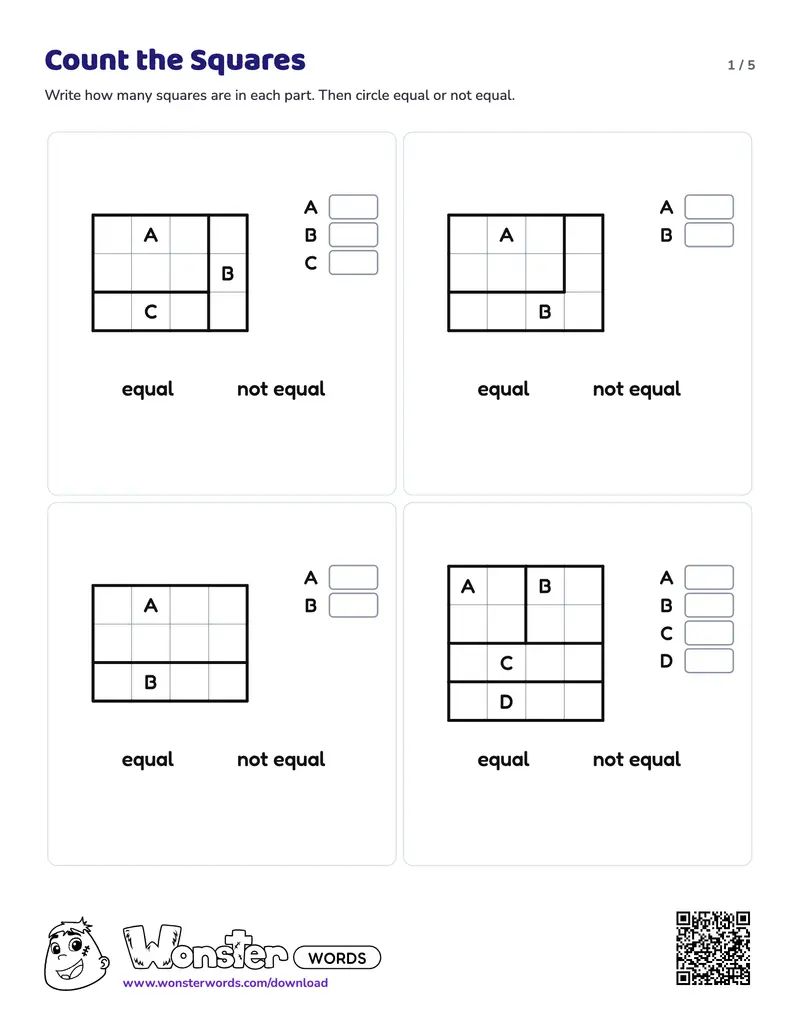
Counting squares settles it without an argument. Draw each large square on grid paper, 4 grid squares wide and 4 tall, which is 16 grid squares in all. A small square is 2 by 2 and covers 4 of them. A strip is 1 by 4 and also covers 4. The Count the Squares worksheet gives your child this count to practice, on rectangles.
A rectangle that is longer than it is wide, cut corner to corner, makes two equal halves that do not fold onto each other, and the symmetry guide picks up that difference.
What grade learns halves, thirds, and fourths?
Children learn halves and fourths in first grade under both the Common Core and the Texas standards. After that the two differ: the Common Core adds thirds in second grade, and Texas adds eighths in second grade and thirds in third.
| Grade | Common Core | Texas (TEKS) |
|---|---|---|
| Pre-K and kindergarten | No standard names equal shares | No standard names equal shares |
| 1st | Halves and fourths of circles and rectangles, in words (1.G.A.3) | Halves and fourths of two-dimensional figures, in words, with examples and non-examples (1.6(G), (H)) |
| 2nd | Adds thirds, says the whole as “three thirds”, and learns that equal shares need not match in shape (2.G.A.3) | Halves, fourths, and eighths, in words; more parts, smaller parts; counting parts past one whole; examples and non-examples (2.3(A)–(D)) |
| 3rd | Equal areas with each part a unit fraction (3.G.A.2), and written fractions (3.NF.A.1) | Thirds arrive with denominators of 2, 3, 4, 6, and 8 (3.3(A), (E)); equal areas, and shapes need not match (3.6(E)) |
Before first grade, neither the Common Core nor the Texas standards (TEKS) ask for equal shares of a shape, and sharing can start at home. The Institute of Education Sciences says sharing activities “can begin as early as preschool or kindergarten”, and the fractions guide covers what comes next by grade.
How does partitioning shapes into equal shares relate to fractions?
Partitioning shapes into equal shares is how fractions start. Before third grade, in both the Common Core and the Texas standards, the names of equal shares are words, not written fractions. The writers of the Common Core, in their Progressions, put it this way: “In Grades 1 and 2, students use fraction language to describe partitions of shapes into equal shares.” They continue: “In Grade 3, they start to develop a more general concept of fraction, building on the idea of partitioning a whole into equal parts and expressing the number of parts symbolically, using fraction notation.” Two identical shapes cut in different ways let a child see parts of the same whole side by side.
In third grade, one equal part goes on to four next steps.
- It becomes a unit fraction, such as 1/4.
- It gets a top number and a bottom number.
- It moves to a number line.
- It can cover the same amount as several smaller parts of the whole, and fractions that name the same amount are equivalent fractions.
Common mistakes when dividing shapes equally
Six mistakes come up when a child divides a shape, and each has something to say or do about it. The Institute of Education Sciences (IES) practice guide on fractions describes four of them, numbers 2–5.
- Counting the pieces and stopping. A child sees 4 pieces and says “fourths”. Ask whether they are the same amount, and lay one on top of another. Texas asks first and second graders to identify “examples and non-examples” of these parts (TEKS 1.6(H) and 2.3(D)). Show a shape that fails as well as one that passes.
- Giving equal numbers of pieces instead of equal amounts. The IES guide says that with big and small pieces on a plate, “a child might give out equal numbers of pieces of food rather than equal amounts.” Put the pieces side by side and ask who has more.
- Calling every part “a half”. The IES guide notes that “some children think that all fractional parts are called one-half.” Say the part’s name each time, such as “one fourth” or “one third”.
- Halving to get thirds. The guide says students “may be tempted to use repeated halving for all sharing problems.” Lay 2 sticks on a rectangle before cutting.
- Leaving part of the whole out. The guide says students “may not share all of the items, especially if a sharing scenario requires partitioning an object.” Every bit of the shape belongs to a part, so ask who gets the leftover piece.
- Thinking equal parts must look alike. A child may reject two parts because their shapes differ. Count the amount instead, on a grid if you can, as in the same-shape section.
A child’s drawn parts do not have to be exact. The IES guide advises teachers to let students know “that it is acceptable to draw parts that are not exactly equal, as long as they remember that the parts should be considered equal.” At the kitchen table, a wobbly line that was meant to make equal parts counts as equal parts.
How can parents support learning about equal shares at home?
Parents can support learning about equal shares at home in five short steps, with a sandwich, a sheet of paper, playdough, and a brownie. The Institute of Education Sciences advises teachers to start with sharing, add the names after, and build on halving before thirds. These steps adapt that order for the kitchen table.
Share one thing between two
Share one sandwich or one piece of toast between you and your child. Before anyone eats, ask how many pieces there are and whether they are the same amount. If the pieces are not the same amount, trim the bigger one to match and share the trimmed bit.
Fold paper for halves, then fourths
Fold a sheet of paper in half and open it to see 2 equal parts, each one half. Fold it in half, then in half again, and open it to see 4 equal parts, each one fourth. Count the parts with your child.
Say the names and the whole
Pat playdough into a flat rectangle and cut it into fourths. Point to one part and say "one fourth." Push the parts together and say "four fourths make the whole." Then do the same with "one half" and "two halves."
Plan thirds with two sticks
Lay 2 craft sticks or 2 straws across a rectangular brownie where the cuts will go, so the 3 parts look the same. Move the sticks until they do, then cut. Each part is one third, and the whole is three thirds.
Print a worksheet
Print one of the worksheets and let your child say why each answer is right. A wobbly line between the printed dots still counts.
For a first grader, steps 1–3 cover halves and fourths, which is what both frameworks ask for in first grade. Step 4 is second-grade work under the Common Core and third-grade work in Texas, so a first grader can stop at step 3 and print a worksheet.
A pizza, a sandwich, and a measuring cup all show equal parts, and the everyday fractions list is longer. The drawings to use are circles and rectangles here, strips you can print for lengths, and fraction circles for round pieces. Sharing a set of things, such as 12 grapes on 3 plates, is the first step in introducing fractions at home, and the same equal groups lead to division. Fraction games turn equal shares into play.
Free equal parts worksheets
The free equal parts worksheets are five PDFs for first through third grade, each with one activity, an answer key, and a page for grown-ups. They print in black and white, with no account and no email. Print them in this order:
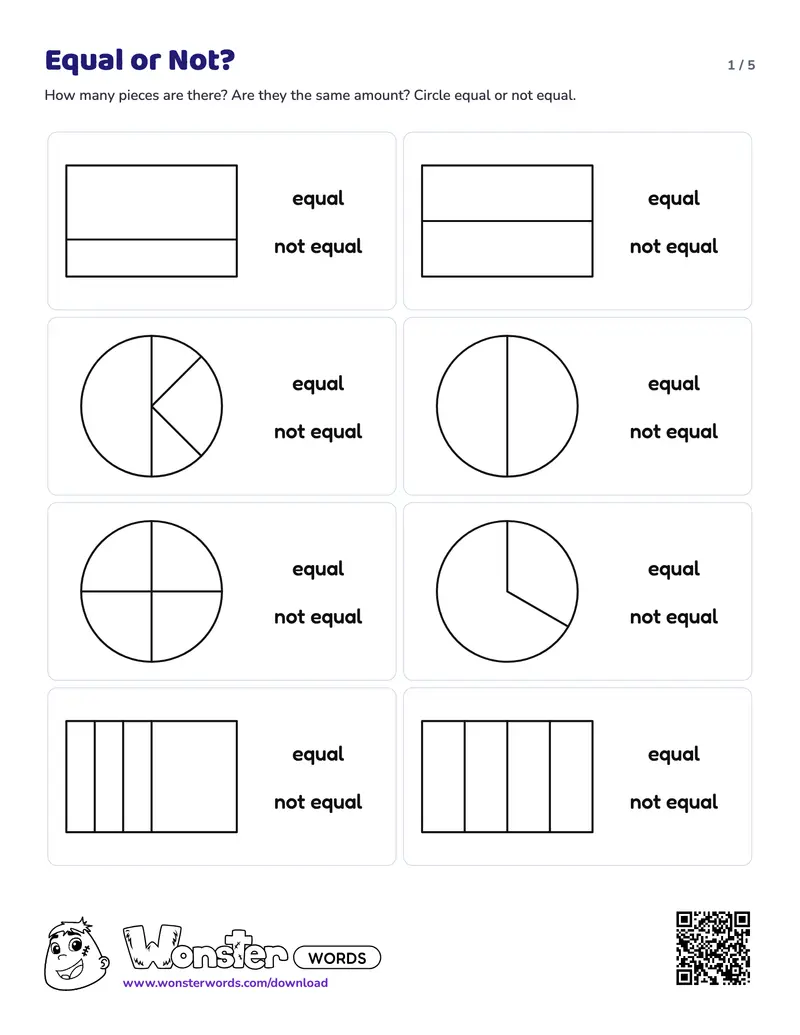
- Equal or Not? Your child circles “equal” or “not equal” beside a circle or rectangle whose parts are plainly one or the other.
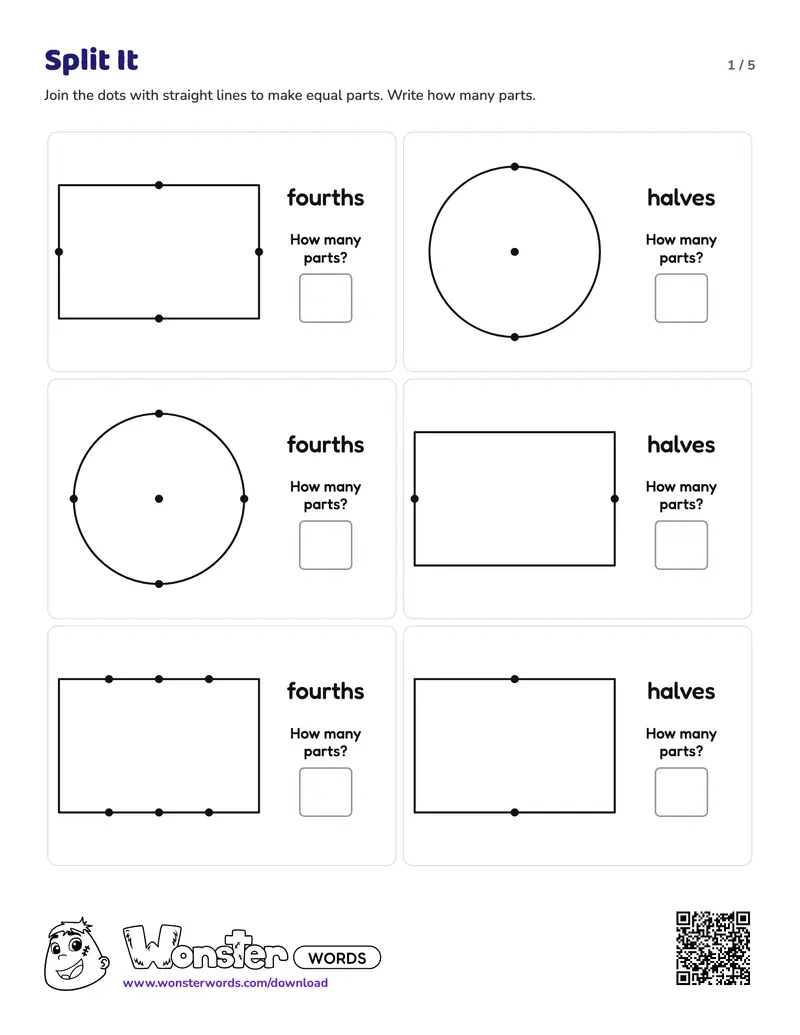
- Split It. Your child joins the dots on each shape with straight lines to make the halves, thirds, fourths, or eighths the prompt names. Then your child writes how many parts there are.
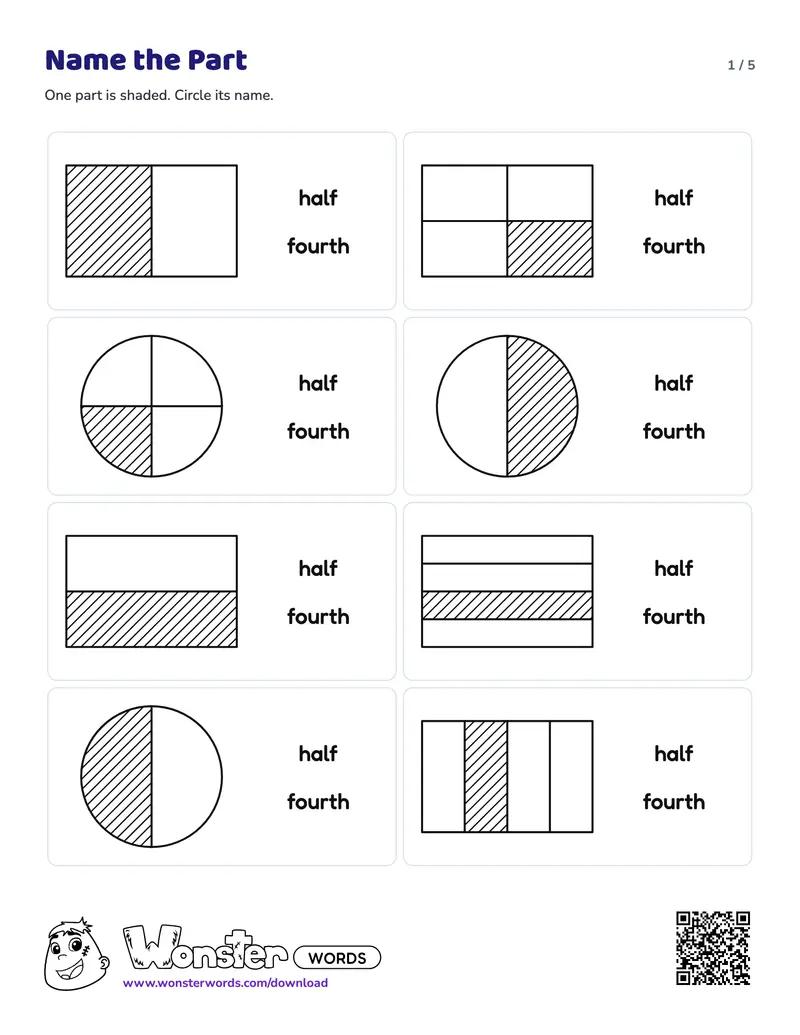
- Name the Part. A shape has one part shaded, and your child circles its name.
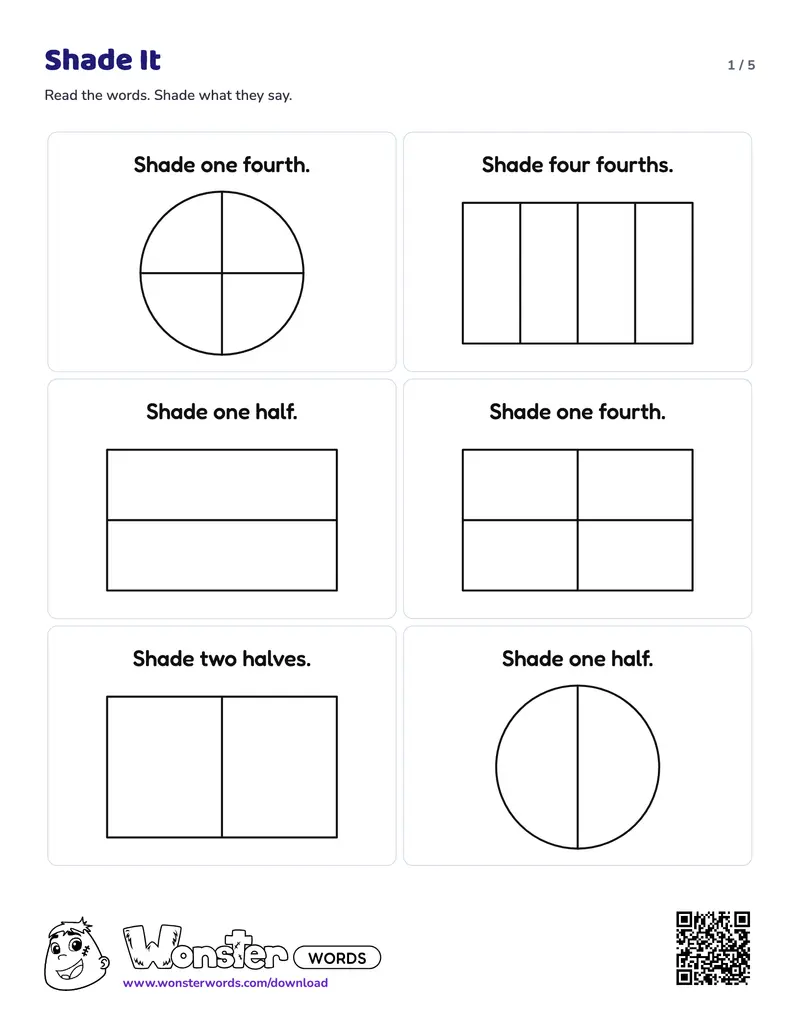
- Shade It. Your child shades what a prompt in words says, such as one half or four fourths.
- Count the Squares, for second and third grade. A rectangle on a square grid is cut into lettered parts. Your child writes how many squares each part covers, then circles “equal” or “not equal.” On page 3, for third grade, your child also writes the fraction for one equal part.
The first four sheets run in stages. Page 1 is halves and fourths (first grade in both frameworks), page 2 adds thirds (second grade, Common Core), and page 3 is halves, fourths, and eighths (second grade, Texas). Every fraction sheet by grade is on the fraction worksheets page.
Free PDF · no sign-up
Feedback?Print the equal parts worksheets
Each PDF is three pages of one activity, an answer key, and a page for grown-ups.
- Equal or Not? (PDF)24 shapes · answer key included · 5 pages
Preview page 1Preview
- Split It (PDF)18 shapes · answer key included · 5 pages
Preview page 1Preview
- Name the Part (PDF)24 shapes · answer key included · 5 pages
Preview page 1Preview
- Shade It (PDF)18 shapes · answer key included · 5 pages
Preview page 1Preview
- Count the Squares (PDF)12 rectangles · answer key included · 5 pages
Preview page 1Preview
Frequently asked questions
What is an equal share in the context of geometry?
An equal share is one of the parts of a shape that has been cut so every part is the same amount. A circle cut through its center gives 2 equal shares, called halves. Equal shares are also called equal parts or fair shares.
Are equal shares and equal parts the same thing?
Yes. Equal shares and equal parts are two names for one idea, parts of one whole that are all the same amount. The Common Core says equal shares, and the Texas standards say fair shares or equal parts.
Equal shares vs. unequal shares: what are the key differences?
Equal shares are all the same amount, and unequal shares are not. Both can have the same number of pieces. Only equal shares get a name such as halves or fourths, so a sandwich cut into a big piece and a small piece is not cut into halves.
What is the difference between equal shares worksheets and fraction worksheets for second graders?
Equal shares worksheets use words on shapes, such as halves, thirds, and fourths. Fraction worksheets use written fractions such as 1/4, which the Common Core and the Texas standards start in third grade. A second grader works on equal shares in words.
What is the importance of teaching equal shares in preschool education?
Equal shares matter because the writers of the Common Core describe third-grade fractions as building on the idea of partitioning a whole into equal parts. Neither the Common Core nor the Texas standards (TEKS) ask for equal shares of a shape before first grade. The Institute of Education Sciences says sharing activities can begin as early as preschool or kindergarten, so sharing a snack evenly at home is a good place to start.
Can equal shares be applied to three-dimensional shapes as well?
Yes. The writers of the Common Core describe first graders putting two triangular blocks together to make a rectangular block and recognizing that each triangular block is half of it. The worksheets on this page use flat circles and rectangles.
How can equal shares be used in real-life scenarios?
Equal shares come up whenever something is shared or divided, such as cutting a sandwich for two children, folding a towel in half, or cutting paper for a craft. Each time, the parts have to be the same amount.
What are examples of equal parts that are not the same shape?
A square cut into 4 small squares and a square of the same size cut into 4 strips both show fourths, although a small square and a strip are different shapes. A rectangle cut across the middle makes two rectangles, and the same rectangle cut corner to corner makes two triangles. Each of those parts is half of the rectangle.
How do I help my first grader cut shapes into halves and fourths?
Fold a sheet of paper in half and open it, then fold it in half twice and open it. Ask how many pieces there are and whether they are the same amount. Then cut a sandwich the same way and say the names, such as one half, two halves, one fourth, and four fourths.
How can I explain halves and fourths to my child in simple terms?
Tell your child that halves are 2 equal parts of one thing, and fourths are 4 equal parts of one thing. Cut a sandwich into 2 pieces of the same size to show halves. Then cut each half in half to show fourths, which are also called quarters.
What are the differences between halves, thirds, and fourths for beginners?
The difference is how many equal parts make the whole, which is 2 halves, 3 thirds, or 4 fourths. With the same whole, more equal parts means smaller parts, so a fourth of a sandwich is smaller than a half of that sandwich.
What age should children learn to cut shapes into parts?
Children learn to cut shapes into halves and fourths in first grade, at about ages 6–7, under both the Common Core and the Texas standards. Thirds come in second grade under the Common Core and in third grade in Texas.
What tools can help kids cut shapes accurately?
A sheet of paper folds into equal parts with no tools at all. Two craft sticks or straws laid on a shape show where the cuts for thirds will go, and a ruler marks even spaces on a rectangle. A child's drawn line does not have to be exact.
Why is it important for first graders to learn about halves and fourths?
Halves and fourths are where fractions start under the Common Core and the Texas standards. The writers of the Common Core describe third-grade fractions as building on the idea of partitioning a whole into equal parts, which is the idea a first grader meets with halves and fourths.
Related guides
Standards this page teaches: Common Core: 1.G.A.3, 2.G.A.3, 3.G.A.2 · Texas: 1.6(G), 1.6(H), 2.3(A), 2.3(B), 2.3(C), 2.3(D), 3.3(E), 3.6(E)
Last updated
Looking for something else?
Looking for something else?