
Math
Fractions for Kids
What a fraction is, what children learn about fractions from first to third grade, how to introduce them at home step by step, and what to do when a child gets stuck.
Grades: pre-K to grade 3
A fraction is a number that names equal parts of a whole: 1/4, read “one fourth”, means one of four equal parts. Children share things out fairly before they start school. Under the Common Core, they name halves and fourths of shapes in first grade, add thirds in second grade, and write fractions as numbers in third grade.
Two questions help at every grade: “Are the parts equal?” and “Half of what?” Until third grade, a fraction is a word for an equal share. Third grade makes it a number with its own place on a number line. Each grade is in what children learn and when, the order to teach it is in the steps for home, and the common mistakes are in when your child is struggling.
What is a fraction?
A fraction is a number that tells how many equal parts of a whole we mean. The fraction 1/4 means one of four equal parts. The Common Core’s glossary gives the technical version, “A number expressible in the form a/b where a is a whole number and b is a positive whole number”, as quoted in the Common Core Progressions on fractions.
Both rectangles have four parts. Only the left one has fourths, because only its parts are equal.
The bottom number says how many equal parts the whole is cut into, and the top number says how many of them we are counting. In 3/4, the whole is cut into 4 equal parts and we are counting 3. The two numbers have names, the numerator and the denominator, and a child can use “top” and “bottom” until those words come along.
Every fraction is built from one-part fractions. In the words of the Progressions, “a fraction is built from unit fractions”: 1/4 is one of four equal parts, and 3/4 is three of those parts. Unit fractions are the first fractions children write.
Equal is the whole idea. Cut a sandwich into a big piece and a little piece, and neither piece is a half.
A fraction is a number too, and it can sit between two whole numbers. Whole numbers count whole things: 0, 1, 2, 3. The fraction 1/2 is halfway from 0 to 1 on a number line, a place no whole number can name.
Proper, improper, and mixed are words for later. The Progressions say “there is no need to introduce ‘proper fractions’ and ‘improper fractions’ initially”. Decimals come later too, in fourth grade.
When do kids learn fractions?
Children start fractions in first grade, as words for equal shares of a shape, and write them as numbers in third grade. In the Common Core, first graders describe shares “using the words halves, fourths, and quarters” (1.G.A.3), and second graders add thirds. Its Progressions then say “In Grade 3, students are introduced to fraction notation”. Grade by grade, in the Common Core and in Texas:
| Age or grade | What children work on | Fractions | Common Core | Texas (TEKS) | Taught on |
|---|---|---|---|---|---|
| Preschool and kindergarten (about 3–6) | Share things out fairly and give each person the same number. No Common Core or TEKS standard asks for it | No names expected | None | None | Home step 1 |
| 1st grade | Cut circles and rectangles into two and four equal shares and name them; learn that more shares means smaller shares | Halves, fourths, and quarters, in words | 1.G.A.3 | 1.6(G) “two and four fair shares”; 1.6(H) examples and non-examples of halves and fourths | Halves and fourths as equal parts |
| 2nd grade | Cut shapes into two, three, or four equal shares; say the whole as “three thirds”; learn that equal shares of the same whole need not be the same shape | Adds thirds, in words (Common Core) | 2.G.A.3 | 2.3(A) halves, fourths, and eighths; 2.3(B) more parts, smaller parts; 2.3(C) count parts past one whole, in words; 2.3(D) examples and non-examples | Thirds as equal parts |
| 3rd grade | Write fractions as numbers: unit fractions first, then fractions like 3/4; place them on a number line; find simple equal fractions; compare fractions with the same top or bottom number | Bottom numbers 2, 3, 4, 6, and 8 | 3.NF.A.1–3, 3.G.A.2 | 3.3(A)–(H), 3.6(E), 3.7(A): the same bottom numbers; 3.3(A) and (B) stay at or below 1, and 3.7(A) states no limit; thirds arrive here | Unit fractions, from 1/2 to 1/8, the top and bottom numbers, number lines for fractions, equivalent fractions, comparing fractions |
It is common for first graders to learn fractions, because halves and fourths are in the first-grade standard. A first grader cutting a cookie in half is on time. A third grader who sees 1/4 written down for the first time and finds it sudden is on time too: the writing is new in third grade, and the sharing underneath it is not. In the Common Core, first- and second-grade fractions sit in the geometry standards, where children cut shapes into equal shares.
Texas names eighths in second grade and thirds in third grade, and its third-grade standards 3.3(A) and 3.3(B) stay at or below one. The eighths are in TEKS grade 2 (2.3(A)), and the thirds and that limit are in TEKS grade 3. Standard 3.7(A), halves, fourths, and eighths as distances from zero on a number line, states no limit. First-grade Texas matches the Common Core’s halves and fourths in TEKS grade 1.
By the end of third grade, a child working to the Common Core should be able to do five things with fractions:
- Say that 1/4 is one of four equal parts, and that 3/4 is three of those parts (3.NF.A.1).
- Put a fraction on a number line from 0 to 1 (3.NF.A.2).
- Find simple equal fractions, such as 1/2 = 2/4 and 2/3 = 4/6 (3.NF.A.3b).
- Write a whole number as a fraction, such as 3 = 3/1, and see that 4/4 is one whole (3.NF.A.3c).
- Compare two fractions with the same top or bottom number, as long as both are fractions of the same whole (3.NF.A.3d).
The Common Core keeps that work to halves, thirds, fourths, sixths, and eighths: “Grade 3 expectations in this domain are limited to fractions with denominators 2, 3, 4, 6, and 8”. Adding fractions, fractions with unlike bottom numbers, and decimals come in fourth grade and after.
Before first grade, neither the Common Core nor the Texas standards (TEKS) ask for equal shares of a shape, and fair sharing can start at home anyway. The panel behind the Institute of Education Sciences practice guide on fractions says sharing activities “can begin as early as preschool or kindergarten”, and it rates the evidence for its sharing recommendation as minimal.
The first step asks only that a child deal out the same number of things to each person. The Institute of Education Sciences guide says that “By age 4, children can distribute equal numbers of equal-size objects among a small number of recipients”, and that by 5 or 6 they are “reasonably skilled” at sharing both a set of things and a single thing. Counting and sharing come first, and fractions build on whole numbers.
Why are fractions important for kids?
Fractions matter because they are one of third grade’s four main topics, and because fraction knowledge in elementary school predicts later math achievement. The Common Core’s grade 3 introduction lists “developing understanding of fractions, especially unit fractions (fractions with numerator 1)” among the year’s four critical areas.
Siegler and colleagues analyzed large data sets from the United States and the United Kingdom, and reported in 2012 that elementary students’ knowledge of fractions and of division “uniquely predicts” their knowledge of algebra and their overall math achievement in high school, “5 or 6 years later”. The Institute of Education Sciences panel calls understanding fractions “essential for algebra and other more advanced areas of mathematics”. Fractions are also on inch rulers and in recipes.
How to introduce fractions at home, step by step
Fractions at home start with sharing and climb nine steps, each leaning on the one before, with the grades following the Common Core. Texas moves thirds to third grade. The order inside third grade is our advice. The grade and standard for each step:
| Step | What the child does | Grade | Standard | Taught on |
|---|---|---|---|---|
| 1 | Share things out fairly | Pre-K to kindergarten | No Common Core or TEKS standard; the Institute of Education Sciences panel recommends it | This page |
| 2 | Cut one thing into two equal parts and say “half” | 1st grade | 1.G.A.3; TEKS 1.6(G), (H) | Cutting into halves |
| 3 | Cut into fourths, and see that more shares means smaller shares | 1st grade | 1.G.A.3; TEKS 1.6(G), 2.3(B) | Cutting into fourths |
| 4 | Cut into thirds, and say the whole as “three thirds” | 2nd grade | 2.G.A.3; TEKS 3.3 | Cutting into thirds |
| 5 | Write a unit fraction | 3rd grade | 3.NF.A.1; TEKS 3.3(C) | What a unit fraction is |
| 6 | Build fractions from unit fractions, and read the top and bottom | 3rd grade | 3.NF.A.1; TEKS 3.3(D) | Numerator and denominator |
| 7 | Put fractions on a number line | 3rd grade | 3.NF.A.2; TEKS 3.3(A)–(B), 3.7(A) | Fractions on a number line |
| 8 | Find fractions that are the same size | 3rd grade | 3.NF.A.3a–c; TEKS 3.3(F)–(G) | Fractions of the same size |
| 9 | Compare fractions with the same top or bottom number | 3rd grade | 3.NF.A.3d; TEKS 3.3(H) | Comparing pairs of fractions |
Move from hands, to pictures, to numbers, and go back a step whenever a new kind of fraction appears. That order is our advice. Hold off on the written fraction until your child can say the words. The Progressions have first and second graders “use fraction language” before third grade brings the notation. One short routine for each step:
Share things out fairly
Set out 12 grapes and 3 plates, and ask your child to share the grapes so every plate has the same number. Each plate gets 4. Then ask how 4 friends could share 1 apple.
Cut one thing into two equal parts and say "half"
Cut a cookie for two children, so both pieces are the same size. Say "a half of the cookie" and "two halves make one whole cookie." Ask "Are they equal?" before you hand them out.
Cut into fourths, and see that more shares means smaller shares
Fold a sheet of paper in half, then in half again, and open it. The 4 equal parts are fourths, also called quarters. Hold a fourth next to a half: more equal shares means smaller shares.
Cut into thirds, and say the whole as "three thirds"
Share a candy bar among three people by cutting it into 3 equal parts. Each person gets a third. Count the parts back together: one third, two thirds, three thirds, one whole candy bar.
Write a unit fraction
Write 1/4 on one part of the folded paper and read it "one fourth." The 4 says the paper has 4 equal parts, and the 1 says you mean one of them.
Build fractions from unit fractions, and read the top and bottom
Shade three of the four parts and count them: one fourth, two fourths, three fourths. Write 3/4. The bottom number says how many equal parts make the whole, and the top number says how many you are counting.
Put fractions on a number line
Draw a line from 0 to 1 as long as a strip of paper. Fold the strip in half, lay it along the line, and mark the fold as 1/2. Fold it in half again to find 1/4 and 3/4.
Find fractions that are the same size
Fold one strip in half and an identical strip into fourths. Lay them side by side. One half covers the same length as two fourths, so 1/2 = 2/4.
Compare fractions with the same top or bottom number
Cut two identical sheets of paper, one into 3 equal parts and one into 8. One third is more than one eighth, because fewer parts share the sheet. With the same top number, 3/4 is more than 3/8. With the same bottom number, 5/8 is more than 3/8.
Four habits hold at every step:
- Start with sharing. The Institute of Education Sciences panel advises, “Use sharing activities that involve dividing sets of objects as well as single whole objects”. Sharing 12 grapes “tends to be easier for young children” than sharing a single candy bar.
- Say the words every time, such as “a half of the cookie” and “one of four equal parts”.
- Ask “Are they equal?” and “Half of what?” before you confirm an answer.
- Draw it after you have cut it.
A sharing story is the word problem at this level. Ask, “Four friends share one apple. How much does each friend get?” Each friend gets 1/4 of the apple. Written word problems with adding and subtracting belong to fourth grade and after. Any bedtime story where the characters split something works the same way, so stop at the split and ask how much each one gets.
Pictures for fractions: circles, strips, and number lines
Children use three pictures for fractions, and each one shows something the others do not. A circle or rectangle shows the part and the whole, a strip shows sizes side by side, and a number line shows a fraction as a place, which is what the standard means by “a fraction as a number on the number line” (3.NF.A.2).
| Picture | Best for | Taught on |
|---|---|---|
| Circles and rectangles cut into equal parts | Equal shares, grades 1–2 | Fraction circles, equal parts of shapes |
| Fraction strips (also called bars or tiles) | Seeing halves, fourths, and eighths side by side: folded paper in grades 1–2, then written fractions in grade 3. Texas calls them strip diagrams (3.3(A)) | Fraction strips, the fraction chart |
| Number line | Fractions as numbers, grade 3 | Marking fractions on a line, how number lines work |
Use all three with every child, whatever kind of learner they seem to be, and a child’s teacher can say which one has worked in class.
Fractions in everyday life: pizza, recipes, and snacks
Fractions come up in the kitchen every day, because food gets shared and measured. Five everyday places to find them:
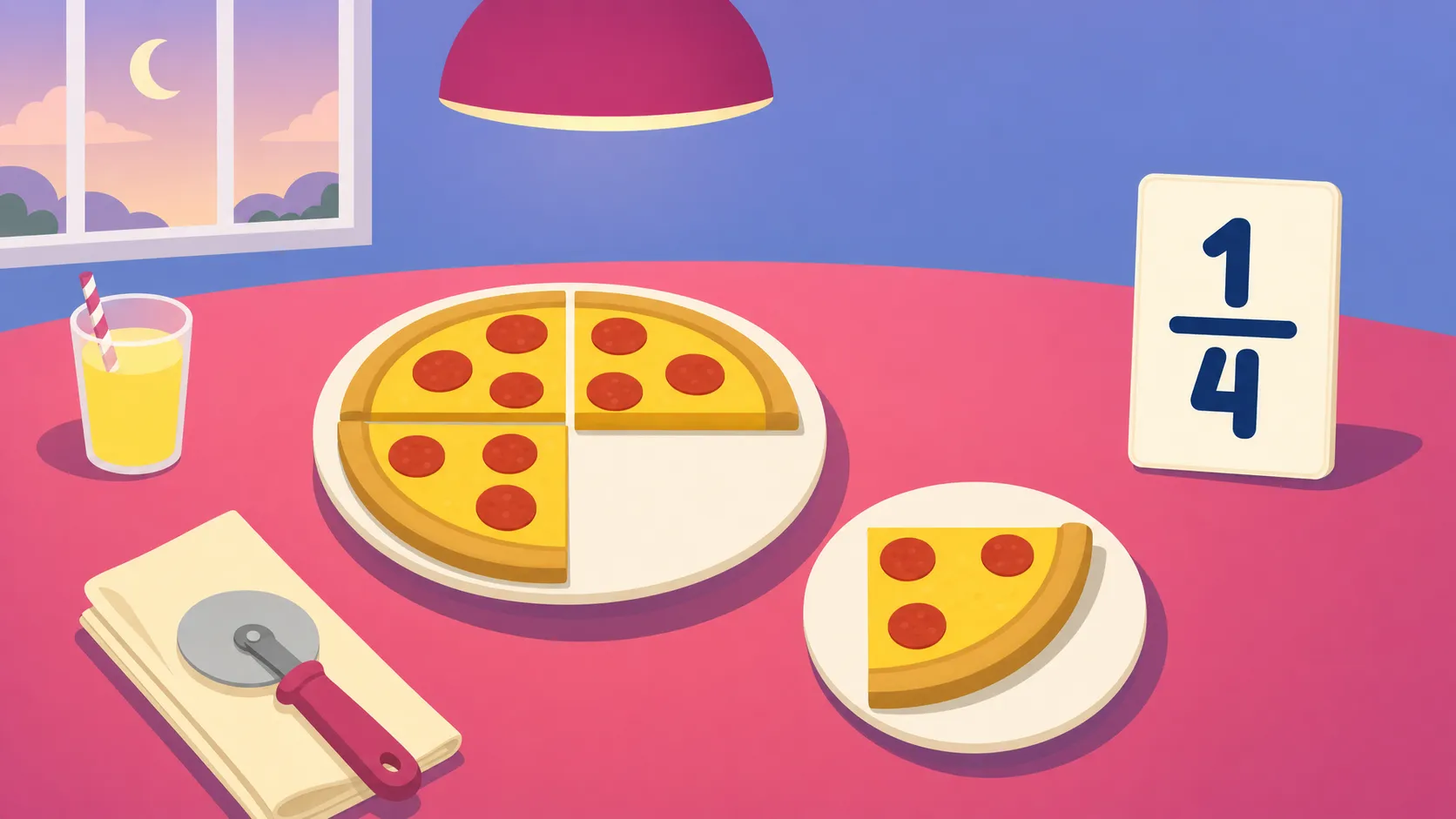
- Pizza and pie. Cut it into equal slices and count them. Two children sharing a pizza cut into 4 slices each get 2 slices, which is half. The Institute of Education Sciences guide shows a class “sharing four pizzas among eight children”, and that comes to half a pizza each as well.
- Sandwiches and crackers. Cut one sandwich down the middle and an identical one corner to corner. All four pieces are halves of a sandwich, because equal shares of identical wholes “need not have the same shape” (2.G.A.3).
- Measuring cups. Pour a 1/2 cup into a 1-cup measure twice, and two halves fill it. A 1/4 cup takes four pours.
- Snacks to share. Share 12 grapes onto 3 plates, and each plate holds 4 grapes, which is 1/3 of them.
- Around the house. A ruler marks halves and quarters of an inch, a towel folds into fourths, a clock has a half hour, and 6 cups of a 12-cup egg carton are half of it.
A pizza with uneven slices is not cut into fractions. Slices of different sizes are not eighths, however many there are, so ask “Are they equal?” before you count.
Hands-on fraction activities
Five hands-on fraction activities need only paper, counters, water, or a set of pattern blocks.
- Fold and name. Fold a strip of paper in half, then in half again. Open it and label each part 1/4. The What Works Clearinghouse guide for children who struggle with math suggests the same start: “fold a strip of paper in half to see two equal parts”.
- Fair-share plates. Deal out beans, buttons, or other counters from around the house onto 2, 3, or 4 plates, and check that every plate matches. The Institute of Education Sciences panel suggests counters “(e.g., beans, tokens)” for sharing problems.
- Cut and swap. Cut two identical rectangles into halves two different ways, one down the middle and one corner to corner. One cut makes two small rectangles, and the other makes two triangles. Each piece is still one of two equal parts of the same rectangle, so all four pieces are halves.
- Water and cups. Fill one straight-sided clear cup to a half and an identical cup to a quarter, and compare them. Say “the cups are the same size” each time, since a half of a bigger cup would be a different amount.
- Pattern blocks. Fit blocks on a yellow hexagon. The Progressions give the sentence a first grader might say, “A red block is half of a yellow block”, and the one a second grader might say, “A blue block is a third of a yellow block”.
Fraction games, for printing and playing, are on the fraction games page.
Hands come first because a child can see that folded parts match before the numbers mean anything. The What Works Clearinghouse recommends that teachers “use a well-chosen set of concrete and semi-concrete representations” with children who struggle with math.
When your child is struggling with fractions
Fractions are hard for many children, and a child who is stuck has plenty of company. On the 2004 National Assessment of Educational Progress, “50% of 8th-graders could not order three fractions from least to greatest”, the Institute of Education Sciences guide reports. One reason is whole-number thinking: a bigger number means more when counting, and it stops meaning that on the bottom of a fraction.
Where should my child start with fractions? Use the free 2-minute assessment
This free online assessment asks up to five questions for your child’s grade, one at a time, and you tap whether each went easily, with some help, or not yet. You need a few sheets of paper. It ends on the first fraction idea to go back to, and how. It is a quick check of where to start, not a screening tool.
A 2-minute check shows where to start. The first two are for first and second grade, and the last three are for third grade. The first one your child finds hard points at the step to go back to. It is a quick check of where to start, not a screening or diagnostic tool.
- Cut paper into two pieces that are clearly different sizes and ask, “Are these halves?” The answer is no, because 1.G.A.3 calls for equal shares.
- Fold paper into four equal parts and ask what one part is called. A fourth or a quarter is right.
- Ask, “Which is more, 1/3 or 1/8 of the same cookie?” The answer is 1/3.
- Draw a line from 0 to 1 and ask your child to mark 1/2. The mark goes halfway (3.NF.A.2).
- Show a small cookie and a large one and ask, “Is half of this one the same as half of that one?” The answer is no, because a half depends on the whole (3.NF.A.3d).
Five common fraction mistakes, each with a fix:
- Thinking a bigger bottom number means a bigger fraction. A child says 1/8 is more than 1/3, the example the Institute of Education Sciences guide gives of this error. Cut two identical sheets of paper, one into thirds and one into eighths, and put one part of each side by side. More parts share the sheet, so each part is smaller.
- Reading the top and bottom as two separate numbers. A child says 3/8 is more than 3/5 because 8 is more than 5, the error the same guide traces to “comparing the two denominators”. Both fractions have 3 parts, so compare the size of the parts: fifths are bigger than eighths, and 3/5 is more.
- Calling unequal parts halves. Ask “Are they equal?” and fold the two parts together to check.
- Forgetting the whole, such as calling half of a small pizza the same as half of a large one. The Common Core says comparisons are valid “only when the two fractions refer to the same whole” (3.NF.A.3d), so ask “Half of what?”
- Believing a fraction cannot be more than one whole. Many children decide 4/3 is not a number and, as the Institute of Education Sciences guide reports, say, “You cannot have four parts of an object that is divided into three parts.” Count thirds along a number line: three thirds lands on 1, and four thirds lands one step past it. Common Core third grade includes fractions above one. In Texas, standards 3.3(A) and 3.3(B) stay at or below one, and second graders count parts past one whole in words (2.3(C)).
The fix for most fraction trouble is to go back one step and cut or fold before writing. Keep practice short and often. Bring in the number line once the words are solid, which is our advice. The Institute of Education Sciences guide (Recommendation 2) and the What Works Clearinghouse guide (Recommendation 4) both recommend number lines, and the first says “from the early grades onward”. The What Works Clearinghouse says fractions in grades 3 and 4 “can be difficult for students” and are “critical” for later math.
A child who says they hate math can still start from food or a game. Let your child cut a sandwich and decide who gets which piece, keep it to a few minutes, praise the try, and leave the timer off.
Naming halves is a first-grade standard. If your child still cannot name a half of a cut shape late in second grade, or the teacher raises a concern, talk to your child’s teacher. Bring what you saw in the check, and ask which step the class is on. A tutor can give the same one-step-back practice. Whether a difficulty across all of math calls for an evaluation for dyscalculia is a question for the school rather than for a check at home.
Fractions pages and worksheets: where to go next
Every fraction worksheet on this site lives on the page that teaches its step, so each sheet comes with its explanation. If you are not sure which page you need, start with every sheet sorted by grade. Otherwise, go to the page that matches what your child is working on:
| If your child is working on | Go to |
|---|---|
| One part of a whole, written 1/4 | Unit fractions to print and practice |
| What the top and bottom numbers mean | The numerator and denominator |
| Fractions as places on a line | Fractions on the number line |
| Fractions that are the same size | Equal fractions such as 1/2 and 2/4 |
| Cutting shapes into equal parts | Equal parts and equal shares |
| Strips of paper cut into fractions | Fraction strips to cut out |
| Round pieces to hold and compare | Fraction circles to cut out |
| All the fractions on one chart | The fraction chart and wall |
| Which of two fractions is greater | Comparing two fractions |
| Games to print and play | Fraction games for the table |
| Every fraction sheet, sorted by grade | Fraction worksheets to print, by grade |
| Number lines from whole numbers up | Number lines for kids |
| A bar cut into equal parts | Tape diagrams and bar models |
| Counters, strips, and blocks at home | Homemade math manipulatives |
Going further: fractions of a set
A fraction of a set takes a group of things as the whole, so 1/4 of 8 cookies is one of 4 equal groups: 2 cookies. To find a fraction of a set, share the things into as many equal groups as the bottom number says. Then count as many groups as the top number says. Three of those groups, 3/4 of the 8 cookies, make 6 cookies. In the same way, 1/3 of 12 grapes is 4 grapes, because 12 shared into 3 equal groups is 4 in each.
A child who has shared grapes onto plates has already met this idea. The Institute of Education Sciences panel’s sharing step uses “sets of objects”, and third graders in Texas share “an object or a set of objects” (TEKS 3.3(E)). The Common Core’s Progressions keep third grade mainly on shapes and lengths, and extend the whole to “a collection of objects” in fifth grade, as a fraction times a whole number.
Some programs write fractions sooner than the Common Core does. Singapore Math’s Dimensions Math teaches halves and fourths in book 1B (Chapter 15) and writes unit fractions in book 2B (Chapter 11), a grade before the Common Core. Beast Academy, whose Level 3 books are for ages 8–10, lists mixed numbers among their fractions topics.
Frequently asked questions
What is a basic definition of a fraction?
A fraction is a number that names equal parts of a whole. In 3/4, the bottom number, 4, says the whole is cut into 4 equal parts, and the top number, 3, says you are counting 3 of them. The parts have to be equal, or the fraction does not describe them.
How can a parent explain fractions to a child?
Tell your child that a fraction is one or more of the equal parts of something. Fold a sheet of paper in half and in half again, open it, and point to one part. That part is one fourth, written 1/4, because it is one of four equal parts. Ask "Are the parts equal?" every time, so the word stays tied to equal shares.
Which grade do kids typically start learning fractions in elementary school?
Children start fractions in first grade in both the Common Core and the Texas standards, by cutting circles and rectangles into halves and fourths and naming them in words. Second graders add thirds under the Common Core. Third graders write fractions as numbers, such as 1/4 and 3/4, and put them on a number line.
Is it common for first graders to learn fractions?
Yes. First grade is when fractions start in both the Common Core and the Texas standards. First graders cut circles and rectangles into two and four equal shares and name them with words such as halves, fourths, and quarters. Neither set of standards asks for written numbers like 1/4 until third grade, so a first grader naming halves is on time.
Do kids learn fractions in preschool or kindergarten?
Not in the standards. Before first grade, neither the Common Core nor the Texas standards (TEKS) ask for equal shares of a shape, and fair sharing can start at home. A panel convened by the Institute of Education Sciences says sharing activities can begin as early as preschool or kindergarten, and dealing out grapes so each person has the same number is a good place to start.
How do I know if my child is ready to learn fractions?
The first step asks only that a child share things out so that each person gets the same number, such as 12 grapes on 3 plates. Children can usually do this with a few objects by age 4, and by 5 or 6 they can usually split a single thing fairly as well. The fraction names come in first grade and the written numbers in third.
Fractions vs. whole numbers: what should kids learn first?
Whole numbers come first. Children count and share before they name fractions, and fractions build on that counting, since 3/4 is three of the unit 1/4 counted one at a time. Fraction words start in first grade, while children are still learning whole numbers, and written fractions wait until third grade.
What fraction skills should be mastered by third graders?
By the end of third grade, the Common Core expects children to understand 1/4 as one of four equal parts and 3/4 as three of those parts, place fractions on a number line, find simple equal fractions such as 1/2 = 2/4, and compare two fractions with the same top or bottom number. The bottom numbers are limited to 2, 3, 4, 6, and 8. Texas asks for the same kinds of skills, and its standards 3.3(A) and 3.3(B) stay at or below one.
Why is learning fractions important for children?
Fractions matter because they lead into later math. A 2012 study by Siegler and colleagues, using large data sets from the United States and the United Kingdom, found that elementary students' knowledge of fractions and of division predicts their knowledge of algebra and their overall math achievement in high school, 5 or 6 years later. Fractions are also part of everyday life, from a recipe to a ruler.
How can I use pizza slices to teach fractions to children?
Cut the pizza into equal slices and count them. If there are 8 equal slices, each slice is 1/8 of the pizza, and 4 slices are 4/8, which is the same as half. Ask "Are the slices equal?" first, because slices that are not cut evenly are not eighths.
Which is larger, 1/8 or 1/3, and why?
The fraction 1/3 is larger than 1/8. The bottom number says how many equal parts share the whole, so a whole cut into 8 parts has smaller parts than the same whole cut into 3. Cut two identical sheets of paper, one into thirds and one into eighths, and put one part of each side by side to see it.
How can I find a fraction of a set of objects?
Share the objects into as many equal groups as the bottom number says, then count as many groups as the top number says. For 1/4 of 8 cookies, make 4 equal groups of 2, and one group is 2 cookies. For 3/4 of 8 cookies, count three groups, which is 6 cookies.
What are signs a child struggles with fractions?
Signs a child is struggling with fractions include calling two unequal pieces halves, not knowing what one of four equal parts is called, saying 1/8 is more than 1/3 of the same cookie, being unable to mark 1/2 on a line from 0 to 1, and comparing halves of two different-sized things as if they were equal. These are a quick check of where to start, not a screening or a diagnosis.
How can parents help children struggling with fractions?
Go back one step to the last thing your child can do easily. Cut or fold real things before writing any numbers, keep practice short and frequent, and use a number line once the fraction words are solid. Naming halves is a first-grade standard. If a child still cannot name a half of a cut shape late in second grade, or the teacher raises a concern, talk to the teacher.
What are common mistakes children make with fractions?
Five mistakes are common. Children think a bigger bottom number means a bigger fraction, such as 1/8 being more than 1/3. They compare tops and bottoms as separate numbers, such as 3/8 being more than 3/5. They call unequal parts halves. They compare fractions of different wholes, such as half of a small pizza and half of a large one. And they believe a fraction cannot be more than one whole, so that 4/3 is not a number.
How can I make fractions fun for my child who dislikes math?
Start from food or a game, not a worksheet. Let your child cut a sandwich into equal parts and decide who gets which piece, keep it to a few minutes, praise the try, and leave the timer off. A child who says they hate math can often still make a fair share, because sharing comes before any numbers.
Related guides
Standards this page teaches: Common Core: 1.G.A.3, 2.G.A.3, 3.G.A.2, 3.NF.A.1, 3.NF.A.2, 3.NF.A.3 · Texas: 1.6(G), 1.6(H), 2.3(A), 2.3(B), 2.3(C), 2.3(D), 3.3(A), 3.3(B), 3.3(C), 3.3(D), 3.3(E), 3.3(F), 3.3(G), 3.3(H), 3.6(E), 3.7(A)
Last updated
Looking for something else?
Looking for something else?