
Math
Free Printable Fraction Circles
A set of circles to print and cut, how to use them at home, what grade uses them, and what circles show that fraction strips and a number line do not.
Grades: grade 1 to grade 3
Fraction circles are circles divided into equal parts, one circle for each kind of piece, that children handle to see a fraction as part of one whole. The free set on this page prints a whole, halves, thirds, fourths, sixths, and eighths, all one size and in black and white. A practice sheet comes with it.
While your child holds the pieces, ask one question: “How many more fourths fill the circle?” The question makes your child look at the whole as well as the part. Fraction circles are a good first picture of a fraction and a poor last one, because a circle cannot show a fraction as a number on a line. Third graders also work with lengths and a number line.
Free printable fraction circles to cut out
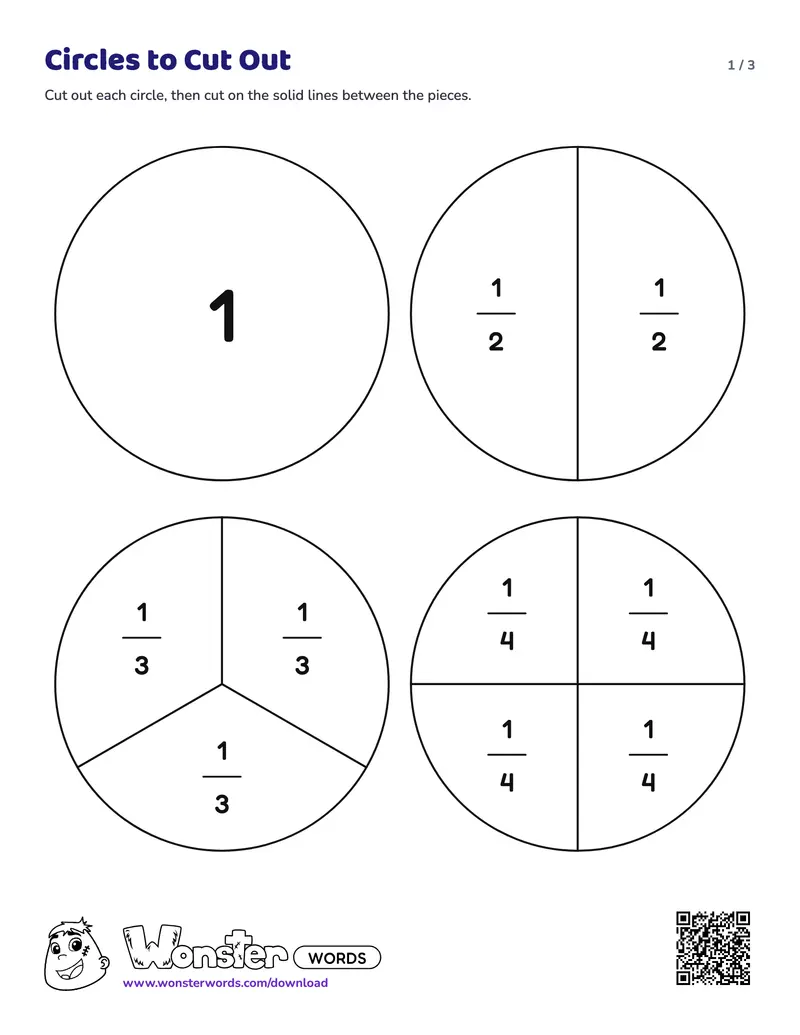
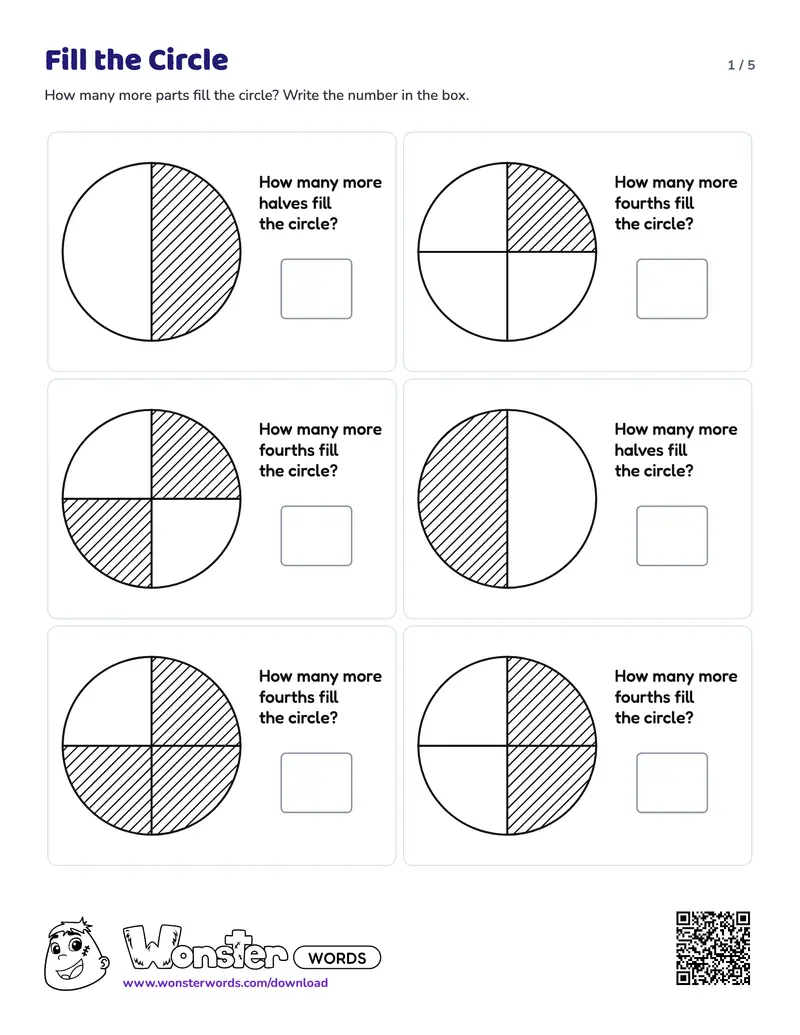
The free printable fraction circles come as Circles to Cut Out, a set of pieces, and Fill the Circle, a practice worksheet with an answer key, in black and white, with no account and no email.
- Circles to Cut Out. Print this one first, for any child from first to third grade. A whole, halves, thirds, fourths, sixths, and eighths make 24 pieces, each labeled with its fraction. Two blank circles are mats to build on. The lines are solid and the circles are plain, with no pictures.
- Fill the Circle. Print this one once your child has handled the pieces. Each item shows a circle in equal parts with some parts shaded, and asks how many more fill the circle. A first grader stops after page 1. Page 2 adds thirds, and page 3 adds sixths and eighths.
Free PDF · no sign-up
Feedback?Print the fraction circles
A page for grown-ups closes each PDF.
- Circles to Cut Out (PDF)24 pieces · 3 pages
Preview page 1Preview
- Fill the Circle (PDF)18 circles · answer key included · 5 pages
Preview page 1Preview
More fraction practice sheets are on the fraction worksheets page.
Every fraction circle in the set is the same size, because a part means nothing without its whole. The writers of the Common Core show the trap in their Progressions with two pizzas of different sizes. A student might think 1/4 is greater than 1/2, “because a fourth of the pizza on the right is bigger than a half of the pizza on the left.” Inside one set, a fourth is always smaller than a half.
To print and cut a set, use card stock if you have it, since thicker paper lasts longer. Cut each circle out first, then cut its pieces apart on the solid lines. Keep each set in its own envelope. To make the pieces easy to sort, color each circle with one crayon before you cut it.
How to make fraction circles at home
To make fraction circles at home, trace one bowl onto paper and cut out several circles, so that every circle is the same size. Fold one circle in half and cut on the crease for halves. Fold a second circle in half twice for fourths, and a third circle three times for eighths. Folding makes those three and not thirds or sixths, which do not fold evenly by eye, so use the printed circles for those. Leave the homemade circles plain. The equal parts guide shows what makes parts equal.
What are fraction circles used for, and what grade uses them?
Fraction circles are used to show a fraction as a part of one whole, and under the Common Core and the Texas standards they fit first through third grade. They are one of the math manipulatives children handle at school. The What Works Clearinghouse lists them beside fraction bars and fraction tiles as a concrete tool for fractions, in its 2021 guide on children who struggle with math.
Which fraction circles to use depends on your child’s grade and on which standards your state follows, the Common Core or the Texas standards (TEKS):
| Grade | Common Core | Texas (TEKS) | Pieces to use |
|---|---|---|---|
| 1st grade | Partition circles and rectangles into two and four equal shares (1.G.A.3) | Two and four fair shares of figures (1.6(G)) | Halves and fourths |
| 2nd grade | Adds thirds, and describes the whole as “three thirds” (2.G.A.3) | Halves, fourths, and eighths (2.3(A)), and “how many parts it takes to equal one whole” (2.3(C)) | Common Core: halves, thirds, and fourths. Texas: halves, fourths, and eighths |
| 3rd grade | Fractions as numbers, with denominators 2, 3, 4, 6, and 8 (3.NF.A.1), and shapes cut into equal areas (3.G.A.2) | The same denominators, with thirds arriving here, for fractions at or below 1 (3.3(A) and (B)) | Halves, thirds, fourths, sixths, and eighths |
Before first grade, neither the Common Core nor the Texas standards has a fraction standard, so talk about fair sharing comes first and the set waits for first grade. The fractions guide covers what children learn about fractions in each grade.
How can parents use fraction circles at home?
Parents can use fraction circles at home in five short steps, about 10 minutes at a sitting, with one set of pieces. With a first grader, use only halves and fourths. With a third grader, use all five kinds of piece.
Give your child the pieces
Hand over the pieces of one circle and let your child do the moving. Start with halves and fourths, and keep your own hands off the pieces.
Name the whole first
Have your child lay the fourths on a blank circle until it is full, and say it together: four fourths make one whole. The Common Core asks second graders to describe a whole this way, as "four fourths."
Count the pieces by name
Have your child take the pieces off and lay them back one at a time, saying: one fourth, two fourths, three fourths. The Common Core's writers describe three fourths the same way, as three of the one-fourth pieces put together.
Ask how many more fill the circle
Have your child lay three fourths on a blank circle, then ask, "How many more fourths fill the circle?" Your child looks at the empty space and fills it with one more fourth. Then try another kind of piece.
Keep to one set, then move to a drawing
Use pieces from one set, so every piece comes from the same size of circle. Once your child answers without the pieces, draw a circle in equal parts and shade some of them. Write the fraction last.
Step 3 is where a child meets a unit fraction, one equal part of a whole, and the top and bottom numbers of a fraction name the pieces your child has counted. Fill the Circle is how a parent checks step 4 on paper, without the pieces.
Talk about pizza, and keep the circles your child handles plain. The Institute of Education Sciences poses eight children sharing four pizzas as a fraction problem, so pizza belongs in the conversation rather than on the pieces.
Fraction circle activities and games
Two fraction circle activities use the printed pieces, and Cover Up also needs a die. More games are on the fraction games page.
- Cover Up. Print one set per player, choose eighths, and take turns rolling a die and laying that many eighths on a blank circle. The first player to fill the circle exactly wins, and a roll that would overfill it is skipped.
- Build It. One player builds a fraction, such as three fourths, on a blank circle. The other player says what is missing, one fourth, and lays it in to check.
Laying two fourths on top of one half shows that they cover the same space, which is how equivalent fractions begin.
Are fraction circles, fraction strips, or a number line better for my child?
Fraction circles are a good first picture of a fraction and a poor last one. A fraction circle, the hands-on form of a pie chart, shows a fraction as a part of one whole. A strip shows it as a length, and a number line shows it as a place. The studies read for this page test circles against number lines, pictures, paper pizzas, and watching a teacher. None of them tests circles against strips with young children, so neither one can be called the better teacher.
| Tool | Shows a fraction as | Use it for |
|---|---|---|
| Fraction circles | A part of one round whole | Picturing a share of one round whole |
| Fraction strips | A length you can lay against another | Laying pieces side by side, and building a fraction piece by piece |
| Number line | A point at a distance from 0 | Fractions as numbers, including fractions past 1 |
What fraction circles do well
- The whole stays in view. A closed circle shows the whole and the missing part at once.
- Circles match the early standards. The Common Core names “circles and rectangles” for equal shares in first and second grade.
- Handling them helped more than watching. The Institute of Education Sciences guide reports a “relatively small-scale,” unpublished study. Children who used fraction circles themselves understood fraction concepts relevant to computation better than children who watched a teacher use them (effect size 0.73, statistically significant). Against pictures of the circles, the gain was “substantively important, but not statistically significant.”
- Plain circles did well for first graders. Kaminski and Sloutsky found that first graders who used plain, pre-made paper circles scored higher than first graders who made colorful paper pizzas. The gap showed on tests given before the lesson as well as after it. The authors suggest starting with “simple, generic, pre-made material”, which is why the printed set has no pictures.
Where fraction circles stop helping
- The Common Core’s writers count circles as harder to draw and divide. The Progressions say that in third grade “the main focus is on shapes that are easier for students to draw and subdivide, e.g., lengths of ‘tape’ rather than circles.” A printed set removes the problem and some of the practice, because a child cutting on our lines is not deciding where equal parts go. The page on cutting shapes into equal parts has that practice.
- Training on a part-of-a-whole picture did not carry over to comparing fractions in one study. Hamdan and Gunderson trained second and third graders on a number line or on an area model, the part-of-a-whole kind of picture that a fraction circle is. Each group improved on the model it practiced, and “only the number line training led to transfer to an untrained fraction magnitude comparison task.” The authors conclude that the number line “is more beneficial than the widely used area model.” For comparing fractions with a set, lay one cut-out piece on top of another. A strip gives the same check along a straight edge.
- A fraction past 1 needs more circles. A number line keeps going, so 5/3 fits on one line and takes two circles. A strip also stops at its own end. The Institute of Education Sciences tells teachers to “use number lines as a central representational tool”, and rates that evidence Moderate.
- Circles and strips share one risk. The Institute of Education Sciences guide warns against “simply counting parts of the fraction strip or circle” without seeing that the two numbers name one amount.
How to use circles, strips, and a number line together
Children can use all three tools, each for its own job: circles and rectangles for equal shares, strips for lining lengths up, and a number line for fractions as numbers. A fraction chart stacks those lengths in rows. The Common Core’s Progressions place the line after the others, saying that “initially they use other representations such as area representations, strips of paper, and tape diagrams.”
What are common mistakes with fraction circles?
The fraction circle mistake to watch for first is comparing pieces from circles of different sizes. Each of these three has a quick fix.
- Mixing pieces from circles of different sizes. A fourth of a large circle can be bigger than a half of a small one, as the Common Core’s Progressions show with two pizzas. Keep to one printing of one set, and compare only pieces from that set.
- Counting the two numbers separately. A child who sees three of four parts shaded and says “three” and “four” has counted without reading the fraction, the counting the Institute of Education Sciences guide warns against. Say “three fourths” every time, and ask how much of the circle that is.
- Using pieces that are not equal. Pieces cut by eye or folded crookedly are not equal parts, so they do not show fourths or eighths, however many there are. Lay matching pieces on top of each other to check, and recut any that stick out.
Frequently asked questions
What age group benefits most from using fraction circles?
The Common Core and the Texas standards do not say which age benefits most, but they put this work in first through third grade, at ages 6–9. First graders use halves and fourths. Third graders use halves, thirds, fourths, sixths, and eighths. Before first grade, neither framework has a fraction standard, and talking about fair sharing comes first.
Which is more effective for teaching fractions: fraction circles or fraction strips?
Neither one is shown to be more effective in the sources read for this page, because none of them tests circles against strips with young children. A fraction circle shows a part of one round whole, and a fraction strip shows a length you can lay against another length. Children use both, and each one shows something the other does not.
Can fraction circles be combined with other tools for teaching fractions?
Yes. Children can use fraction circles for equal shares, fraction strips for laying lengths side by side, and a number line for fractions as numbers. Use the same fraction on each one, such as three fourths, so your child sees that the three pictures name one amount.
What alternatives are there to fraction circles for teaching fractions?
The main alternatives to fraction circles are rectangles cut into equal parts, folded paper, fraction strips or bars, a fraction chart, and a number line. A circle shows a part of one whole, a strip shows a length, and a number line shows a place. Children use more than one of these by third grade.
How do fraction circles relate to the concept of equivalent fractions?
Fraction circles show equivalent fractions when different pieces cover the same space. Two fourths cover one half exactly, so 1/2 = 2/4. Three sixths and four eighths cover one half too. Pieces from one set are needed, because the comparison only works when the circles are the same size.
Printable fraction circles vs. physical fraction circles: which should I use?
Printable and physical fraction circles are the same pieces, so either one works. Bought sets last longer. Printed sets cost a few sheets of paper, and you can print another when pieces get lost. Keep to one set at a time, so every piece comes from the same size of circle.
Can fraction circles help students understand addition and subtraction of fractions?
Yes, in later grades. A practice guide from the Institute of Education Sciences shows 1/2 + 1/3 worked with fraction circles, by trading the pieces for sixths to get 3/6 + 2/6 = 5/6. Adding and subtracting fractions is a Common Core topic in grades 4 and 5, after the work on this page.
When should students transition from fraction circles to abstract fraction problems?
Neither the Common Core nor the Texas standards sets a time to stop using fraction circles. Move one step at a time, from the pieces to a drawing and then to written fractions, and go back to the pieces whenever an answer stops making sense. In third grade, children also work with lengths and a number line.
Are there any studies on the effectiveness of fraction circles in elementary education?
Yes, and each one tests something narrow. One small study found that children who handled fraction circles understood fraction concepts relevant to computation better than children who watched a teacher use them. One study of first graders found that children using plain, pre-made circles scored higher than children who made paper pizzas, on tests given before the lesson as well as after it. One study of second and third graders compared number line training with area model training, the part-of-a-whole kind of picture a circle gives, and only the number line training carried over to comparing fractions.
Related guides
Standards this page teaches: Common Core: 1.G.A.3, 2.G.A.3 · Texas: 1.6(G), 2.3(A), 2.3(C)
Last updated
Looking for something else?
Looking for something else?