
Math
Fraction Games
Printable board, card, and dice games for first to third grade, what counts as a match when 1/2 and 2/4 are the same amount, which game suits which grade, and games to make at home.
Grades: grade 1 to grade 3
A fraction game for first to third grade should tie each turn to an amount your child can see, with one right answer. The games here are short, and you print them and play at a table. Five kinds to start with are roll and shade, bingo, a number line race, dominoes, and memory match. Each one is a free PDF, with no email and no account.
Fractions need one rule that whole-number games do not. Since 1/2 and 2/4 name the same amount, every game below states what counts as a match. A game is practice for an idea your child has already met, and what a fraction is comes first. A first grader starts with halves and fourths in words, and written fractions such as 3/4 wait for third grade.
Free printable fraction games for kids
The six free printable fraction games run from equal shares in first grade to equal fractions in third grade. Each PDF prints in black and white, with shading drawn by hatching, and closes with a page for grown-ups. A game that uses a spinner needs a paper clip and a pencil.
| Game | Grade | You need | Players | What counts as right |
|---|---|---|---|---|
| Roll and Shade: Equal Shares | 1st, 2nd | Pencil, paper clip | 2 | The share the spinner named |
| Roll and Shade: Unit Fractions | 3rd | Pencil, paper clip | 2 | The bar’s total, in its own parts |
| Fraction Bingo | 3rd | Boards, covers, caller cards | Up to 3 | The picture of the called amount |
| Fraction Line Race | 3rd | Piece, and a coin, spinner, or die | Up to 3 | The mark, in the line’s own parts |
| Fraction Dominoes | 3rd | 11 tiles | 2 or more | The one half showing that amount |
| Fraction Memory Match | 3rd | 12 cards on card stock | 2 or more | Any two cards of one amount |
Roll and shade: equal shares
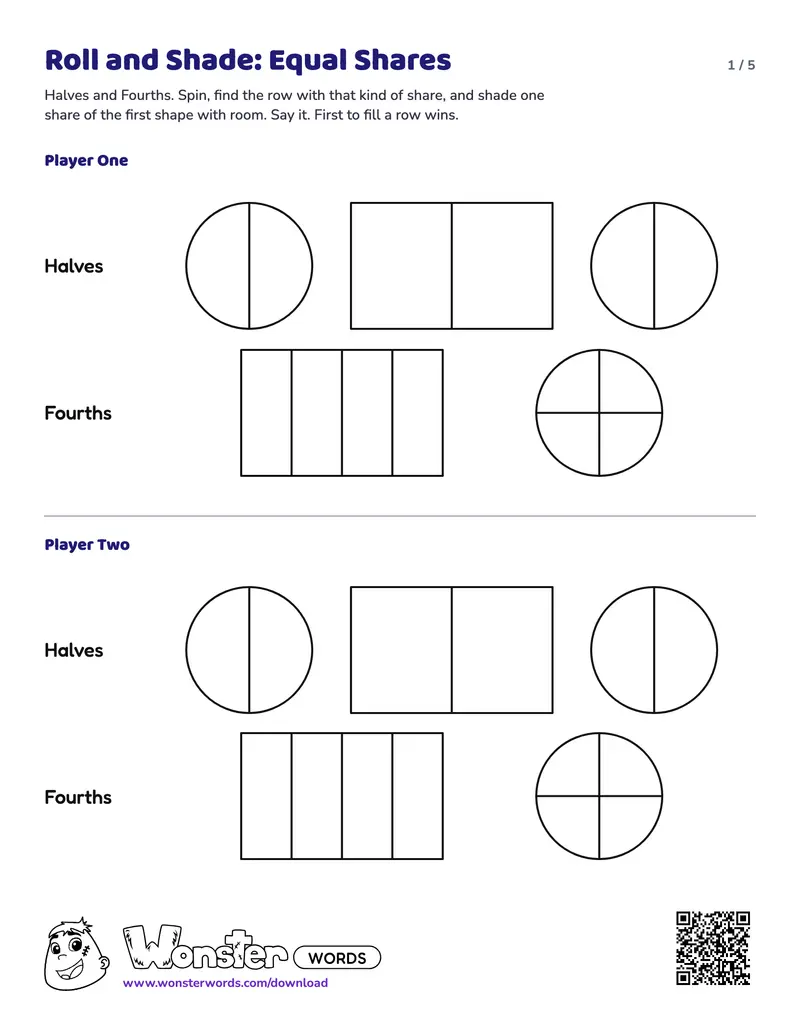
Roll and Shade: Equal Shares is the game for first and second graders, because it uses words and no numerals. It practices equal shares of circles and rectangles. Each player has half of a board. Spin to name a share, such as a fourth, and find the row that holds that kind of share. Shade one empty share of the first shape in that row with room, and say, “I shaded a fourth.” The first player to fill a row wins.
The three boards are halves and fourths; halves, thirds, and fourths; and halves, fourths, and eighths. A turn is right when the shaded share is the kind the spinner named. Equal shares of one shape are the same amount, so shading any empty share of that shape would be correct, and the first-empty rule only stops an argument.
Roll and shade: unit fractions
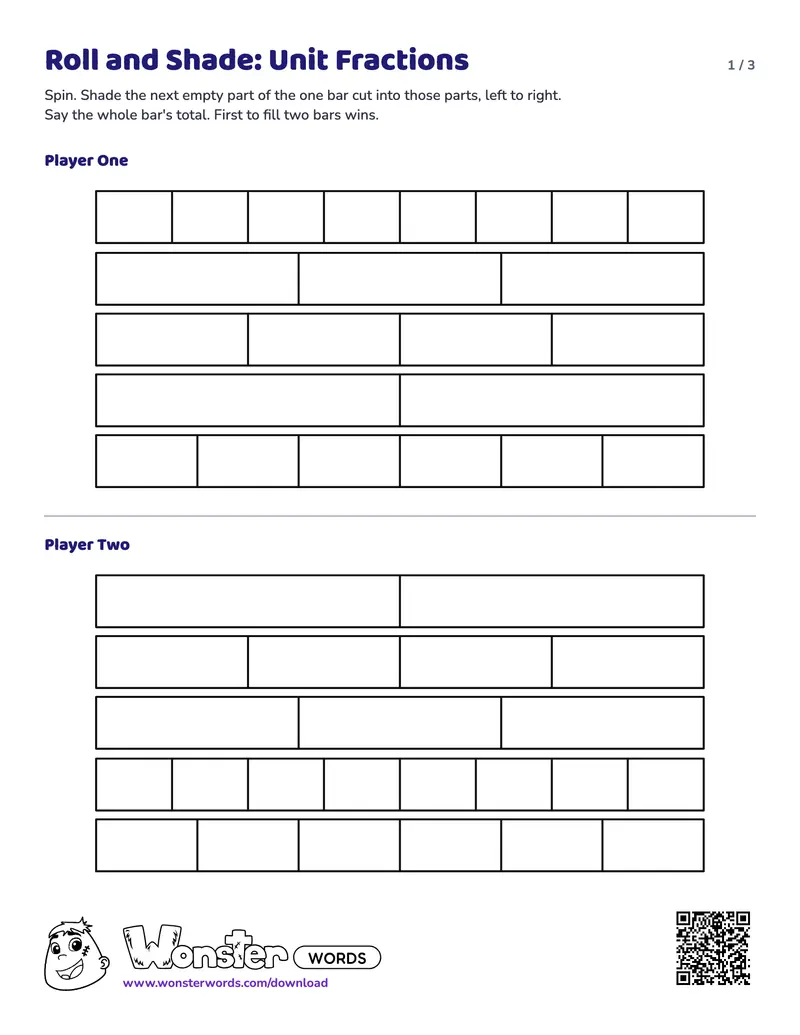
Roll and Shade: Unit Fractions is the third-grade version, played with written fractions. It practices unit fractions, the fractions with 1 on top, and building a whole from them. Each player has five bars of the same length, cut into 2, 3, 4, 6, and 8 parts. Spin a unit fraction and shade the next empty part of the one bar cut into those parts, working left to right. Then say the bar’s whole total, such as “three eighths”. A spin for a full bar is lost, and the first player to fill two bars wins.
The right answer names the shaded total in that bar’s own parts. A child who shades 4 of 8 parts and says “one half” is right about the amount. Say so, then ask for the name in this bar’s parts: four eighths.
Fraction bingo
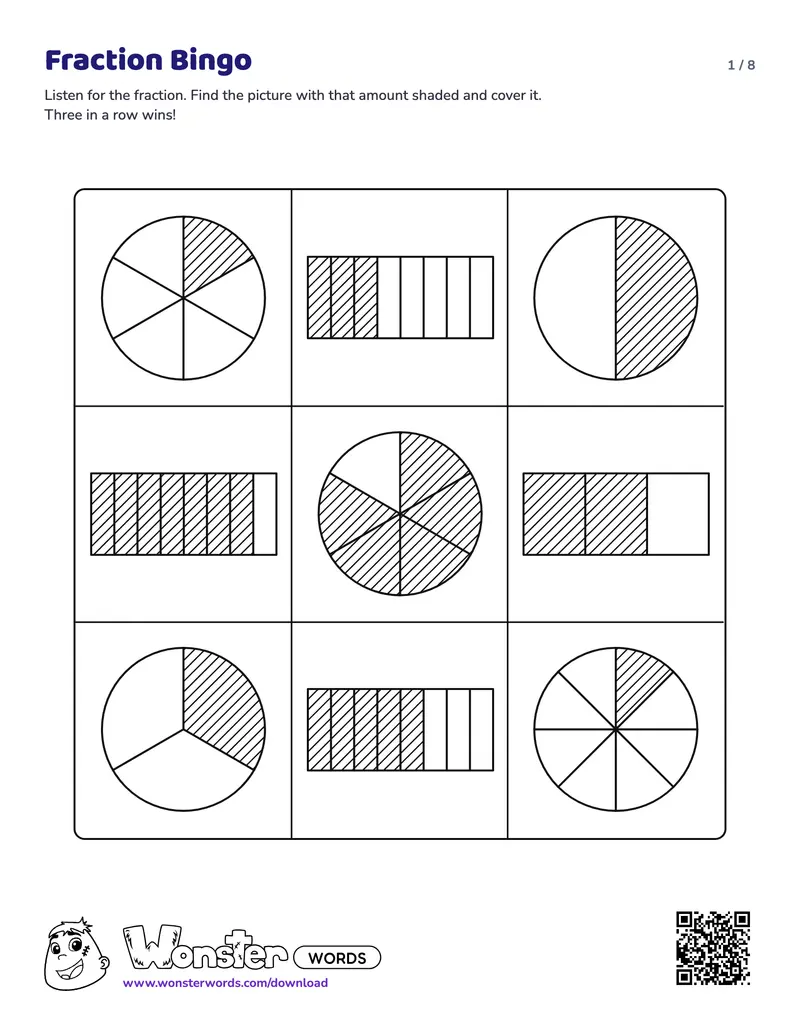
Fraction bingo is played with boards of shaded pictures and a caller deck of fractions. The caller reads a fraction, such as three fourths; each player finds the picture that shows that amount and covers it. Three in a row wins. A game ends after about five calls, which leaves time for three rounds.
Print
Print the three boards of shaded pictures, the page of covers for each board, and the page of 11 caller cards.
Cut
Cut out the covers and the caller cards. Coins or buttons work as covers too.
Deal
Give each player a different board and its covers, up to three players. Shuffle the caller cards and put them face down.
Call
The caller turns over the top card and reads the fraction aloud, such as "three fourths". The small picture on the card lets the caller check a cover.
Cover
Each player looks for the picture that shows that amount and covers it. Every board leaves out 2 of the 11 amounts, so a call can cover nothing on your board.
Three in a row
The first player with three in a row, across, down, or corner to corner, wins. Two players who finish on the same call both win. Play three rounds, swapping boards.
Every call in Fraction Bingo has at most one right cover. The deck holds 11 caller cards, one for each different amount, each in lowest terms, so 2/4 is never called. A board holds each amount no more than once.
Fraction line race
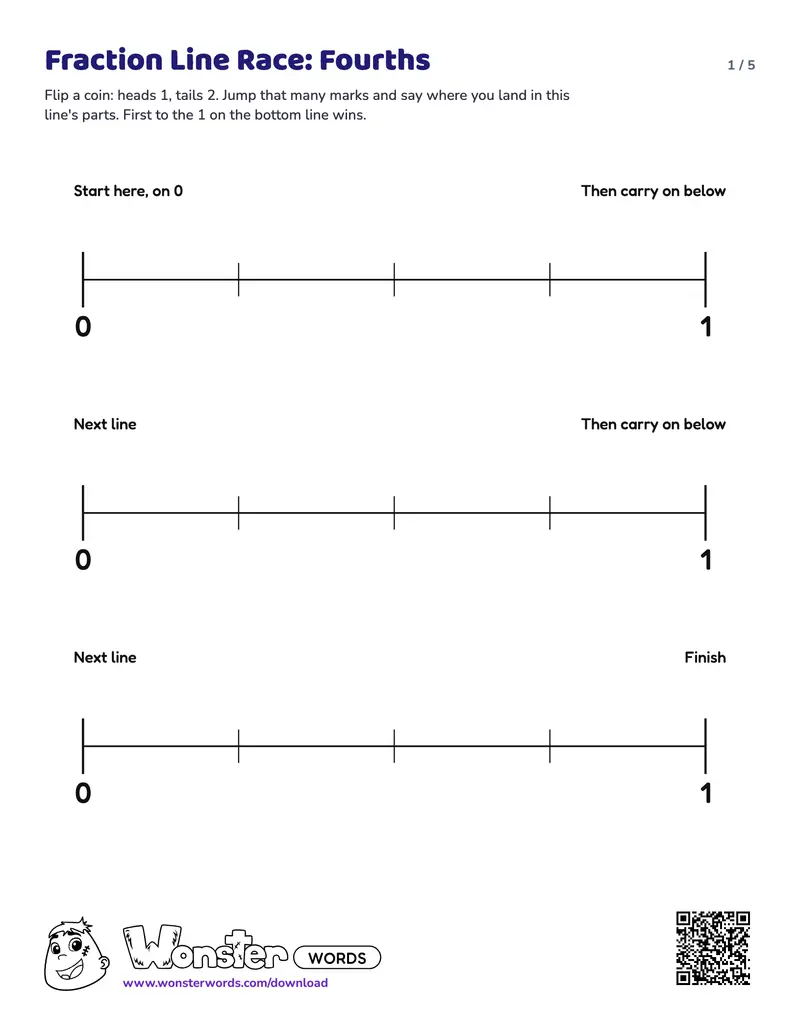
Fraction Line Race is the board game, played on number lines from 0 to 1. It practices fractions on a number line for third graders. The three boards are fourths, played with a coin (heads 1, tails 2); sixths, played with a spinner of 1, 2, and 3; and eighths, played with a die. Each board stacks three lines with every mark drawn and only 0 and 1 labeled.
Start on the 0 of the top line. Jump the number of marks you flip, spin, or roll, and say where you land in the line’s own parts, such as “five eighths”. A jump that starts on a line’s 1 or runs past it keeps counting on the next line down, from its first mark after 0. From seven eighths, a roll of 3 lands on two eighths of the next line. The first player to reach the 1 on the bottom line wins, and landing on it exactly is not required.
A roll and a position fix the landing mark, so each move has one right answer. The name is the mark’s own count, so the second mark on the fourths line is 2/4. A child on the fourth mark of the eighths line who says “one half” is right about the place. Agree, then ask for the name in eighths. A child on the last mark who reads the printed 1 is right too. Agree, then ask for it in the line’s own parts, such as four fourths.
Fraction dominoes
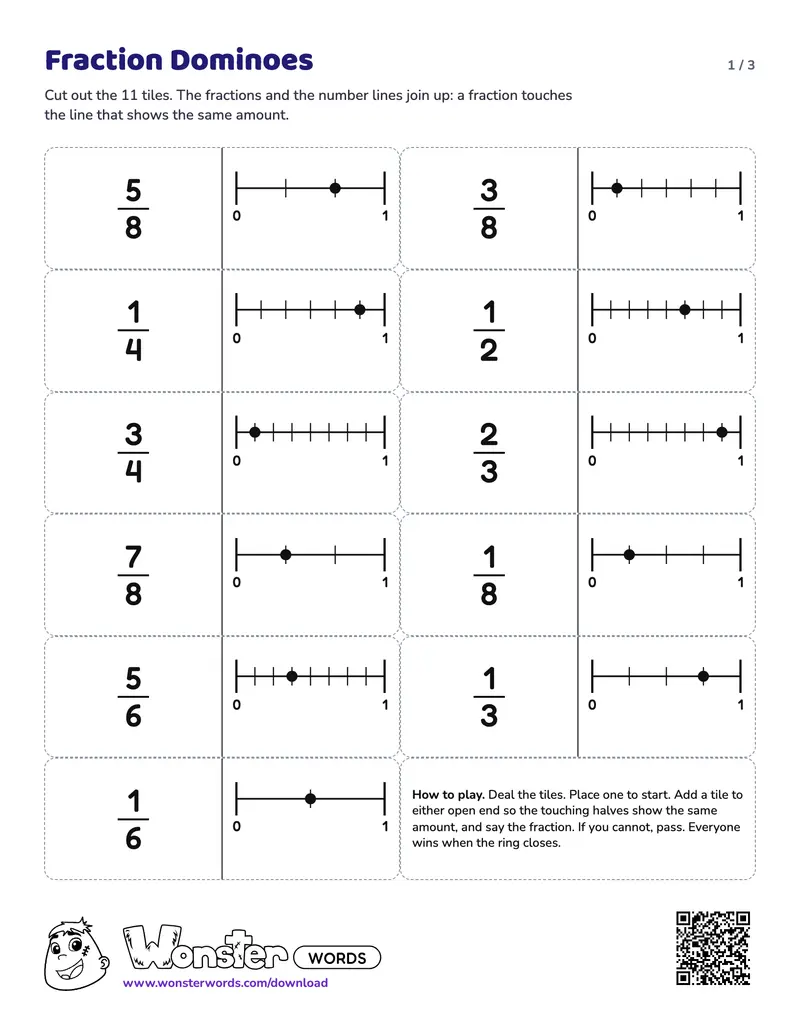
Fraction Dominoes is a cooperative game for third graders that joins each fraction to its place on a number line. Each of the 11 tiles has a written fraction on one half and a 0-to-1 line with one point marked on the other. Deal the tiles and place one to start. On your turn, add a tile to either open end so the two touching halves show the same amount, and say the fraction. If you cannot, pass. Everyone wins when the ring closes.
Each of the 11 amounts appears on exactly two half-tiles, once as a fraction and once as a point. Each open end therefore has exactly one partner in the whole set.
Fraction memory match
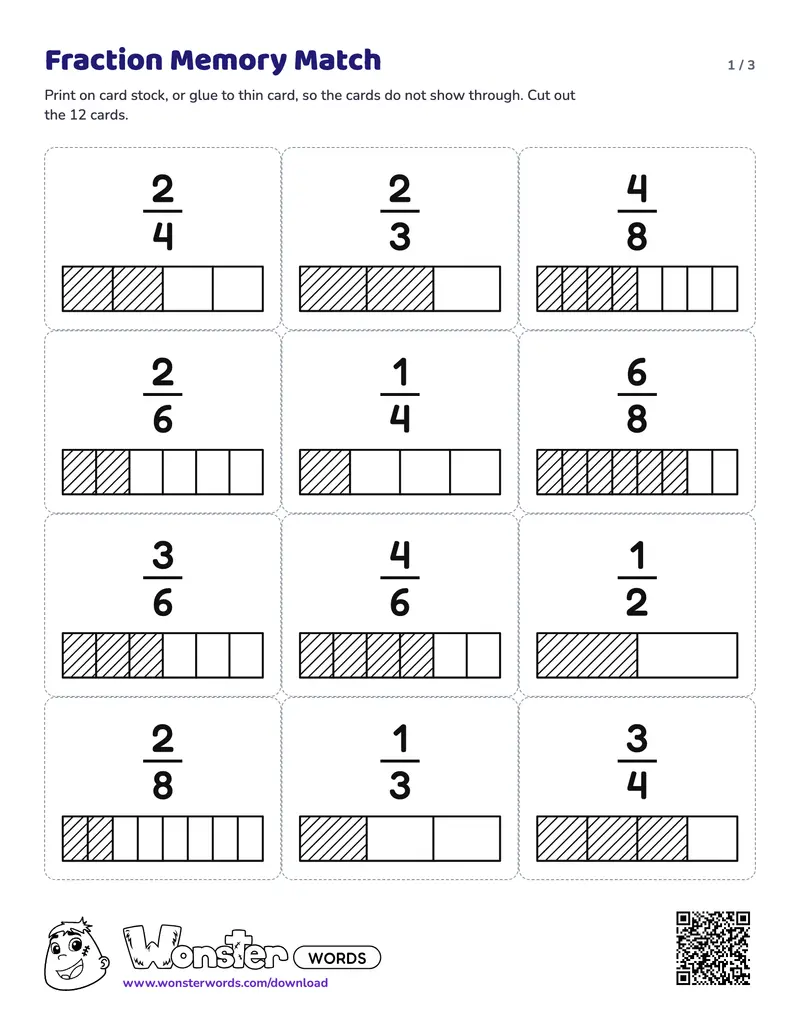
Fraction Memory Match is the game for third graders where equal fractions are the point. The deck is 12 cards, each a fraction above a bar shaded to show it: 1/2, 2/4, 3/6, 4/8, 1/3, 2/6, 2/3, 4/6, 1/4, 2/8, 3/4, and 6/8. Print it on card stock or glue it to thin card, so the cards do not show through.
Lay the cards face down and turn over two. If the shaded amounts are the same, say so, such as “two fourths and one half are the same amount”, keep the pair, and go again. The player with the most pairs wins. Two cards match when their amounts are equal, so 1/2 pairs with 2/4, 3/6, or 4/8. Every amount in the deck has an even number of cards, so no card is left over. The equivalent fractions page teaches the idea this game practices.
Free PDF · no sign-up
Feedback?Free printable fraction games for kids
Six free PDFs in black and white, with no account and no email, one game to a PDF, in the order children meet the ideas: two roll and shade games, bingo, a line race, dominoes, and memory match. Each ends with a page for grown-ups.
- Roll and Shade: Equal Shares (PDF)3 boards · 5 pages
Preview page 1Preview
- Roll and Shade: Unit Fractions (PDF)5 fractions · 3 pages
Preview page 1Preview
- Fraction Bingo (PDF)11 fractions · 8 pages
Preview page 1Preview
- Fraction Line Race (PDF)3 boards · 5 pages
Preview page 1Preview
- Fraction Dominoes (PDF)11 fractions · answer key included · 3 pages
Preview page 1Preview
- Fraction Memory Match (PDF)12 fractions · answer key included · 3 pages
Preview page 1Preview
If 1/2 and 2/4 are the same amount, what counts as a match?
A fraction game has to decide what counts as a match, because 1/2 and 2/4 name the same amount. With the third-grade bottom numbers 2, 3, 4, 6, and 8, the 18 fractions between 0 and 1 name only 11 different amounts. Five of those amounts have more than one name, and six have only one: 1/6, 5/6, 1/8, 3/8, 5/8, and 7/8.
A homemade memory deck with 1/2, 2/4, and 3/6 goes wrong in two ways: each card has two right partners, and three cards cannot all be paired. A fraction game has two honest fixes. It can keep one name per amount on the table, as fraction bingo and fraction dominoes do. Or it can make the same amount the rule and give every amount an even number of cards, as memory match does. Before you play any fraction game, ask whether two cards could both be right, and if they can, whether the rules say so. The reason two names share one amount is on the equal fractions page.
Which fraction games suit first, second, and third grade?
The fraction game that suits a child depends on what the child’s grade names: first and second graders name shares in words and pictures, and third graders write fractions as numbers. Every printed game on this page names fractions at or below 1, the range Texas sets in TEKS 3.3(A) and 3.3(B), while TEKS 3.7(A) states no limit.
| Grade | What children name | Common Core | Texas (TEKS) | Game to print |
|---|---|---|---|---|
| 1st | Halves and fourths of shapes, in words | 1.G.A.3 | 1.6(G) | Roll and Shade: Equal Shares, halves and fourths board |
| 2nd | Common Core adds thirds, in words. Texas names halves, fourths, and eighths, with thirds in third grade | 2.G.A.3 | 2.3(A) | Roll and Shade: Equal Shares, the thirds board (Common Core) or the eighths board (Texas) |
| 3rd | Written fractions with bottom numbers of 2, 3, 4, 6, and 8 | 3.NF.A.1–3 | 3.3(A)–(D), (F), (G), 3.7(A) | Roll and Shade: Unit Fractions, Fraction Bingo, Fraction Line Race, Fraction Dominoes, Fraction Memory Match |
A first or second grader who plays with shaded shapes and share names is practicing what the standards ask at that age, since neither framework asks for written fractions before third grade. The equal parts page teaches the shares these boards use. Younger brothers and sisters can play the whole-number math board games at the same table.
What fraction games can I play with my third grader at home?
A third grader can start with Roll and Shade: Unit Fractions, then play Fraction Bingo, Fraction Line Race, and Fraction Dominoes, and finish with Fraction Memory Match. Memory match comes last because it asks whether two different fractions are the same amount (Common Core 3.NF.A.3), and the other games name one fraction at a time.
Your child needs to know what the top and bottom numbers mean before the numerals make sense, and the numerator and denominator page covers that. To settle an argument during any game, lay out a fraction chart, fraction strips, or fraction circles and compare the two amounts.
Fraction games you can make with things at home
A fraction game you can make at home needs turns, a goal, and a winner or a shared win, and paper, a die, or a measuring cup is enough. Something with no turns and no goal is one of the hands-on fraction activities instead. Here are four games.
- Unit Fraction War (paper and a pencil, third grade). Each player writes 1/2, 1/3, 1/4, 1/6, and 1/8 on five cards and shuffles them. Both flip one card, and the greater amount wins the round. Say why: “One third is greater than one eighth, because thirds are larger pieces of the same whole.” If the cards are the same, nobody scores. After five flips, the player who won more rounds wins, and a tie means you both win. Every card has a 1 on top, and comparing fractions with the same top number is a Common Core third-grade skill (3.NF.A.3d). A deck of playing cards does not work here, because two cards can make 3/5 against 2/7, which is past third grade.
- Plate race (paper plates, markers, and a die). Fold each plate into 8 equal parts and draw along the folds. Roll the die, color that many parts, and say your total in eighths, such as “five eighths”. A roll that would overfill your plate is a pass. The first player to fill their plate exactly wins.
- Scoop guess (a 1/4 cup scoop, a 1 cup measure, and a bowl of rice). In turn, each player guesses how many 1/4 cups fill 1 cup. Take turns pouring a scoop while everyone counts. The closest guess wins, and equally close guesses both win. The count is 4. If you have a 1/3 cup scoop, guess again, and the count is 3.
- Floor line race (tape and a die). Tape a line from 0 to 2 in fourths on the floor. Roll, jump that many fourths, and say the fraction you land on. The first player to reach 2 wins. This race runs past 1, so save it for a child who has met the floor number line and fractions greater than 1.
On a family game night, fraction bingo and the printed line race each play with up to three. A homemade game costs a few minutes to make, and it gets the same check as a boxed one: ask whether two cards could both be right, and if they can, whether the rules say so.
Fraction games for kids who dislike math
A child who dislikes math can start with a fraction game whose names they already know, one game and a few minutes at a time, with no timer. For a first or second grader, that game is Roll and Shade: Equal Shares on the halves and fourths board. For a third grader, it is Roll and Shade: Unit Fractions.
Let your child be the caller in fraction bingo, the player who reads the cards and checks everyone’s covers. Choose fraction dominoes when winning feels out of reach, because everyone wins together when the ring closes. Stop while your child still wants another turn. A child who stays stuck after short practice needs the idea taught again. Start with when your child is struggling with fractions and your child’s teacher.
Do fraction games work better than worksheets?
The studies we read do not show whether a fraction game beats a worksheet for a first to third grader, so choose by the job: a game checks each turn at the table, and a worksheet leaves a written record. Either way, teach the idea first. A turn in a fraction game asks a child to name an amount, so a child who cannot yet name one has nothing to play with.
- A fraction game checks every turn at the table. The picture, the bar, or the line shows whether the fraction was right, and you hear each one your child says.
- A worksheet leaves a page you can look over afterward. The fraction worksheets by grade cover that half.
The studies we read that tested fraction games as the main activity worked with children in fourth grade or older. Gabriel and colleagues worked with children in grades 4 and 5, and Navarrete-Ulloa and Munoz-Rubke with fifth graders. For a younger child, a game is practice built on what school teaches at that grade.
Whichever game you choose, have your child say the fraction aloud on every turn.
Frequently asked questions
Are there board games that teach fractions?
A board game can give a child practice with fractions already met at school. A fraction line race is a board game you can print: players jump along number lines from 0 to 1 and say the fraction they land on. To check a boxed fraction board game, look at what happens on one turn. A turn should tie a fraction to an amount your child can see, and only one answer should be right.
What age group benefits most from fraction board games?
Match the game to what your child's grade names. First and second graders name halves, fourths, and thirds or eighths in words, so a game for them uses pictures and no numerals. Third graders write fractions as numbers, with bottom numbers of 2, 3, 4, 6, and 8, so a board game with numerals and number lines fits third grade.
How to create your own printable board game for teaching fractions?
Draw three rows of 8 squares, label only the last square of each row 1, and have players count to name a square in eighths. Players roll a die, move that many squares, and say the fraction they land on. The first to reach the last square wins. Using one bottom number means every square is named in eighths. Then ask of any cards you add whether two could both be right, and if they can, whether the rules say so.
Board games vs. card games for teaching fractions: which is better?
Choose by what your child is practicing. A board game on number lines practices where a fraction sits between 0 and 1, and a card game such as memory match practices which fractions are the same amount. Either one needs a check on every turn, which the picture, the bar, or the line provides.
Homemade fraction game vs. store-bought fraction game
A homemade fraction game costs a few minutes and paper, and you choose the fractions. A store-bought game lasts longer and needs no making. Hold both to the same test before you play: ask whether two cards could both be right, and if they can, whether the rules say so. A deck holding 1/2, 2/4, and 3/6 leaves one card without a pair, so add 4/8 and make the rule that any two equal amounts match.
Are online fraction games effective for learning?
Fazio and colleagues, Nuraydin and colleagues, and Bhatia and colleagues tested screen fraction games with children in fourth grade or older. Their studies do not say what a screen game does for a first to third grader. Judge a screen game by one turn: it should tie a fraction to an amount your child can see, with one right answer. A game at the table also lets you hear every fraction your child says.
Should 1/2 and 2/4 count as a match in a fraction memory game?
Yes, if the rule of the game is that two cards match when they show the same amount, because 1/2 and 2/4 are the same amount. Make that the stated rule before you start, and let any two equal cards pair up. A game with a fixed partner for each card would call a mathematically right pair wrong.
What qualities make a game good for teaching fractions?
A good fraction game ties every turn to an amount a child can see and check, such as a shaded picture, a bar, or a mark on a number line. It has exactly one right answer on each turn, it uses the fractions your child's grade names, and your child says the fraction aloud, so you can hear a wrong one.
What materials can be used to create homemade fraction memory games?
Index cards, or paper cut into cards, and a pencil and ruler are enough. Use 12 cards: 1/2, 2/4, 3/6, 4/8, 1/3, 2/6, 2/3, 4/6, 1/4, 2/8, 3/4, and 6/8. Under each fraction, draw a bar of the same width on every card and shade that fraction of it. Thick paper keeps the cards from showing through.
Related guides
Standards this page teaches: Common Core: 1.G.A.3, 2.G.A.3, 3.NF.A.1, 3.NF.A.2, 3.NF.A.3 · Texas: 1.6(G), 2.3(A), 3.3(A), 3.3(B), 3.3(C), 3.3(D), 3.3(F), 3.3(G), 3.7(A)
Last updated
Looking for something else?
Looking for something else?