
Math
Comparing Fractions
How to compare two fractions with the same top or bottom number, why both must be parts of the same whole, what comes next in fourth grade, the mistakes to watch for, and free worksheets.
Grade 3
To compare two fractions, find the number that matches. With the same bottom number (denominator), the larger top number is the greater fraction: 5/8 is greater than 3/8. With the same top number (numerator), the smaller bottom number is the greater fraction: 3/4 is greater than 3/8, because fewer pieces in the whole means larger pieces. Both rules hold only when the two fractions are parts of the same whole.
The same bottom number means same-size pieces, so count them. The same top number means the same count of pieces, so compare their size. Those two cases are third-grade work in the Common Core and in Texas. Comparing fractions when both numbers differ, as with 1/2 and 3/8, is the next step, in fourth grade. Free comparing fractions worksheets with answer keys practice the same bottom number, the same top number, number lines, and a mix, in black and white with no sign-up.
How do you compare fractions?
To compare two fractions, find the number that matches, then use the rule for that case. The numerator and denominator are the top and bottom numbers of a fraction.
| What matches | What it means | How to compare | Example | Grade |
|---|---|---|---|---|
| The bottom number (denominator) | The pieces are the same size | The larger top number is the greater fraction | 5/8 > 3/8 | 3rd, Common Core and Texas |
| The top number (numerator) | There are the same number of pieces | The smaller bottom number is the greater fraction | 3/4 > 3/8 | 3rd, Common Core and Texas |
| Neither number | The pieces differ in both count and size | Next step: make the bottoms match first | 1/2 > 3/8 | 4th, Common Core and Texas |
Copied onto paper, the table works as a comparing fractions anchor chart for a homework folder.
Comparing fractions that share a top or bottom number is third-grade work. The Common Core standard 3.NF.A.3d reads, “Compare two fractions with the same numerator or the same denominator by reasoning about their size.” Texas asks children to “compare two fractions having the same numerator or denominator in problems by reasoning about their sizes” (TEKS 3.3(H)).
Find the number that matches
Look at the two fractions and find the number they share. If they share the bottom number, use step 2. If they share only the top number, use step 3. If neither number matches, as with 1/2 and 3/8, stop here, because that comparison is fourth-grade work in the Common Core and in Texas.
Same bottom number: compare the tops
The pieces are the same size, so the larger top number is the greater fraction. The fraction 5/8 is greater than 3/8. If the top numbers match too, the two fractions are equal.
Same top number: compare the bottoms
There are the same number of pieces, so the smaller bottom number has the larger pieces and is the greater fraction. The fraction 3/4 is greater than 3/8.
Check the whole
Make sure both fractions are parts of the same whole, such as two bars of the same length. If the wholes are different sizes, the comparison does not hold.
Write the sign
Write >, <, or = between the two fractions, and read the sentence from left to right: 3/4 > 3/8 is read as three fourths is greater than three eighths.
Children record each comparison with >, <, or = and, in the Common Core’s words, “justify the conclusions, e.g., by using a visual fraction model.” What the greater than and less than signs mean has its own guide. When one number matches, two fractions are equal only when they are the same fraction written twice, such as 3/4 and 3/4. A top number of 0 is the one exception, as in 0/4 and 0/8, which both name 0. Whether 1/2 equals 2/4 is a question about equivalent fractions, which name one amount in two ways.
Why both fractions must be parts of the same whole
Comparing fractions only works when both fractions are parts of the same whole. The Common Core’s grade 3 standards, at 3.NF.A.3d, have children recognize that “comparisons are valid only when the two fractions refer to the same whole.” The writers of the Common Core show the trap in their Progressions with a small pizza on the left and a large one on the right: “A student might think that 1/4 > 1/2, because a fourth of the pizza on the right is bigger than a half of the pizza on the left.” When two fractions come from different things, ask “Half of what?” A larger denominator guarantees a smaller fraction only when the numerators match and the wholes are the same.
How do you compare fractions with the same denominator?
Comparing fractions with the same denominator means counting pieces, because the pieces are the same size. The fraction with the larger top number has more of those pieces, so it is the greater fraction. Compare 3/8 and 5/8: each piece is one eighth, 5 pieces are more than 3 pieces, and 5/8 is greater than 3/8. One piece, such as one eighth, is called a unit fraction. The writers of the Common Core say in their Progressions on fractions that with the same denominator, “the underlying unit fractions are the same size, so the fraction with the greater numerator is greater because it is made of more unit fractions.”
Both bars are the same length and both are cut into eighths, so the pieces are the same size. The bar for 5/8 has more of them shaded.
A child comparing 5 eighths with 3 eighths can reason as with 5 apples and 3 apples, because the word after the number is the same. A number line marked in eighths shows the same comparison as spaces counted from 0: 5/8 is 5 spaces along and 3/8 is 3. Putting three fractions with one denominator in order, such as 2/6, 5/6, and 3/6, is the same counting done again.
How do you compare fractions with the same numerator?
Comparing fractions with the same numerator means comparing the size of the pieces, because each fraction has the same number of them. Compare 3/4 and 3/8: each one is 3 pieces. A whole cut into 4 equal pieces has larger pieces than the same whole cut into 8. Three larger pieces are more than three smaller pieces, so 3/4 is greater than 3/8, even though 8 is greater than 4. The writers of the Common Core state the rule in their fractions Progressions: “for two fractions that have the same numerator, the fraction with the smaller denominator is greater.”
Both bars have 3 pieces shaded. Fourths are larger than eighths, so 3/4 is greater than 3/8.
Fractions with different denominators but the same numerator, such as 2/3 and 2/6, are this third-grade case: the smaller bottom number is the greater fraction, so 2/3 is greater than 2/6. Comparing 1/3 with 1/4 is the one-piece version of the same reasoning. Same-numerator pairs break the whole-number habit, because a child used to whole numbers expects 3/8 to win when 8 is greater than 4. Keep the wholes equal when you show it, because 3/8 of a large pizza can be more food than 3/4 of a very small one.
How do you compare fractions with different denominators?
Next step: fourth grade (4.NF.A.2). To compare fractions with different numerators and different denominators, make the bottom numbers match, then compare the tops. For 1/2 and 3/8, 1/2 is the same amount as 4/8, and 4/8 is greater than 3/8, so 1/2 is greater than 3/8. Children compare fractions like these in fourth grade in the Common Core and in Texas (TEKS 4.3(D)). The Common Core’s examples include making common denominators and asking whether each fraction is more or less than 1/2. Texas names no method. Making the bottoms match ends in the third-grade comparison: once both fractions share a denominator, the Progressions’ fourth-grade pages say “students can compare them using Grade 3 methods.”
How to explain greater than and less than with fractions
To explain greater than and less than with fractions, use two strips of paper cut the same length and two questions: “Are the pieces the same size? Are there the same number of pieces?” Mark one fraction on each strip, shade it, and lay the strips side by side. For 3/4 and 3/8, fold one strip into fourths and the other into eighths. The pieces are different sizes and each strip has 3 shaded, so piece size decides. For 3/8 and 5/8, the pieces match, so the count decides.
Have your child say the whole comparison: “Three fourths is greater than three eighths.” Say “greater than” rather than “bigger.” The What Works Clearinghouse 2021 guide on math intervention lists “Bigger, Smaller” among terms to replace, with “Greater Than, Less Than” in their place. Once your child can say the comparison, show which way the sign points.
Fraction strips and fraction circles do the same job as folded paper, as long as both pieces come from wholes of the same size. A fraction chart stacks the piece sizes one above the other. To turn the two questions into play, try the fraction games guide.
On a number line, a larger fraction sits farther to the right, as the guide to fractions on a number line shows. The Institute of Education Sciences suggests starting on number lines with the marks already drawn, in its 2010 fractions practice guide. It calls them useful “for locating and comparing fractions whose locations are indicated (e.g., 3/8 and 5/8 on a number line with eighths marked).” Its panel rates the number line recommendation as moderate evidence.
Common mistakes when comparing fractions
Three mistakes come up when comparing fractions, and each one has a fix.
- Treating the top and bottom as two whole numbers. The writers of the Common Core say in their Progressions for grades 3–5 that after years of comparing whole numbers, children “may initially say, ‘7 > 5, so 2/7 > 2/5.’” The Institute of Education Sciences writes, in its fractions practice guide, “Errors such as believing that 3/8 > 3/5 arise from comparing the two denominators and ignoring the essential relation between each fraction’s numerator and its denominator.” To fix it, shade 3/8 and 3/4 on strips of the same length and let your child see which shaded part is longer.
- Comparing parts of different wholes. A fourth of a large pizza can be more food than a half of a small one. Ask “Half of what?”, then draw both fractions on bars of the same length.
- Using a rule where neither number matches. The fraction 2/8 is less than 1/2 even though 2 is greater than 1, and 3/4 is greater than 1/2 even though 4 is greater than 2. The top number decides only when the bottoms match, and the bottom number decides only when the tops match. Ask which number matches before using either rule.
Free comparing fractions worksheets
The free comparing fractions worksheets are black-and-white PDFs for third grade. They practice the two comparisons a third grader is asked to make: the same top number or the same bottom number. Every denominator is 3, 4, 6, or 8, all on the Common Core’s list for grade 3.
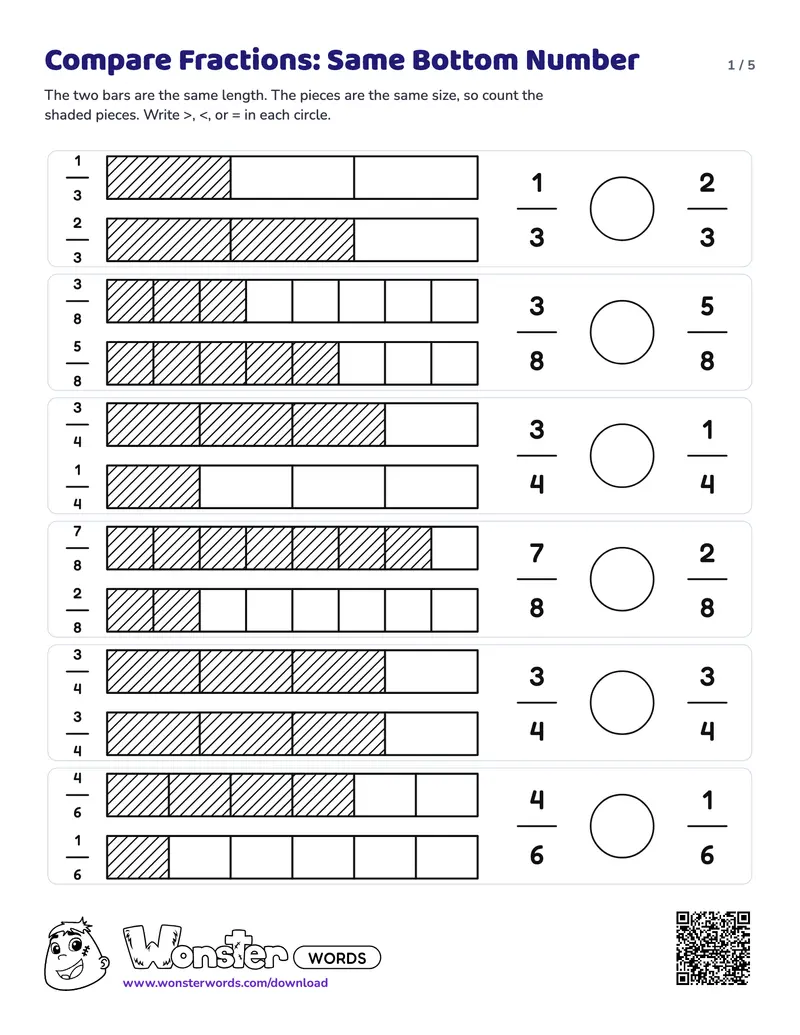
- Compare Fractions: Same Bottom Number, grade 3. Each item is two bars of the same length, one above the other, each with its fraction shaded. Your child writes >, <, or = between the two fractions.
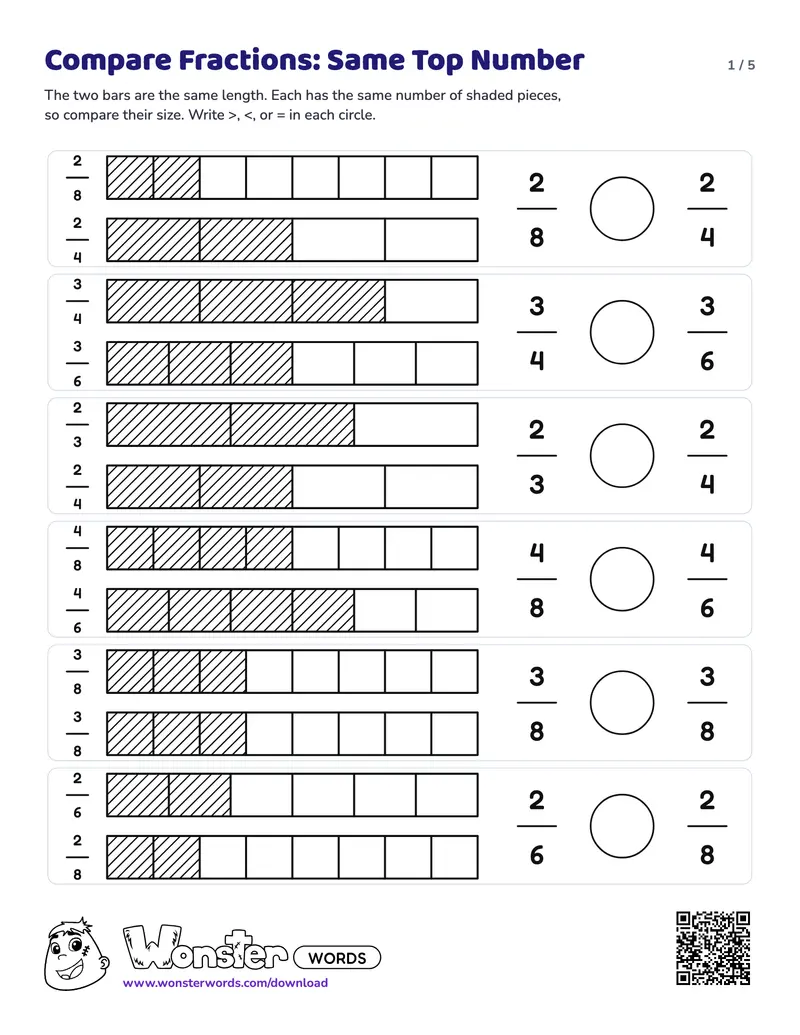
- Compare Fractions: Same Top Number, grade 3. The same layout, with top numbers greater than 1, so your child compares the size of the shaded pieces.
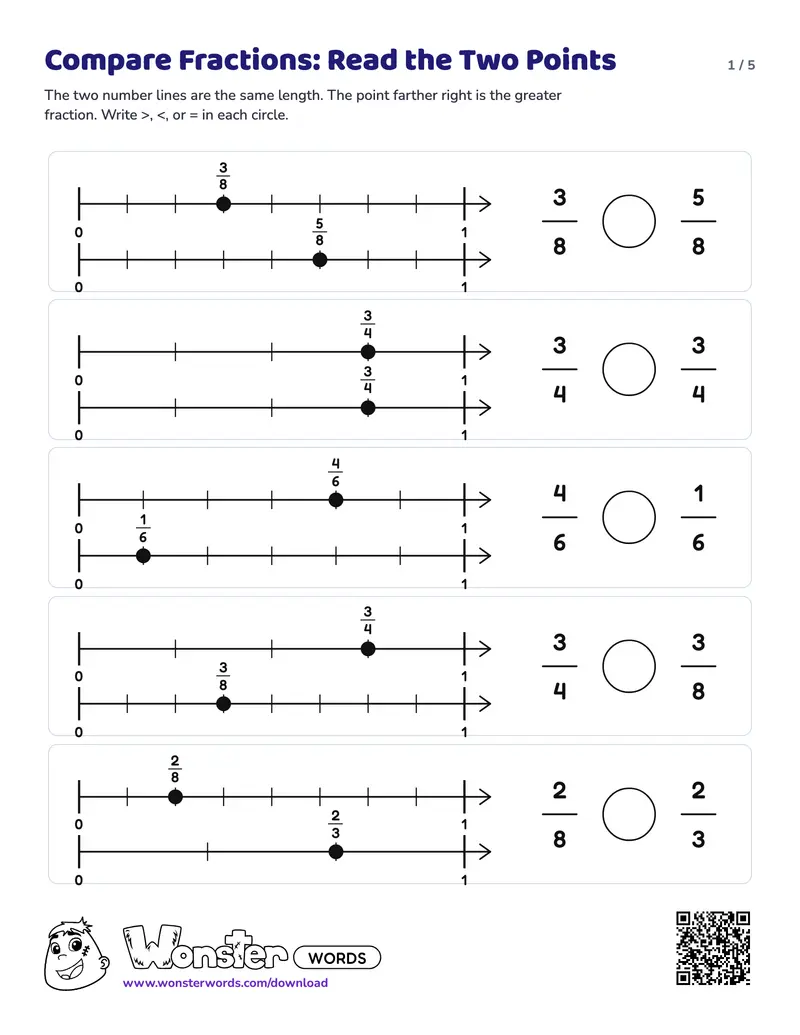
- Compare Fractions: Read the Two Points, grade 3. Each item is two number lines from 0 to 1, the same length, with each fraction’s point already marked and named. Your child writes the sign.
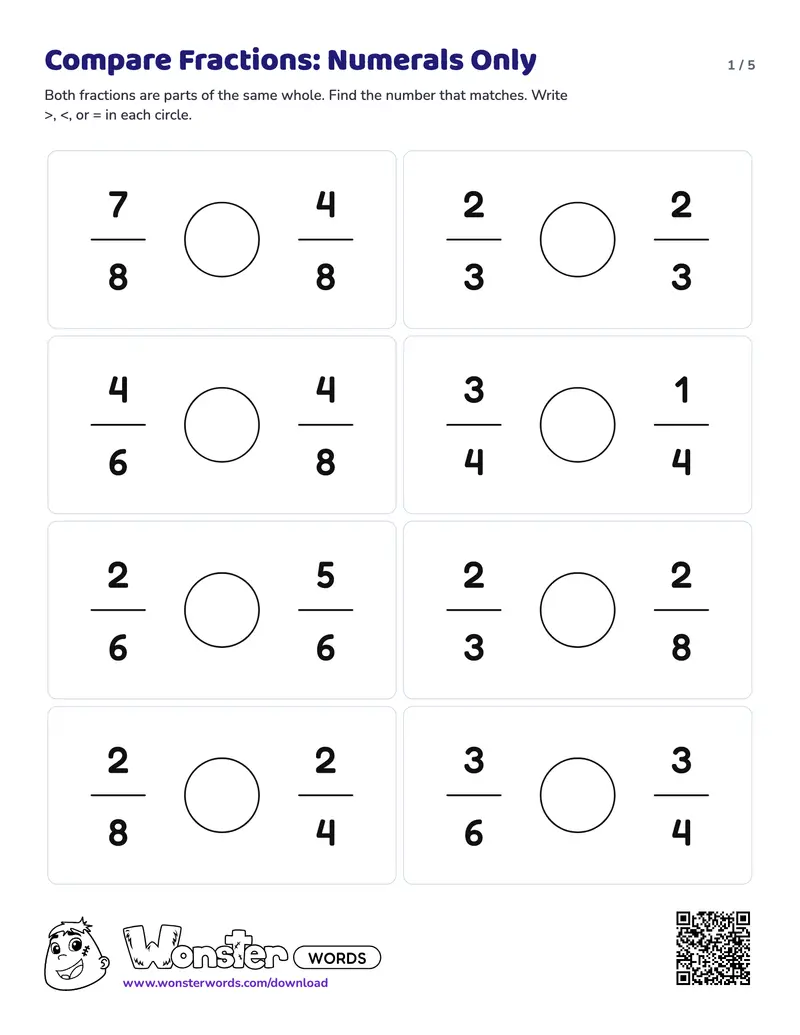
- Compare Fractions: Numerals Only, grade 3. Each item is two fractions with no picture. Your child decides which number matches, then writes the sign.
Every page has one equal pair, so = stays a real choice. The answer key pages write each sign in place, and a page for grown-ups closes each PDF. A wider set by grade is on the fraction worksheets page.
Free PDF · no sign-up
Feedback?Free comparing fractions worksheets
Free PDFs in black and white, with no account and no email: each one is three pages of one activity, an answer key, and a page for grown-ups.
- Compare Fractions: Same Bottom Number (PDF)18 pairs · answer key included · 5 pages
Preview page 1Preview
- Compare Fractions: Same Top Number (PDF)18 pairs · answer key included · 5 pages
Preview page 1Preview
- Compare Fractions: Read the Two Points (PDF)15 pairs · answer key included · 5 pages
Preview page 1Preview
- Compare Fractions: Numerals Only (PDF)24 pairs · answer key included · 5 pages
Preview page 1Preview
Frequently asked questions
Which is bigger, 3/4 or 3/8?
The fraction 3/4 is greater than 3/8 when both are parts of the same whole. Each fraction is 3 pieces, and a fourth is a larger piece than an eighth, so 3 fourths is more than 3 eighths. Draw both on bars of the same length, and the shaded part of 3/4 is twice as long.
How do numerator and denominator affect the comparison of fractions?
The denominator, the bottom number, sets the size of the pieces, and the numerator, the top number, sets how many pieces there are. When the denominators match, the larger numerator is the greater fraction. When the numerators match, the smaller denominator is the greater fraction. Both rules need the two fractions to be parts of the same whole.
How does changing the denominator affect the comparison between two fractions?
When the numerators match and the wholes are the same, a larger denominator makes a smaller fraction, because the whole is cut into more, smaller pieces. For example, 3/8 is less than 3/4. When the numerators differ, the denominator alone does not say which fraction is greater.
What grade level should students start learning about greater than and less than with fractions?
Children start comparing fractions in third grade under the Common Core (3.NF.A.3d) and the Texas standards (TEKS 3.3(H)), with fractions that share a top number or a bottom number. Fractions that differ in both numbers come in fourth grade in both frameworks. The greater than and less than signs arrive earlier, in first grade in both, for whole numbers (1.NBT.B.3 and TEKS 1.2(G)).
Why do students struggle with comparing fractions?
Students arrive after years of comparing whole numbers, the cause the writers of the Common Core name in their Progressions. A child may see that 8 is greater than 4 and decide that 3/8 is greater than 3/4. The Institute of Education Sciences traces the same error to comparing the two denominators and ignoring how each numerator relates to its denominator. Two strips of paper cut to the same length show the real sizes.
Why is it important to learn how to compare fractions?
Comparing fractions with the same top or bottom number is the base for fourth-grade comparing. The writers of the Common Core say in their Progressions that fractions rewritten with one denominator are compared using Grade 3 methods. Comparing also settles everyday questions, such as whether 3/4 cup of flour is more than 3/8 cup.
What strategies can parents use to help kids compare fractions at home?
Cut two paper strips the same length, shade one fraction on each, and lay them side by side. Ask whether the pieces are the same size and whether there are the same number of pieces. Have your child say the comparison as a sentence with greater than or less than, and ask what the whole is whenever two fractions come from different things.
Are there free ready-made comparing fractions worksheets for third graders?
Yes. This page has free black-and-white comparing fractions worksheets for third grade, with answer keys and no account or email. Children compare fractions that share a bottom number, fractions that share a top number, points on two number lines, and a mix with no pictures.
How can I explain comparing fractions with the same denominator to my child?
Tell your child that the pieces are the same size, so the fraction with more pieces is greater. Compare 5 eighths with 3 eighths the way you would compare 5 apples with 3 apples. Then cut two strips the same length into eighths, shade 5 on one and 3 on the other, and lay them side by side.
Why do fractions with the same numerator have different values?
Fractions with the same numerator have the same number of pieces, and the pieces are different sizes. The denominator sets the size. A whole cut into 8 equal pieces has smaller pieces than the same whole cut into 4, so 3/8 is less than 3/4. A numerator of 0 is the one exception, because 0/4 and 0/8 are both 0.
What grade levels typically learn to compare fractions with different denominators?
Children learn to compare fractions that differ in both numbers in fourth grade, in the Common Core (4.NF.A.2) and in Texas (TEKS 4.3(D)). Third graders already compare fractions with different denominators when the numerators match, such as 2/3 and 2/6, in both frameworks.
Related guides
Standards this page teaches: Common Core: 3.NF.A.3d · Texas: 3.3(H)
Last updated
Looking for something else?
Looking for something else?