
Math
Fractions on a Number Line
How to place a fraction on a number line, why fourths take 3 marks, what happens past 1, the mistakes to watch for, which grade learns it, and free worksheets.
Grade 3
To place 3/4 on a number line, cut the space from 0 to 1 into 4 equal parts, then count 3 of those parts from 0. The point where you stop is 3/4. The denominator, the bottom number, says how many equal spaces the whole from 0 to 1 is cut into. The numerator, the top number, says how many of those spaces to count.
A fraction on a number line is a distance from 0, counted in equal spaces, never a count of marks. That is why fourths take 3 marks between 0 and 1: the two ends are already there. A whole-number line works the same way, by counting the jumps and not the marks.
Fractions on a number line are a third-grade skill in the Common Core (3.NF.A.2) and in Texas (TEKS 3.3(A)–(B)), with denominators of 2, 3, 4, 6, and 8. Free worksheets and blank fraction number lines, with answer keys, are on this page.
How do you place fractions on a number line?
To place a fraction on a number line, name the whole first, cut it into equal spaces, then count spaces from 0. The Common Core standard 3.NF.A.2 says the same, in the order a child does it: define “the interval from 0 to 1 as the whole”, partition it into equal parts, then mark off “a lengths 1/b from 0”. These five steps work for any fraction a third grader meets on a line from 0 to 1.
Find 0 and 1
Find 0 and find 1 on the line. The whole is the space between them, not the whole line, so name both before you count anything.
Read the bottom number
The denominator, the bottom number, says how many equal spaces the whole is cut into. For 3/4 the bottom number is 4, so the space from 0 to 1 needs 4 equal spaces.
Draw one mark fewer
Draw one mark fewer than the denominator between 0 and 1, because the two ends are already there. Fourths take 3 marks, and 3 marks make 4 equal spaces.
Read the top number and count
Put a finger on 0. The numerator, the top number, says how many spaces to count. For 3/4, jump 3 spaces and say a number only when the finger lands.
Stop and mark the point
The point where you stop is the fraction. Mark it with a dot and write the fraction there.
Here is how the steps run on two fractions, and what changes when a line is already marked in a different denominator:
- 3/4 on a line in fourths. The bottom number is 4, so 3 marks make 4 equal spaces. Count 3 spaces from 0. The point is one space short of 1.
- 2/3 on a line in thirds. The bottom number is 3, so 2 marks make 3 equal spaces. Count 2 spaces from 0. The point is one space short of 1.
- 1/2 on a line marked in eighths. The line has no mark labeled 1/2, and a fraction does not need one. One half of 8 spaces is 4 spaces, so count 4 from 0 and stop on the middle mark, which is also 4/8.
Three fourths is three spaces of one fourth from 0, and two thirds is two spaces of one third. The dot is the fraction. The marks at 0 and 1 are longer and heavier than the fraction marks.
The fraction is the point where the count stops, and its distance from 0 is its size. The standard says the end of the counted length “locates the number a/b on the number line”, the way 7 is the point seven steps from 0 on a whole-number line. A unit fraction such as 1/4 is the first of those lengths: one space from 0.
How to draw the marks yourself
Draw one mark fewer than the denominator between 0 and 1. The two ends are already on the line, so the marks you add only cut up the space between them. The Institute of Education Sciences states the rule in its 2010 fractions practice guide: “dividing the number line into 1/n units requires drawing n – 1 hash marks”.
| Fraction family | Marks between 0 and 1 | Equal spaces |
|---|---|---|
| Halves | 1 | 2 |
| Thirds | 2 | 3 |
| Fourths | 3 | 4 |
| Sixths | 5 | 6 |
| Eighths | 7 | 8 |
To find the marks without measuring, cut a strip of paper as long as the space from 0 to 1 and fold it. Fold it in half for halves, in half again for fourths, and once more for eighths. Fold it in three for thirds, then in half for sixths. Lay the strip along the line and mark each crease.
Can a fraction be bigger than 1? Fractions greater than 1 on a number line
A fraction can be bigger than 1: when its top number is bigger than its bottom number, counting its spaces from 0 carries past 1. The steps work the same past 1, with one addition: draw the marks in every whole. To place 5/3, draw 2 marks between 0 and 1 and 2 more between 1 and 2, then count 5 spaces of one third. The count passes 1 at the third space, because 3/3 is 1, and stops two spaces later, between 1 and 2.
The count passes 1 at the third space, because 3/3 is 1, and stops two spaces later at 5/3. The marks at 0, 1, and 2 are longer and heavier than the marks for thirds.
The writers of the Common Core treat 5/3 as a third-grade fraction. Their Progressions say “there is no need to introduce ‘proper fractions’ and ‘improper fractions’ initially; 5/3 is what you get by combining 5 parts when a whole is partitioned into 3 equal parts”. Your child may still see the word improper on homework. It means only that the top number is as big as or bigger than the bottom number.
The What Works Clearinghouse sets the order in its 2021 guide for children who struggle with math: teach fractions less than one first, then “expand the 0–1 segment to 0–2 to depict fractions equal to and greater than one”. The guide’s reason is to keep a child from assuming every fraction is less than 1.
In Texas, TEKS 3.3(A) and (B) stay at fractions at or below 1, so 5/4 is outside those two standards. TEKS 3.7(A), on halves, fourths, and eighths as distances from zero, states no limit. Mixed numbers such as 1 2/3, the other way to write 5/3, come with fourth grade’s adding and subtracting (4.NF.B.3c).
How do you write a whole number as a fraction?
To write a whole number as a fraction, count its spaces in the fractions you are using, or put the number over 1. On a line in fourths, 1 is 4/4 and 2 is 8/4, because 4 spaces of one fourth reach 1 and 8 reach 2. The number 3 is also 3/1. The Common Core standard 3.NF.A.3c, “Express whole numbers as fractions”, gives this example: “locate 4/4 and 1 at the same point of a number line diagram”. Draw the mark at each whole number longer and heavier than the fraction marks, so a child sees where each whole ends.
Free fractions on a number line worksheets and blank fraction number lines
The free fractions on a number line worksheets are five PDFs, each one activity, in black and white, with no account and no email, in the order to use them:
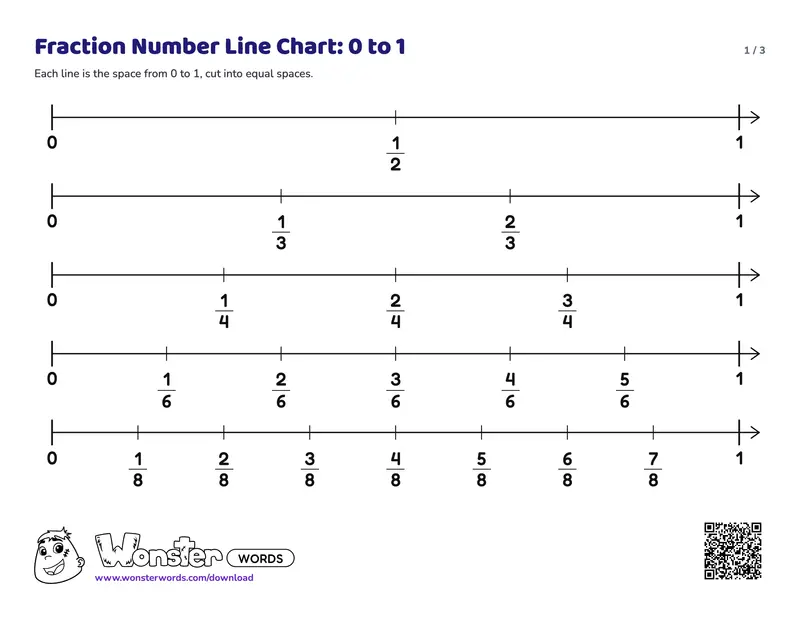
- Fraction Number Line Chart. Stacked lines from 0 to 1 in halves, thirds, fourths, sixths, and eighths with the marks lined up, and the same lines to 2 with the whole-number names. Keep it on the table. It has no answers to fill in.
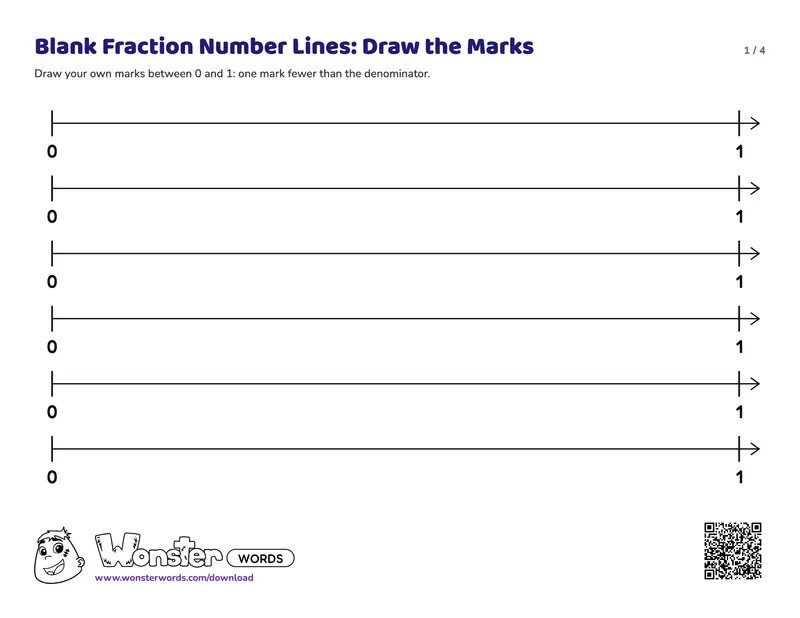
- Blank Fraction Number Lines. Lines with only 0 and 1 to draw your own marks, then lines already marked in halves, fourths, and eighths, and in thirds and sixths, with no labels.
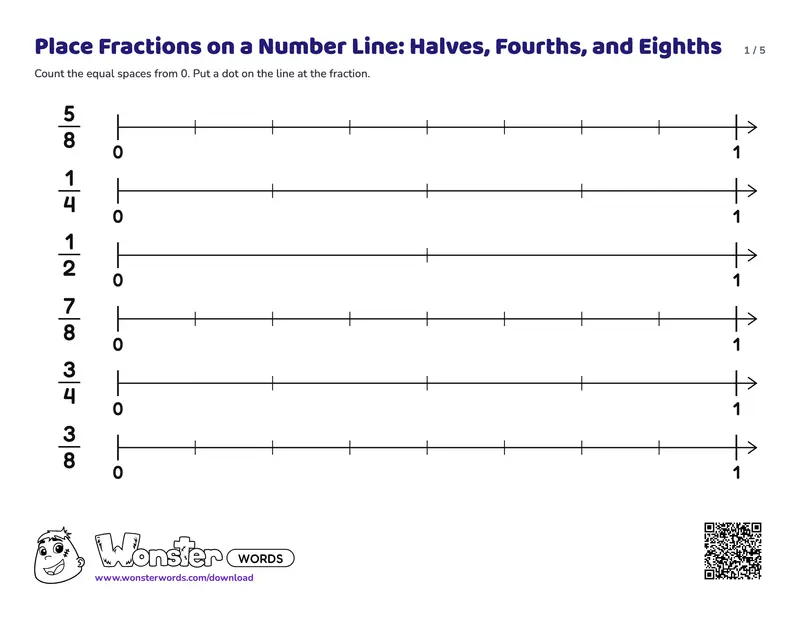
- Place Fractions on a Number Line. Each line is marked in equal spaces with a fraction beside it, and your child puts a dot at the fraction. An answer key follows the practice pages.
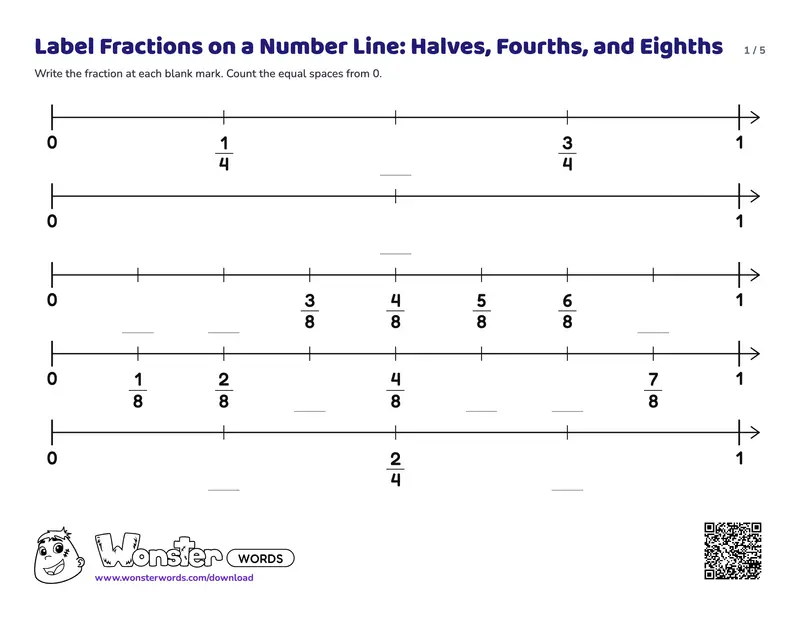
- Label Fractions on a Number Line. The marks are drawn and some are labeled, and your child writes the fraction at each blank mark, with a key.
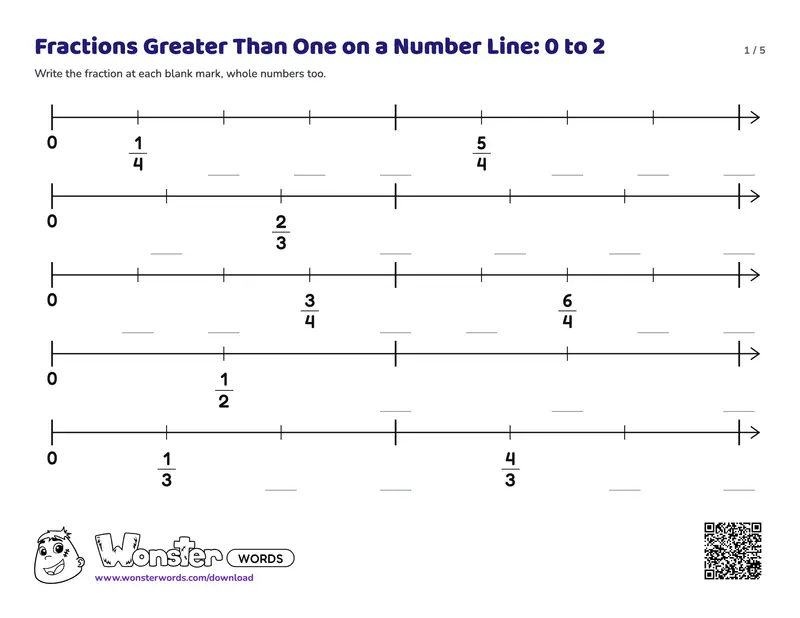
- Fractions Greater Than One on a Number Line. Lines from 0 to 2 and 0 to 3, with marks to label, every whole number among them, such as 4/4 at 1 and 8/4 at 2. This sheet is Common Core third grade, and TEKS 3.3(A) and (B) stay at or below 1. It has a key.
Print Place Fractions on a Number Line first for a child with a homework sheet tonight, and Label Fractions on a Number Line once placing is easy. A child can also draw their own marks on the blank sheet, one fewer than the denominator between 0 and 1. To make your own worksheet, write fractions beside the blank sheet’s lines that are already marked. A page for grown-ups closes every PDF. The label and greater-than-1 keys write each fraction in its line’s own denominator, so 2/4 stays 2/4 even though 1/2 is the same point. The place key puts a dot on each mark.
Free PDF · no sign-up
Feedback?Free fractions on a number line worksheets
Five free PDFs in black and white, with no account and no email, in teaching order: a stacked fraction number line chart, blank lines, place the fraction, label the fraction, and fractions greater than 1. The three practice sheets have answer keys.
- Fraction Number Line Chart (PDF)10 lines · 3 pages
Preview page 1Preview
- Blank Fraction Number Lines (PDF)18 lines · 4 pages
Preview page 1Preview
- Place Fractions on a Number Line (PDF)18 fractions · answer key included · 5 pages
Preview page 1Preview
- Label Fractions on a Number Line (PDF)15 lines · answer key included · 5 pages
Preview page 1Preview
Fraction sheets beyond the number line are sorted on the fraction worksheets by grade page.
Common mistakes with fractions on a number line
The fraction number line mistake to watch for first is drawing as many marks as the denominator: four marks for fourths. The Institute of Education Sciences fractions guide lists it among the roadblocks teachers meet.
- Four marks for fourths. Students draw “four hash marks rather than three”. Have your child count the spaces aloud after drawing: 3 marks make 4 spaces.
- Treating the whole line as the whole. The same roadblock names children who “treat the whole number line as the unit”. Name where 1 is before counting anything. Every line on these sheets runs past 1 with an arrow, so the end of the line is never the 1, and the place and label sheets print the 1 for your child to find first.
- Reading a fraction as two whole numbers. A child reads 3/4 as a 3 and a 4 and places it “between 3 and 4”. Have your child put 3 and 4 on a line from 0 to 4, find 3/4 between 0 and 1, and say why each one goes where it goes.
- Counting the marks instead of the spaces. A child who says “one” on the 0 and counts marks stops on 2/4 for 3/4, one space short. Put a finger on 0 and say a number only when the finger lands.
- Thinking 2/4 and 1/2 are two points. Label halves above the line and fourths below it, so both names sit on one mark.
How do you compare fractions on a number line?
On a number line, a larger fraction sits farther to the right. The Common Core’s fractions Progressions state the rule: of two points on the line, “the one to the left is said to be smaller and the one to its right is said to be larger”. With the same denominator, count spaces: 3/4 is less than 5/4, because 3 spaces of one fourth stop before 5 spaces do. The trap is the whole. The Common Core standard 3.NF.A.3d says “comparisons are valid only when the two fractions refer to the same whole”. Two fractions drawn on one line share one whole. The rest of comparing, including fractions with different bottom numbers, is in the comparing fractions guide.
How does a number line show equivalent fractions?
A number line shows equivalent fractions as two names for one point. Mark halves above a line from 0 to 1 and fourths below it, and 1/2 and 2/4 land on the same mark. The Common Core standard 3.NF.A.3a calls two fractions equivalent when they are “the same size, or the same point on a number line”, and Texas says the same in TEKS 3.3(G). Finding those fractions, and why they match, is the subject of the equivalent fractions guide.
One half above the line and two fourths below it name the same point, and 4/4 names the same point as 1.
Why do schools use a number line for fractions?
Schools use a number line because it shows a fraction as a number with a size, on the same line as the whole numbers. The Institute of Education Sciences tells teachers to “use number lines as a central representational tool”, and it rates the evidence Moderate, saying the evidence comes mostly from studies of number lines with whole numbers. A study by Hamdan and Gunderson, published in 2017 in Developmental Psychology, compared number line and area-model training with second and third graders. Each group improved on the model it practiced, and “only the number line training led to transfer to an untrained fraction magnitude comparison task”.
A pie chart or fraction circle shows a fraction as a part of one shape. A number line shows the same fraction as a point at a distance from 0, so 5/3 and 3/1 fit on it without drawing more circles. A bar or strip shows a fraction as a length too, and it stops at its own end, so a fraction past 1 needs a second bar.
Children start on the other pictures. The Common Core Progressions say that “initially they use other representations such as area representations, strips of paper, and tape diagrams”, and the line comes after. The fractions guide follows that order.
What grade learns fractions on a number line?
Children learn fractions on a number line in third grade, in the Common Core and in Texas, with denominators of 2, 3, 4, 6, and 8. Common Core second graders share shapes into halves, thirds, and fourths (2.G.A.3), and Texas second graders share objects into halves, fourths, and eighths (TEKS 2.3(A)). The number line guide shows which grades use a line for whole numbers. The fractions timeline shows what each grade does with fractions.
| Common Core | Texas (TEKS) | |
|---|---|---|
| Fractions as points on a line | 3.NF.A.2, 3.NF.A.2a–b | 3.3(A)–(B) and 3.7(A): halves, fourths, and eighths as distances |
| Whole numbers as fractions | 3.NF.A.3c | 4/4 is in range under 3.3(A); 3.3 names no whole number past 1 |
| Past 1 | In scope | Stays at or below 1 under 3.3(A)–(B) |
| Denominators | 2, 3, 4, 6, 8 | 2, 3, 4, 6, 8 |
TEKS 3.3(A) and (B) put the limit in the words “greater than zero and less than or equal to one”.
How can parents help children understand fractions on a number line?
Parents can help children understand fractions on a number line with five routines of a few minutes each, using things already at home. Each one is the same idea on a real object: equal spaces, counted from 0.
- A ruler. The Progressions for fractions suggest thinking of a number line as “an infinite ruler”. Find the quarter-inch marks between 0 and 1 and count 3 of those spaces to 3/4 inch. Third graders measure to the half and quarter inch under standard 3.MD.B.4.
- A measuring cup. Pour a quarter cup of water at a time, saying 1/4, 2/4, 3/4, and 4/4. Keep going to 5/4 cups, which is more than 1 cup and less than 2, the kind of amount the Institute of Education Sciences guide suggests talking through.
- A folded strip. Fold a strip of paper into fourths, lay it along a line from 0 to 1, and mark each crease.
- A floor line. Put painter’s tape on the floor like a floor number line, with 0, 1, and 2 a big step apart and a mark halfway between each. Your child walks 3 halves from 0 and stops at 3/2.
- A clothesline. Tie a string between a 0 card and a 1 card and hang 1/2, then 1/4 and 3/4, then ask where 7/8 goes. The Institute of Education Sciences guide suggests lines marked only with 0, 1/2, and 1 because they make a child think about where a fraction sits.
To tell whether it has clicked, ask your child to put 2/3 on a blank line from 0 to 1 and say how they knew. Listen for 3 equal spaces and a count of 2 from 0. A roll-and-jump race along the floor line turns the same practice into a game, and Fraction Line Race, on the fraction games page, is a version to print.
Frequently asked questions
How are fractions represented on a number line?
A fraction on a number line is a point at a distance from 0. The space from 0 to 1 is cut into as many equal spaces as the bottom number says, and the top number says how many of those spaces to count from 0. The point where the count stops is the fraction, so 3/4 is three spaces of one fourth from 0.
How can unit fractions be represented on a number line?
A unit fraction, such as 1/4, is one space from 0 on a number line. Cut the space from 0 to 1 into as many equal spaces as the bottom number says, and the end of the first space is the unit fraction. On a line in fourths that first mark is 1/4, and on a line in eighths it is 1/8.
Why do students struggle with fractions on number lines?
Students often struggle because they attend to the marks instead of the lengths between them, the cause the Common Core writers name in their Progressions. A child may draw four marks for fourths, treat the whole line as the whole instead of the space from 0 to 1, or put 3/4 between 3 and 4 by reading it as two whole numbers. The Institute of Education Sciences lists these difficulties in its 2010 fractions practice guide.
How do I find equivalent fractions using a number line?
Draw one number line from 0 to 1, mark halves above it and fourths below it, and look for two names on one mark. The mark for 1/2 is also the mark for 2/4, so those two fractions are equivalent. Two fractions are equivalent when they land on the same point of the same line.
What grade levels are best suited for introducing fractions on a number line?
Third grade is when fractions on a number line are taught, in the Common Core (3.NF.A.2) and in Texas (TEKS 3.3). Both limit third graders to denominators of 2, 3, 4, 6, and 8. Second graders share shapes and name parts such as halves and fourths before fractions go on a number line in third grade.
What games can be used to teach fractions on a number line?
A race along a number line taped to the floor is a simple fraction game. Mark the tape from 0 to 2 in fourths, roll a die, and jump that many fourths, saying the fraction you land on. The first player to reach 2 wins. Hanging fraction cards on a clothesline between a 0 card and a 1 card is another.
How to assess understanding of fractions on number lines in kids
Ask your child to put 2/3 on a blank line from 0 to 1 and to say how they knew. A child who understands draws 2 marks, makes 3 equal spaces, and counts 2 spaces from 0. Ask next where 5/3 goes on a line from 0 to 2. Counting marks instead of spaces shows the idea is not there yet.
Number line vs. bar model for comparing fractions
A number line puts both fractions on one line, so the fraction farther to the right is the larger one. A bar model shows each fraction as part of a bar, and the comparison holds only when both bars are the same length. Schools use both, because each shows a fraction a different way, and a child can draw 3/4 and 2/3 either way.
How is 5/3 represented on a number line?
Five thirds, 5/3, is the point five spaces of one third from 0. Cut the spaces from 0 to 1 and from 1 to 2 into thirds, count 5 spaces from 0, and stop. The count passes 1 at the third space and stops two spaces later, between 1 and 2.
Why is 4/4 equal to 1?
Four fourths equal 1 because four spaces of one fourth reach exactly from 0 to 1. On a number line 4/4 and 1 are the same point. The Common Core asks third graders to locate 4/4 and 1 at the same point of a number line diagram, in standard 3.NF.A.3c.
Can every whole number be expressed as a fraction?
Yes, every whole number can be written as a fraction, by putting it over 1 or by counting its spaces in fourths or any other size. The whole number 3 is 3/1, and on a line in fourths it is 12/4, because 12 spaces of one fourth reach 3.
Why is 5/3 considered an improper fraction?
A fraction is called improper when its top number is as big as or bigger than its bottom number. The top number of 5/3 is bigger than its bottom number, so 5/3 is more than 1 whole. Nothing is wrong with such a fraction, and it is a point on a number line like any other.
Related guides
Standards this page teaches: Common Core: 3.NF.A.2, 3.NF.A.2a, 3.NF.A.2b, 3.NF.A.3c · Texas: 3.3(A), 3.3(B), 3.7(A)
Last updated
Looking for something else?
Looking for something else?