
Math
Equivalent Fractions
What equivalent fractions are, a chart for 1/2, 1/3, 2/3, 1/4, and 3/4, how to find them with a model and on a number line, why the multiply rule works, and free worksheets.
Grade 3
Equivalent fractions are fractions that name the same amount, such as 1/2 and 2/4. The Common Core’s test is that the two fractions are the same size, or sit at the same point on a number line. To find one, cut every piece of a fraction into the same number of smaller pieces, then count. Cut both halves of a bar in two and 1/2 becomes 2/4. The amount stays the same, and only the number and size of the pieces change.
Written in numbers, that cut is multiplying the top and the bottom by the same number, a rule the Common Core places in fourth grade. Third graders draw it, as part of the fractions they learn in third grade. This guide has a chart of the equivalents of 1/2, 1/3, 2/3, 1/4, and 3/4. Three free worksheets cover models, number lines, and the chart, all in black and white with no sign-up.
What are equivalent fractions?
Equivalent fractions are fractions that name the same amount, even though their numbers are different. The Common Core standard 3.NF.A.3a asks third graders to “understand two fractions as equivalent (equal) if they are the same size, or the same point on a number line.” The word “equivalent” means equal in amount.
The amount stays the same, and only the number and size of the pieces change. Cut each half of a bar in two and 1/2 becomes 2/4: twice as many pieces, each half as big, and the same amount shaded. Fourth grade’s standard, 4.NF.A.1, puts it this way: “how the number and size of the parts differ even though the two fractions themselves are the same size.”
Each half was cut in two: twice as many pieces, each half as big, and the same amount shaded.
The top and bottom numbers of the two fractions are different, and the shaded part of the bar is not. Point at the shaded part of each bar: that is the part that stayed the same.
Equivalent fractions are not the same thing as comparing fractions. Comparing fractions asks which of two fractions is larger, and equivalent fractions name one amount twice.
Equivalent fractions chart: what fractions are equivalent to 1/2, 1/3, 2/3, 1/4, and 3/4?
This equivalent fractions chart lists the fractions that name the same amount as 1/2, 1/3, 2/3, 1/4, and 3/4. The first column of answers uses only the denominators third graders meet, and the Common Core limits grade 3 to 2, 3, 4, 6, and 8. The last column is for older students looking up a fraction.
| Fraction | Equivalent fractions a third grader meets (denominators 2, 3, 4, 6, 8) | Past grade 3 (denominators 9, 10, 12, 16) |
|---|---|---|
| 1/2 | 2/4, 3/6, 4/8 | 5/10, 6/12, 8/16 |
| 1/3 | 2/6 | 3/9, 4/12 |
| 2/3 | 4/6 | 6/9, 8/12 |
| 1/4 (one fourth, also called one quarter) | 2/8 | 3/12, 4/16 |
| 3/4 | 6/8 | 9/12, 12/16 |
- Fractions equivalent to 1/2 include 2/4, 3/6, and 4/8.
- Fractions equivalent to 1/3 include 2/6, 3/9, and 4/12.
- Fractions equivalent to 2/3 include 4/6, 6/9, and 8/12.
- Fractions equivalent to 1/4 include 2/8, 3/12, and 4/16.
- Fractions equivalent to 3/4 include 6/8, 9/12, and 12/16.
Between 0 and 1, the third-grade denominators make five families of equivalent fractions and only five. They are the five rows of this table. Six fractions between 0 and 1 have no partner among those denominators: 1/6, 5/6, 1/8, 3/8, 5/8, and 7/8. Each of those six has an equivalent with a larger denominator, such as 2/12 for 1/6, but not one with a denominator of 2, 3, 4, 6, or 8.
To make an equivalent fractions anchor chart for a wall or a homework folder, copy these five rows onto a sheet of paper. A printable chart is with the worksheets on this page. A fraction wall, which stacks strips for halves, thirds, fourths, and smaller pieces under one whole, shows the same families as edges that line up.
How to find equivalent fractions with a model, step by step
To find an equivalent fraction with a model, draw the fraction on a bar, cut every piece into the same number of smaller pieces, and count again. A model is a drawing that shows the fraction, usually a bar or a circle. The standard 3.NF.A.3b asks third graders to “explain why the fractions are equivalent, e.g., by using a visual fraction model.” Texas asks children to represent equivalent fractions “using a variety of objects and pictorial models, including number lines” (TEKS 3.3(F)). Here are the steps for 2/3.
Draw and shade the fraction
Draw a bar and cut it into equal pieces, as many as the bottom number of the fraction. Shade as many pieces as the top number. For 2/3, draw 3 equal pieces and shade 2.
Cut every piece
Cut every piece into the same number of smaller equal pieces, shaded pieces and unshaded pieces alike. For 2/3, cut each of the 3 pieces in two.
Count the pieces
Count all the pieces for the new bottom number, and count the shaded pieces for the new top number. For 2/3, there are now 6 pieces and 4 are shaded, so the new fraction is 4/6.
Check the shaded amount
Read the new fraction and check that the shaded amount has not moved. The shaded part of 4/6 ends at the same place as the shaded part of 2/3, so 2/3 and 4/6 are equivalent.
Each third was cut in two, which makes 6 pieces with 4 shaded. The shaded amount did not move, so 2/3 and 4/6 are equivalent.
Every smaller piece is a unit fraction, one piece of a whole cut into equal parts: 1/3 before the cut and 1/6 after it. A third grader needs only a pencil to do this, because the drawing does the work.
To check whether two fractions are equivalent, draw them on two bars the same size and see whether the shaded parts end at the same place. Bars for 2/3 and 4/6 line up. Bars for 2/3 and 3/4 do not, so those two fractions are not equivalent. The bars must be the same size, because half of a small bar is not the same amount as half of a large one. Texas says the same thing: two fractions are equivalent if they “represent the same portion of a same size whole for an area model” (TEKS 3.3(G)).
How to find equivalent fractions on a number line
Equivalent fractions on a number line sit at the same point. Draw a number line from 0 to 1 cut into halves. Under it, draw a second line the same length cut into fourths, and a third cut into eighths. The mark for 1/2 on the top line sits directly above 2/4 on the second line and 4/8 on the third, so those three are equivalent fractions.
The dashed line passes through 1/2, 2/4, and 4/8 at the same point, the middle of the line from 0 to 1. Three names, one amount.
That is the Common Core’s second test, the same point on a number line. The Texas standards ask children to explain that two fractions are equivalent when they are “both represented by the same point on the number line.” The writers of the Common Core say in the 2023 edition of their Progressions that as third graders experiment, “they discover that many fractions label the same point on the number line.”
A single line can carry both names. The panel behind the Institute of Education Sciences’ 2010 fractions practice guide recommends number lines and writes that they “can be used to illustrate that equivalent fractions describe the same magnitude.” The panel rates that recommendation as moderate evidence, and the evidence comes mostly from studies of whole numbers. The guide suggests writing one set of labels above the line and another below it, such as halves above and eighths below. A child can then see that 1/2 and 4/8 share a mark. How to place a fraction on a number line in the first place has its own guide.
Why do you multiply the top and bottom to find equivalent fractions?
Next step: fourth grade (4.NF.A.1). The shortcut for finding equivalent fractions, multiplying the top and the bottom by the same number, works because the multiplying is the cutting. Multiply the top and the bottom of 2/3 by 2: 2 × 2 = 4 and 3 × 2 = 6, so 2/3 = 4/6.
Cut each third of a bar into 2 smaller pieces and there are twice as many pieces in all and twice as many shaded ones. The Common Core writers say in their Progressions on fractions that multiplying the top and the bottom by the same number “corresponds to partitioning each piece of the diagram” into that many “smaller equal pieces.”
The Common Core’s third-grade standard asks for the drawing. Fourth grade adds the rule, and the Common Core grade 4 standard still asks children to explain it “by using visual fraction models.”
How to explain equivalent fractions to a child
Explain equivalent fractions with one strip of paper and two questions: “Is it still the same amount? What changed?” Fold a strip in half and shade one half. Then fold it in half again, open it, and count: 4 pieces, 2 of them shaded. Fold it a third time and there are 8 pieces, 4 of them shaded. The shading never moved, so 1/2, 2/4, and 4/8 name the same amount. The Progressions list strips of paper among the models that “can be subdivided,” which is what a fold does.
Food works the same way. The Institute of Education Sciences guide uses four pizzas shared among eight children. Cut every pizza into eighths and each child gets 4/8 of a pizza. Cut every pizza into fourths and each child gets 2/4, and cut every pizza in half and each child gets 1/2. Each child gets the same amount, whichever way the pizzas are cut.
Fraction strips, one of the math manipulatives schools use, and fraction circles do the same job as the folded paper.
For a 5-minute game, write 1/2, 2/4, 3/6, 4/8, 1/3, and 2/6 on cards. Your child sorts the cards into the two groups that name the same amount, and a folded strip checks the answer. Fraction Memory Match, a printed game on the same idea, is with more fraction games.
Why are equivalent fractions important?
Equivalent fractions are important because later fraction work is built on them. The Common Core writers call the multiply rule “a fundamental property of equivalent fractions” in the writing team’s Progressions. The property “forms the basis for important work in Grade 4, including the comparison of fractions.” In fifth grade, children add fractions with different bottom numbers by replacing them with equivalent fractions, under standard 5.NF.A.1.
Equivalent fractions also show up in recipes and measuring. A recipe that calls for 1/2 cup of flour can be measured with two 1/4 cups, because 1/2 = 2/4.
A third grader who understands equivalent fractions can call one amount by many names: 1/2, 2/4, 3/6, and 4/8 are four names for the same amount.
Common mistakes when finding equivalent fractions
Reading the two numbers in a fraction as separate whole numbers is a common fraction mistake, and it can make 2/4 look bigger than 1/2. The Institute of Education Sciences fractions guide calls this “a common misconception” and gives the example of placing 3/4 between 3 and 4 on a number line.
- Reading 2/4 as bigger than 1/2, because 2 and 4 are bigger numbers than 1 and 2. Draw both on bars the same size, and let your child see that the shaded parts end at the same place.
- Not seeing that two equivalent fractions are one point on a number line. The Institute of Education Sciences guide names this as well. Write halves above the line and eighths below it, then point at the mark that has both 1/2 and 4/8.
- Comparing parts of different wholes. Half of a small pizza is not the same amount as half of a large one. Standard 3.NF.A.3d says comparisons are “valid only when the two fractions refer to the same whole.” Draw both bars the same size.
- Cutting unequal pieces. A bar cut into 4 pieces of different sizes does not show fourths. Fold the paper, or measure with a ruler, so that every piece is the same size.
Free equivalent fractions worksheets with answer keys
The free equivalent fractions worksheets are three black-and-white PDFs for third grade: a models sheet, a number line sheet, and a chart. Both practice sheets stick to the denominators 2, 3, 4, 6, and 8, and neither one asks a child to multiply.
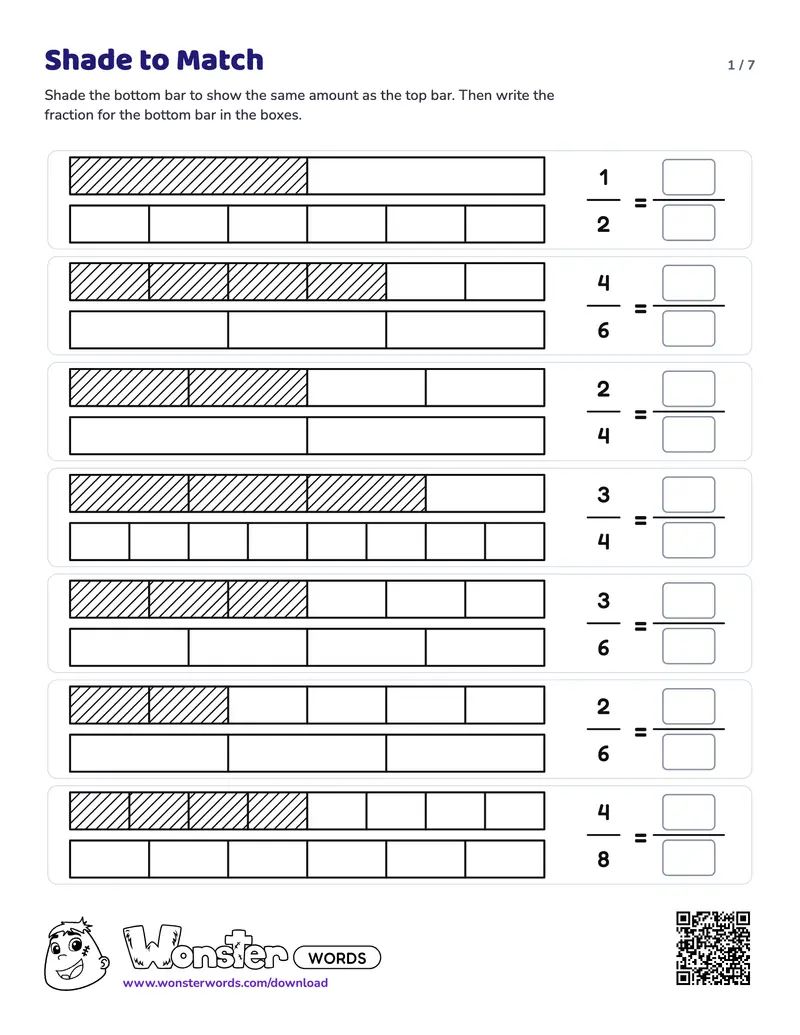
- Equivalent Fractions: Shade to Match, grade 3. Each item is two bars of the same length. The top bar is shaded and named, and your child shades the same amount on the bottom bar and writes the fraction.
- Equivalent Fractions: Same Point, New Name, grade 3. Each item is two number lines from 0 to 1. Your child marks the same point on the bottom line and writes its new fraction.
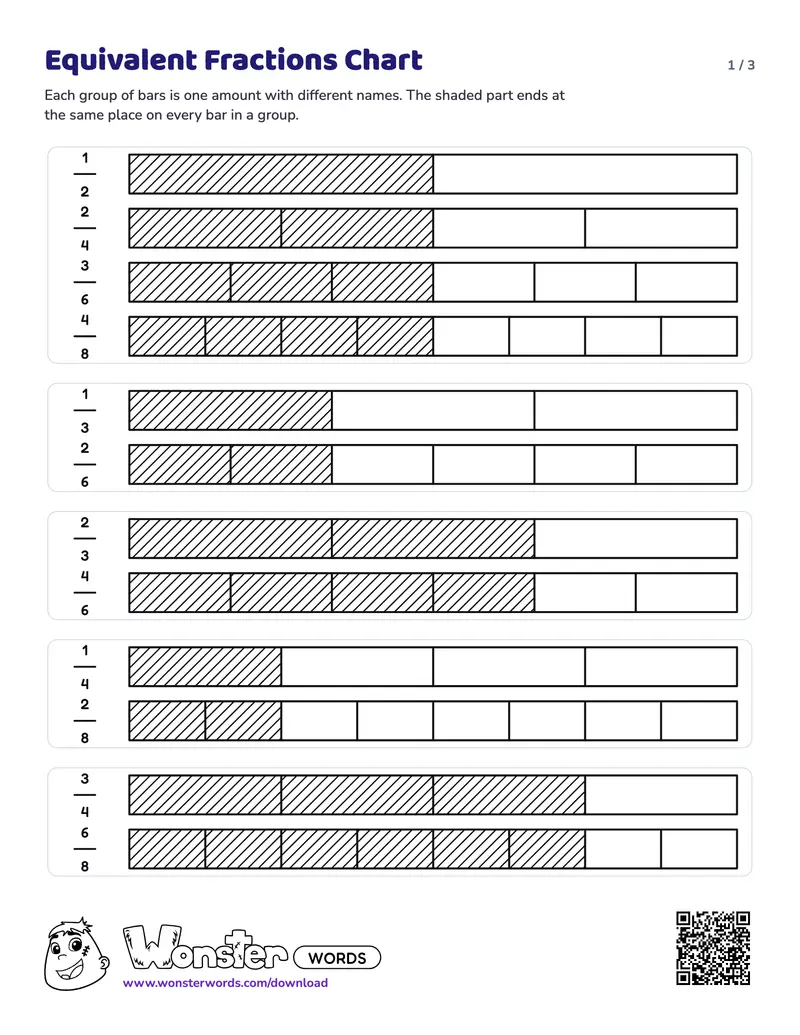
- Equivalent Fractions Chart, grade 3. A reference for the homework folder: each family as stacked bars, then five number lines lined up, with the fractions that have no partner listed.
The answer key pages write each answer in place, so a parent can check a sheet at a glance.
Free PDF · no sign-up
Feedback?Free equivalent fractions worksheets with answer keys
Three free PDFs in black and white, with no account and no email: two practice sheets with answer keys and a reference chart, each with a page for grown-ups.
- Equivalent Fractions: Shade to Match (PDF)20 items · answer key included · 7 pages
Preview page 1Preview
- Equivalent Fractions Chart (PDF)5 families · 3 pages
Preview page 1Preview
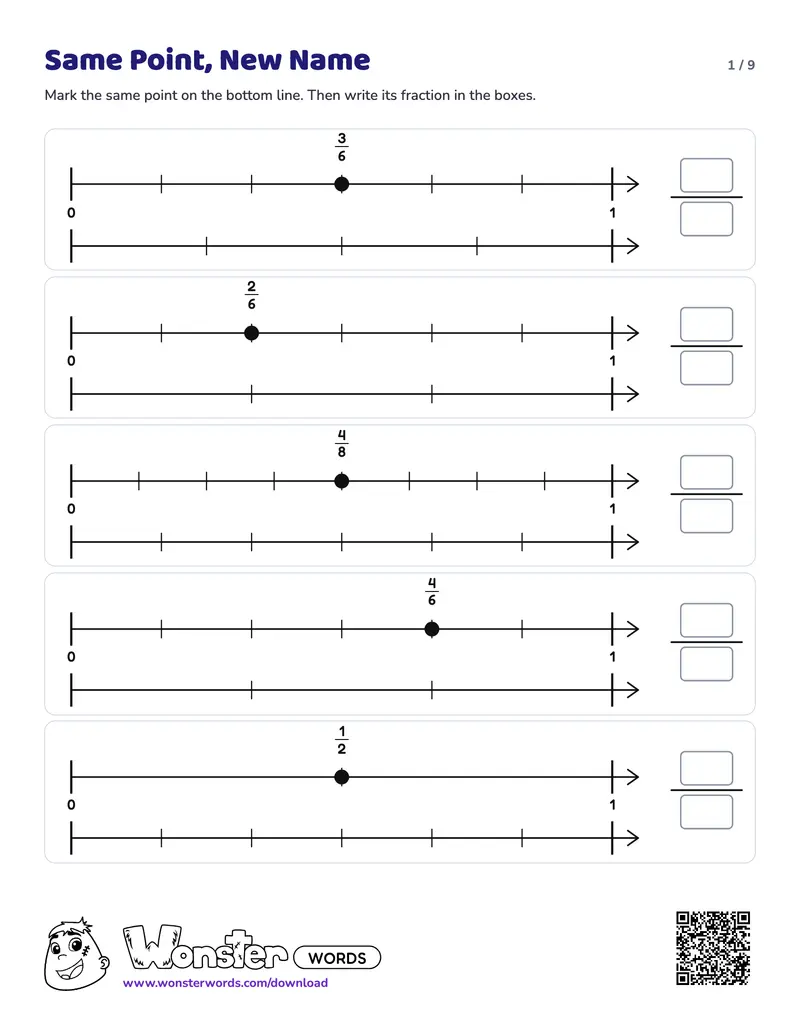
More fraction sheets, sorted by grade, are on the fraction worksheets page.
Frequently asked questions
What are equivalent fractions?
Equivalent fractions are fractions that name the same amount, such as 1/2 and 2/4. They are the same size, and they sit at the same point on a number line. Cutting each half of a bar into 2 smaller pieces turns 1/2 into 2/4, with twice as many pieces, each half as big, and the same amount shaded.
What fraction is equivalent to 1/3?
The fraction 2/6 is equivalent to 1/3, and so are 3/9 and 4/12. Cut each third of a bar into 2 equal pieces, and the 1 shaded third becomes 2 shaded sixths. Third graders work with 2/6, because grade 3 uses the denominators 2, 3, 4, 6, and 8.
What are the equivalent fractions for 3/4?
Fractions equivalent to 3/4 include 6/8, 9/12, and 12/16. A third grader meets 6/8, which shows the same amount as 3/4 when each fourth is cut in half.
What are equivalent fractions of 1/2?
Fractions equivalent to 1/2 include 2/4, 3/6, 4/8, 5/10, and 6/12. In each one, the top number is half of the bottom number, so exactly half of the whole is shaded.
How do I check if two fractions are equivalent?
Draw two bars the same size, shade one fraction on each, and see whether the shaded parts end at the same place. If they do, the fractions are equivalent. You can also mark both fractions on number lines of the same length and see whether they land on the same point. The two bars or lines must be the same length, or the test does not work.
What grade do kids learn equivalent fractions?
Children learn equivalent fractions in third grade under the Common Core (3.NF.A.3) and the Texas standards (TEKS 3.3(F) and (G)). Third graders show them with drawings and number lines, using the denominators 2, 3, 4, 6, and 8. In fourth grade (4.NF.A.1), children add the rule of multiplying the top and the bottom by the same number.
Are equivalent fractions the same as comparing fractions?
No. Equivalent fractions name the same amount, such as 1/2 and 2/4. Comparing fractions asks which of two fractions is larger, such as 3/4 and 1/2. Both ideas depend on using the same whole for the two fractions.
Are there any shortcuts to find equivalent fractions?
Yes. The shortcut is to multiply the top and the bottom of a fraction by the same number, a rule the Common Core places in fourth grade, and it works because multiplying is the same as cutting every piece into smaller pieces.
How can I teach my child to draw equivalent fractions?
Draw a bar, cut it into equal pieces, and shade the fraction. Then cut every piece into the same number of smaller pieces, and count all the pieces and the shaded pieces to name the new fraction. Ask your child whether the shaded amount moved. It should not, and that is what makes the two fractions equivalent.
Related guides
Standards this page teaches: Common Core: 3.NF.A.3, 3.NF.A.3a, 3.NF.A.3b · Texas: 3.3(F), 3.3(G)
Last updated
Looking for something else?
Looking for something else?