
Math
Numerator and Denominator
Which number is which, a simple way to remember, how to explain the two words to a child in six steps, why a bigger denominator means smaller pieces, and the mistakes that show which job got confused.
Grades: grade 1 to grade 3
The numerator is the top number of a fraction and the denominator is the bottom number. The two numbers do different jobs. The denominator says how many equal parts the whole was cut into, which names the size of the piece. The numerator counts how many of those pieces you have. In 3/4, the 4 says the whole was cut into 4 equal parts, so the pieces are fourths, and the 3 counts 3 of them. One number names the piece and the other counts the pieces.
Before using either word, say 3/4 as “3 of the 4 equal parts.” A free Label the Fraction worksheet with an answer key comes with this guide, in black and white with no sign-up.
What are numerator and denominator in simple terms?
The denominator is the bottom number of a fraction and tells how many equal parts the whole was cut into; the numerator is the top number and counts how many of those parts you have. The Institute of Education Sciences defines them the same way in its fractions practice guide: the denominator is “the number of parts into which a whole amount is divided”, and the numerator is “the number of fractional parts represented by a fraction”. On a fraction typed on one line, such as 3/4, the numerator comes first, before the slash.
The table compares numerator and denominator job by job.
| Numerator | Denominator | |
|---|---|---|
| Where it sits | On top, above the bar | On the bottom, below the bar |
| What it tells you | How many parts you have | How many equal parts make the whole, which names the size of each part |
| The question it answers | How many do we have? | How many equal parts in all? |
| In 3/4 | 3: you have 3 parts | 4: the whole is cut into 4 equal parts, called fourths |
| In 5/8 | 5: you have 5 parts | 8: the whole is cut into 8 equal parts, called eighths |
A fraction needs both numbers, because a 3 on its own does not say 3 of what. The parts also have to be equal, since a denominator names one size of piece. A numerator can be 0, which means none of the parts. A denominator is never 0, because a whole cannot be cut into zero equal parts. The fractions guide explains what a fraction is.
A simple way to remember numerator and denominator
The shortest way to remember which is which is “Denominator, Down”: the denominator is the number down below the bar. That trick settles where each number sits. Saying the fraction as two jobs also tells your child what each number does.
- “Denominator, Down.” Both words start with D. Use it when a homework question only asks which number is which.
- Say the fraction as two jobs. Read 3/4 aloud as “count: 3, kind: fourths”. Your child hears which number counts and which number names.
How to explain numerator and denominator to a child
Explain numerator and denominator to a child in six steps, starting with something you can cut and saying the two words last. You need a sandwich or a strip of paper and a few minutes. The panel behind the Institute of Education Sciences fractions guide recommends building on what children already know about sharing. That is why the first step is cutting and sharing, before any numbers are written.
Share something first
Cut a sandwich into 4 equal pieces, or fold a paper strip in half and in half again, before you write any numbers. Share out the pieces and check together that they are the same size.
Name the piece
Point to one piece and call it a fourth. In the Common Core, children use the words halves and fourths in first grade and add thirds in second grade, so the name of the piece comes before any numeral.
Count the pieces
Lay out three of the pieces and count them by name: one fourth, two fourths, three fourths. The top number of the fraction will be this count.
Say it as parts of the whole
Point to the 3 pieces and then to all 4, and say "3 of the 4 equal parts." Have your child say it back while pointing.
Write it, then name it
Write the 4 below a short bar and the 3 above it. Then say the two words, last: the 3 on top is the numerator, and the 4 on the bottom is the denominator.
Ask the two questions
On the next fraction, ask: how many equal parts in all, and how many do we have? The first answer goes on the bottom and the second goes on top.
Step 3 is how the writers of the Common Core describe the numerator. Their 2011 draft Progressions for fractions read the 3 in 3/4 as saying that 3/4 is what you get by “putting 3 of the 1/4’s together”. Standard 3.NF.A.1 says the same in letters: a fraction a/b is “formed by a parts of size 1/b”.
Step 4 says the fraction as parts of a whole. In one experiment by Paik and Mix (2003), U.S. children’s performance improved when fraction names explicitly referred to part-whole relations.
The two words come last because school brings them in last. Common Core and the Texas standards first use them in third grade, and the grade-by-grade map of fractions shows what comes before.
To draw the explanation, make a rectangle, cut it into 4 equal parts with one line down and one line across, and shade 3. A pizza works the same way: 8 equal slices are eighths, and the slices on your plate are the count. Paper fraction strips are among the math manipulatives that make the cut easy to see, and fraction circles show the same count on a round whole.
Why does a larger denominator make a fraction smaller?
A larger denominator makes a fraction smaller when the whole is the same and the numerator is the same. Cut one pizza into 8 equal slices instead of 4 and every slice is smaller, so 1/8 of that pizza is less than 1/4 of it. The reason, in the words of the 2011 draft of the Common Core Progressions, is that “in order for more (identical) pieces to make the same whole, the pieces must be smaller”.
Children meet this idea before they meet the two words. Common Core’s first-grade standard 1.G.A.3 says “decomposing into more equal shares creates smaller shares”. The Texas standards ask second graders to explain that “the more fractional parts used to make a whole, the smaller the part” (TEKS 2.3(B)). The denominator is where that older idea gets written down. On a number line from 0 to 1, 1/8 sits closer to 0 than 1/4 does. A fraction with a 1 on top, such as 1/8, is called a unit fraction.
Is a fraction with a larger denominator always smaller?
No: a larger denominator guarantees a smaller fraction only when the numerators match and the wholes are the same. For example, 3/4 is more than 1/2 even though 4 is bigger than 2: half of a strip is 2 of its 4 fourths, and 3 fourths is one fourth more. The size of the whole matters just as much. Common Core’s Grade 3 introduction gives the example: “1/2 of the paint in a small bucket could be less paint than 1/3 of the paint in a larger bucket”. Standard 3.NF.A.3d says that comparisons “are valid only when the two fractions refer to the same whole”.
The numerator works the other way around: with the same denominator, a larger numerator makes a larger fraction. The pieces are the same size, so more of them is more, and 5/8 is more than 3/8. Fractions with different numerators and different denominators need a different way of comparing fractions.
What are common mistakes kids make with numerators and denominators?
Each common mistake with numerators and denominators comes from losing track of what one of the two numbers does. The Institute of Education Sciences lists treating numerators and denominators as separate whole numbers among “common misconceptions” in its practice guide, so a child who does it has company.
- Thinking a bigger bottom number means a bigger fraction. A child who says 1/8 is more than 1/3 is reading the 8 as a whole number, the same example the guide gives. Cut two strips of the same length, one into 3 equal parts and one into 8, and lay one part of each side by side.
- Writing the numbers the wrong way up. If 3 of 4 parts are shaded and your child writes 4/3, the numbers have swapped jobs, and 4/3 is more than a whole. Ask how many equal parts there are in all and how many are shaded, and write the first answer on the bottom.
- Reading the fraction as two separate numbers. The guide says errors such as believing that 3/8 is more than 3/5 “arise from comparing the two denominators and ignoring the essential relation between each fraction’s numerator and its denominator”. Say each fraction as one amount, 3 of the 8 equal parts.
- Counting shaded against unshaded. If 3 of 4 parts are shaded and your child writes 3/1, your child counted the shaded parts against the unshaded one. Count every part, shaded and unshaded, for the denominator.
- Cutting unequal parts. A shape cut into 4 pieces of different sizes does not show fourths, because fourths are equal. Fold the paper to get equal parts.
Numerators and denominators in everyday life
Numerators and denominators appear at home wherever a whole is cut into equal parts. Each row below names a whole, the equal parts in it, and how many you have.
| At home | Denominator: equal parts in the whole | Numerator: how many you have | Fraction |
|---|---|---|---|
| A pizza cut into 8 slices, with 3 on your plate | 8 | 3 | 3/8 |
| A sandwich cut into 4 pieces, with 1 for you | 4 | 1 | 1/4 |
| A measuring cup filled to the 1/2 mark | 2 | 1 | 1/2 |
| 3 quarters, out of the 4 that make a dollar | 4 | 3 | 3/4 |
In a recipe, 1/4 cup is 1 of the 4 equal parts that fill the cup, so four 1/4 cups fill a 1-cup measure.
Free Label the Fraction worksheet
The free Label the Fraction worksheet is one PDF that practices naming the numerator and the denominator from a drawing. Each item shows a circle or a rectangle cut into equal parts with some parts shaded, beside a frame of two boxes and a bar. Your child writes how many parts are shaded in the top box and how many equal parts there are in all in the bottom box. On each picture, ask aloud how many equal parts there are in all and how many are shaded. Denominators stay at 2, 3, 4, 6, and 8, the ones Common Core’s third-grade standards are limited to, and the answer key writes each number in its box.
Free PDF · no sign-up
Feedback?Free Label the Fraction worksheet
One free PDF in black and white, with no account and no email: three pages with the prompts taken away a step at a time, an answer key, and a page for grown-ups.
- Label the Fraction (PDF)18 fractions · answer key included · 5 pages
Preview page 1Preview
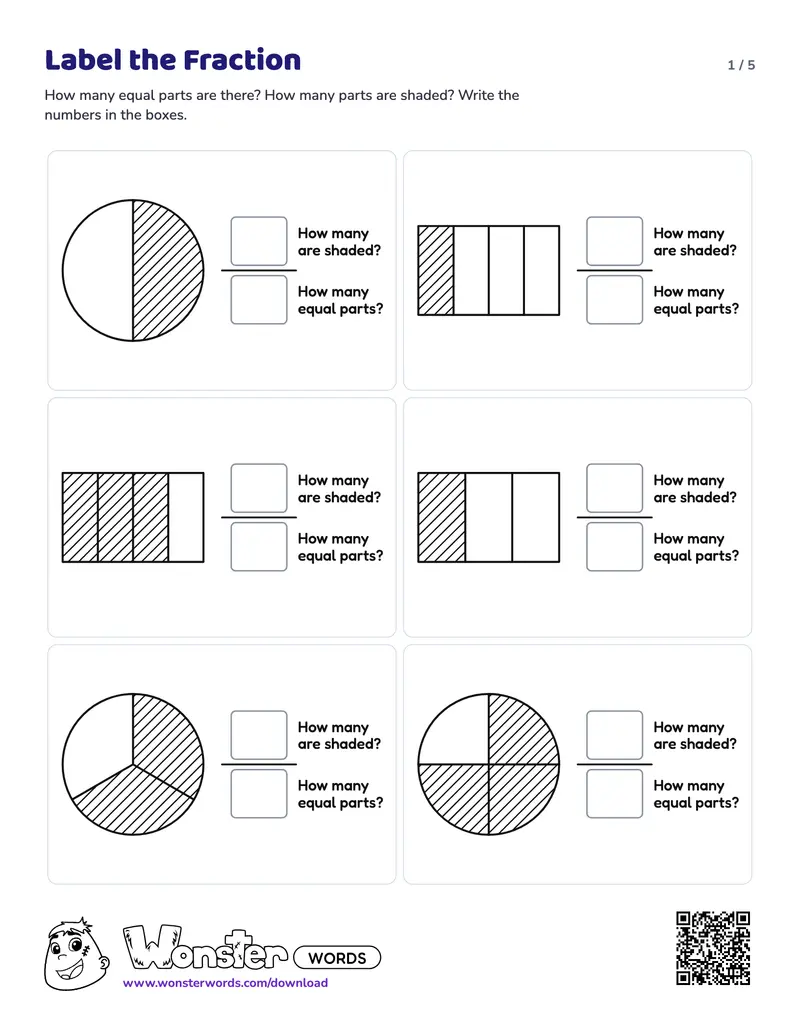
More fraction sheets, sorted by grade, are on the fraction worksheets page, and the fraction games page turns the same naming into play.
Frequently asked questions
Is the numerator the top or bottom number of a fraction?
The numerator is the top number of a fraction, and the denominator is the bottom number. In 3/4, the 3 is the numerator and the 4 is the denominator. On a fraction typed on one line, the numerator comes first, before the slash. To remember which is which, say "Denominator, Down."
What is the meaning of the denominator in a fraction?
The denominator is the bottom number of a fraction, and it means how many equal parts the whole was cut into. That number names the size of each part. In 3/8, the 8 says the whole was cut into 8 equal parts, so each part is an eighth.
My third grader keeps mixing up the numerator and denominator. How can I help?
Give your child the two questions, how many equal parts in all and how many do we have, and write the answers in that order, bottom first. Have your child say each fraction as "3 of the 4 equal parts" before using either word. For which word is which, use "Denominator, Down." Then practice on a folded paper strip, where your child can see the parts.
Why does my child think 1/8 is bigger than 1/3?
Your child is reading the denominator as a whole number, and 8 is more than 3. A denominator names the size of the piece, and more pieces in the same whole means smaller pieces. Cut two paper strips of the same length, one into 3 equal parts and one into 8, and lay one part of each side by side. The third is longer, so 1/3 is more than 1/8.
Why is it important to understand numerators and denominators?
The numerator and denominator together tell how much a fraction is, so a child has to read them as one amount. A child who reads them as two separate numbers can decide that 3/8 is more than 3/5, or later add 2/4 and 5/4 by adding the tops and the bottoms. Both errors come from missing that one number names the piece and the other counts the pieces.
Numerators vs denominators: which is more important in fractions?
Neither is more important, because a fraction needs both to name one amount. The denominator says what size the pieces are, and the numerator says how many of them you have. A 3 on its own does not say 3 of what, and fourths on their own do not say how many.
What age is appropriate for teaching numerators and denominators?
Third grade, at ages 8–9, is when children learn the two words in the Common Core and in the Texas standards. Neither word appears in grades 1 or 2 of either framework. In both, children use halves and fourths in first grade. In second grade, Common Core adds thirds and Texas adds eighths. A younger child can share and name the pieces well before learning the words.
What games can help kids understand numerator and denominator?
A game helps when a child has to say both numbers aloud. Cut paper strips into 2, 3, 4, 6, and 8 equal parts, and write some fractions on cards. Take turns drawing a card and building that fraction from the pieces. Say how many equal parts in all and how many you have each time.
What questions should I ask children to gauge their understanding of numerators and denominators?
Ask how many equal parts there are in all, how many we have, and which is bigger, 1/2 or 1/4 of the same thing. A child who answers the first two from a drawing and can show why 1/2 is bigger understands what each number does, whether or not the two words come easily.
Related guides
Standards this page teaches: Common Core: 3.NF.A.1, 3.NF.A.3d · Texas: 3.3(C), 3.3(D), 3.3(H)
Last updated
Looking for something else?
Looking for something else?