
Math
Free Fraction Worksheets by Grade
Sheets for first and second grade in words, third-grade sheets with written fractions, charts and cut-outs, how to tell which sheet your child is ready for, and how to use one at home.
Grades: grade 1 to grade 3
These 28 free printable fraction worksheets, charts, and cut-outs run from first to third grade. Every practice sheet has an answer key, and every sheet is designed to print in black and white, with no account and no email. The sheets are sorted into three groups:
- First and second grade: halves, fourths, and thirds, in words.
- Third grade: fractions written as numbers.
- Charts and cut-outs: tools to use beside a worksheet.
Fractions start as words and become numbers in third grade. First and second graders cut shapes into equal shares and name them. Third graders write those shares as numbers, so a sheet in words comes before a sheet with numerals.
To choose, go through seven small tasks with your child, in order, and stop at the first one your child cannot do yet. That task names what to print. A first or second grader stops sooner, at the last task for that grade. The sheets stop where third grade stops, so adding fractions is not among them.
Fraction worksheets for different grade levels
Fraction worksheets match a grade by what its standards ask children to do with fractions, not by a child’s age. Children work in words in first and second grade and in written numbers in third grade, under the Common Core and under the Texas standards (TEKS).
| Grade (usual age) | What children are asked to do | Common Core | Texas (TEKS) | |
|---|---|---|---|---|
| Preschool and kindergarten (about 3–6) | Share things out fairly. No Common Core or TEKS standard asks for fractions | None | None | Nothing yet: real snacks and paper |
| 1st grade (usually 6–7) | Cut shapes into two and four equal shares and name them in words | 1.G.A.3: “Partition circles and rectangles into two and four equal shares”, “using the words halves, fourths, and quarters” | 1.6(G): “two and four fair shares”; 1.6(H): examples and non-examples of halves and fourths | The equal parts sheets, halves and fourths |
| 2nd grade (usually 7–8) | Cut shapes into two, three, or four equal shares, name them in words, and describe the whole | 2.G.A.3 adds thirds | 2.3(A): halves, fourths, and eighths; 2.3(B)–(D). Thirds come in third grade | The equal parts sheets, with thirds (Common Core) or eighths (Texas) |
| 3rd grade (usually 8–9) | Write fractions as numbers, such as 1/4 and 3/4; place them on a number line; find simple equivalent fractions; compare fractions with the same top or bottom number | 3.NF.A.1–3, denominators 2, 3, 4, 6, and 8 | 3.3(A)–(H), with the same denominators in 3.3(A), (B), (E), and (F); 3.7(A), on halves, fourths, and eighths. Standards 3.3(A) and (B) stay at or below 1, and 3.7(A) states no limit | The third-grade sheets |
The standards name grades, not ages, so the ages in the table are the usual US ones. What your child can do decides the sheet, and age does not. A 9-year-old on a first-grade sheet is using the right sheet if that is the step the child is on.
Common Core and Texas place thirds and eighths in different grades. Common Core puts thirds in second grade (2.G.A.3) and eighths in third grade. Texas has halves, fourths, and eighths in second grade (TEKS 2.3(A)) and thirds in third grade.
How do I know which fraction worksheet my child is ready for?
To choose a fraction worksheet, ask your child to do each task in this table, starting at the top, and stop at the first one your child cannot do yet. That row names what to print. It takes a pencil, some paper, and a few minutes. Print the first sheet that row names, and go on to the next when your child gets the answers right.
| Ask your child to | If not yet, print |
|---|---|
| Say whether a shape cut into two parts is cut equally, then cut a drawn rectangle into 2 equal parts, then 4, and name one part (“a half”, “a fourth” or “a quarter”) | Equal or Not?, then Split It and Name the Part, the pages with halves and fourths |
| Cut a drawn circle into 3 equal parts and name one part (“a third”) | Split It, Name the Part, and Shade It, the pages with thirds |
| Write the fraction for one shaded part of a bar cut into 4 | Share It, then Name the Unit Fraction |
| Write the fraction for 3 shaded parts out of 8, and say what the 3 and the 8 count | Label the Fraction, then Build From Unit Fractions |
| Put 3/4 on a number line from 0 to 1 already marked in fourths | Place Fractions on a Number Line, then Label Fractions on a Number Line |
| Say whether 1/2 and 2/4 of the same whole are the same amount, and show it with a drawing | Equivalent Fractions: Shade to Match, then Equivalent Fractions: Same Point, New Name |
| Say which is greater, 1/3 or 1/4 of the same whole, and why | Compare Unit Fractions, then Compare Fractions: Same Bottom Number and Compare Fractions: Same Top Number |
A child who can do every row has reached the last step on these sheets, and no row needs printing. A first grader stops after the first row, because thirds come later under the Common Core and in Texas. A Common Core second grader stops after the thirds row, because written fractions start in third grade. A Texas second grader skips the thirds row until third grade, prints the page with eighths instead, and stops there. A child who gets stuck on a sheet goes back one row. For a child stuck on several rows, start with the check in the fractions guide.
Free first and second grade fraction worksheets
First and second grade fraction worksheets name equal parts in words, with no written fractions. First graders work on halves and fourths of circles and rectangles. Second graders add thirds under the Common Core and describe a whole circle as “three thirds”, still in words.
The five sheets below come in teaching order, and the equal parts page shows how to teach each one.
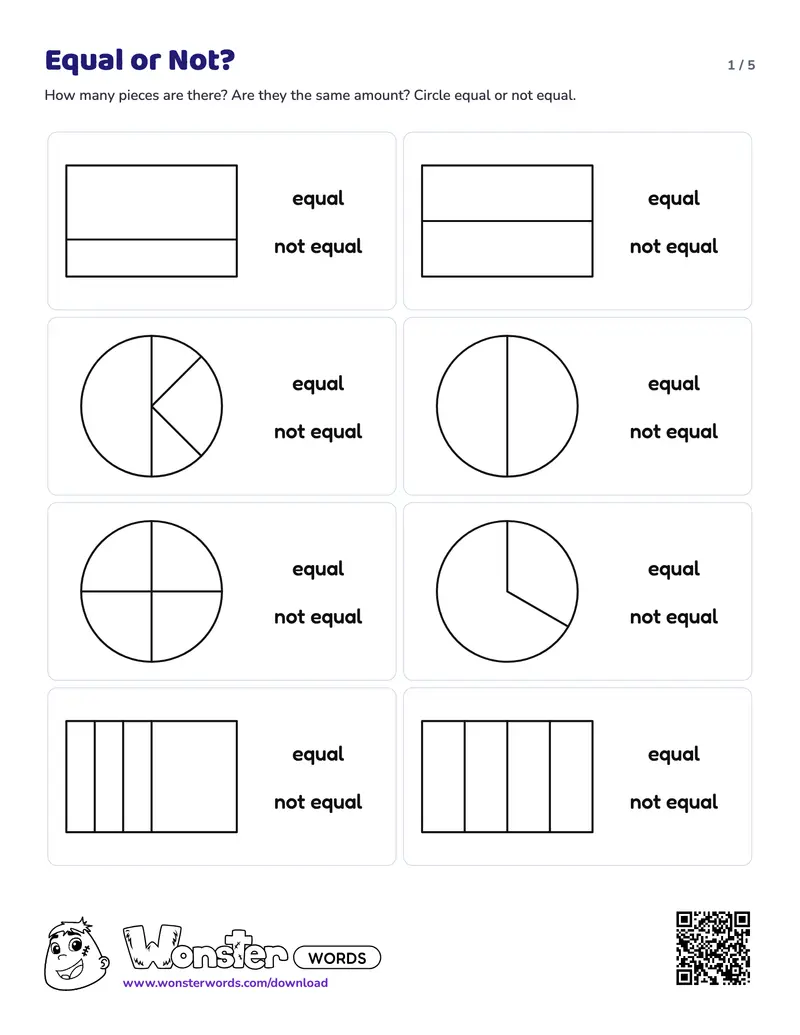
- Equal or Not? A circle or rectangle is cut in parts, and your child circles “equal” or “not equal”.
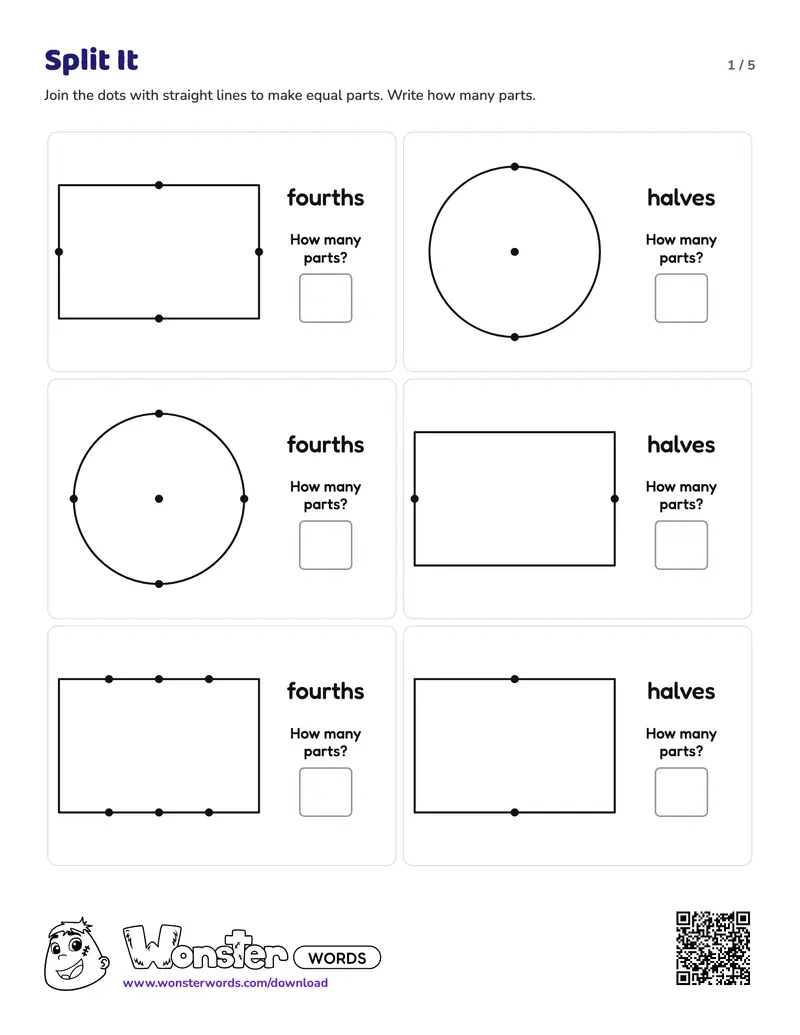
- Split It. Your child joins the dots on a shape to cut it into equal parts, then writes how many parts there are.
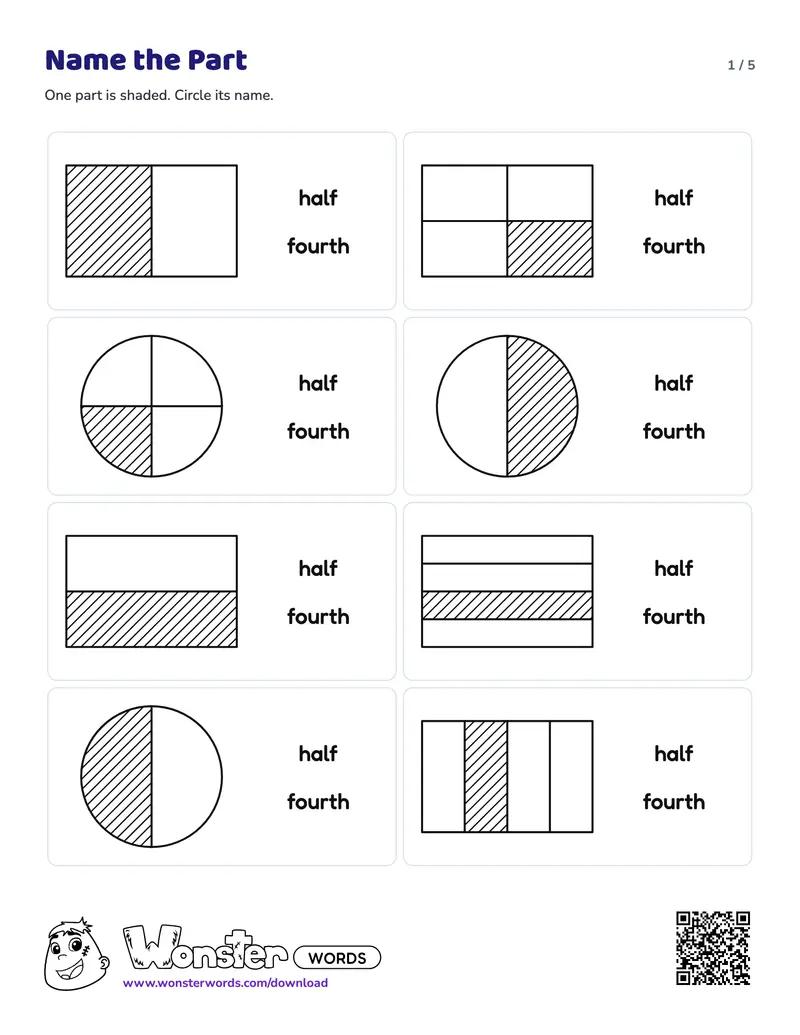
- Name the Part. One part of a shape is shaded, and your child circles its name.
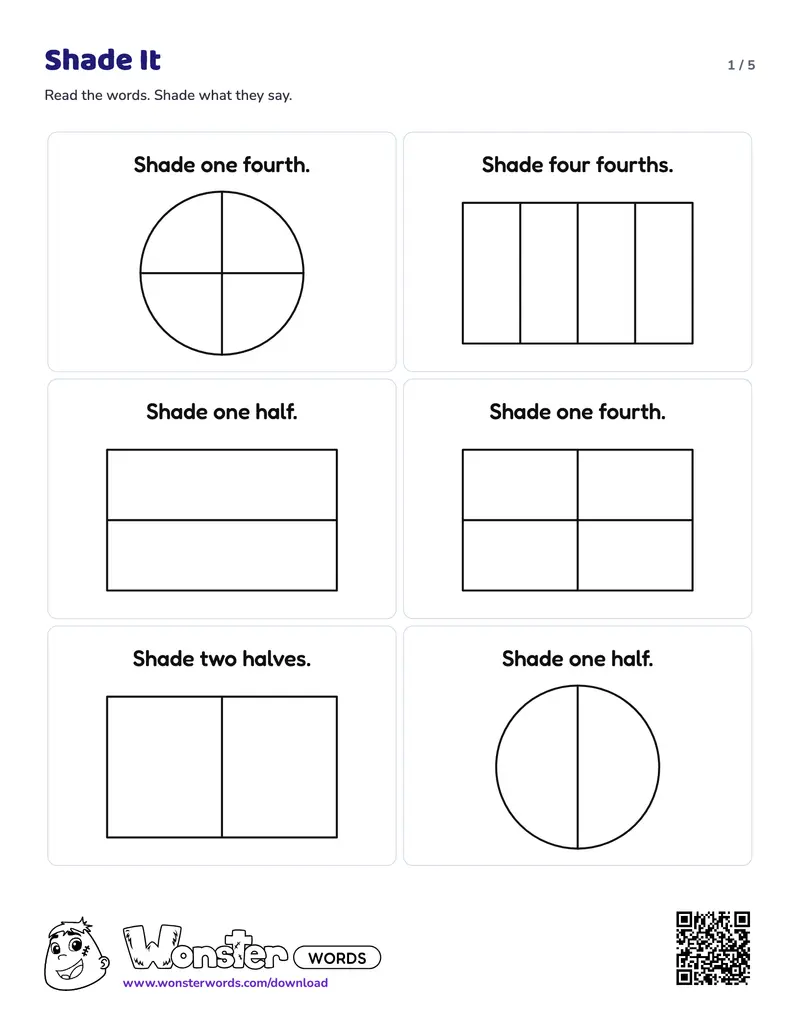
- Shade It. The words on the sheet, such as “Shade one half”, say what your child shades.
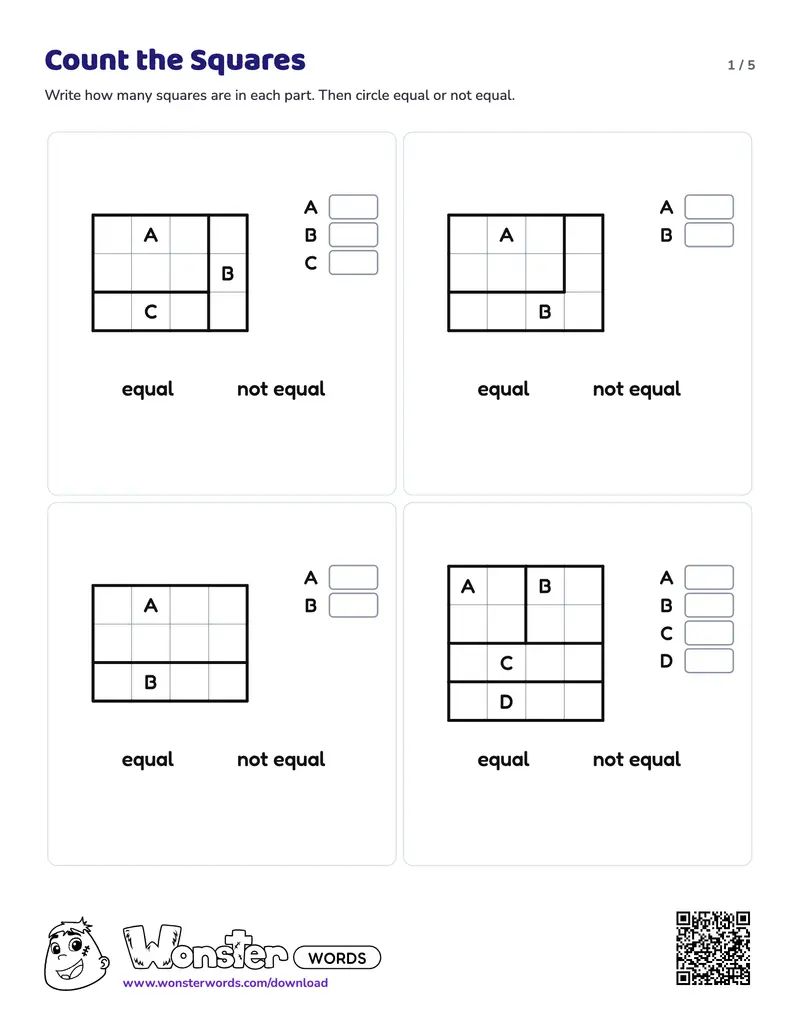
- Count the Squares, for second grade under the Common Core and third grade in Texas. A rectangle on a grid is cut into lettered parts, and your child counts the squares in each one and circles “equal” or “not equal”.
Equal or Not?, Split It, Name the Part, and Shade It grow by page. A first grader stops at page 1, with halves and fourths. A Common Core second grader goes on through page 2, which adds thirds. A Texas second grader does pages 1 and 3, because page 3 has eighths and Texas leaves thirds to third grade. Page 3 of Count the Squares asks for a written unit fraction, so it waits for third grade in both frameworks.
Free PDF · no sign-up
Feedback?Free printable first and second grade fraction worksheets
These first- and second-grade PDFs are free and print in black and white, and each one ends with its answer key and a page for grown-ups.
- Equal or Not? (PDF)24 shapes · answer key included · 5 pages
Preview page 1Preview
- Split It (PDF)18 shapes · answer key included · 5 pages
Preview page 1Preview
- Name the Part (PDF)24 shapes · answer key included · 5 pages
Preview page 1Preview
- Shade It (PDF)18 shapes · answer key included · 5 pages
Preview page 1Preview
- Count the Squares (PDF)12 rectangles · answer key included · 5 pages
Preview page 1Preview
Free third grade fraction worksheets
Third grade fraction worksheets cover five steps: unit fractions, the top and bottom numbers, the number line, equivalent fractions, and comparing. Common Core limits third grade to the denominators 2, 3, 4, 6, and 8 (3.NF, footnote 1), and Texas names the same five in TEKS 3.3. Each step below links the page that teaches it. Print the next sheet in the order given.
- Unit fractions. What a unit fraction is: Share It, then Name the Unit Fraction.
- The numerator and denominator. Which number is which: Label the Fraction, then Build From Unit Fractions (on the unit fractions page).
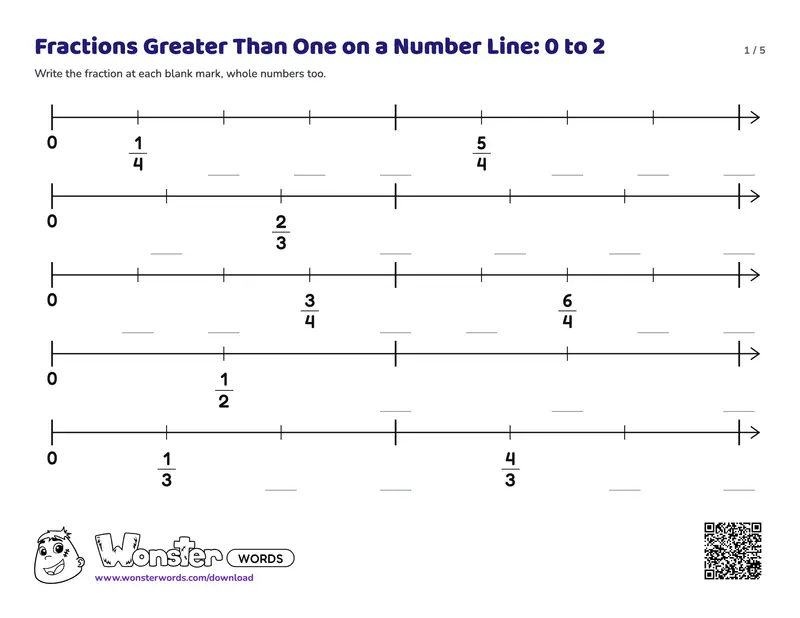
- The number line. Fractions on a number line: Place Fractions on a Number Line, Label Fractions on a Number Line, then Fractions Greater Than One on a Number Line. That last sheet is Common Core third-grade work (3.NF.A.2 and 3.NF.A.3c). Texas standards 3.3(A) and (B) stay at or below 1, and 3.7(A), on halves, fourths, and eighths, states no upper limit.
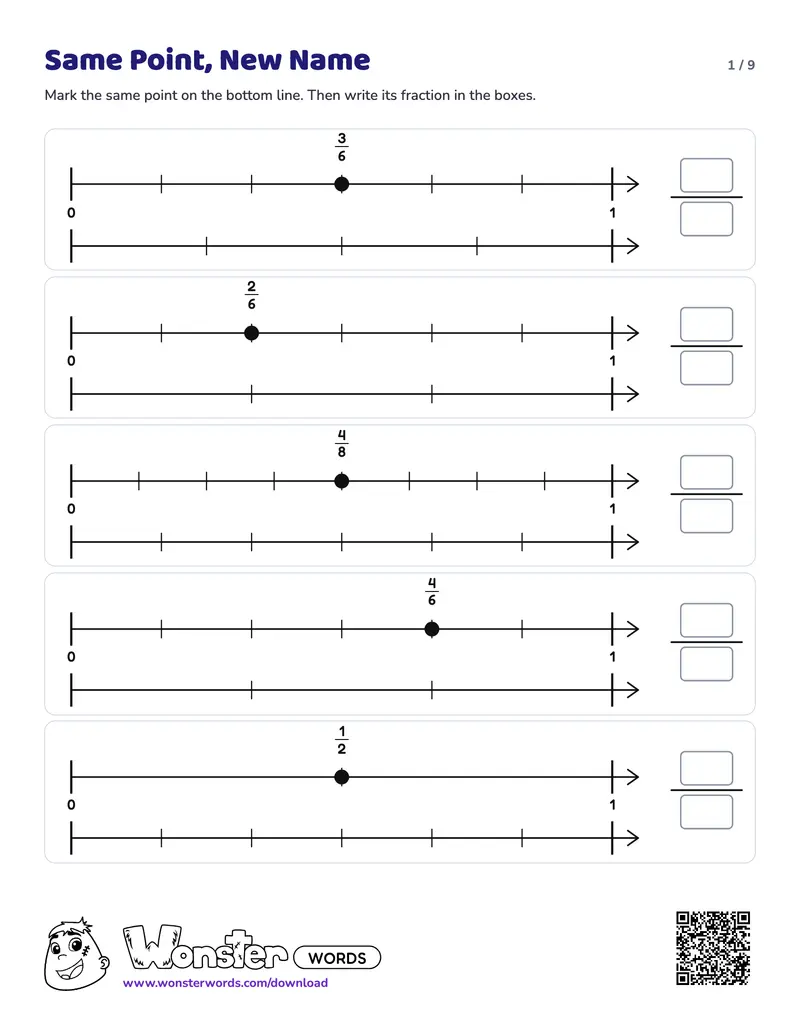
- Equivalent fractions. Fractions that name the same amount: Equivalent Fractions: Shade to Match, then Equivalent Fractions: Same Point, New Name. The rule of multiplying the top and bottom is fourth-grade work and is on no sheet here.
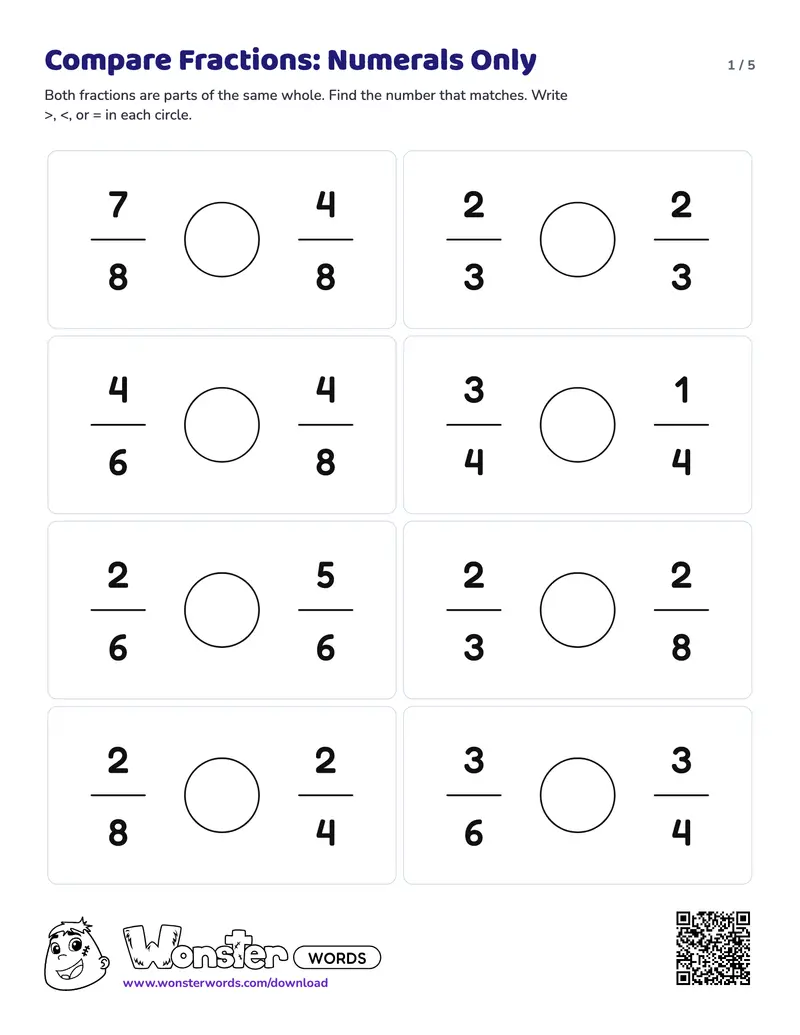
- Comparing. Comparing fractions: Compare Unit Fractions (on the unit fractions page), then Compare Fractions: Same Bottom Number, Compare Fractions: Same Top Number, Compare Fractions: Read the Two Points, and Compare Fractions: Numerals Only. Every pair has the same top number or the same bottom number, because different tops and bottoms are fourth-grade work in the Common Core (4.NF.A.2).
Common Core’s grade 3 introduction gives the reason for the first step: “Students develop an understanding of fractions, beginning with unit fractions”. The order after that first step is this site’s, and no standard sets it.
Free PDF · no sign-up
Feedback?Free printable third grade fraction worksheets
These third-grade PDFs are free and print in black and white, and each one ends with its answer key and a page for grown-ups.
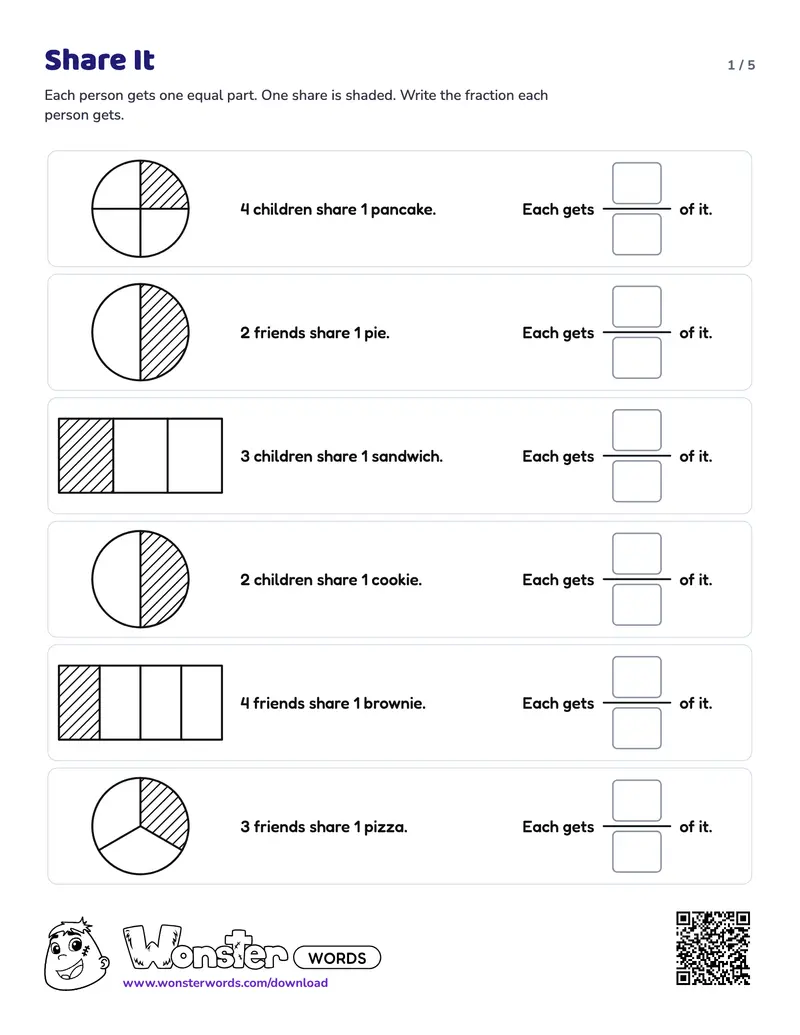
- Share It (PDF)18 stories · answer key included · 5 pages
Preview page 1Preview
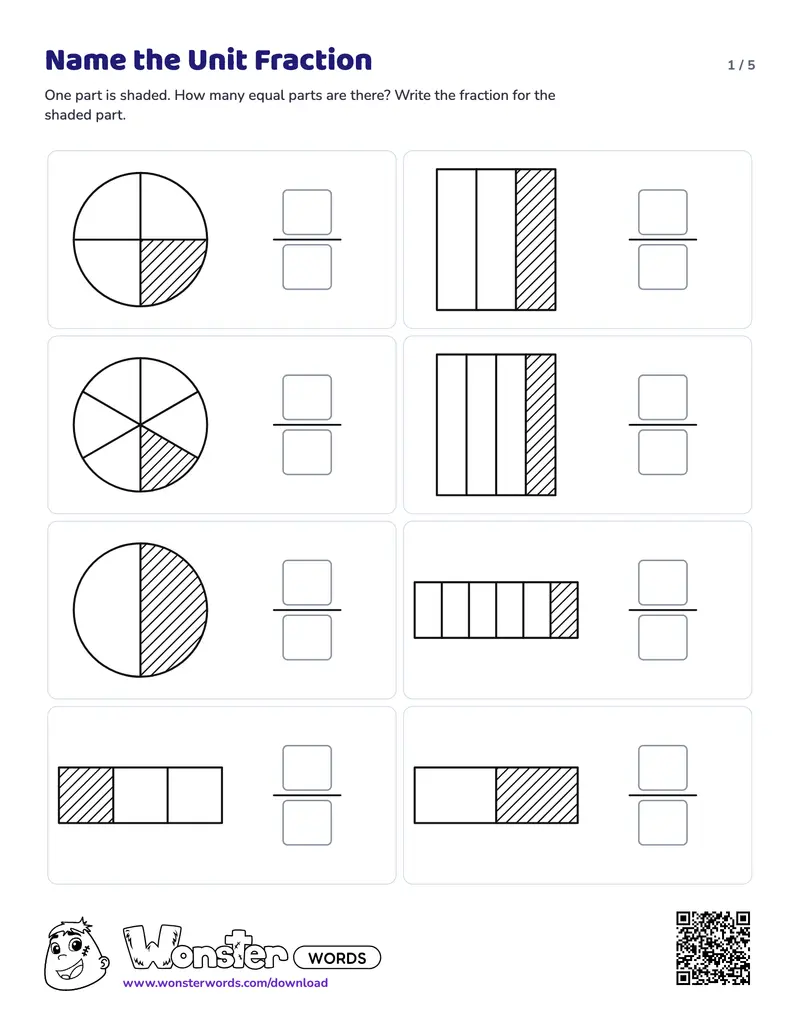
- Name the Unit Fraction (PDF)24 pictures · answer key included · 5 pages
Preview page 1Preview
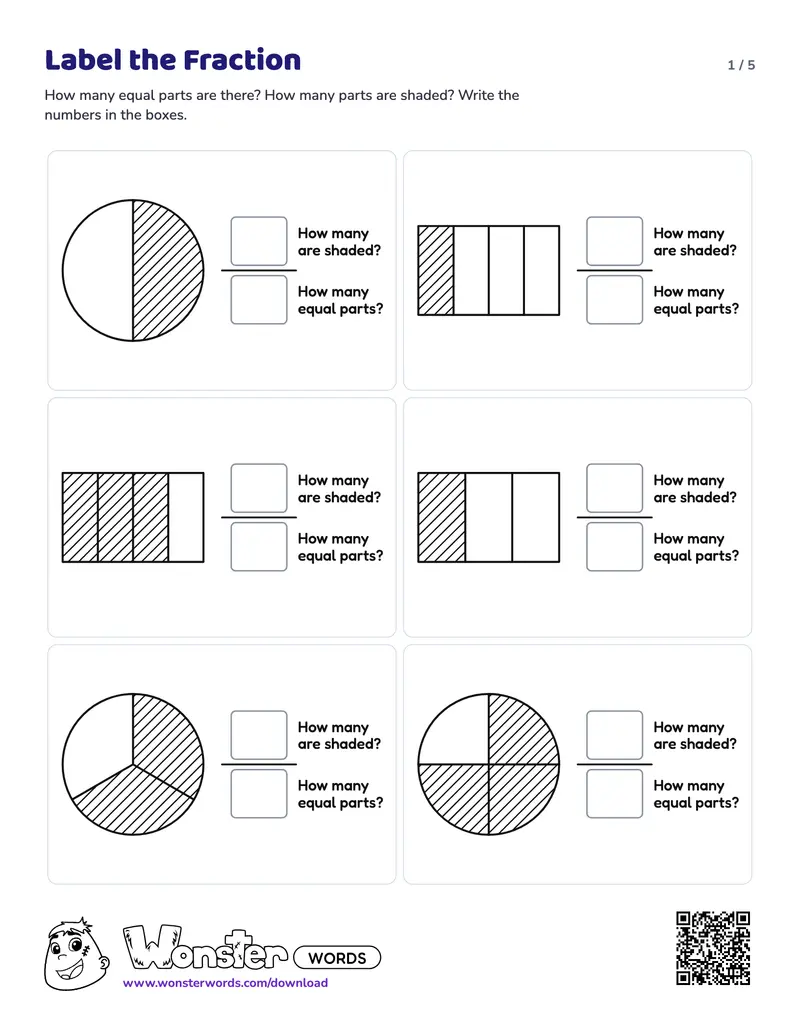
- Label the Fraction (PDF)18 fractions · answer key included · 5 pages
Preview page 1Preview
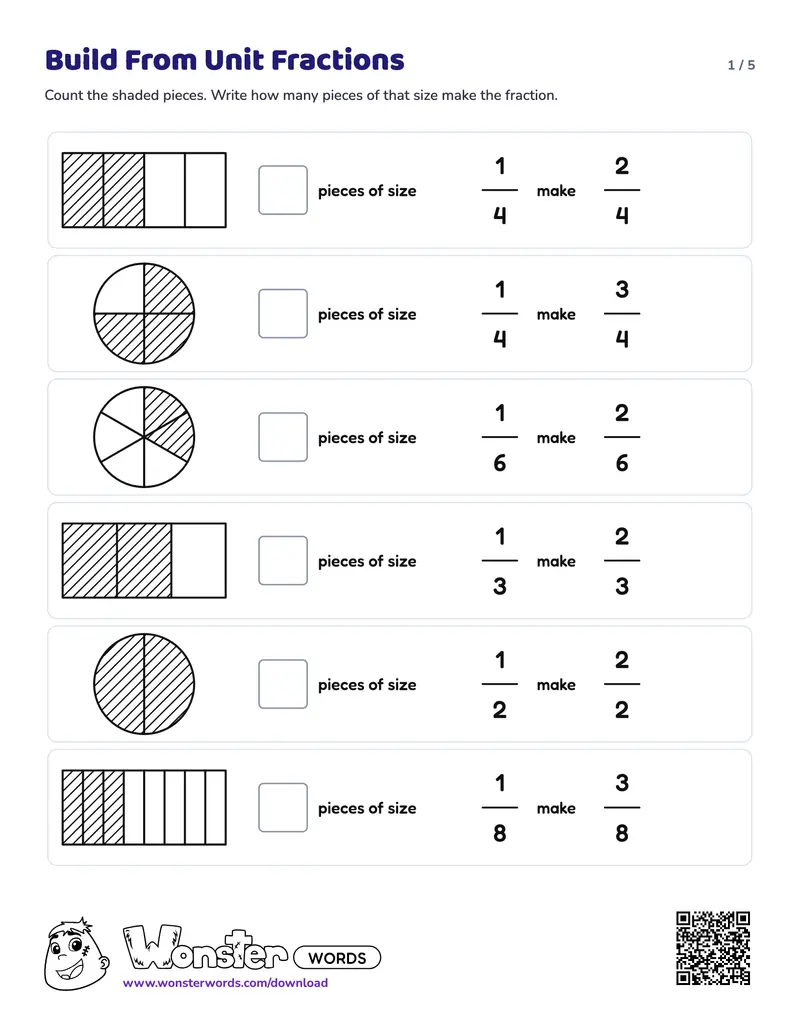
- Build From Unit Fractions (PDF)18 figures · answer key included · 5 pages
Preview page 1Preview
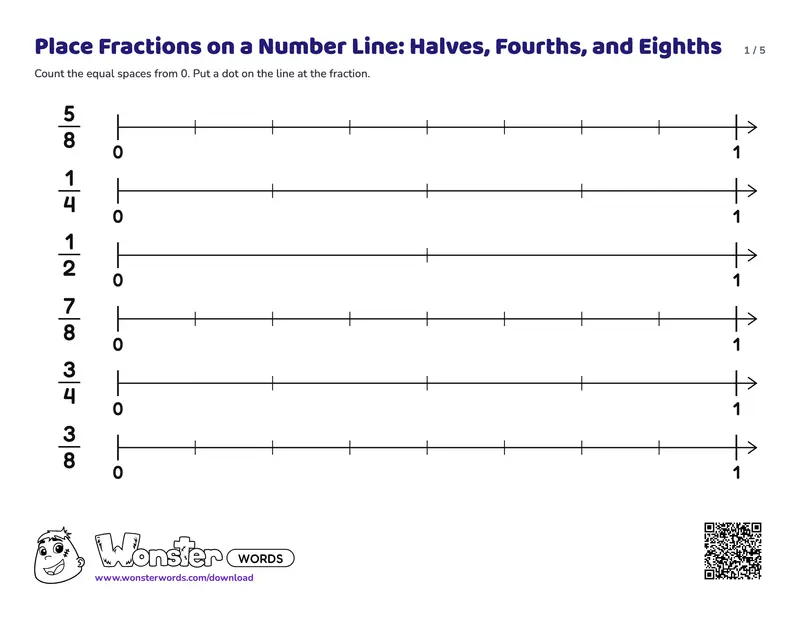
- Place Fractions on a Number Line (PDF)18 fractions · answer key included · 5 pages
Preview page 1Preview
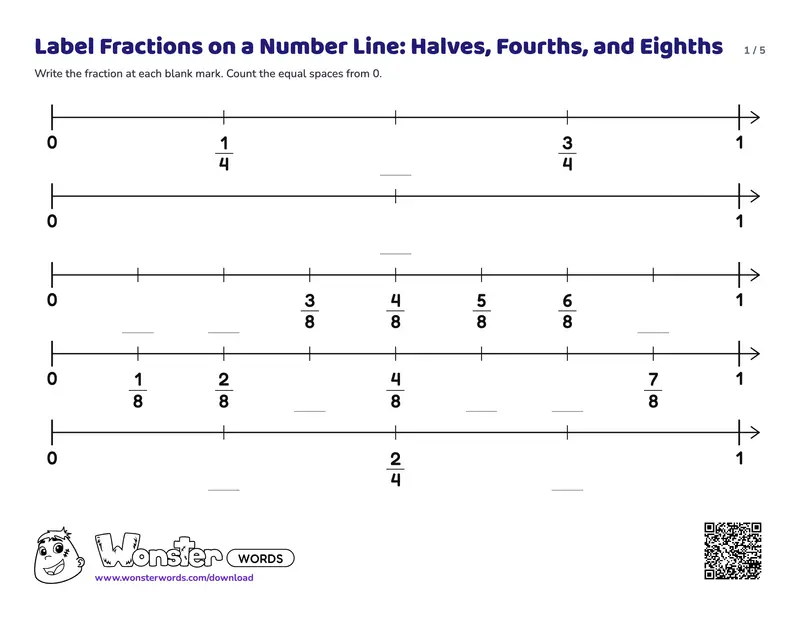
- Label Fractions on a Number Line (PDF)15 lines · answer key included · 5 pages
Preview page 1Preview
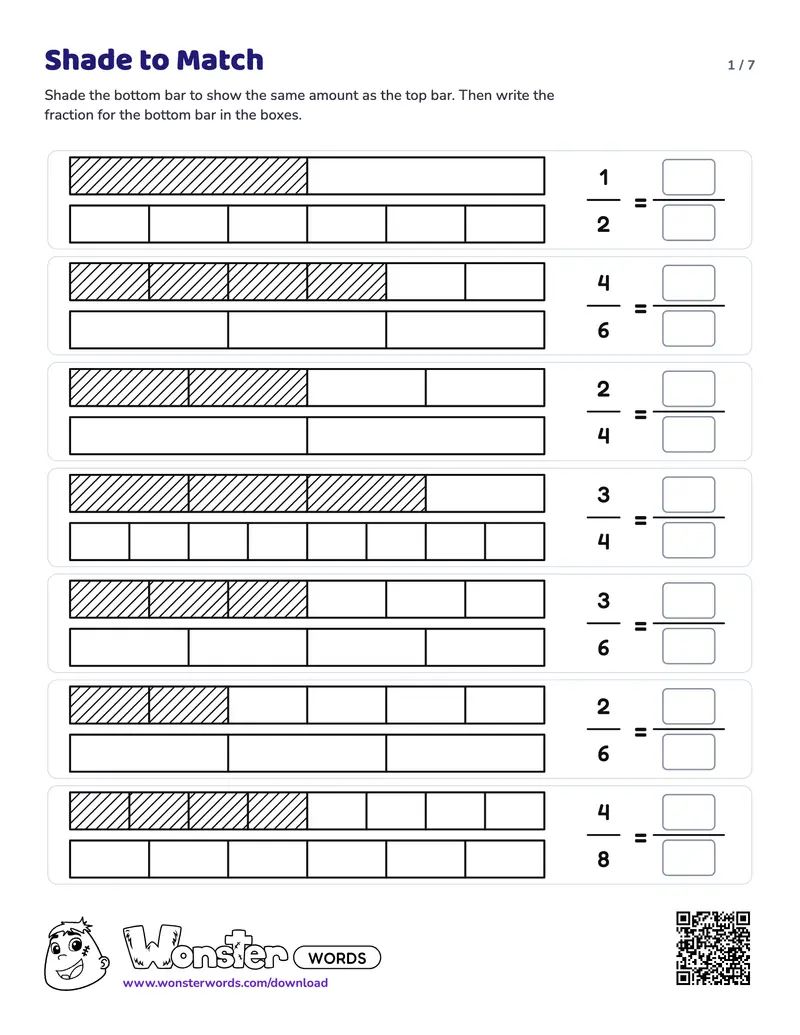
- Equivalent Fractions: Shade to Match (PDF)20 items · answer key included · 7 pages
Preview page 1Preview
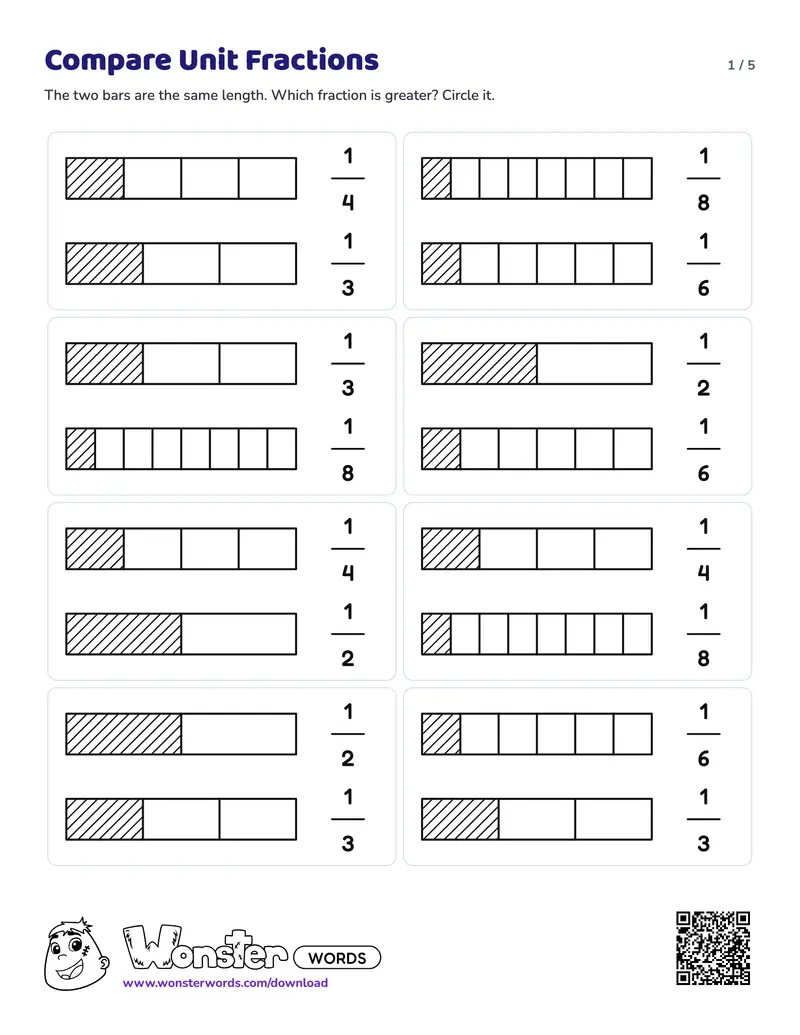
- Compare Unit Fractions (PDF)24 pairs · answer key included · 5 pages
Preview page 1Preview
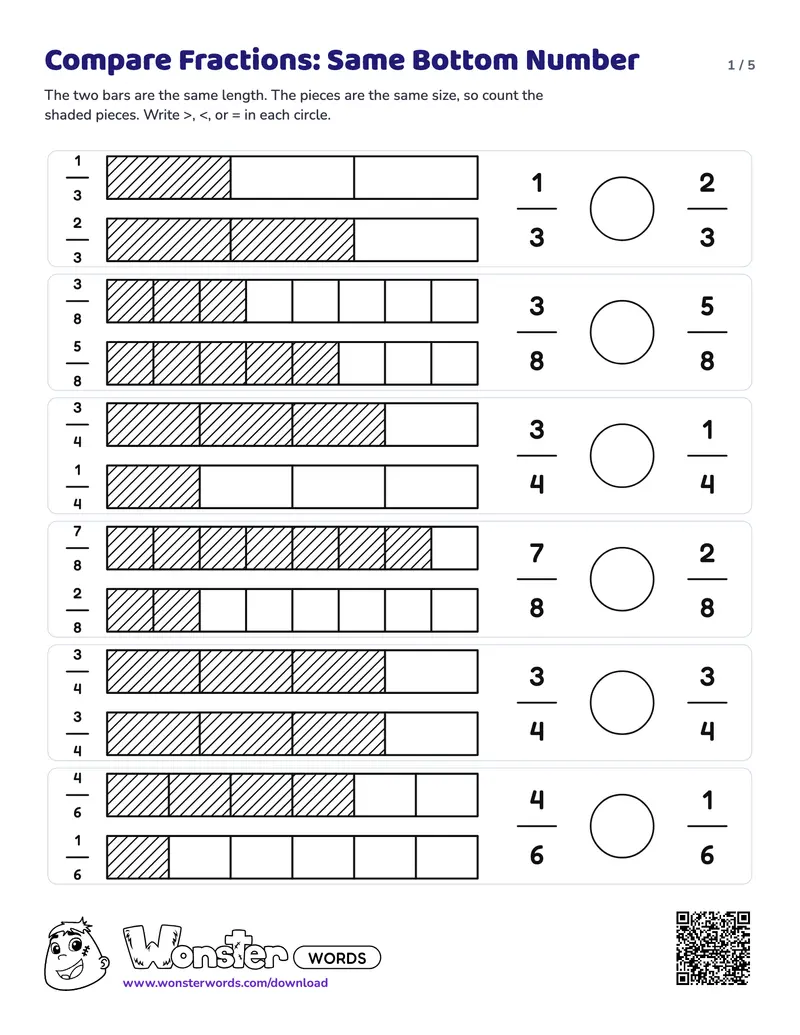
- Compare Fractions: Same Bottom Number (PDF)18 pairs · answer key included · 5 pages
Preview page 1Preview
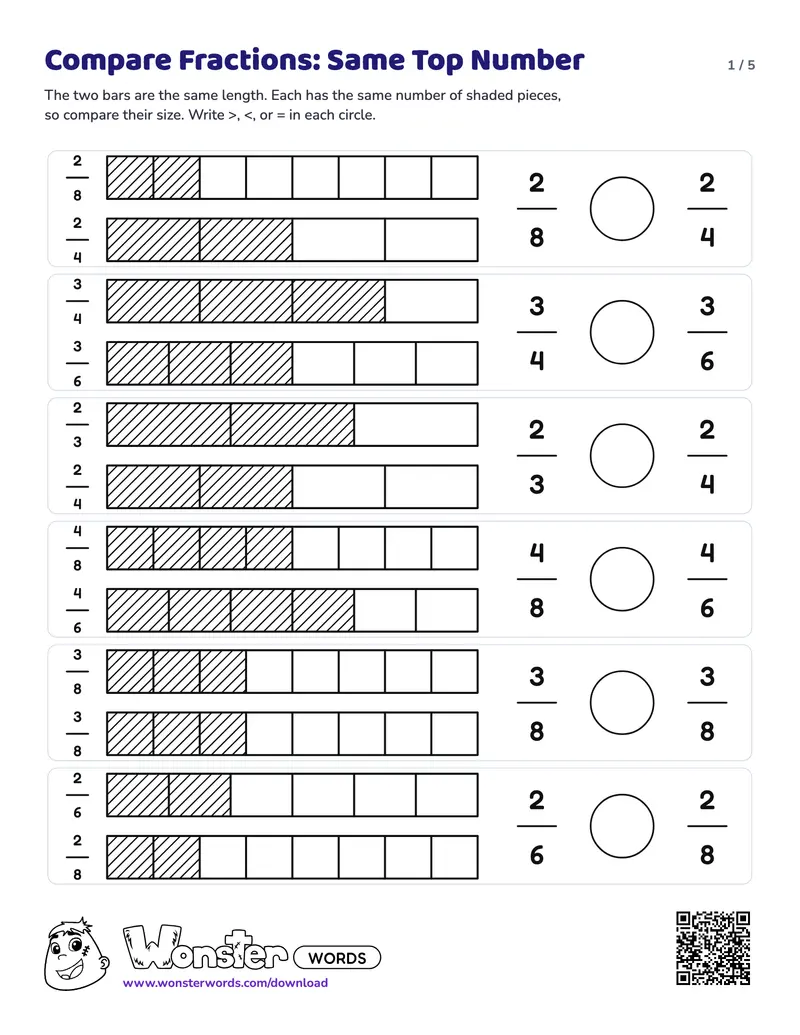
- Compare Fractions: Same Top Number (PDF)18 pairs · answer key included · 5 pages
Preview page 1Preview
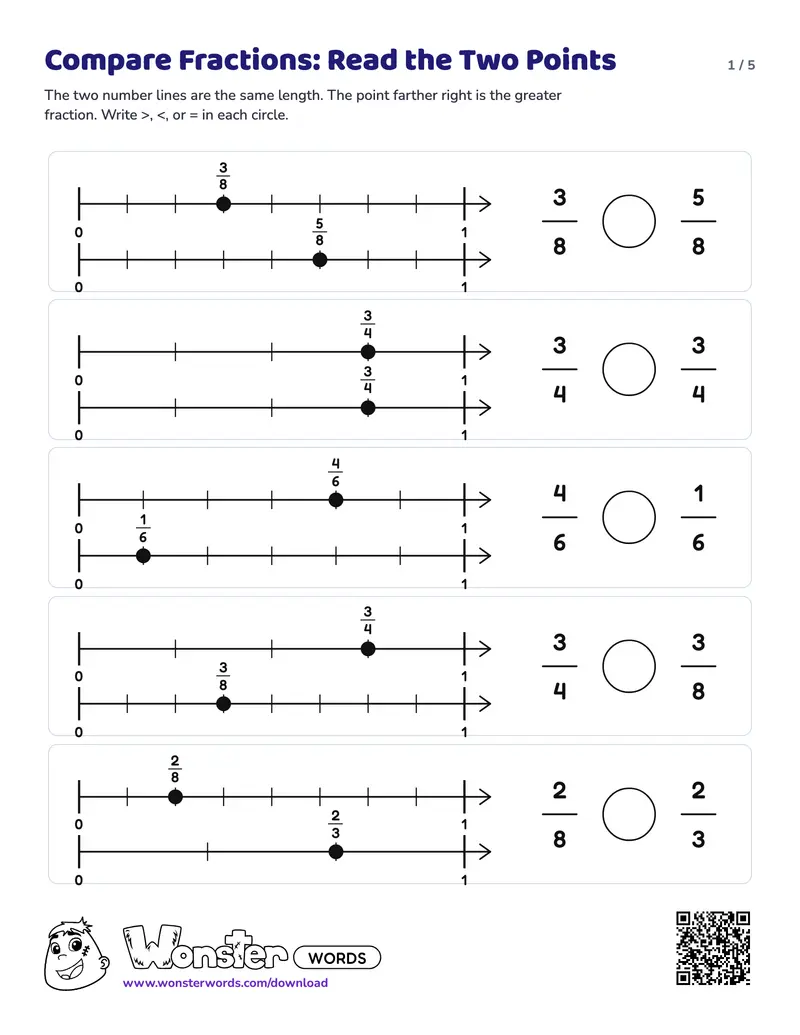
- Compare Fractions: Read the Two Points (PDF)15 pairs · answer key included · 5 pages
Preview page 1Preview
- Compare Fractions: Numerals Only (PDF)24 pairs · answer key included · 5 pages
Preview page 1Preview
Fraction charts, strips, circles, and blank number lines to print
Fraction charts, strips, circles, and blank number lines are tools to keep on the table beside a worksheet. The strips, the circles, and the wall chart each have a page on how to use them.
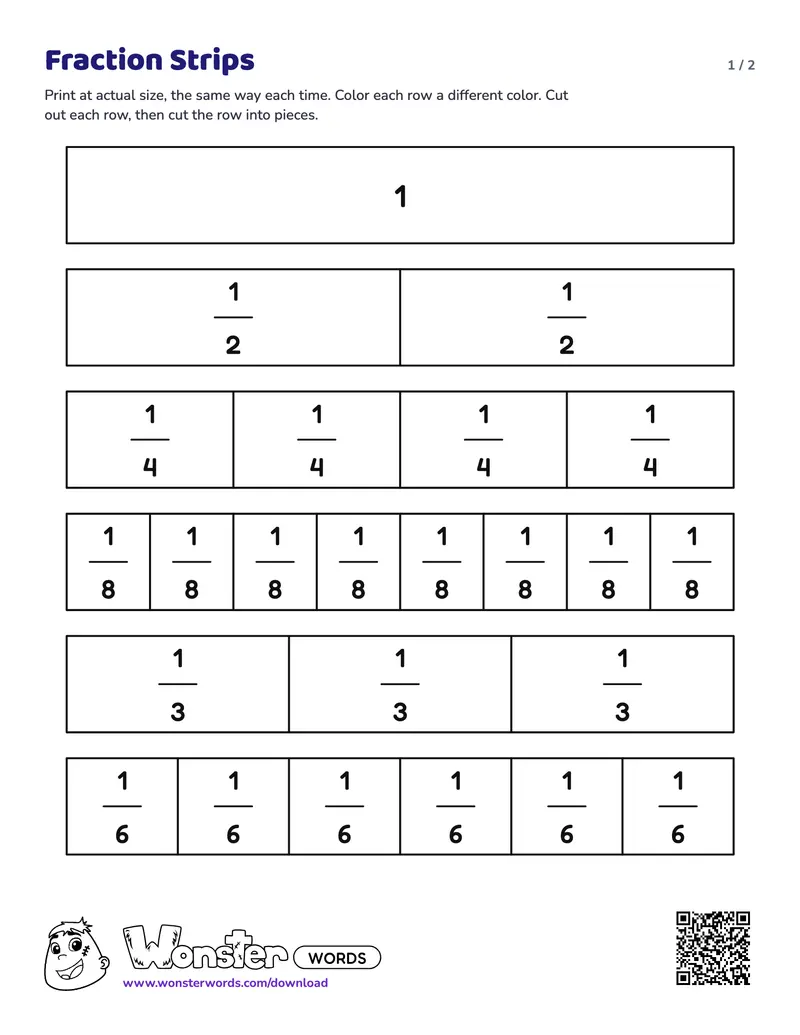
- Fraction Strips. A set to cut out, one whole and then halves, fourths, eighths, thirds, and sixths, each piece labeled with its fraction.
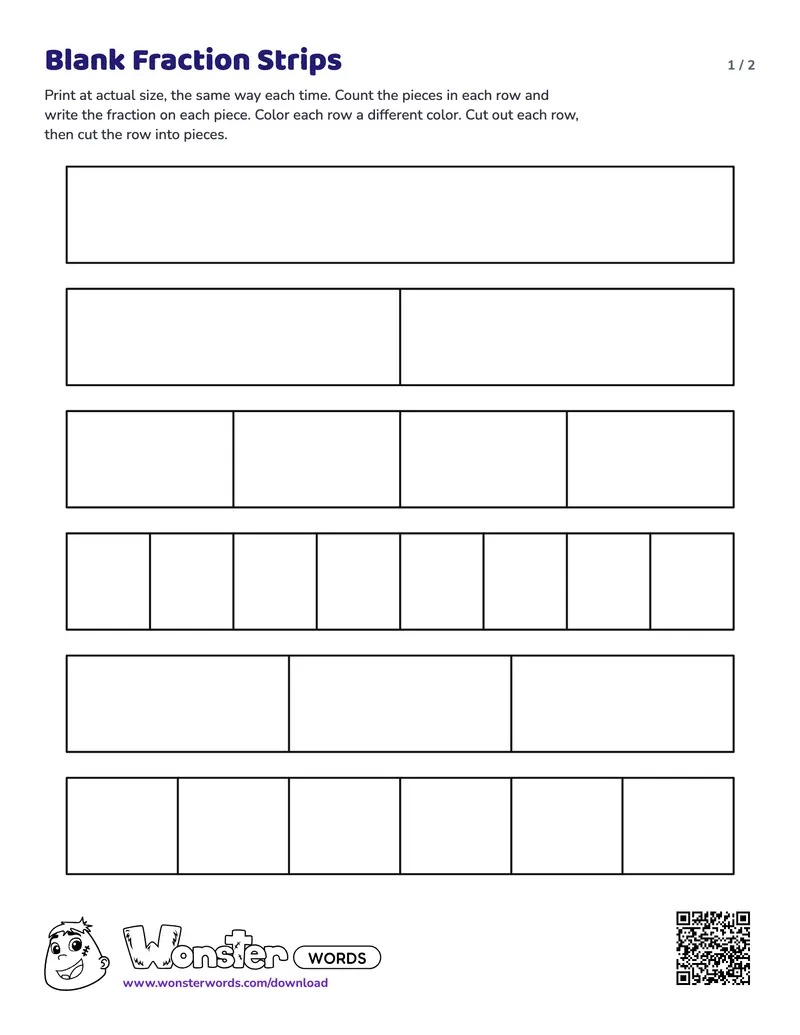
- Blank Fraction Strips. The same pieces with no numbers, and your child writes each fraction.
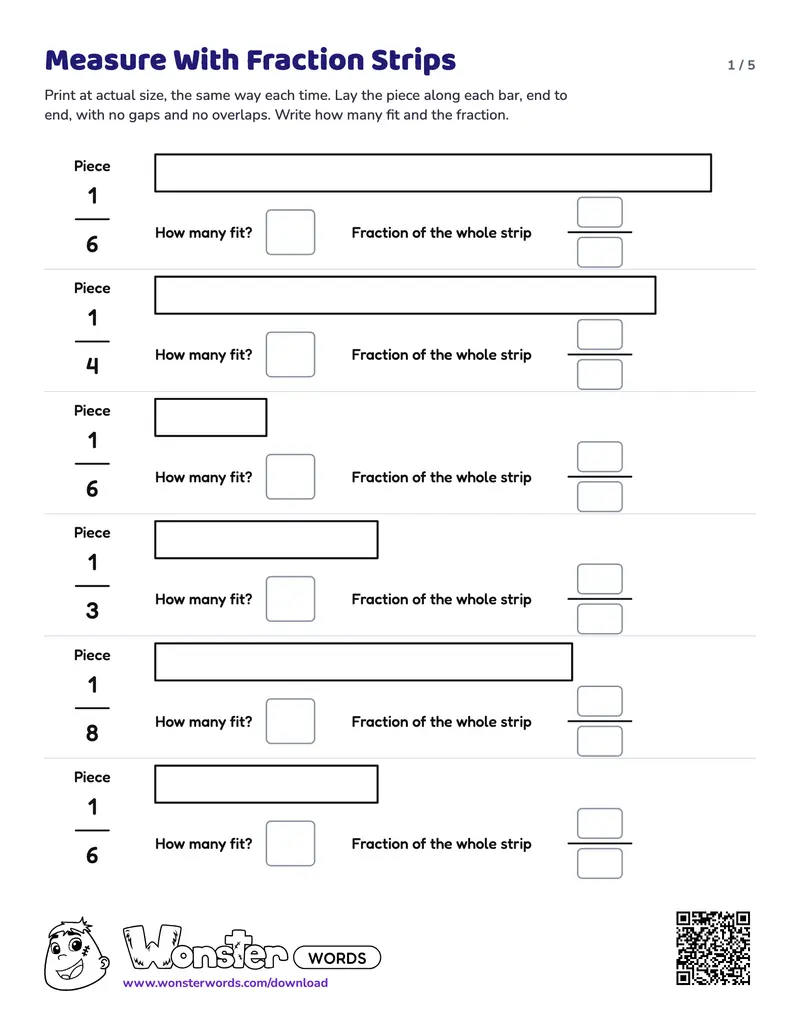
- Measure With Fraction Strips. Your child lays a strip piece along a plain bar and writes how many fit and what fraction of the whole strip the bar is.
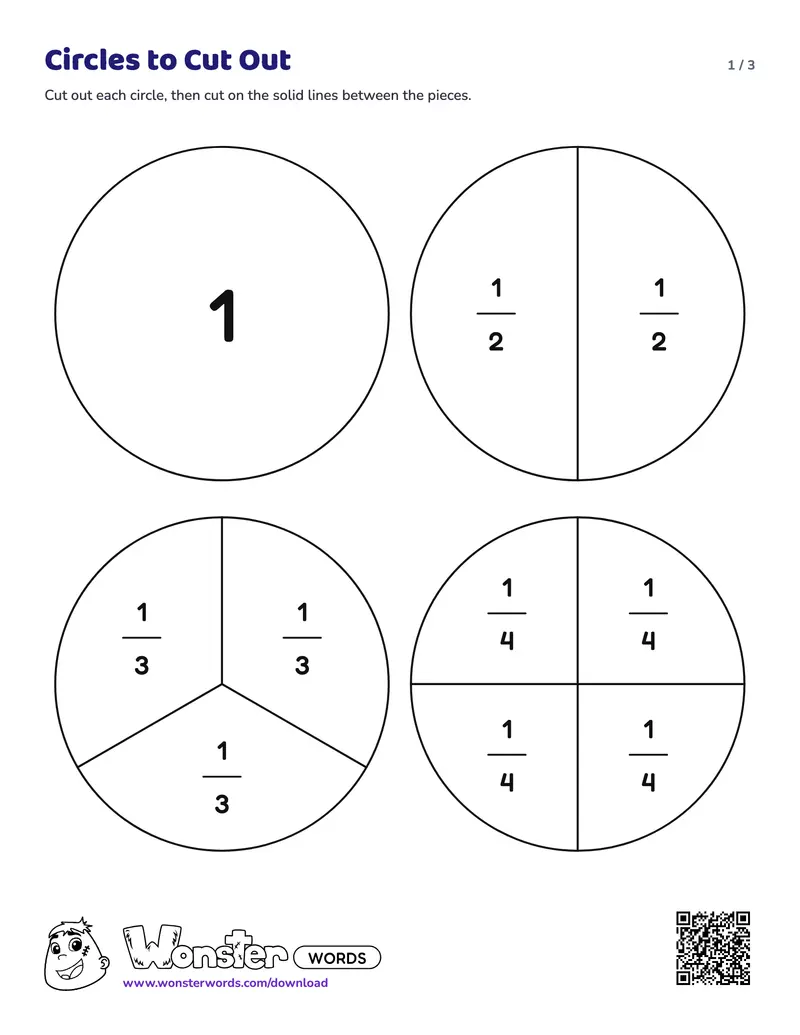
- Circles to Cut Out. A whole, halves, thirds, fourths, sixths, and eighths, plus two blank circles to build on.
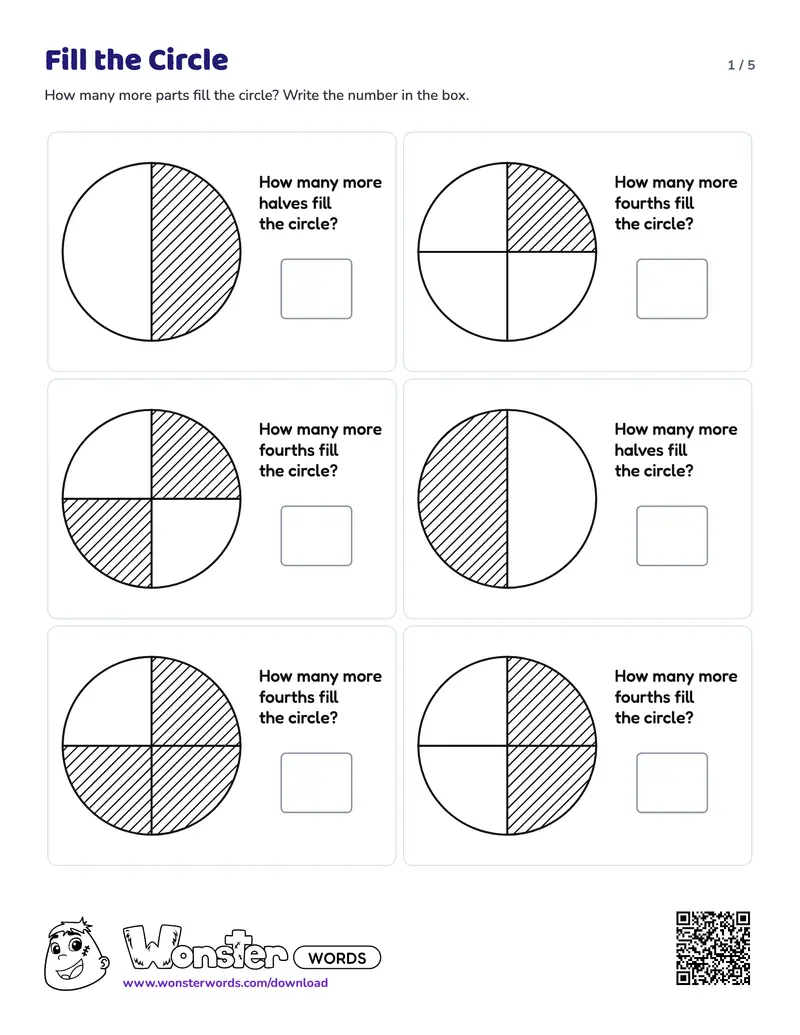
- Fill the Circle. Some parts of a circle are shaded, and your child writes how many more fourths, or other parts, fill it.
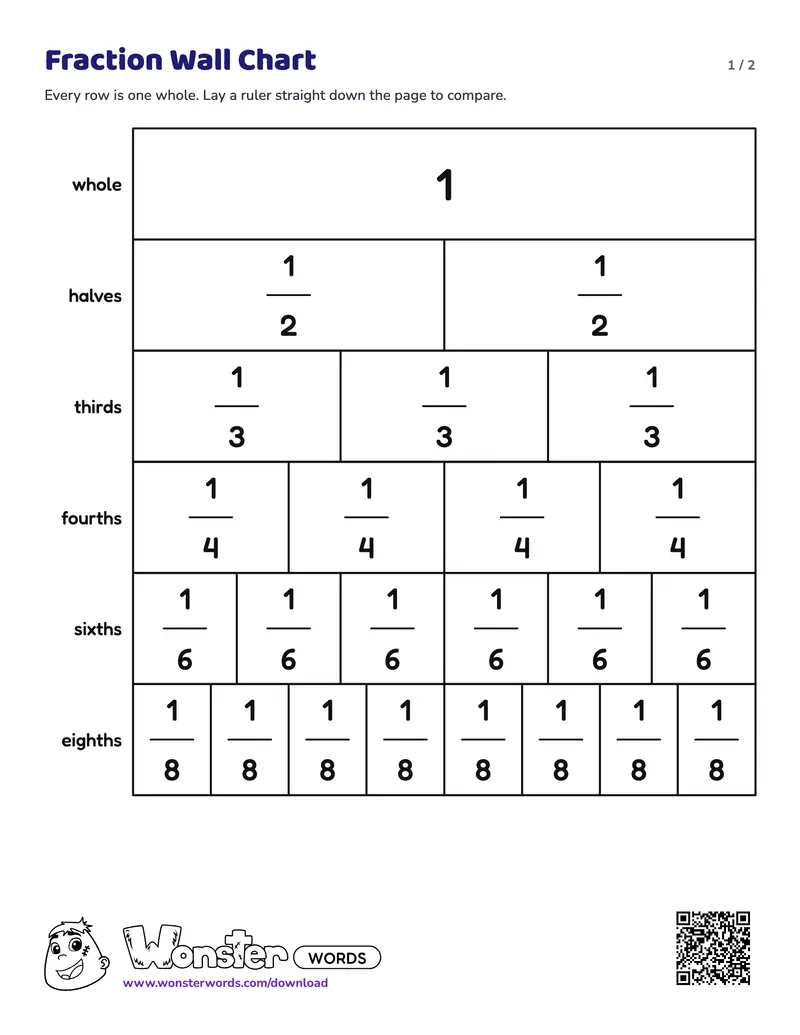
- Fraction Wall Chart. One whole, then rows of halves, thirds, fourths, sixths, and eighths, every piece labeled.
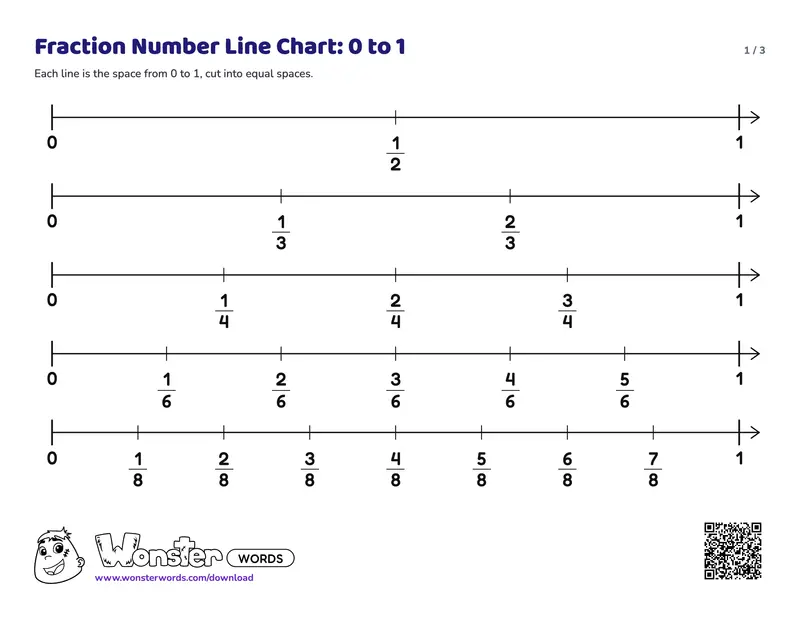
- Fraction Number Line Chart. Stacked lines from 0 to 1 and on to 2, with every mark named.
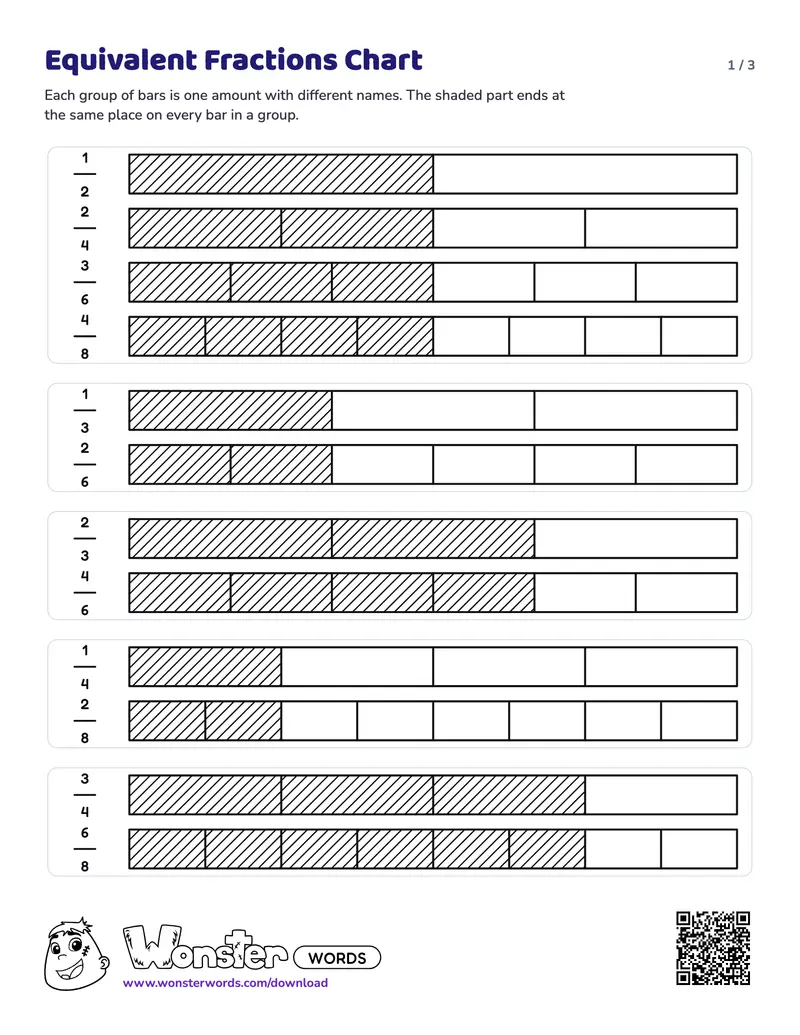
- Equivalent Fractions Chart. Each family of equal fractions drawn as bars and marked on number lines.
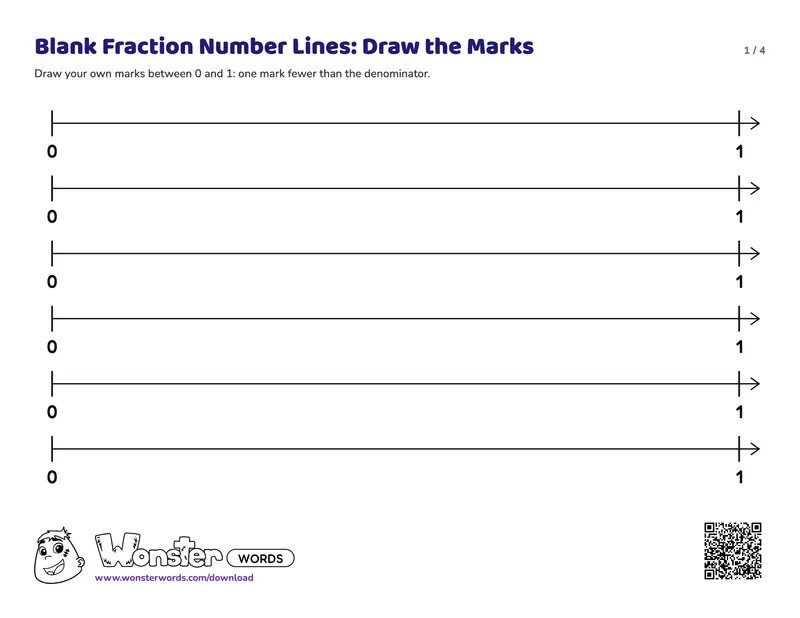
- Blank Fraction Number Lines. Lines with only 0 and 1 for your child’s own marks, and lines with marks and no labels.
The fraction strips, the wall chart, the two reference charts, and the blank number lines are labeled for third grade, and the circles for grades 1–3. The circle pieces are printed with written fractions, so a first or second grader says each part’s name in words. That child uses only that grade’s pieces: halves and fourths in first grade, thirds added in second grade under the Common Core, and eighths added in second grade in Texas. On Fill the Circle, a first grader and a Texas second grader stop at page 1, and a Common Core second grader stops at page 2. Page 3 has sixths, which wait for third grade.
Printable games are on the fraction games page, since a game is played at a table and not filled in like a worksheet.
Free PDF · no sign-up
Feedback?Free printable fraction charts, strips, circles, and number lines
Charts and cut-out sets have no answer key because there is nothing to answer, and a child who labels a blank set checks it against the printed one. Measure With Fraction Strips and Fill the Circle end with an answer key, and each of these PDFs is free and prints in black and white.
- Fraction Strips (PDF)24 pieces · 2 pages
Preview page 1Preview
- Blank Fraction Strips (PDF)24 pieces · 2 pages
Preview page 1Preview
- Measure With Fraction Strips (PDF)18 bars · answer key included · 5 pages
Preview page 1Preview
- Circles to Cut Out (PDF)24 pieces · 3 pages
Preview page 1Preview
- Fill the Circle (PDF)18 circles · answer key included · 5 pages
Preview page 1Preview
- Fraction Wall Chart (PDF)6 rows · 2 pages
Preview page 1Preview
- Fraction Number Line Chart (PDF)10 lines · 3 pages
Preview page 1Preview
- Equivalent Fractions Chart (PDF)5 families · 3 pages
Preview page 1Preview
- Blank Fraction Number Lines (PDF)18 lines · 4 pages
Preview page 1Preview
Can I find fraction worksheets focusing on word problems?
Yes: Share It is the third-grade fraction story sheet on this page. Its one-line stories read like “4 friends share 1 brownie”, and your child writes the fraction each person gets. Common Core’s fourth-grade standards first name fraction word problems (4.NF.B.3d and 4.NF.B.4c), and the third-grade fraction standards do not use the words “word problem”. Texas asks third graders to “solve problems involving partitioning an object or a set of objects among two or more recipients” (TEKS 3.3(E)) and to compare fractions “in problems” (3.3(H)). Word problems with whole numbers have their own sheets on the tape diagram page.
How can parents effectively use printable fraction worksheets at home?
Parents can use printable fraction worksheets at home in five short steps, so a sheet practices what a child already understands. The steps work on every practice sheet on this page.
Teach the step first, then hand over the sheet
A worksheet practices a step your child has already met; it does not teach a new one. Try the step together first, then print the sheet.
Cut something real first
Before the picture on the sheet, cut a sandwich, fold a strip of paper, or share crackers equally between two plates. Then go to the drawn shape.
Do the first row together, out loud
Work the first row side by side. Ask "How do you know the parts are equal?" before your child moves on, because the answer shows how your child is thinking.
Check it together with the answer key
Check each answer against the key while the problems are fresh. Your child fixes each one that is wrong.
Move on when your child is accurate and calm
Go to the next sheet when your child gets the answers right and can say why, not when a page is finished. If a sheet stays hard, go back one sheet.
For step 1, the fractions guide sets out what to try at home from the first cut to the number line. Step 2 follows the Institute of Education Sciences guide on fractions, which recommends, with minimal evidence by its panel’s rating: “Use equal-sharing activities to introduce the concept of fractions.”
The Institute of Education Sciences guide on fractions sets no number for how often to practice. A few minutes on most days, stopping while it is going well, is a reasonable place to start.
Worksheets and hands-on work do different jobs, so use both, with the hands-on work first. Cutting and sharing real things introduces the idea, and a worksheet then gives practice and leaves a record you can look back at next week.
What makes a good fraction worksheet, and how do you make your own?
A good fraction worksheet, from any source, passes six checks:
- The parts of each shape really are equal.
- Sheets for first and second grade use words, and third-grade sheets add written fractions.
- Third-grade denominators stay on 2, 3, 4, 6, and 8.
- A comparison uses the same whole, because “comparisons are valid only when the two fractions refer to the same whole” (Common Core 3.NF.A.3d).
- The practice comes in mixed order, not a run of one fraction.
- It has an answer key.
To make your own fraction worksheet, take four steps:
- Fold or rule the shapes so the parts are equal.
- Write the fractions your child is working on.
- Mix the order.
- Write the answer key before your child starts.
Frequently asked questions
What age is best for introducing fraction worksheets?
First grade, usually ages 6–7, is when the Common Core and the Texas standards start fractions, with halves and fourths of shapes named in words. No Common Core or Texas standard asks for fractions before first grade, so a younger child can share real food and paper instead of doing a worksheet.
What fraction worksheets should a first grader do?
A first grader does worksheets on halves and fourths of circles and rectangles, in words, with no written fractions. Look for sheets that ask whether a shape is cut equally, that have your child cut a shape into 2 or 4 equal parts, and that have your child name one part as a half or a fourth. Common Core adds thirds in second grade and written fractions in third grade.
Should my second grader be writing fractions as numbers?
No. Under the Common Core, second graders cut shapes into halves, thirds, and fourths and name them in words, such as "three thirds". Texas second graders work on halves, fourths, and eighths, also in words. Both frameworks have children write fractions as numbers in third grade, and the Common Core starts with unit fractions such as 1/4.
Fraction worksheets for first graders vs. third graders: what is the difference?
A first-grade fraction worksheet uses words, and a third-grade fraction worksheet uses numbers. First graders cut shapes into halves and fourths and say the names of the parts. Third graders write fractions such as 3/4, place them on a number line, find equivalent fractions, and compare fractions with the same top or bottom number.
What are the best fraction practice worksheets for preschoolers?
Preschoolers do not need fraction worksheets. No Common Core or Texas standard asks for fractions in preschool or kindergarten. A 4-year-old or a kindergartner can share crackers between two plates and check that each plate has the same number. The child can also watch you cut a sandwich in two and check that the parts match. Worksheets can wait for first grade.
Do the fraction worksheets have answer keys?
Every practice sheet has an answer key after its worksheet pages, with each answer in red in the place where your child answers. The charts and cut-out sets have no answer key because there is nothing to answer. A child who labels Blank Fraction Strips or Blank Fraction Number Lines checks them against the printed Fraction Strips or the Fraction Number Line Chart. The last page of each PDF is a page for grown-ups.
How often should second graders practice fractions using worksheets?
The Institute of Education Sciences guide on fractions sets no number for how often to practice. A few minutes on most days, stopping while it is going well, is a reasonable place to start. One sheet at a time is enough, because the point is to see whether your child can say why the parts are equal.
What standards should fraction worksheets for second grade align with?
In the Common Core, standard 2.G.A.3 asks second graders to cut circles and rectangles into two, three, or four equal shares, describe them in words, and describe the whole as "three thirds" or "four fourths". In Texas, standards 2.3(A)–(D) cover halves, fourths, and eighths in words. Thirds come in third grade in Texas.
Are worksheets or hands-on activities better for teaching fractions in 3rd grade?
Use both, with the hands-on work first. A third grader who has cut paper into fourths has something to picture when 3/4 appears on a worksheet. The Institute of Education Sciences guide on fractions recommends equal-sharing activities to introduce fractions, with minimal evidence by its panel's rating, and a worksheet then gives practice and a record to look back at.
Are there fraction worksheets for 4th and 5th grade here?
Not on this page. These fraction worksheets stop where third grade stops, with fractions compared only when they share a top or bottom number. Adding fractions and comparing fractions with different tops and bottoms are fourth-grade work in the Common Core.
Related guides
Standards this page teaches: Common Core: 1.G.A.3, 2.G.A.3, 3.NF.A.1, 3.NF.A.2, 3.NF.A.3 · Texas: 1.6(G), 1.6(H), 2.3(A), 2.3(B), 2.3(C), 2.3(D), 3.3(A), 3.3(B), 3.3(C), 3.3(D), 3.3(E), 3.3(F), 3.3(G), 3.3(H), 3.7(A)
Last updated
Looking for something else?
Looking for something else?