
Math
Free Printable Fraction Strips (Fraction Bars and Tiles)
What fraction strips are under their three names, labeled and blank sets to cut out, how to make your own with a ruler, how to use them step by step, and what they show that circles and number lines do not.
Grade 3
Printables, classroom sets, and stores offer one tool under three names: fraction strips, fraction bars, and fraction tiles. The tool is a whole strip of paper or plastic and matching pieces cut into halves, thirds, fourths, sixths, and eighths. Use a fraction strip as a length, not a picture of parts. Keep one whole strip on the table, lay pieces end to end against it with no gaps and no overlaps, and say how many fit.
Three free black-and-white PDFs go with this guide, with no sign-up: Fraction Strips, a labeled set to cut out; Blank Fraction Strips, the same pieces for your child to label; and Measure With Fraction Strips, a practice sheet with an answer key. Strips suit third grade, when the Common Core and the Texas standards both work in halves, thirds, fourths, sixths, and eighths. Children in first and second grade can fold paper strips instead.
What are fraction strips? Fraction bars and fraction tiles are the same tool
Fraction strips, also called fraction bars or fraction tiles, are a set of paper or plastic strips in which one strip stands for one whole and the matching pieces are that whole cut into equal parts. The name usually depends on the book or the box, not on the tool. The fractions practice guide from the Institute of Education Sciences (IES) says fraction strips “are length models”, and it lists strip diagrams and tape diagrams as other names for them (p. 21). A piece is worth 1/4 because 4 copies of it fill the length of the whole strip, which makes a strip a hands-on way to see what a fraction is.
Each name for fraction strips turns up in its own place:
| Name | Where a parent sees it |
|---|---|
| Fraction strips | Printables and the IES fractions guide |
| Fraction bars | Printables and classroom sets; also, separately, the line in a written fraction |
| Fraction tiles | Plastic classroom sets |
| Strip diagram, tape diagram | The drawn version: Texas 3.3(A) and the Common Core glossary |
A set of fraction strips: six rows of one length, 24 pieces in all. Every row fills the same whole strip, so 2 halves, 4 fourths, 8 eighths, 3 thirds, and 6 sixths all end at the same edge.
A strip your child cuts and a strip your child draws are different things, and “fraction strip” can name either. This guide calls the cut-out pieces fraction strips and the drawn version a tape diagram. Homework may use the words the other way. The Common Core glossary lists “fraction strip” as another name for a tape diagram, and the Texas standards write “strip diagrams” (TEKS 3.3(A)). The Common Core writing team’s Progressions note the overlap on p. 134: paper strips “are sometimes called ‘fraction strips,’ but in the Standards ‘fraction strip’ is used as a synonym for ‘tape diagram.’”
“Fraction bar” has a second meaning: the line between the top and bottom numbers of a written fraction. A worksheet that asks a child to write the fraction bar means that line. The Common Core Progressions use the words the same way on p. 166, for ratios “written with fraction bars rather than colons”.
Free printable fraction strips, labeled and blank
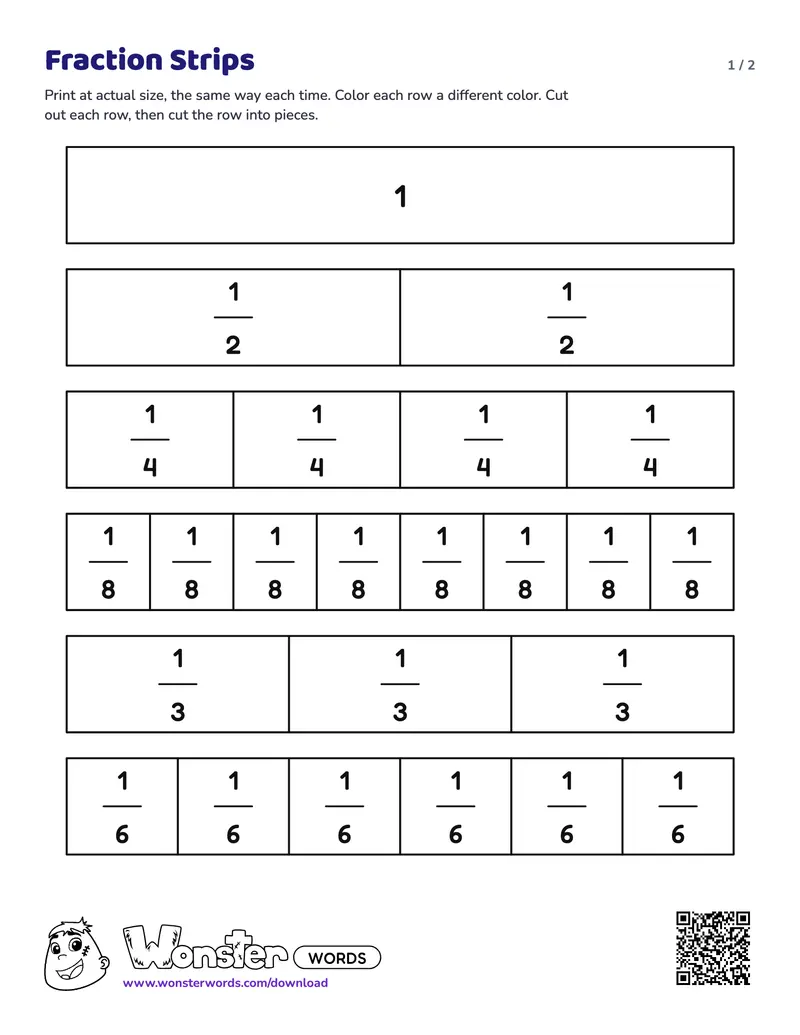
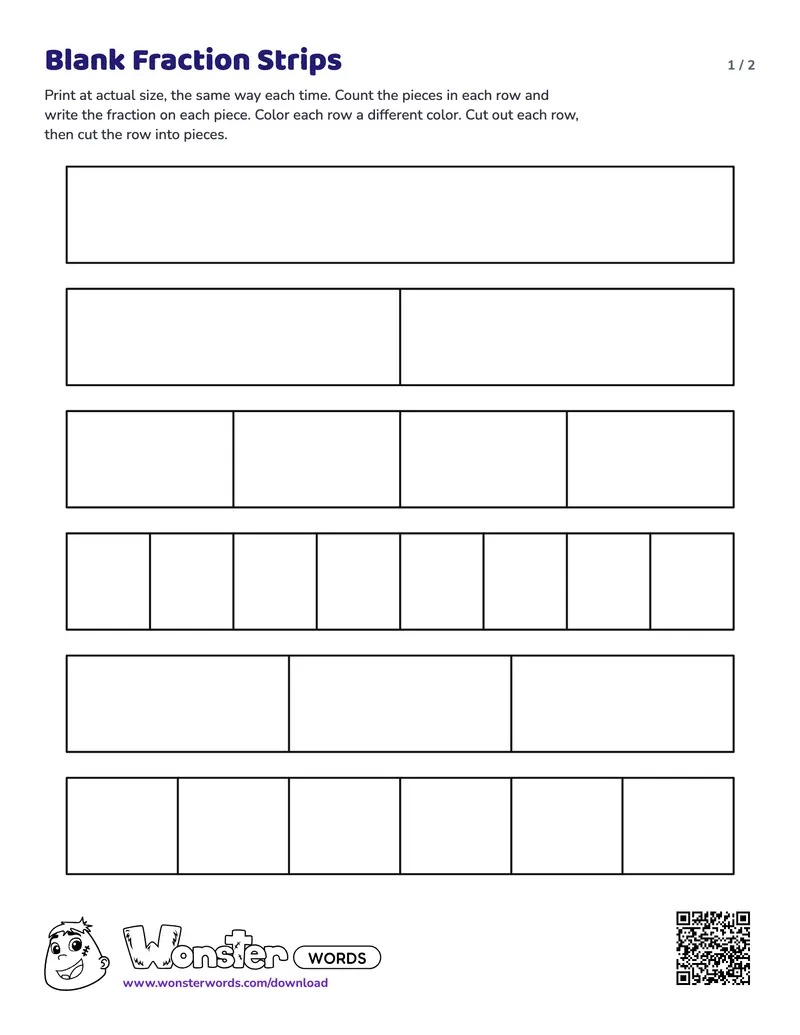
The free fraction strips are three black-and-white PDFs for third grade: a labeled set, a blank set, and a measuring practice sheet. The labeled and blank sets carry the same 24 pieces in six rows: 1 whole, 2 halves, 4 fourths, 8 eighths, 3 thirds, and 6 sixths.
- Fraction Strips, 2 pages. Each piece carries its fraction, and the whole strip is marked 1. Print this one first. The second page is for grown-ups.
- Blank Fraction Strips, 2 pages. The same six rows cut into the same pieces, with no numbers on them, so your child writes each fraction. The second page is for grown-ups.
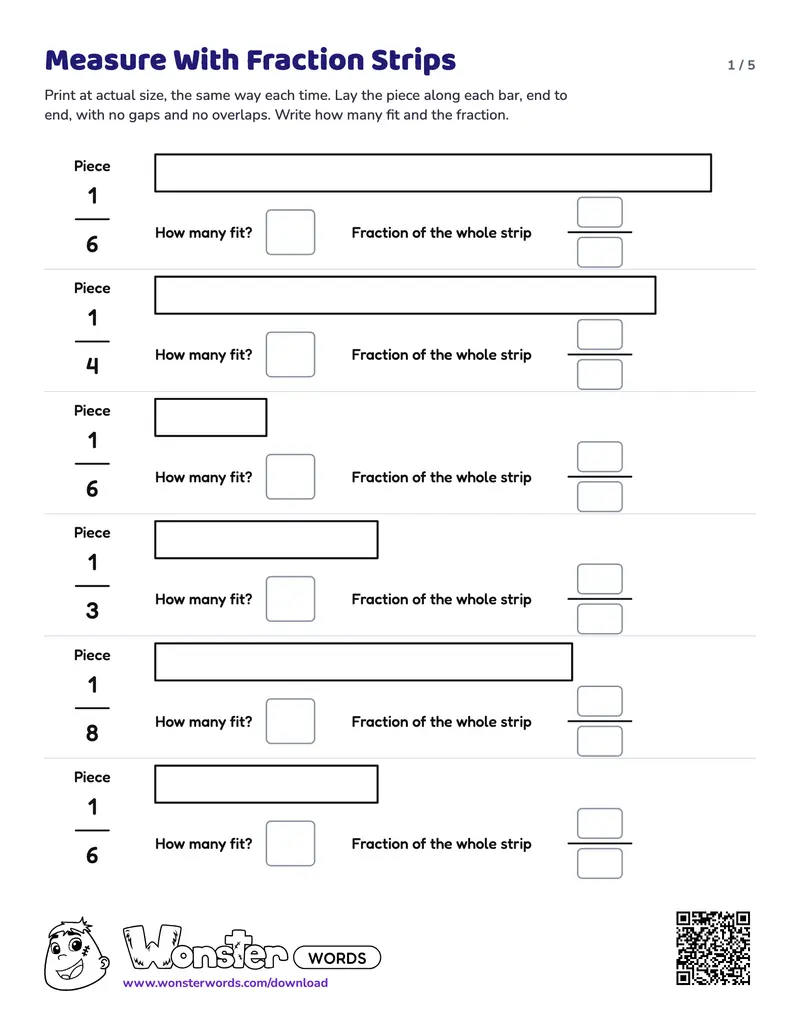
- Measure With Fraction Strips, 5 pages. Each item is a plain bar with no marks inside and a named piece. Your child lays that piece end to end along the bar, writes how many fit, and writes the fraction of the whole strip. Its 18 bars cover every fraction less than 1 with a denominator of 2, 3, 4, 6, or 8, in mixed order over three pages. An answer key and a page for grown-ups follow. Print the strips first, because this sheet’s bars match the printed cut-out set and not a homemade 12-inch one.
Free PDF · no sign-up
Feedback?Print the fraction strips
Three free PDFs in black and white, with no account and no email. Print each one at actual size, not fit to page, and the same way each time, so that the pieces and the measuring bars match.
- Fraction Strips (PDF)24 pieces · 2 pages
Preview page 1Preview
- Blank Fraction Strips (PDF)24 pieces · 2 pages
Preview page 1Preview
- Measure With Fraction Strips (PDF)18 bars · answer key included · 5 pages
Preview page 1Preview
The set stops at the fractions of grade 3. Other sets add fifths, tenths, or twelfths.
To turn the printed sheet into a set of fraction strips, print, color, and cut in that order.
- Print on card stock if you have it, or on plain paper. The measuring activity in the IES guide uses “card stock or construction paper”.
- Color each row a different color before cutting. A black-and-white print has nothing else to tell the rows apart at a glance.
- Cut each row out first, then cut the row into pieces.
A fraction chart keeps rows like these together on one page for reading, and these strips come apart so that a child can move them. More practice is on the fraction worksheets page.
How do I make fraction strips at home?
To make fraction strips at home, cut paper strips 12 inches long, the length of a ruler, because a strip that long puts every mark on a ruler line. You need paper, a ruler, a pencil, and scissors.
| Row | Pieces | Mark every |
|---|---|---|
| Whole | 1 | No marks |
| Halves | 2 | 6 inches |
| Thirds | 3 | 4 inches |
| Fourths | 4 | 3 inches |
| Sixths | 6 | 2 inches |
| Eighths | 8 | 1 1/2 inches |
Mark the 9-inch side of a 9-by-12-inch sheet of construction paper every 1 1/2 inches and cut the long way. That makes exactly six strips 1 1/2 inches wide and 12 inches long, one per row. Cutting all six from one sheet gives every row the same whole. Before you use the set, lay each row end to end against the whole strip, and recut a row that runs long or comes up short.
Folding works for halves, fourths, and eighths: fold in half, again, and again. Thirds are harder to fold evenly. The What Works Clearinghouse guide for children who struggle with math, writing about number lines, says odd denominators “may be more difficult for students to partition equally” (p. 31). Sixths start from thirds, so measure both with the ruler.
How to use fraction strips, step by step
To use fraction strips, keep the whole strip on the table and measure every piece against it, with no gaps and no overlaps between pieces. “No gaps or overlaps between successive length-units” is how the Progressions for the Common Core describe measuring a length (p. 135). A fraction built this way is the one standard 3.NF.A.1 describes: a/b is “a parts of size 1/b”, so 3/4 is 3 parts of size 1/4. Texas asks for the same thing in TEKS 3.3(D), where 3/4 is a sum of 3 parts of 1/4. The five steps use one cut-out set of fraction strips.
Lay the whole strip down
Put the whole strip, the one with no cuts, on the table and leave it there for the entire session. Every piece is measured against it.
Name a piece by how many fill the whole
Give your child the fourths and have them lay all 4 end to end along the whole strip. Say, "It takes 4 of these to fill the whole strip, so each one is one fourth." Do the same with the halves and the thirds.
Build a fraction
Take the pieces off. Have your child lay 3 fourths end to end along the whole strip from its left edge, with no gaps and no overlaps. Three pieces of size one fourth make three fourths.
Check the length and say it
Ask, "How much of the whole strip is this?" Your child runs a finger along the pieces, sees the part of the whole strip they cover and the part left over, and answers, "Three fourths."
Write it last
Only now write 3/4. The 3 counts the pieces on the table, and the 4 says that 4 of those pieces fill the whole strip.
Say “three fourths”, not “three over four”. The Progressions prefer “two thirds” to “two over three” (p. 134) because the words say that the fraction is made of unit fractions, pieces of one size. Once your child can say what the pieces are, the numerator and denominator are names for the two numbers already on the table.
Fraction strip activities to try at home
Four fraction strip activities need only paper strips, and in each one your child says aloud what the strips show.
- Measure something. In the IES fractions guide’s Example 1 (p. 21), a student measures an object with whole strips, then measures the same object with a fractional strip. Measure a book that way and say, “The book stayed the same length. The piece changed.” The Measure With Fraction Strips sheet practices the same move, laying pieces end to end along a printed bar.
- Which is longer? Lay one 1/3 and one 1/4 against the same whole strip. Say, “It takes 3 thirds to fill the strip and 4 fourths to fill it, so a third is longer.” Fewer equal parts means larger parts, and the Common Core’s standard 3.NF.A.3d says a comparison is “valid only when the two fractions refer to the same whole”. The comparing fractions guide takes it further.
- Fill the whole. Fill one whole strip with any mix of pieces and say what you used: “1 half, 1 fourth, and 2 eighths fill it.” Some mixes run past the end, so take a piece off and try again. Write nothing down.
- Fold and name, for first and second graders. Fold a strip in half and say “2 halves”, then in half again and say “4 fourths”. The What Works Clearinghouse guide starts the same way, asking students to “fold a strip of paper in half to see two equal parts” (p. 31).
Printable ways to play are on the fraction games page.
How do fraction strips show equivalent fractions?
Fraction strips show equivalent fractions as pieces that reach the same length. Line up the half strip with 2 fourths, 3 sixths, and 4 eighths, and the four lengths match, so 1/2 = 2/4 = 3/6 = 4/8. The Common Core writing team describes that match as “1 equal share of a decomposition or multiple smaller shares of a different decomposition with more parts” (p. 141). Not every piece has a match: sixths and eighths line up at only one point between 0 and 1, 3/6 and 4/8. Why the matches happen, and how to find them, is on the equivalent fractions page.
Why do fraction strips help children understand fractions?
Fraction strips help a child check a fraction by measuring it, because a piece of the wrong size shows at once against the whole strip. A picture printed on a worksheet cannot be picked up and laid against a whole. Tape diagrams, the drawn form of the strip, “tend to be less complex geometrically than area representations”, according to the Common Core Progressions for fractions (p. 135). The Progressions say diagrams and paper strips test “crucial aspects of fractions”. Those aspects are that “the parts must be the same size, the parts must use all of the whole … and subdividing parts of the same whole makes the parts smaller” (p. 134).
The panel behind the IES practice guide recommends measurement activities with fraction strips under its Recommendation 2, which it rates Moderate Evidence. It says that evidence “primarily comes from studies demonstrating the usefulness of number lines for developing number sense with whole numbers” (p. 20). The rating rests mainly on number lines, not on strips.
A third-grade study in the appendix of the IES fractions guide used fraction strips among 11 named manipulatives and models, so it cannot show what strips do alone. Teachers used these fraction manipulatives together to supplement their curriculum, with a “substantively important, but not statistically significant” effect (effect size 0.60) on a textbook assessment (p. 62). Research on hands-on objects in general, including the 2013 meta-analysis by Carbonneau, Marley, and Selig, is on the math manipulatives page.
Fraction strips vs. fraction circles and number lines: which is better?
Fraction strips, fraction circles, and number lines each show a fraction in a different way, so each has its own job. Students do not start on the number line. As they learn that a fraction is a number, “initially they use other representations such as area representations, strips of paper, and tape diagrams”, in the words of the Progressions on number lines (p. 141).
| Tool | Shows a fraction as | Good for |
|---|---|---|
| Fraction strips | A length you can lay against another | Comparing pieces side by side, building a fraction piece by piece |
| Fraction circles, sometimes called pie charts | A part of one round whole | Picturing a share of one round whole |
| Number line | A point at a distance from 0 | Fractions as numbers, past 1 |
Put strips on the table when the question is which piece is longer or how many fit, and circles when the fraction is a share of one round thing, such as a pizza. A strip stops at its own end, so a fraction past 1 takes a second whole strip. A number line carries on past 1 with no second strip, which makes it the tool for homework that places 5/3.
What grade are fraction strips for?
Fraction strips fit third grade, when the Common Core and the Texas standards both work with denominators 2, 3, 4, 6, and 8. The Common Core sets that limit in a footnote to 3.NF, and Texas names the five in TEKS 3.3(A), along with “concrete objects and pictorial models, including strip diagrams”. The grade-by-grade fractions guide shows what comes before and after.
Before third grade, folded paper fits the equal-parts work of the earlier grades, because a strip is a rectangle. In the Common Core, first graders split rectangles into halves and fourths (1.G.A.3), and second graders add thirds (2.G.A.3). In Texas, second graders partition objects into halves, fourths, and eighths (TEKS 2.3(A)), and thirds arrive in third grade. A fourth grader can keep using strips for fifths, tenths, and twelfths, which are grade 4 denominators in the Common Core. The Progressions warn that paper strips “may become awkward or unworkable” (p. 134), and at that point a child can draw the strips instead.
Common mistakes when using fraction strips
The fraction strip mistake to watch for first is counting parts without looking at the length. The IES fractions practice guide warns that “considerable care needs to be taken to avoid students simply counting parts of the fraction strip or circle” (p. 25).
- Counting parts without looking at the length. Ask, “How much of the whole strip is this?”
- Leaving gaps or overlapping pieces. Push the edges together until they touch, and keep the row against the whole strip.
- Mixing pieces from different sets. Two printings or two sheets of paper can give two different wholes, and a comparison holds only for the same whole. Use one printing as one set.
- Tearing off part of a strip. The Progressions report that “students sometimes just tear off part of the paper strip” (p. 134). A fraction uses all of the whole, so cut the whole strip into equal pieces and keep every piece.
- Using pieces of different sizes in one fraction. The 3 in 3/4 counts fourths, so all 3 pieces must be fourths. Swap out a piece of any other size.
A child who is still stuck goes back to a paper strip folded in half and in half again, naming each part before writing any number.
Frequently asked questions
What are fraction strips and how are they used?
Fraction strips are a set of paper or plastic strips in which one strip stands for one whole and the matching pieces are that whole cut into equal parts. A child keeps the whole strip on the table, lays pieces end to end against it with no gaps and no overlaps, and says how much of the whole strip the pieces cover. Three fourth pieces cover three fourths of the whole strip, and the child writes 3/4.
Are fraction strips and fraction tiles the same thing?
Usually, yes. Printables, classroom sets, and stores use fraction strips, fraction tiles, and fraction bars as three names for one tool, a whole strip and matching pieces cut into equal parts. The word tiles appears on plastic classroom sets and the word strips on paper printables, but a child uses both the same way, by laying pieces end to end against the whole. A strip a child draws on paper is usually called a tape diagram, although the Common Core glossary also lists fraction strip as a name for that drawing.
What is a fraction bar in math?
A fraction bar means one of two things in math. It is the line between the top and bottom numbers of a written fraction, such as the line in 3/4. It is also another name for a fraction strip, a strip of paper or plastic that stands for a whole or a piece of a whole. A worksheet that asks a child to write the fraction bar means the line, and a classroom set of fraction bars means the strips.
How do I use fraction strips with my third grader at home?
Lay one whole strip on the table and leave it there. Have your child lay all 4 fourths along it and say that each one is one fourth because 4 of them fill the strip. Then build a fraction, such as 3 fourths end to end with no gaps and no overlaps, ask how much of the whole strip it covers, and write 3/4 only after your child says three fourths.
How do I make fraction strips at home?
Cut one 9-by-12-inch sheet of construction paper into six strips, each 1 1/2 inches wide and 12 inches long, and use one strip per row. Leave one strip whole and mark the rest with a ruler, halves at 6 inches, thirds every 4 inches, fourths every 3 inches, sixths every 2 inches, and eighths every 1 1/2 inches. Cut on the marks and check that each row fills the whole strip exactly.
How do you compare fractions using fraction strips?
Build each fraction from one set of strips and lay the two rows side by side, starting at the same edge of the whole strip. The row that reaches farther is the larger fraction, so 2/3 is larger than 2/4. The comparison works only when both fractions come from strips cut from the same whole, which is why the pieces should all come from one printing.
Fraction strips vs. fraction circles: which is better for teaching?
Neither one is shown to be more effective, and they show different things. Fraction strips show a fraction as a length, so a child can lay pieces side by side and see which is longer. Fraction circles show a share of one round whole, such as a pizza. Use strips when the question is which piece is longer or how many fit, and circles when the fraction is a share of one round thing.
What grade levels benefit most from using fraction strips?
Fraction strips fit third grade, when the Common Core and the Texas standards both work with denominators 2, 3, 4, 6, and 8. Children in first and second grade can fold a paper strip into equal parts and name them. A fourth grader can keep using strips for fifths, tenths, and twelfths until paper strips get awkward, and then draw them instead.
Why are fraction strips effective for teaching fractions?
Fraction strips make a fraction something a child can measure, because a piece is worth what it is by how many of it fill the whole strip. A piece of the wrong size shows at once against the whole. The evidence is limited, though. A third-grade study in the Institute of Education Sciences fractions guide used strips among 11 manipulatives, with a substantively important effect that was not statistically significant. Because the tools were used together, it cannot show what strips do alone.
Related guides
Standards this page teaches: Common Core: 3.NF.A.1, 3.NF.A.3b · Texas: 3.3(A), 3.3(D), 3.3(F)
Last updated
Looking for something else?
Looking for something else?