
Math
What Is a Unit Fraction?
Simple examples, why third grade starts with unit fractions, which is greater, 1/3 or 1/4, and how counting the pieces gets a child from 1/4 to 3/4.
Grade 3
A unit fraction is a fraction with 1 on top, such as 1/2, 1/3, 1/4, 1/6, or 1/8. It names one equal part of a whole: 1/4 is one part when the whole is cut into 4 equal parts. A unit fraction is the piece, and every other fraction counts pieces, so 3/4 is three 1/4s.
Third grade starts written fractions with unit fractions, because every other fraction is built from one. The Common Core’s Grade 3 overview says students learn fractions “beginning with unit fractions,” and Texas names the unit fraction in TEKS 3.3(C). Practice unit fractions with four free worksheets to print, each with an answer key.
What is a unit fraction in simple terms?
A unit fraction is a fraction with 1 on top, so it always names one piece. The top number is the numerator, and here it says you have one piece. The bottom number, the denominator, says how many equal parts make the whole. The Common Core defines 1/b as “the quantity formed by 1 part when a whole is partitioned into b equal parts.”
| Unit fraction | Say it | Equal parts in the whole | Takes this many to make a whole | Drawn |
|---|---|---|---|---|
| 1/2 | one half | 2 | 2 halves | |
| 1/3 | one third | 3 | 3 thirds | |
| 1/4 | one fourth (one quarter) | 4 | 4 fourths | |
| 1/6 | one sixth | 6 | 6 sixths | |
| 1/8 | one eighth | 8 | 8 eighths |
The bars and circles in this table are drawn versions of fraction strips and fraction circles, and a fraction chart stacks the same unit fractions row by row.
The fraction 1/3 is a unit fraction because it is one part of a whole cut into 3 equal parts. The same test works on any fraction, so 1/5 and 1/100 are unit fractions too. Third grade stays with the five in the table: a Common Core footnote limits grade 3 to denominators of 2, 3, 4, 6, and 8, and Texas uses the same five.
A unit fraction differs from any other fraction in how many pieces it names. The fraction 1/3 names one piece and 2/3 names two. A fraction with more than 1 on top is called a non-unit fraction, and it is made of unit fractions.
To draw a unit fraction, cut a bar or a circle into equal parts and shade one. On a number line, 1/4 is the first mark after 0 when the space from 0 to 1 is cut into 4 equal parts, the idea behind fractions on a number line.
Every unit fraction is a part of something, so ask “1/4 of what?” The writers of the Common Core call this “specifying the whole” in their Progressions. A child who names the whole can tell you whether a piece is 1/4 of a sandwich or 1/4 of a pizza.
What are some everyday examples of unit fractions?
Everyday examples of unit fractions come from anything cut, shared, or measured into equal parts, and each one has a whole you can name.
- Sharing a pizza. One pizza shared equally by 4 people gives each person 1/4 of the pizza. Cut into 8 equal slices, one slice is 1/8 of the pizza.
- Cooking. A set of measuring cups holds 1/2, 1/3, and 1/4 cup, each a part of 1 cup.
- The clock. Half an hour is 1/2 of an hour, which is 30 minutes. A quarter of an hour is 1/4 of an hour, which is 15 minutes.
- Money. A quarter is 1/4 of a dollar, which is why 4 quarters make a dollar.
- The ruler. The half-inch and quarter-inch marks divide an inch into 2 and 4 equal parts, and third graders measure to those marks (Common Core 3.MD.B.4).
- A group of things. One muffin from a box of 6 is 1/6 of the muffins, and the whole is the box. Texas third graders share “an object or a set of objects” (3.3(E)).
Two checks tell you whether something is a unit fraction: the parts are the same size, and you are looking at one of them. A sandwich torn into two uneven pieces is not cut into halves, because the two parts are different sizes.
Find five of these at home tonight, and ask your child to name the whole for each one.
Why is it easier to understand other fractions after learning unit fractions?
Children learn unit fractions first because every other fraction is made of them, and third grade is where written fractions begin. The Common Core’s Grade 3 overview says “Students develop an understanding of fractions, beginning with unit fractions” and “view fractions in general as being built out of unit fractions.” Texas asks third graders to explain “the unit fraction 1/b” by name.
A unit fraction does for fractions what the number 1 does for whole numbers. The Common Core’s writers state the goal in the Progressions: “for students to see unit fractions as basic building blocks of fractions, in the same sense that the number 1 is the basic building block of the whole numbers.” A child who knows 1/4 as one piece can read 3/4 as three of that piece.
Sharing one thing among people produces a unit fraction, which gives children a place to start. The Institute of Education Sciences (IES), in its practice guide on fractions, calls these sharing problems “a useful starting point for introducing fraction names, especially because some children think that all fractional parts are called one-half.” The IES panel rated that sharing recommendation minimal evidence, meaning it recommends the practice but cannot point to a body of causal research showing its positive effect.
Before third grade, children name equal shares in words, and third grade writes them as unit fractions.
| Grade | What children do | Common Core | Texas (TEKS) |
|---|---|---|---|
| 1st grade | Cut shapes into halves and fourths, as equal shares in words | 1.G.A.3 | 1.6(G) |
| 2nd grade | Name equal shares in words: halves, thirds, and fourths in the Common Core; halves, fourths, and eighths in Texas | 2.G.A.3 | 2.3(A) |
| 3rd grade | Write a unit fraction such as 1/4 as a number, then build other fractions from it | 3.NF.A.1 | 3.3(C), 3.3(D) |
The fractions guide covers what children learn in each grade.
Which is bigger, 1/3 or 1/4?
One third (1/3) is greater than one fourth (1/4) when both are parts of the same whole, because a whole cut into fewer equal parts has larger parts. In the Common Core’s Progressions, “in order for more (identical) pieces to make the same whole, the pieces must be smaller.” Texas puts it to second graders this way: “the more fractional parts used to make a whole, the smaller the part” (TEKS 2.3(B)). Texas third graders then compare fractions with the same numerator, such as 1/3 and 1/4 (TEKS 3.3(H)).
The mistake to expect is a child saying 1/8 is greater than 1/3, because 8 is greater than 3. The Institute of Education Sciences uses this example in its practice guide on fractions: children “might think that 1/8 > 1/3.” Show it on two strips of the same length, one cut into 3 equal parts and one into 8, with one part of each shaded. The 1/3 piece is longer.
Both bars are the same length, so the pieces can be compared. The shaded 1/3 is longer than the shaded 1/8, even though 8 is greater than 3.
The comparison holds only when both fractions are parts of the same whole. The Common Core 3.NF.A.3d says “comparisons are valid only when the two fractions refer to the same whole,” so 1/4 of a large pizza can be more food than 1/3 of a small one.
When you talk this through, say “greater than” rather than “bigger,” the wording the What Works Clearinghouse suggests in math class. The same reasoning explains what the bottom number tells you in every fraction. Pairs with the same top or bottom number are on the comparing fractions page.
How do I explain 3/4 to my child once they know 1/4?
To explain 3/4 to a child who knows 1/4, count the pieces: 3/4 is three 1/4s. Cut a paper strip into 4 equal parts and hand them over one at a time, saying the count out loud.
- One piece: one fourth, written 1/4.
- Two pieces: two fourths, written 2/4.
- Three pieces: three fourths, written 3/4.
- Four pieces: four fourths, written 4/4, which is one whole.
The top number counts the pieces and the bottom number names them. The 4 stays the same through the whole count because the pieces stay the same size, and 3/4 is one piece short of the whole. The Common Core states the general rule in 3.NF.A.1: a/b is “the quantity formed by a parts of size 1/b,” so 3/4 is 3 parts of size 1/4.
Moving or converting from a unit fraction to a non-unit fraction is only this one step, counting more than one of the same piece. The Institute of Education Sciences writes it as 3/4 = 1/4 + 1/4 + 1/4. Texas asks for the same sum in third grade, and TEKS 3.3(D) stays at or below one whole. Counting past the whole gives 5/4, or five 1/4s, and adding fractions comes in fourth grade (Common Core 4.NF.B.3a), both covered in the guide to fractions.
How can parents help their children understand unit fractions?
Parents can help their children understand unit fractions in five short steps, with a paper strip, a sandwich, or anything else that can be cut into equal parts. The Institute of Education Sciences advises teachers to move from sharing sets of objects to sharing one object. It suggests starting with 2, 4, or 8 people, since a child can get there by halving, and bringing in thirds after that. These steps start at one object and adapt that order for the kitchen table.
Share one thing
Share one sandwich or paper strip among 2, then 4, then 8 people, cutting each piece in half every time. Then share one among 3, and among 6, which halving cannot do. Each person's share is a unit fraction of the thing you cut.
Name the piece
Say the name of the piece every time: one half, one fourth, one eighth. A child may call every part a half, so ask for the name of each piece and how many of them the whole was cut into.
Count how many make the whole
Lay the pieces back together and count them by name: one fourth, two fourths, three fourths, four fourths. Four fourths make the whole, and six sixths make the whole too.
Compare two pieces of the same whole
Cut two paper strips of the same length, one into 3 equal parts and one into 4. Lay a 1/3 piece beside a 1/4 piece and ask which is greater. The 1/3 piece is, because fewer equal parts means larger parts.
Count past one piece
Hand over the 1/4 pieces one at a time and count them: one fourth, two fourths, three fourths. Write 3/4 and ask what the 3 counts and what the 4 names. Then print a sheet and practice on paper.
What are some common misconceptions about unit fractions?
Four misconceptions come from losing track of the piece or the whole, and each has something to try at home.
- Parts that are not equal. A piece is 1/4 only when all 4 parts are the same size. Hold the pieces against each other and ask, “Are they the same size?” The Common Core’s writers describe equal parts as “parts with equal measurements.”
- Every part is “a half.” Say the piece’s name each time: “This is one sixth, because the whole is cut into 6 equal parts.”
- A bigger number means a bigger piece. Lay a 1/3 piece beside a 1/8 piece, each cut from a strip of the same length, and ask which is greater.
- Pieces of different wholes. Compare pieces of the same whole: “Which is greater, 1/4 of this strip or 1/3 of this strip?”
Paper strips and other hands-on tools let your child hold the pieces side by side.
The fraction games page turns these pieces into play, with Roll and Shade: Unit Fractions and Unit Fraction War.
Free unit fractions worksheets
The free unit fractions worksheets are four PDFs, each with one activity, an answer key, and a page for grown-ups, in black and white, with no account and no email. Print them in this order: share, name, compare, build.
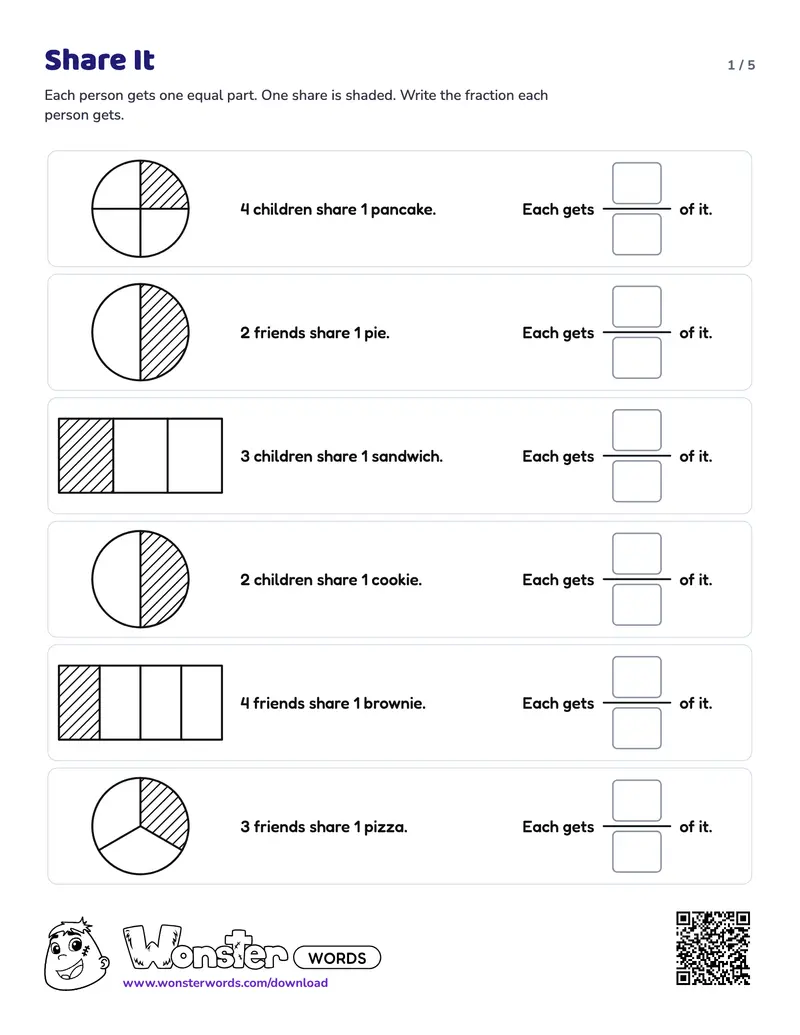
- Share It. One-line stories with a pictured whole: “4 friends share 1 brownie. Each gets ___ of it.”
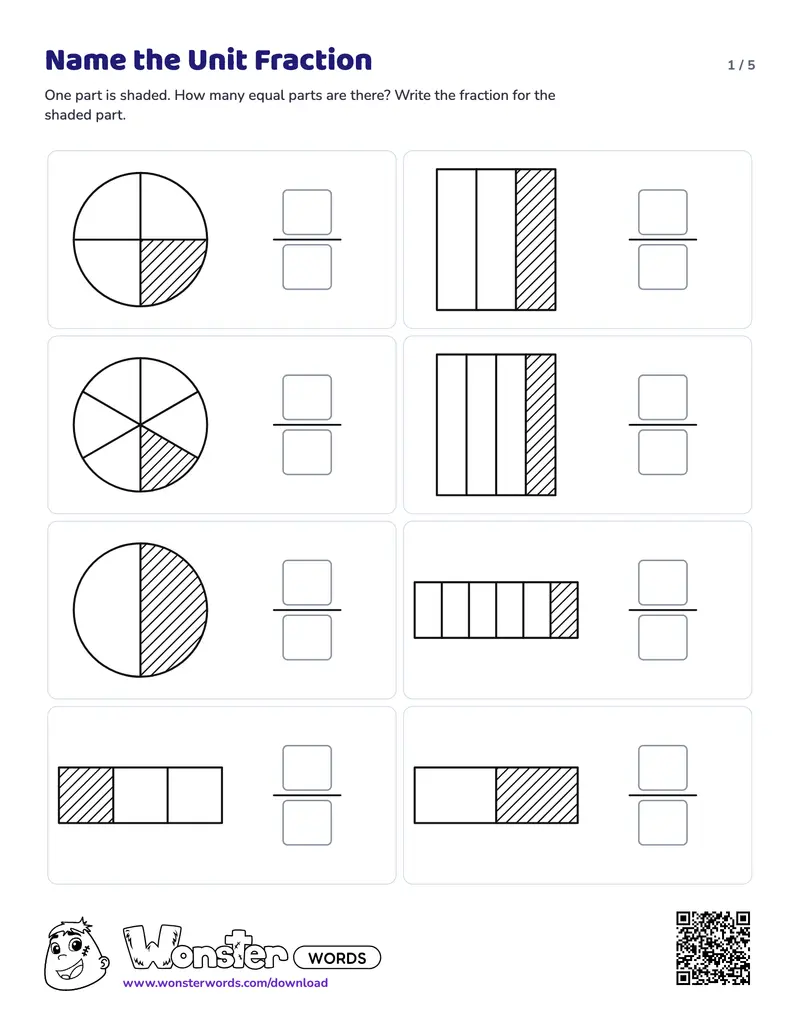
- Name the Unit Fraction. A bar, a circle, or a rectangle with one part shaded, and your child writes the fraction. This is the sheet to use for homework practice.
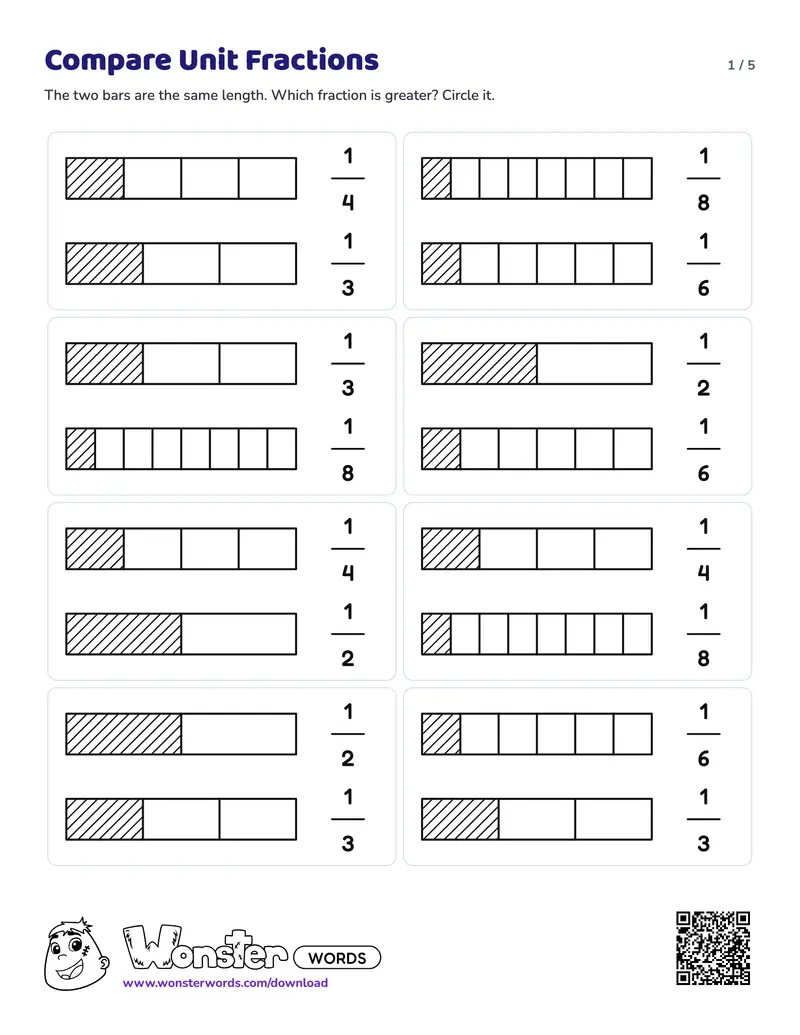
- Compare Unit Fractions. Two unit fractions drawn on same-length bars, and your child circles the greater one.
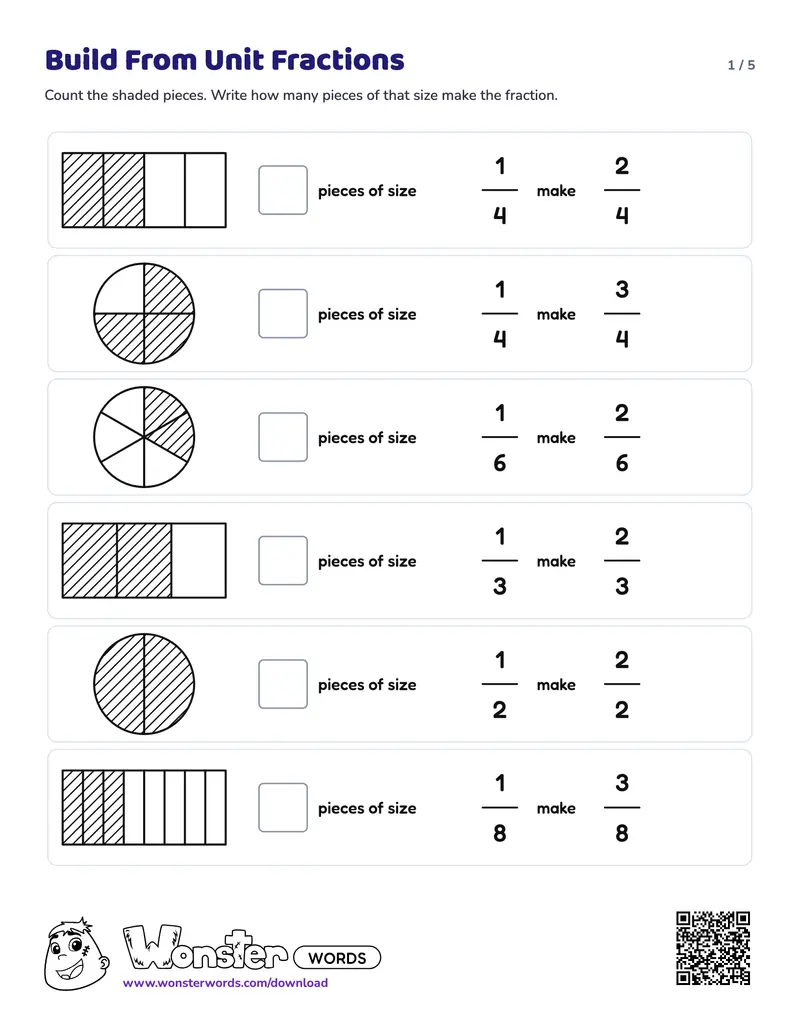
- Build From Unit Fractions. A figure with some parts shaded, and your child counts how many pieces of size 1/4 make 3/4.
All four stay with the third-grade denominators, 2, 3, 4, 6, and 8.
Free PDF · no sign-up
Feedback?Free unit fractions worksheets
Four free PDFs in black and white, with no account and no email: each one is three pages of one activity, an answer key, and a page for grown-ups.
- Share It (PDF)18 stories · answer key included · 5 pages
Preview page 1Preview
- Name the Unit Fraction (PDF)24 pictures · answer key included · 5 pages
Preview page 1Preview
- Compare Unit Fractions (PDF)24 pairs · answer key included · 5 pages
Preview page 1Preview
- Build From Unit Fractions (PDF)18 figures · answer key included · 5 pages
Preview page 1Preview
More fraction sheets, sorted by grade, are on the fraction worksheets page.
Frequently asked questions
What are some unit fractions larger than 1/2?
None, among the fractions children work with. One half is the largest unit fraction less than one whole, because every other unit fraction cuts the whole into more than 2 parts, which makes each part smaller. The fraction 1/1 also has 1 on top, and it equals one whole.
Are there different types of unit fractions?
No. A unit fraction is one idea, one equal part of a whole, with a different number on the bottom. The fractions 1/2, 1/3, and 1/8 differ only in how many equal parts the whole was cut into.
What are unit fractions and non-unit fractions?
A unit fraction has 1 on top and names one equal part of a whole, such as 1/4. A non-unit fraction has a greater number on top and counts more than one of those parts, such as 3/4, which is three 1/4s. Every non-unit fraction is built from unit fractions.
What is the difference between 3/4 and 4/4?
The fraction 3/4 is three of the 4 equal parts of a whole, and 4/4 is all four of them, which is the whole. The difference is one piece of size 1/4.
Can I use cooking to explain 3/4 to my child?
Yes. Fill a 1/4 cup measure and pour it into a bowl three times, counting one fourth, two fourths, three fourths. That is 3/4 of a cup. A fourth pour makes four fourths, which is 1 cup.
What should I do if my child struggles to understand 3/4?
Go back to one piece. Cut a paper strip into 4 equal parts and name one part 1/4. Then count the parts out loud one at a time until your child says three fourths while holding three pieces. Your child can then write 3/4 and say that the 3 counts the pieces and the 4 names them.
How are unit fractions introduced to kindergarten students?
They are not, in the Common Core or the Texas standards, which name no fractions in kindergarten. Fraction language starts in first grade, with halves and fourths as equal shares, and unit fractions arrive as written numbers in third grade. A kindergartner can still share a snack equally with a friend.
What is the history of unit fractions in mathematics?
Unit fractions are more than 3,500 years old. The Rhind papyrus of ancient Egypt discusses them, according to Wolfram MathWorld, and sums of unit fractions are still called Egyptian fractions.
How do unit fractions relate to whole numbers?
A unit fraction builds fractions the way the number 1 builds whole numbers. Combining ones makes any whole number, and combining copies of one unit fraction makes any fraction, so three 1/4s make 3/4.
Why do unit fractions always have a numerator of one?
A numerator counts pieces, and a unit fraction is one piece. Once the numerator is more than 1, the fraction counts more than one piece and is no longer a unit fraction.
Related guides
Standards this page teaches: Common Core: 3.NF.A.1 · Texas: 3.3(C), 3.3(D)
Last updated
Looking for something else?
Looking for something else?