
Math
Free Money Worksheets by Grade
Counting coins and bills from kindergarten to third grade, every practice sheet with an answer key, printable play money to cut out, and how to use a money worksheet at home.
Grades: kindergarten to grade 3
These free printable money worksheets run from kindergarten to third grade, from a coin chart to counting coins and bills. Every practice sheet has an answer key and a page for grown-ups, every sheet is designed to print in black and white, and there is no account and no email. The counting money worksheets are sorted by grade and step, and printable play money, coins and bills, comes with them to cut out. The sections:
- By grade: which sheet for which grade.
- Counting coins: first and second grade.
- Amounts, bills, and word problems: second and third grade.
- Play money: any age.
On paper, a coin is told apart by its size and its printed value, never by its color. Every coin on these sheets is a plain circle at the real coin’s size, with its value or its name printed inside, so the dime is always the smallest.
Do each step with real coins first, then print its sheet.
Money worksheets by grade
Money worksheets match a grade by what its standards ask children to do with money, and the Common Core and Texas put money in different grades. Texas names the coins in kindergarten and waits for bills until third grade. The Common Core puts all of money, dollar bills included, in second grade.
| Grade (usual age) | What the grade asks | Common Core | Texas (TEKS) | |
|---|---|---|---|---|
| Kindergarten (usually 5–6) | Texas: name the four coins | None | K.4 | Coin Chart and Play Money Coins, with real coins |
| 1st grade (usually 6–7) | Coin values, the ¢ sign, and counting pennies, nickels, and dimes | None (money is second grade) | 1.4(A)–(C) | Coin Values, Which Coin Is Worth More?, Counting Coins |
| 2nd grade (usually 7–8) | Mixed coins with quarters to a dollar; word problems with dollar bills and coins | 2.MD.C.8 | 2.5(A)–(B) | Counting Coins to a Dollar, Make the Amount, Counting Coins and Bills (pages 1 and 2, one-dollar bills), Money Word Problems |
| 3rd grade (usually 8–9) | Texas: coins and bills together | None new | 3.4(C) | Counting Coins and Bills, Money Word Problems |
The standards name grades, not ages, so the ages in the table are the usual US ones. The grade does not decide the sheet; the step your child is on does.
Free counting coins worksheets
These counting coins worksheets go from the coin names to counting a mix of coins to a dollar, in teaching order. Each one practices a step your child has first done with real coins.
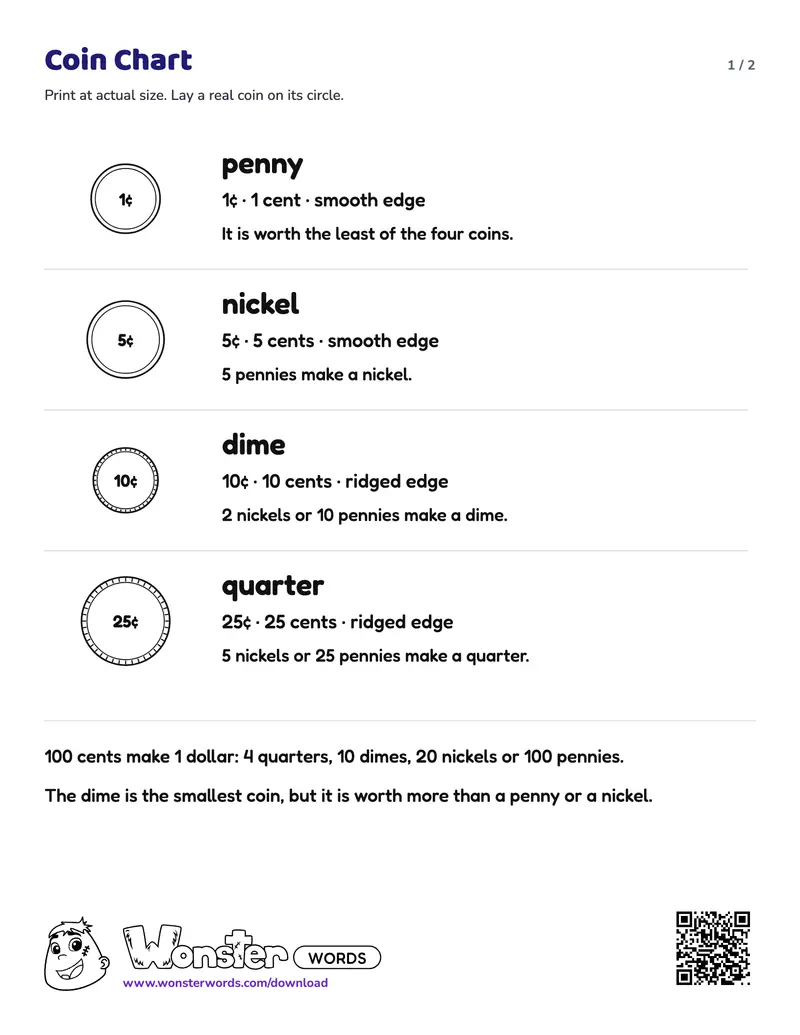
- Coin Chart. The penny, nickel, dime, and quarter at actual size, each with its name, its value in cents, its edge, and the smaller coins that make it, then “100 cents make 1 dollar.” Lay a real coin on each circle.
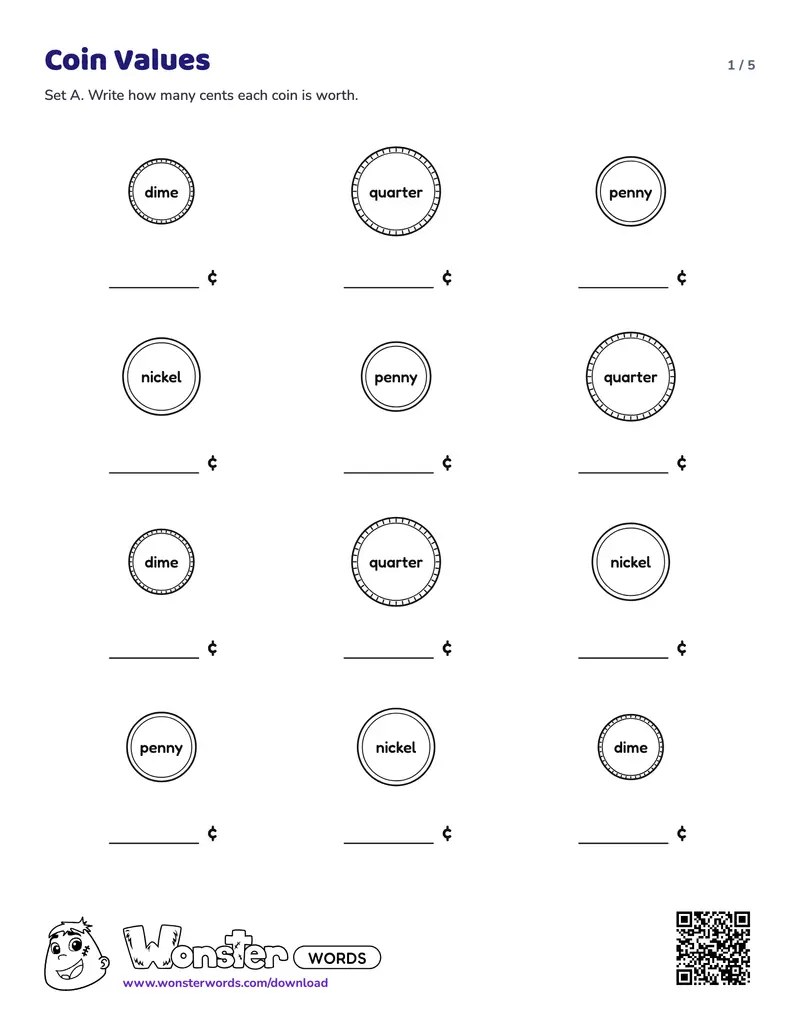
- Coin Values. Coins labeled with their names only, and your child writes how many cents each is worth.
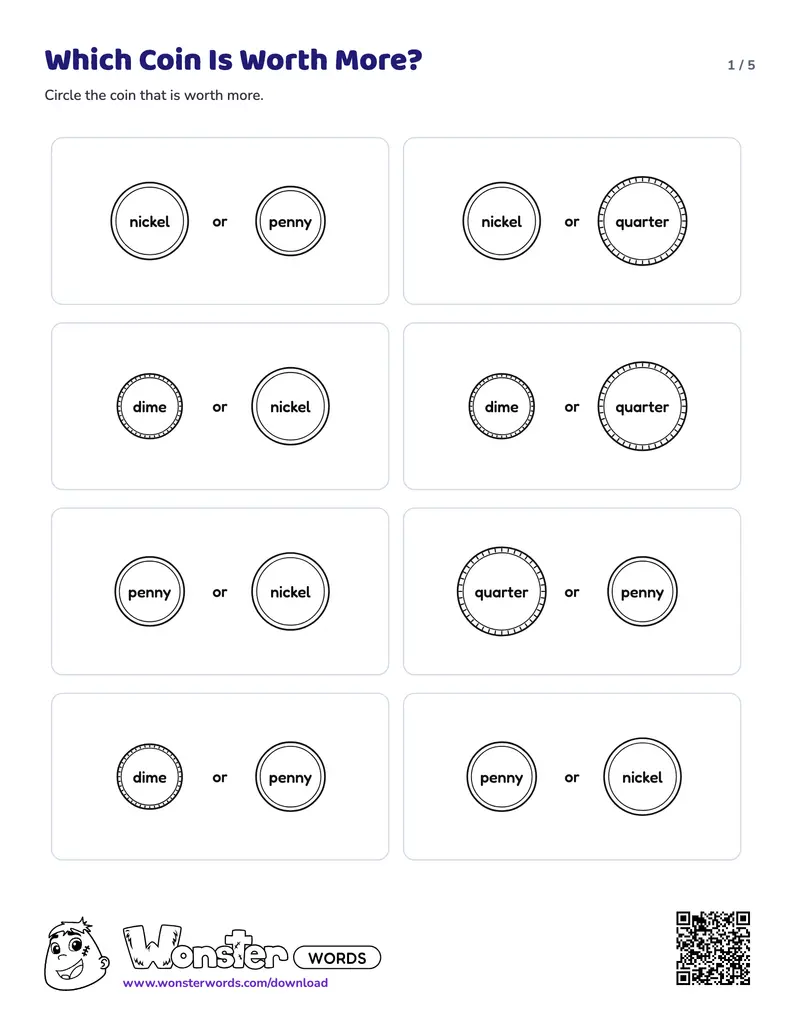
- Which Coin Is Worth More? Pairs of coins drawn at their real sizes, and your child circles the one worth more. Every page has the small dime beside a bigger coin it beats.
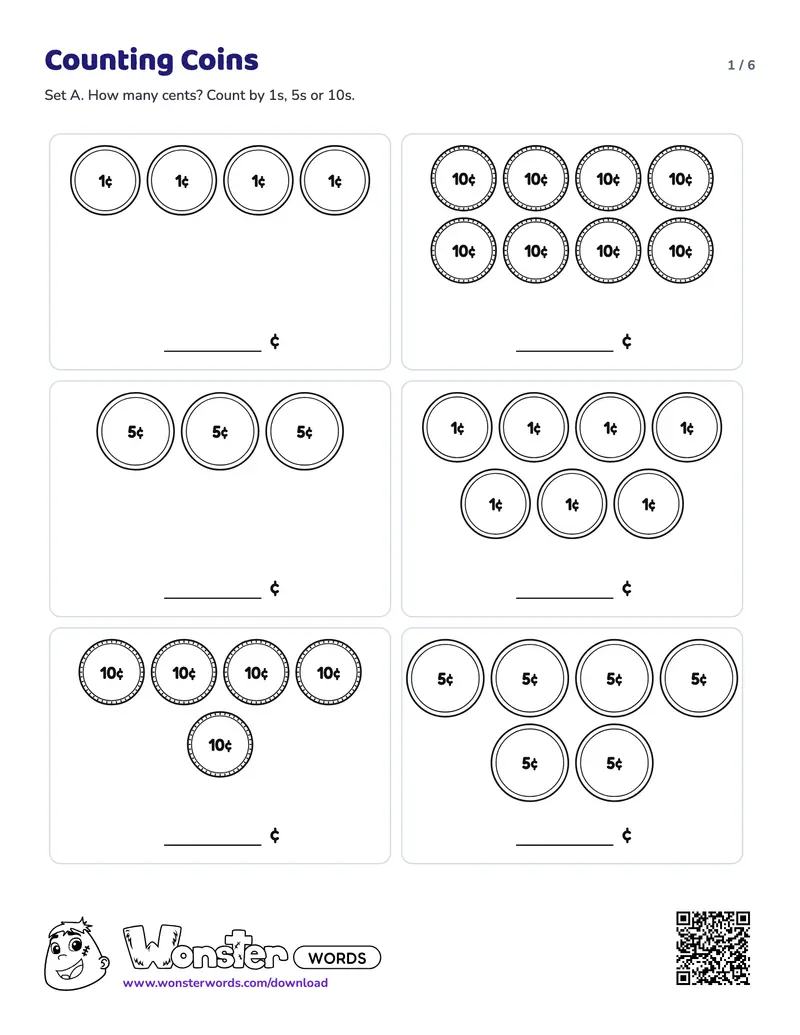
- Counting Coins. Pennies, nickels, and dimes, labeled with their values: one kind at a time first, counting by 1s, then by 5s and 10s, then mixed coins drawn biggest first. No quarters, as in Texas first grade (TEKS 1.4(C)).
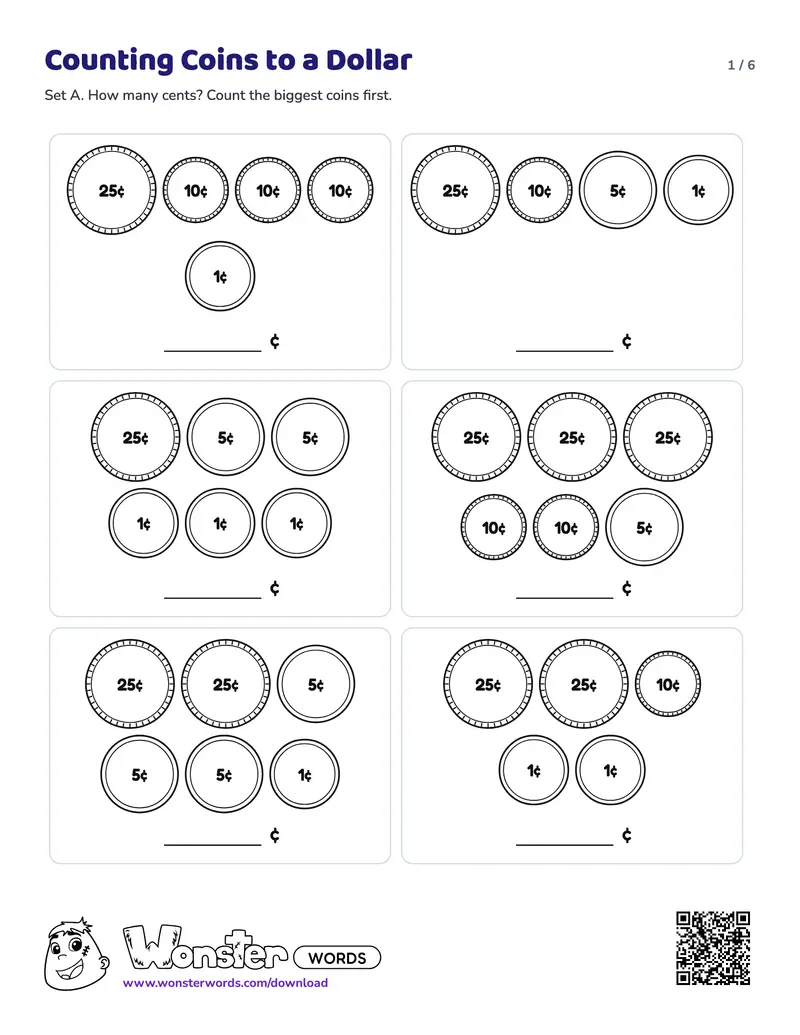
- Counting Coins to a Dollar. All four coins, from 26 cents to 100. Pages 1 and 2 are drawn biggest first, and pages 3 and 4 are mixed as they come out of a pocket.
Free PDF · no sign-up
Feedback?Free printable counting coins worksheets
These PDFs are free and print in black and white. Every practice sheet ends with its answer key and a page for grown-ups, and the coin chart prints at actual size, so a real coin fits its circle.
- Coin Chart (PDF)4 coins · 2 pages
Preview page 1Preview
- Coin Values (PDF)36 coins · answer key included · 5 pages
Preview page 1Preview
- Which Coin Is Worth More? (PDF)24 pairs · answer key included · 5 pages
Preview page 1Preview
- Counting Coins (PDF)24 collections · answer key included · 6 pages
Preview page 1Preview
- Counting Coins to a Dollar (PDF)24 collections · answer key included · 6 pages
Preview page 1Preview
Making amounts, coins and bills, and money word problems
Second and third grade money worksheets ask a child to make an amount, count bills with coins, and solve shopping problems. Each sheet comes after counting coins.
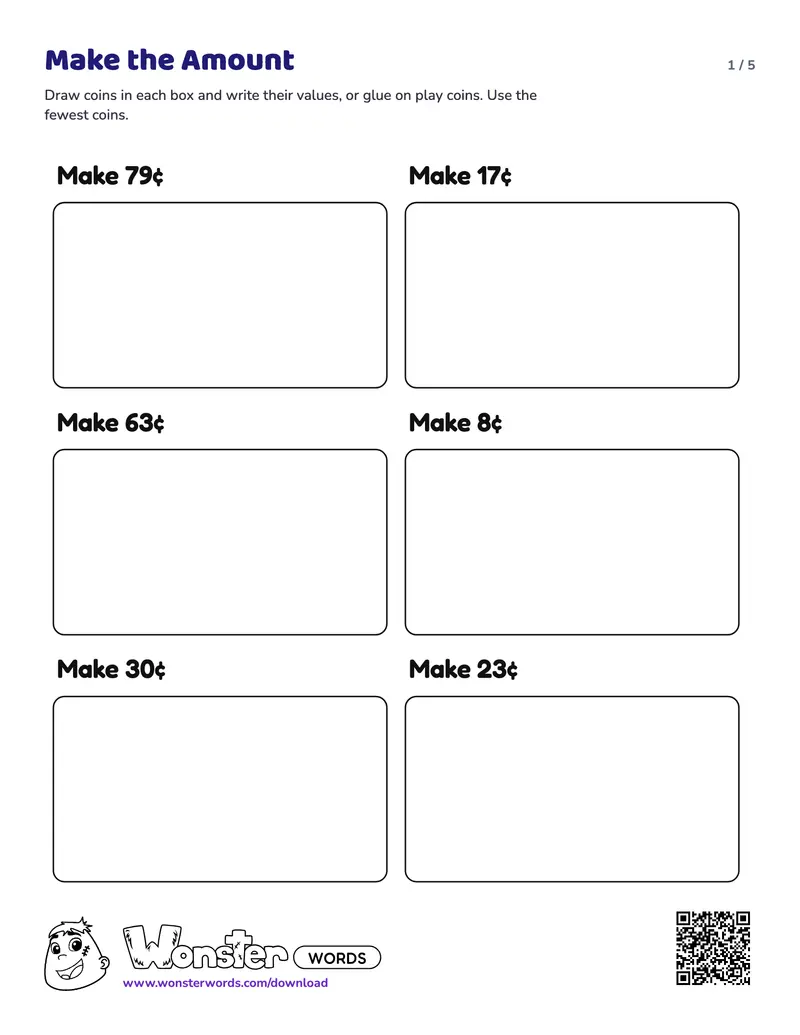
- Make the Amount. A price from 8 to 86 cents over an empty box, and your child draws the fewest coins that make it, writing each coin’s value, or glues on play coins. Other ways to make the amount are right too; the sheet asks for the fewest, so the key has one answer.
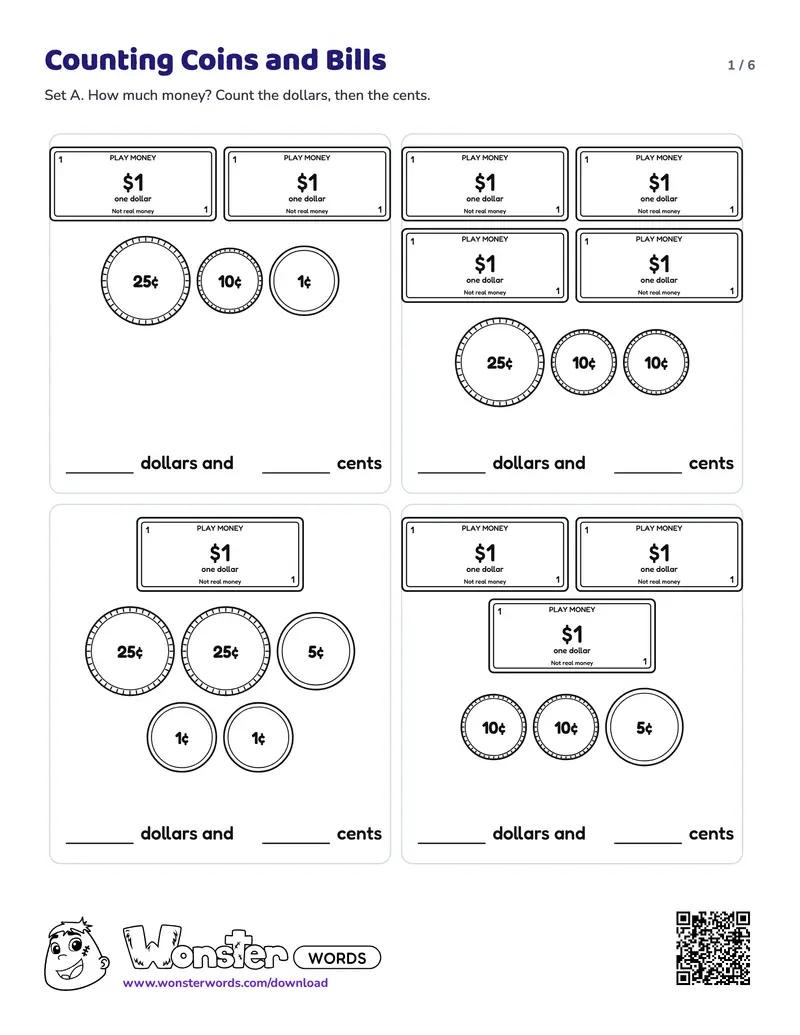
- Counting Coins and Bills. Collections of play bills and coins, and your child writes the dollars and the cents. Pages 1 and 2 have one-dollar bills only, under 5 dollars, as the Common Core names dollar bills in second grade (2.MD.C.8). Pages 3 and 4 add 5- and 10-dollar bills, under 20 dollars, for Texas third grade (TEKS 3.4(C)).
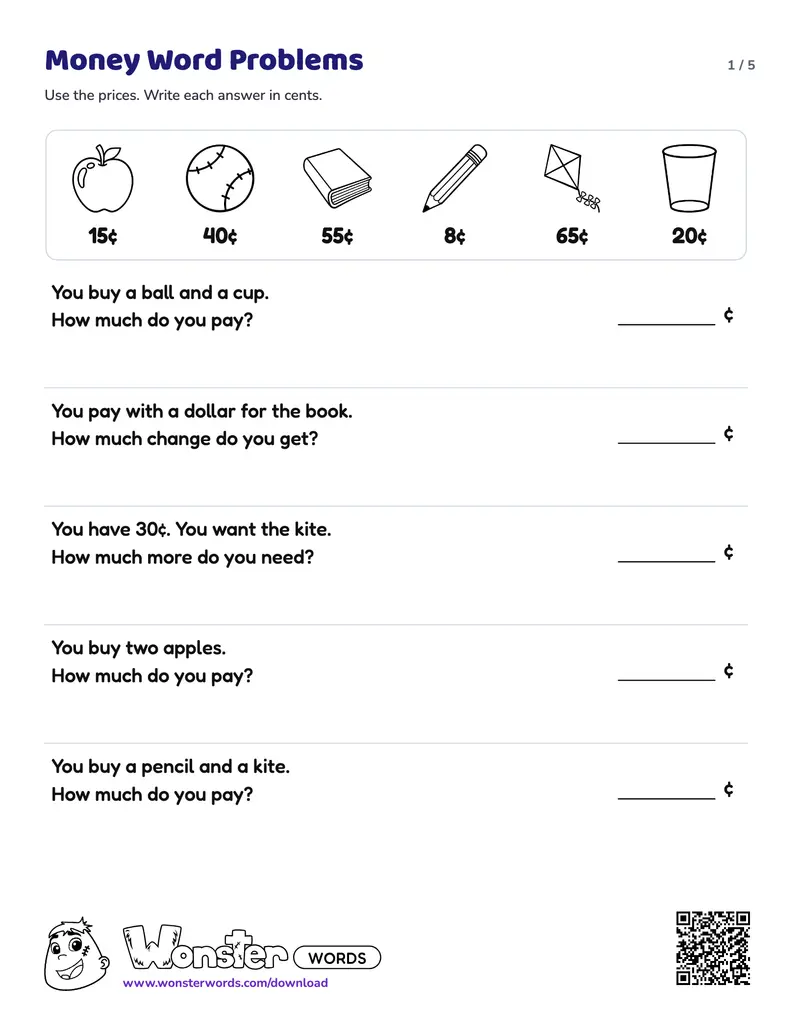
- Money Word Problems. A price list of six pictured things at the top of each page and five shopping stories: the cost of two things, the change from a dollar, how much more you need, and two of the same. Every answer is in cents, within 100.
Making change is counting up, and it is in the word problems. For a 65-cent kite paid with a dollar, count up from 65: “70, 75, 100: 35 cents back.” Common Core second graders write cents with the ¢ sign, and Texas second graders also write $0.75 with a decimal point (TEKS 2.5(B)). A child stuck on a story can draw it as a bar first, as on the tape diagram page, whose problems use whole numbers.
Free PDF · no sign-up
Feedback?Free printable money worksheets for amounts, bills, and word problems
These second- and third-grade PDFs are free and print in black and white, and each one ends with its answer key and a page for grown-ups.
- Make the Amount (PDF)18 amounts · answer key included · 5 pages
Preview page 1Preview
- Counting Coins and Bills (PDF)16 collections · answer key included · 6 pages
Preview page 1Preview
- Money Word Problems (PDF)15 word problems · answer key included · 5 pages
Preview page 1Preview
Printable play money for kids
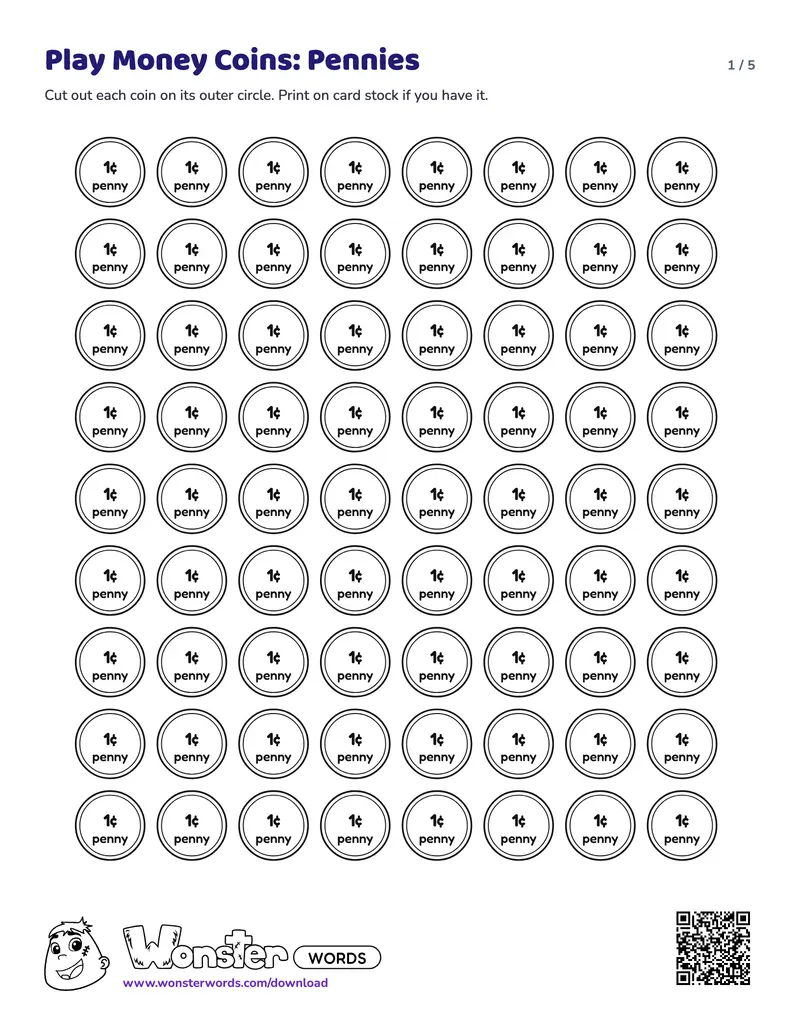
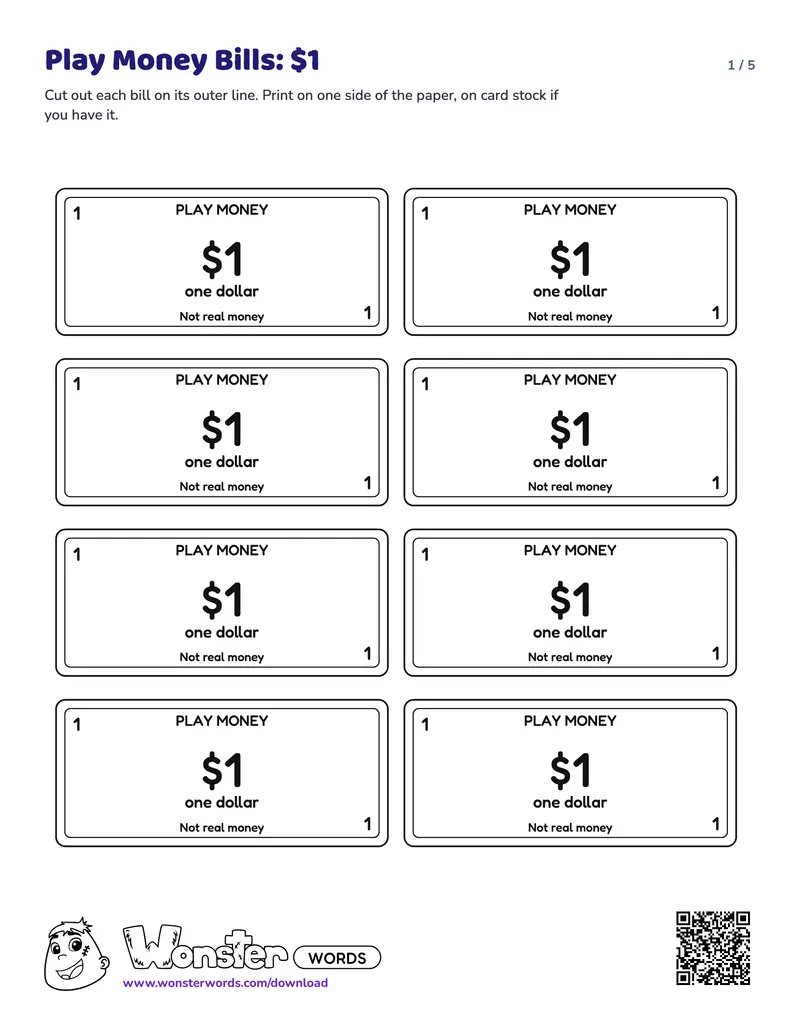
This printable play money is a set of coins and bills to cut out, in two PDFs. Play Money Coins has a page each of pennies, nickels, dimes, and quarters, at actual size with the value and name printed in each, so the dime is the smallest. Play Money Bills has 1, 5, 10, and 20 dollar bills, eight to a page. Both print in black and white; card stock lasts longer if you have it.
Play money is for the pretend store, for making amounts, and for gluing into Make the Amount’s boxes. For learning the coins themselves, real coins come first; play money is for when a pretend store needs more money than a pocket holds.
Printable play money is legal when it copies no real design and keeps to the limits federal law sets for pictures of US money. Under 18 U.S.C. 504, a picture of a US bill is allowed “in black and white” and “of a size less than three-fourths or more than one and one-half, in linear dimension” of the real bill. Treasury rules also allow a color picture at those sizes if it is one-sided, as the US Currency Education Program’s Currency Image Use page explains. A coin may not be copied “as to design, color, or the inscription” under 18 U.S.C. 489. This play money copies no real design at all. Its coins are plain circles with their value and name. Its bills are one-sided, black and white rectangles marked “PLAY MONEY”, smaller than three-fourths of a real bill.
Free PDF · no sign-up
Feedback?Free printable play money: coins and bills
Cut-out sets have no answer key, because there is nothing to answer. Both PDFs are free, print in black and white, and end with a page for grown-ups.
- Play Money Coins (PDF)258 coins · 5 pages
Preview page 1Preview
- Play Money Bills (PDF)32 bills · 5 pages
Preview page 1Preview
How to use money worksheets at home
Parents can use money worksheets at home in five short steps, so a sheet practices what a child can already do with real coins. The steps work on every practice sheet on this page.
Teach the step with real coins first, then hand over the sheet
A worksheet practices a step your child has already met with real coins; it does not teach a new one. Count real coins together first, then print the sheet for that step.
Lay real coins on the coin chart
The coin chart prints at actual size. Have your child lay a real penny, nickel, dime, and quarter on their circles, so the coins on paper match the coins in a pocket.
Do the first row together, out loud
Work the first row side by side, and say "cents" after every number: "25 cents, 35 cents, 40 cents." The way your child counts out loud shows where a count goes wrong.
Check it together with the answer key
Check each answer against the key while the problems are fresh. Your child fixes each one that is wrong, with real coins if it helps.
Move on when your child is accurate and calm
Go to the next sheet when your child gets the answers right without strain, not when a page is finished. If a sheet stays hard, go back one sheet, or back to real coins.
Neither the Common Core nor the Texas standards set how often to practice counting money. A few minutes on most days, stopping while it is going well, is a reasonable place to start.
Games and worksheets do different jobs, and real coins and games come first. A game keeps a child counting real coins; a worksheet then gives practice on paper and leaves a record you can look back at next week.
Every practice sheet’s answer key writes each answer in red, in the place your child writes it, so you can lay the key beside the worksheet and check it answer by answer.
What makes a good money worksheet, and how do you make your own?
A good money worksheet, from any source, passes six checks:
- The coins are drawn at their real relative sizes, so the dime is the smallest.
- Each coin shows its value or its name, and nothing depends on color.
- The amounts stay inside the grade: up to one dollar in second grade (TEKS 2.5(A)).
- Quarters come after pennies, nickels, and dimes.
- The practice comes in mixed order, not totals that climb one coin at a time.
- It has an answer key.
To make your own money worksheet, take four steps:
- Trace around real coins on paper, which gives the true sizes, and write the value in each circle.
- Write amounts your child is working on.
- Mix the order.
- Write the answer key before your child starts.
Frequently asked questions
Do printable counting money worksheets come with answer keys?
Every practice sheet on this page has an answer key after its worksheet pages, with each answer written in red in the place where your child answers. The coin chart and the play money have no answer key, because there is nothing to answer. The last page of every PDF is a page for grown-ups.
What age groups benefit most from counting money worksheets?
First and second graders, usually ages 6–8, because Texas teaches coin values in first grade and the Common Core's money standard is in second grade. Texas starts coin names in kindergarten and adds counting coins and bills together in third grade, so a Texas kindergartner can use the coin chart and a third grader the bills sheets.
Are there money worksheets for preschoolers?
No Common Core or Texas standard asks a preschooler to count money, so there is no preschool sheet here. A preschooler can sort real coins and lay them on the coin chart, with an adult watching, because coins are a choking hazard for young children.
What are the legal requirements for using printable play money templates?
Federal law allows a black and white picture of a US bill that is smaller than three-fourths or larger than one and one-half times the real bill's size. Treasury rules also allow a color picture at those sizes if it is one-sided. A coin's design, color, and wording may not be copied. This play money copies no real design at all, and its bills are black and white, one-sided, and smaller than three-fourths of a real bill.
How frequently should I practice counting money using worksheets?
Neither the Common Core nor the Texas standards set a number. A few minutes on most days, one sheet at a time and stopping while it is going well, is a reasonable place to start. Count real coins first, and use the sheet as practice of what your child can already do.
Games vs worksheets: Which is better for counting coins?
Use both, with real coins and games first. A game with real coins teaches a child to read the coins and keeps the counting going. A worksheet then gives practice on paper and leaves a record you can look back at next week.
Are these worksheets for US money?
Yes. Every sheet uses US coins, the penny, nickel, dime, and quarter, and US dollar bills of 1, 5, 10, and 20 dollars. The sheets follow the US Common Core and Texas standards for money.
Related guides
Standards this page teaches: Common Core: 2.MD.C.8 · Texas: K.4, 1.4(A), 1.4(B), 1.4(C), 2.5(A), 2.5(B), 3.4(C)
Last updated
Looking for something else?
Looking for something else?