
Math
First Grade Math
What first graders learn in math and the skills to master by the end of the year, with the Common Core and Texas standards, free worksheets by skill with answer keys, a quick check of where to start, games for home, and a daily routine.
Grade 1
First grade math is adding and subtracting within 20 with strategies, tens and ones to 120, adding within 100, measuring length, telling time to the hour and half hour, and naming halves and fourths of shapes. By the end of the year, the Common Core expects a first grader to add and subtract within 10 fluently; Texas sets no fluency target and expects the strategies, “including making 10”.
First grade is the year a child stops counting everything and starts using what they know: ten and some more to add, and tens and ones to read a number.
These 1st grade math worksheets are free, print in black and white, and need no account. The page covers:
- What kids learn in 1st grade math, with the Common Core and Texas standards.
- The worksheets, by skill, with answer keys, in seven trays.
- Is my child on track? A quick check of where to start.
- Activities and games at home and a daily routine.
What math do kids learn in 1st grade?
By the end of first grade, a child is expected to add and subtract within 20 using strategies, count to 120, read every two-digit number as tens and ones, and add within 100. The Common Core grade 1 introduction names four critical areas, led by “developing understanding of addition, subtraction, and strategies for addition and subtraction within 20” and place value “including grouping in tens and ones”. Measuring length and shapes are the other two.
The table gives each topic by strand, in the order first grade teaches it, with the Common Core code and the Texas (TEKS) code beside it. Each topic links to the page that teaches it.
| What children learn | Common Core | Texas |
|---|---|---|
| Addition and subtraction | ||
| Add and subtract within 20 by strategy: count on, doubles, near doubles, make ten | 1.OA.B.3, 1.OA.C.5–6 | 1.3(C)–(E) |
| Fact families, and subtraction as a missing addend ("think addition") | 1.OA.B.4 | Related: 1.5(F)–(G) |
| Word problems of every type within 20, the unknown in any place; adding three numbers | 1.OA.A.1–2 | 1.3(B), 1.3(F), 1.5(D) |
| Add within 100: a two-digit number plus a one-digit number or a ten | 1.NBT.C.4 | 1.3(A) |
| Ten more and ten less in your head; subtract tens | 1.NBT.C.5–6 | 1.5(C) |
| Patterns, data, and the equal sign | ||
| The equal sign means "the same as"; true or false equations; the missing number | 1.OA.D.7–8 | 1.5(E)–(F) |
| Sort data into up to 3 groups and read the counts | 1.MD.C.4 | 1.8(A)–(C) |
| Counting and number sense | ||
| Count, read, and write to 120 from any number | 1.NBT.A.1 | 1.5(A); forward and backward |
| Place value | ||
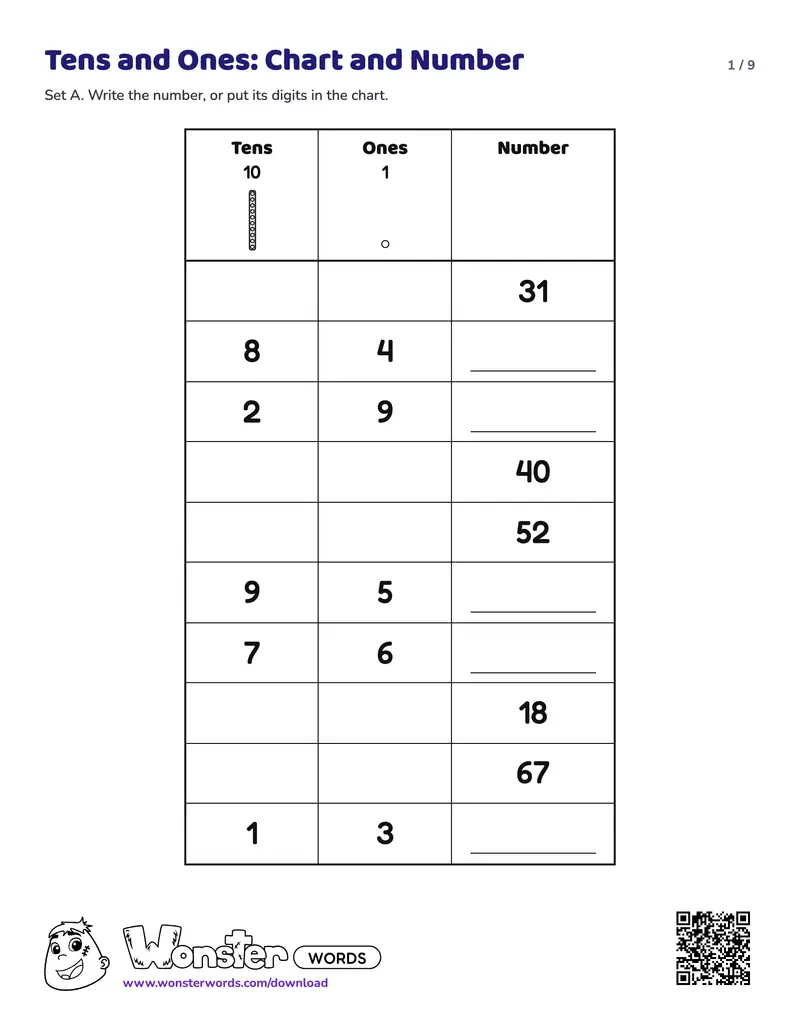
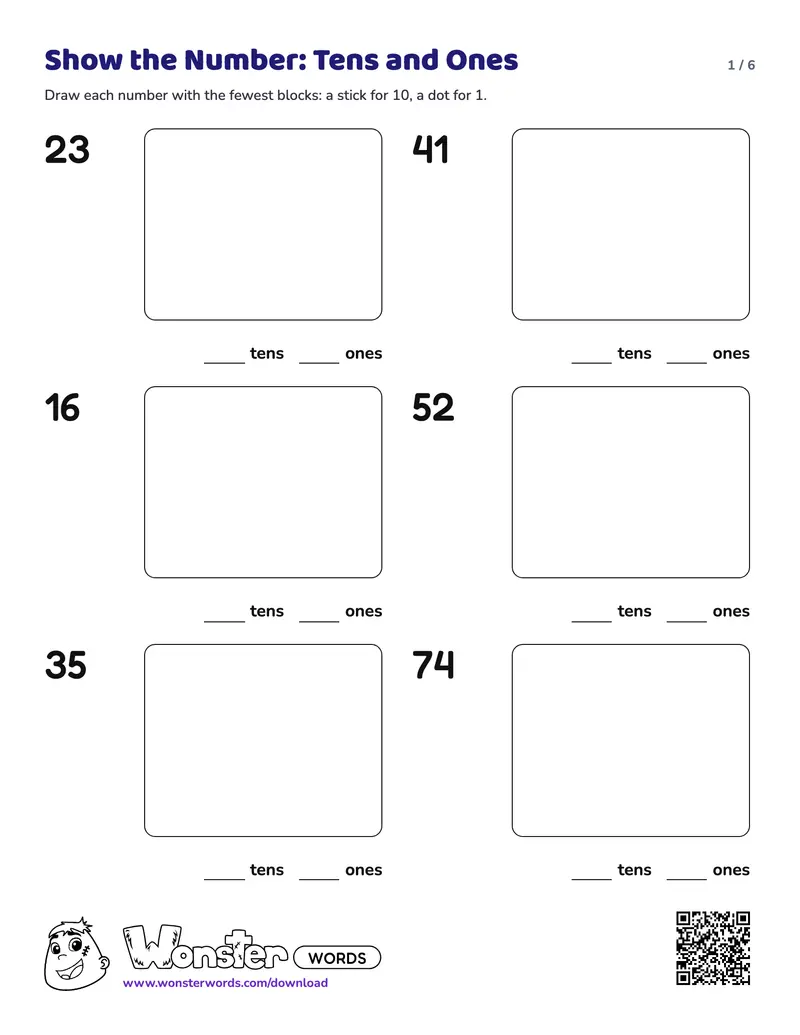
| Tens and ones: 10 as a bundle of ten ones | 1.NBT.B.2 | 1.2(B)–(C) |
| Compare two-digit numbers with >, =, and < | 1.NBT.B.3 | 1.2(D)–(G) |
| Skip count by 2s, 5s, and 10s | Second grade, 2.NBT.A.2 | 1.5(B) |
| Measurement, time, and money | ||
| Order things by length; measure with same-size units, no gaps or overlaps | 1.MD.A.1–2 | 1.7(A)–(D) |
| Tell time to the hour and half hour | 1.MD.B.3 | 1.7(E) |
| Coin names and values; count coins (most schools start coins this year) | Second grade, 2.MD.C.8 | 1.4(A)–(C) |
| Earning, saving, spending, and giving | Not in Common Core | 1.9(A)–(D) |
| Shapes and space | ||
| Name a shape by what makes it that shape (sides, corners, faces), flat and solid | 1.G.A.1 | 1.6(A)–(E) |
| Build new shapes from shapes | 1.G.A.2 | 1.6(F) |
| Fractions | ||
| Halves and fourths (quarters) of circles and rectangles | 1.G.A.3 | 1.6(G)–(H) |
The milestone differs by framework. Common Core’s 1.OA.C.6 asks for fluency within 10 and names the strategies within 20: “Use strategies such as counting on; making ten”. Fluency here means accurate and without counting every one, not fast. Texas sets no first grade fluency target and makes the strategies the standard: “including making 10 and decomposing a number leading to a 10” (1.3(D)).
Texas places four things in first grade that Common Core leaves to second grade or does not ask for. Texas first graders count forward and backward to 120 (1.5(A)), skip count by 2s, 5s, and 10s (1.5(B)), write numbers to 120 in expanded form (1.2(C)), and identify coins “by value” and count collections of them (1.4). Texas also teaches earning and saving money in first grade (1.9).
First grade is usually ages 6 to 7. Kindergarten covered counting to 100, adding and taking away within 10 with objects, and teen numbers as ten and some ones. Second grade moves to hundreds, tens, and ones to 1,000 and the facts from memory. The whole PreK-3 math scope and sequence shows where first grade sits.
Free 1st grade math worksheets by skill, with answer keys
These free first grade math worksheets are sorted by the skill they practice, in seven trays in the order first grade teaches the skills. Each PDF prints in black and white and needs no account and no email. Every practice sheet ends with its answer key, and charts, mats, and cards have nothing to answer. Each tray names the page that teaches its skill. Print the sheet for the one skill your child is on, not a whole tray.
1. Addition and subtraction facts within 20
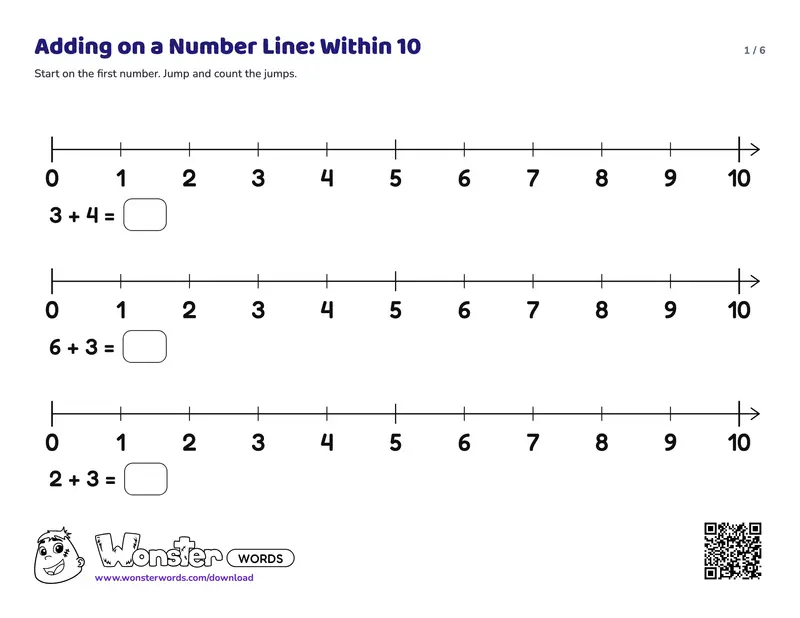
Adding and subtracting within 20 by strategy is first grade’s biggest standard (1.OA.B.3 to 1.OA.C.6). The tray runs from facts within 10 to number bonds, the number line, doubles and make ten, turnaround facts, and fact families, then facts within 20. The sheets come from the addition and subtraction worksheets, number bonds, number line, and addition chart pages. The addition and subtraction worksheets page places Mixed Addition and Subtraction in second grade. It suits a first grader who already does both within 20 easily.
Free PDF · no sign-up
Feedback?Addition and subtraction facts within 20
Fifteen free PDFs in black and white, from facts within 10 to the strategy sheets and facts within 20. Each ends with an answer key.
- Addition Within 10 (PDF)88 problems · answer key included · 11 pages
Preview page 1Preview
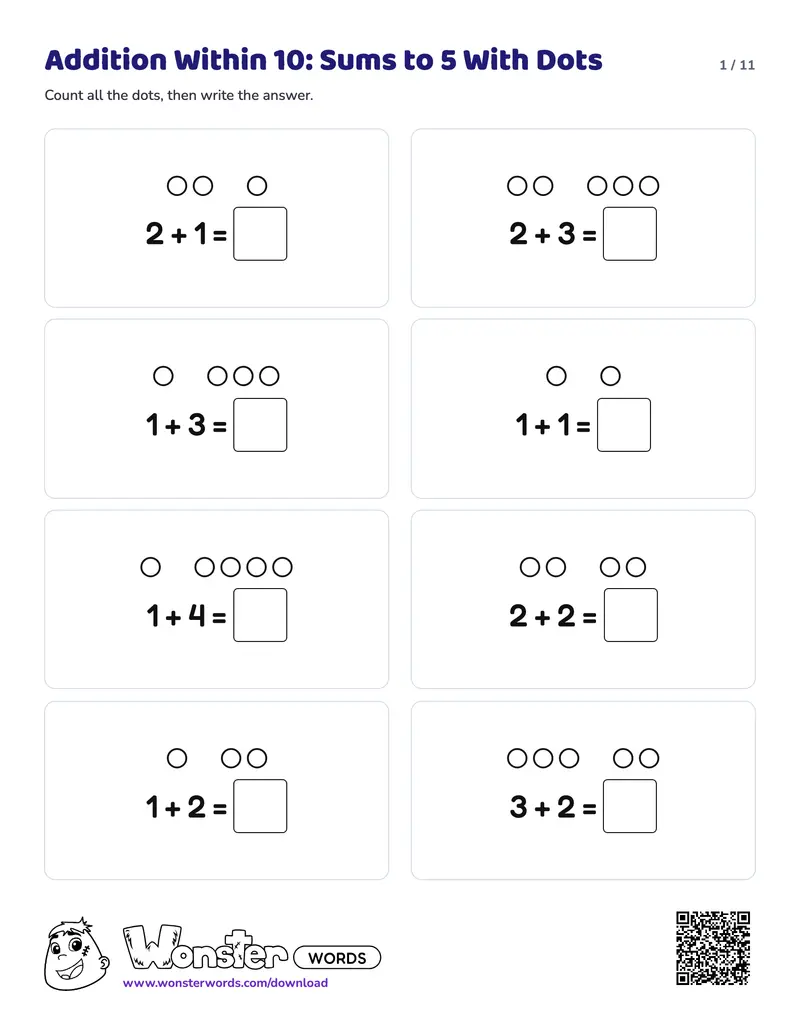
- Subtraction Within 10 (PDF)88 problems · answer key included · 11 pages
Preview page 1Preview
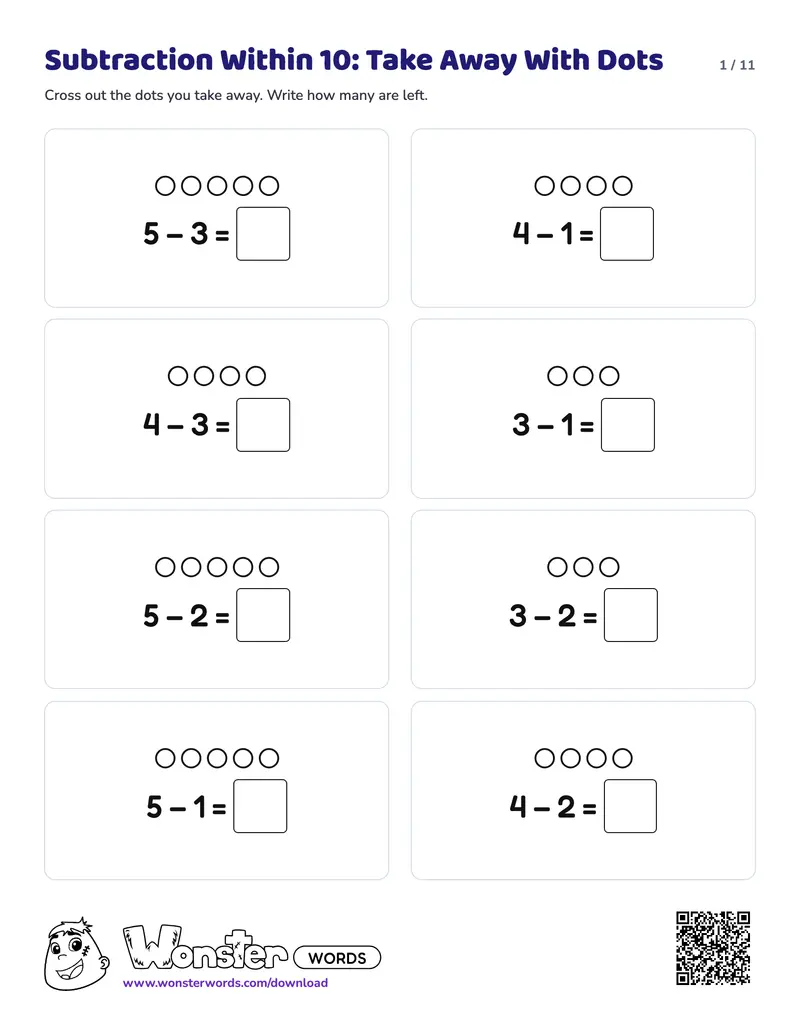
- Number Bonds (PDF)36 number bonds · answer key included · 6 pages
Preview page 1Preview
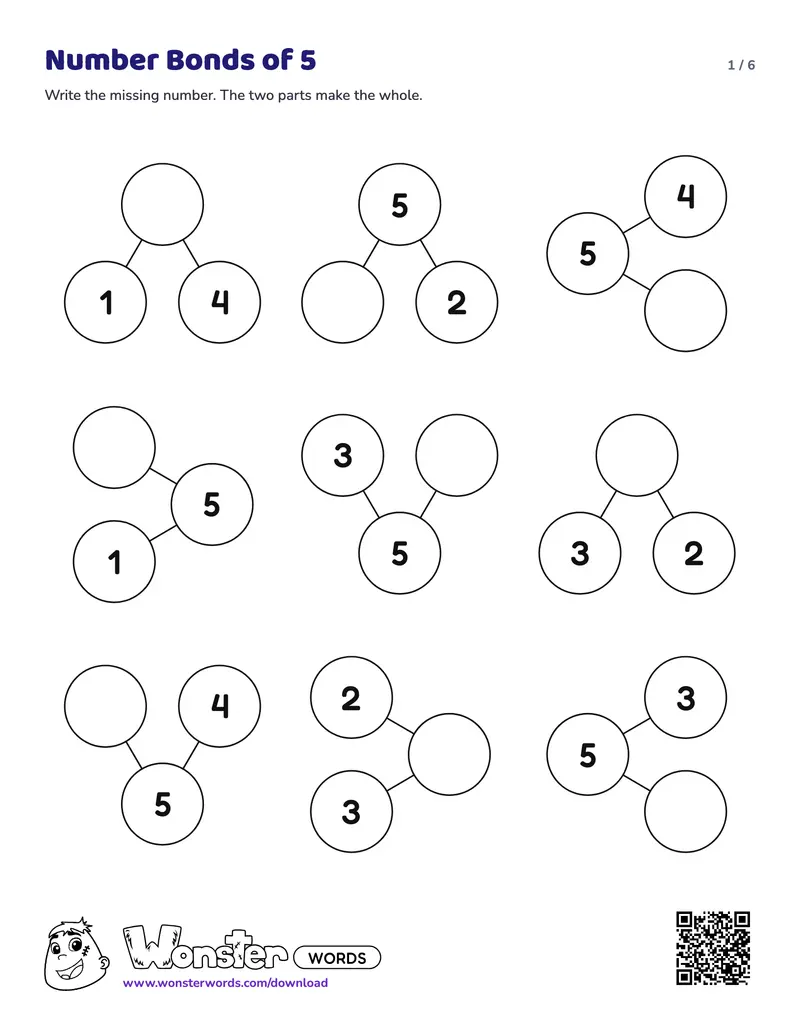
- Ways to Make a Number (PDF)21 number bonds · answer key included · 5 pages
Preview page 1Preview
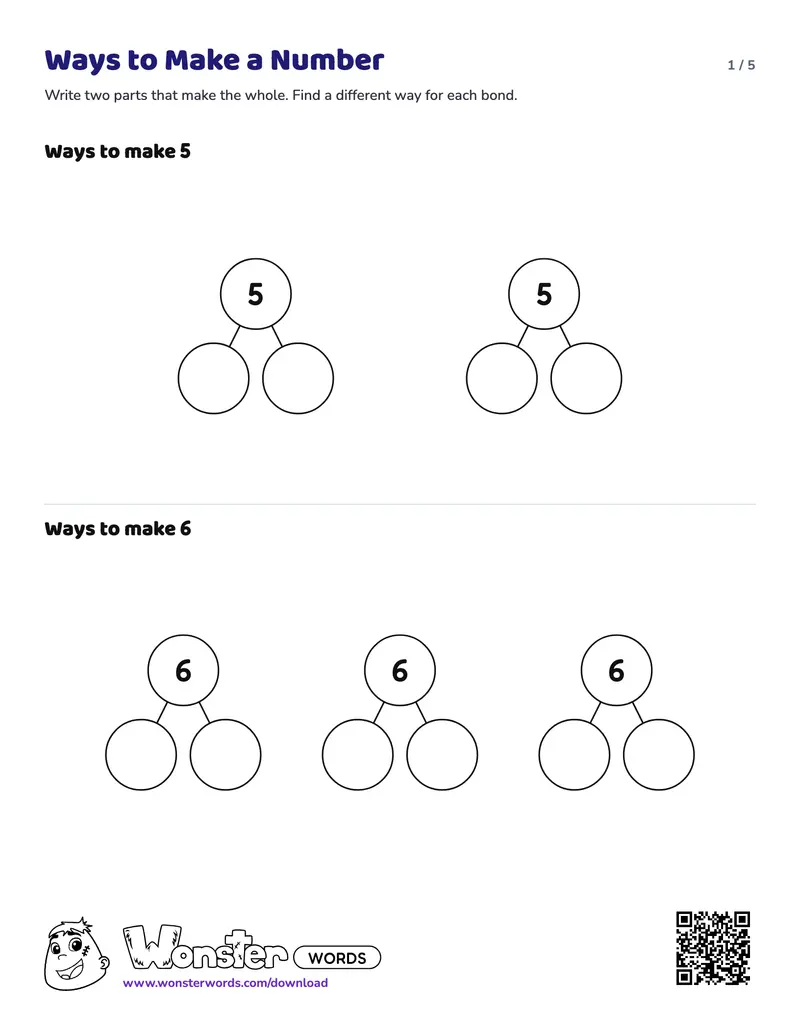
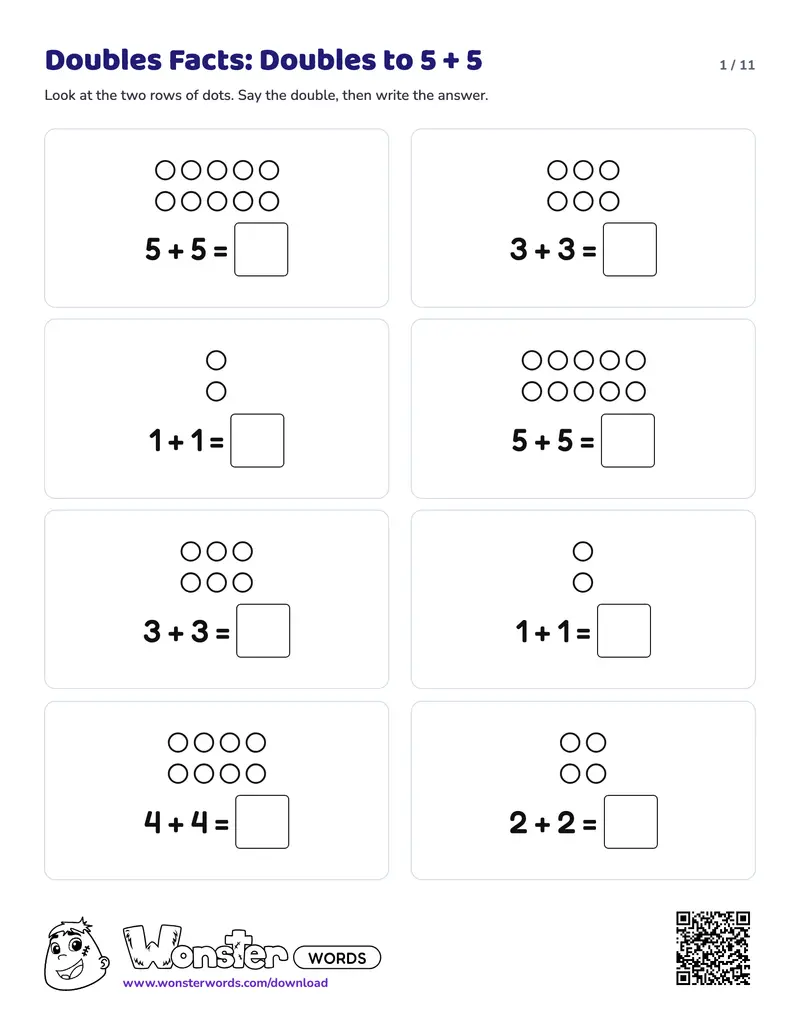
- Doubles Facts (PDF)76 facts · answer key included · 11 pages
Preview page 1Preview
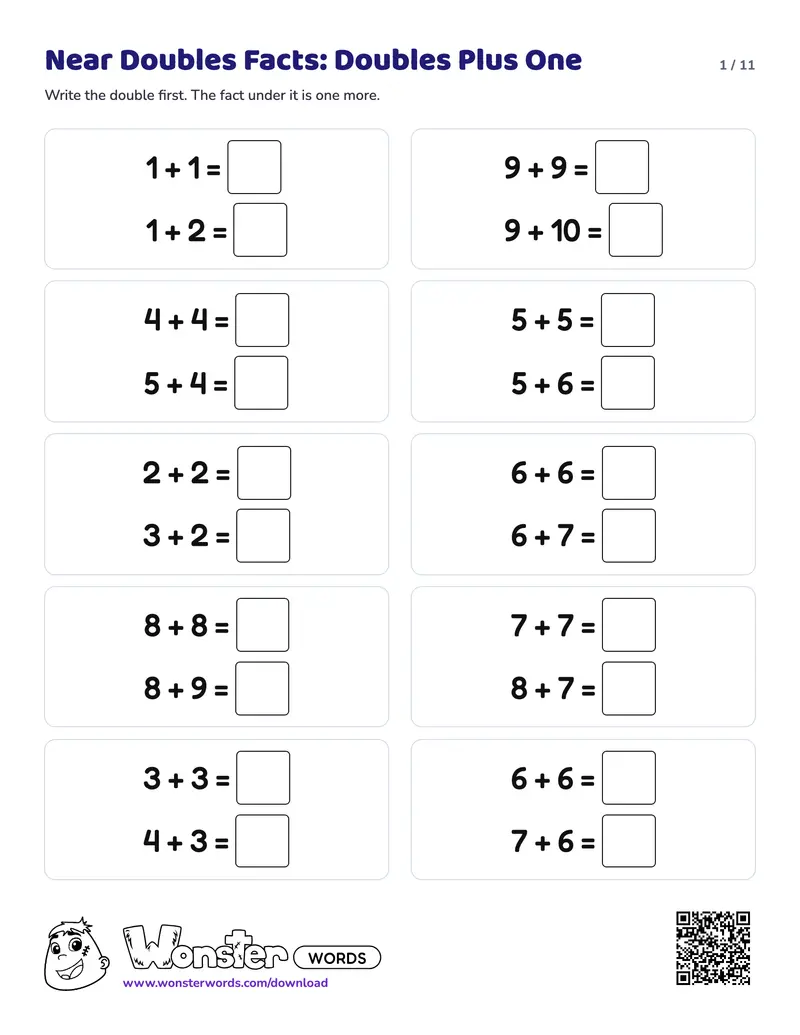
- Near Doubles Facts (PDF)84 facts · answer key included · 11 pages
Preview page 1Preview
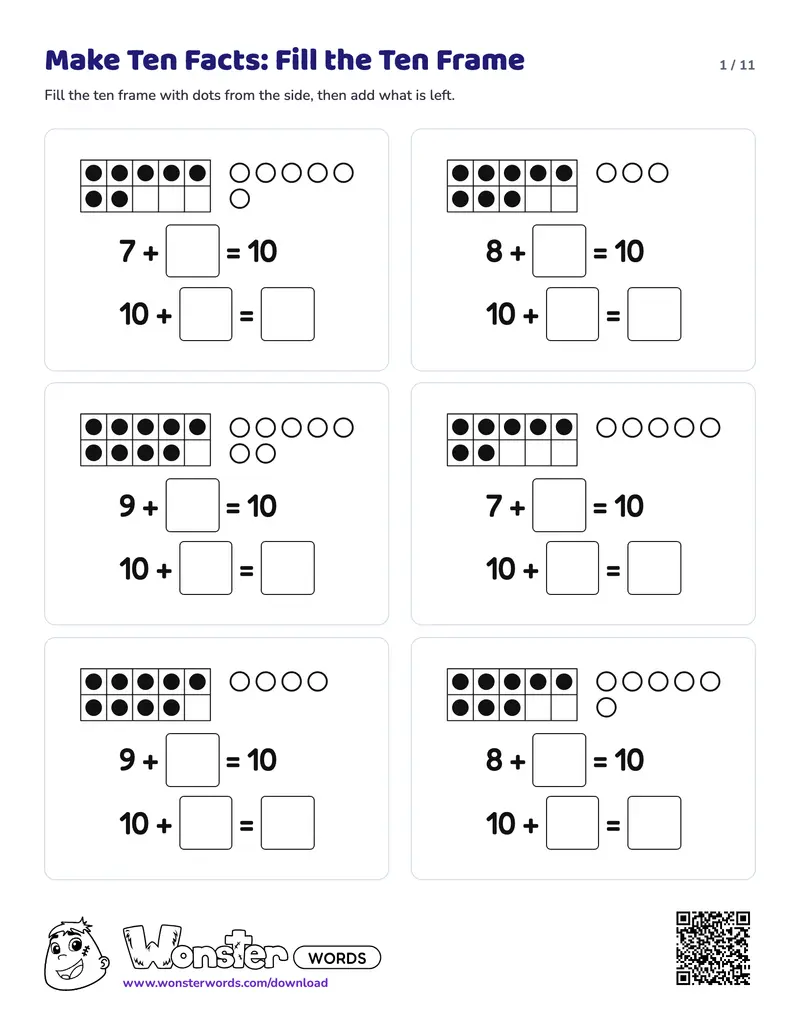
- Make Ten Facts (PDF)68 facts · answer key included · 11 pages
Preview page 1Preview
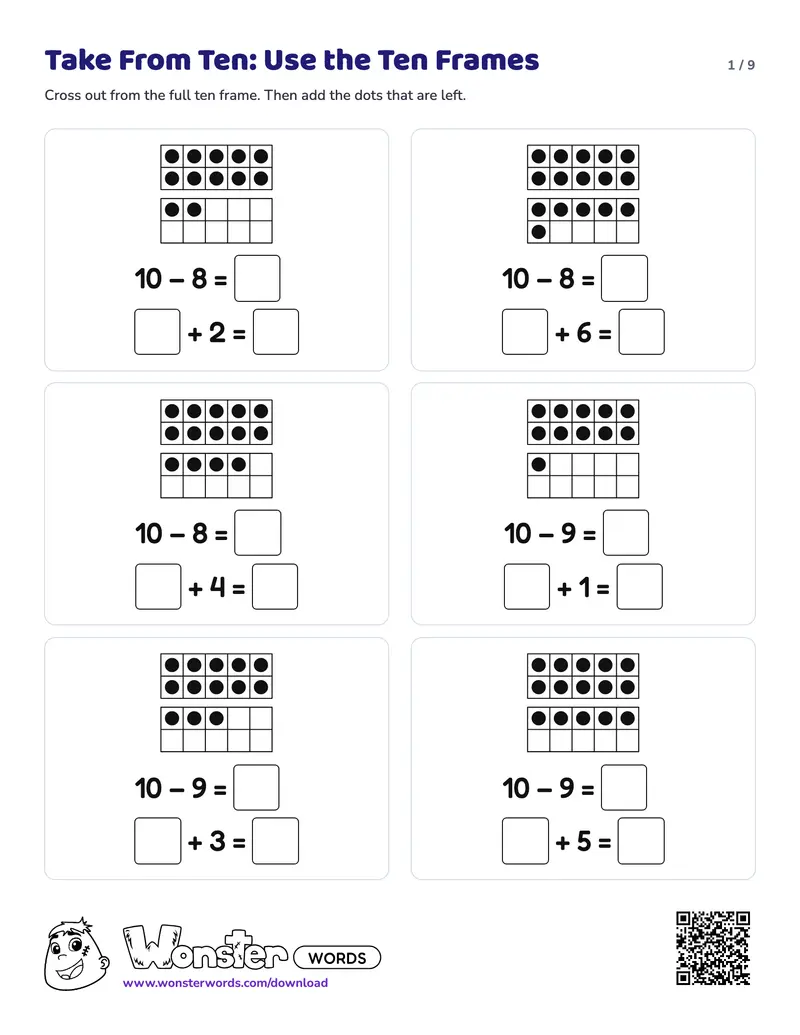
- Take From Ten (PDF)52 facts · answer key included · 9 pages
Preview page 1Preview
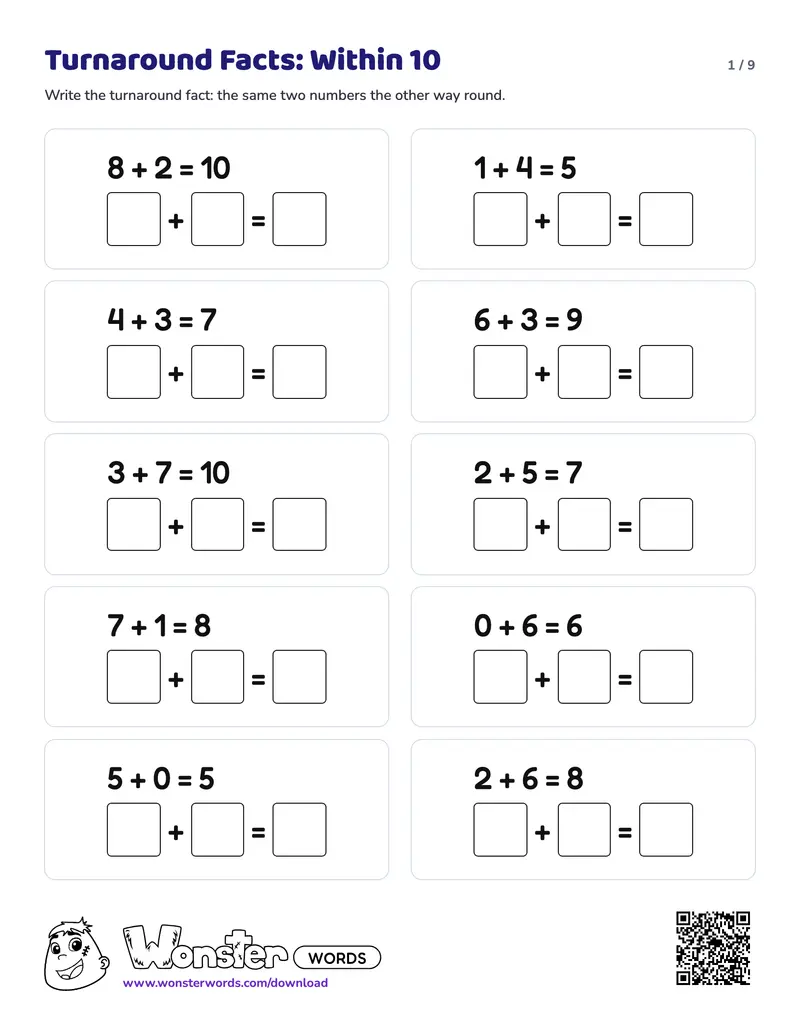
- Turnaround Facts (PDF)56 facts · answer key included · 9 pages
Preview page 1Preview
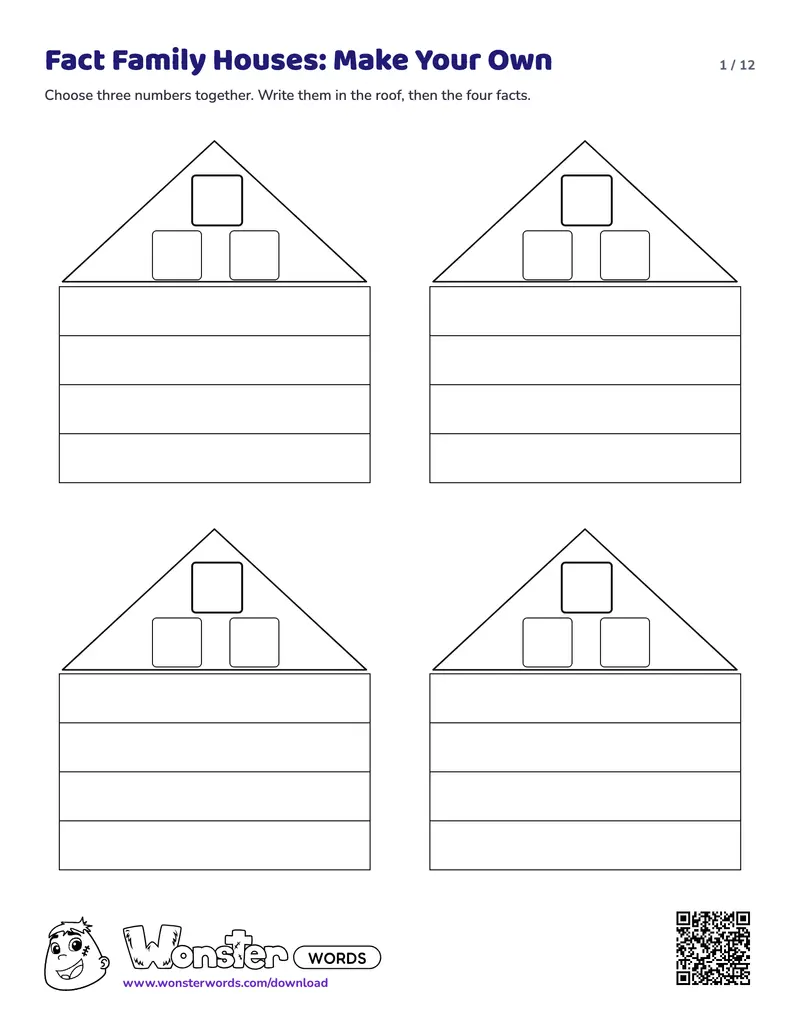
- Fact Family Houses (PDF)36 fact family houses · answer key included · 12 pages
Preview page 1Preview
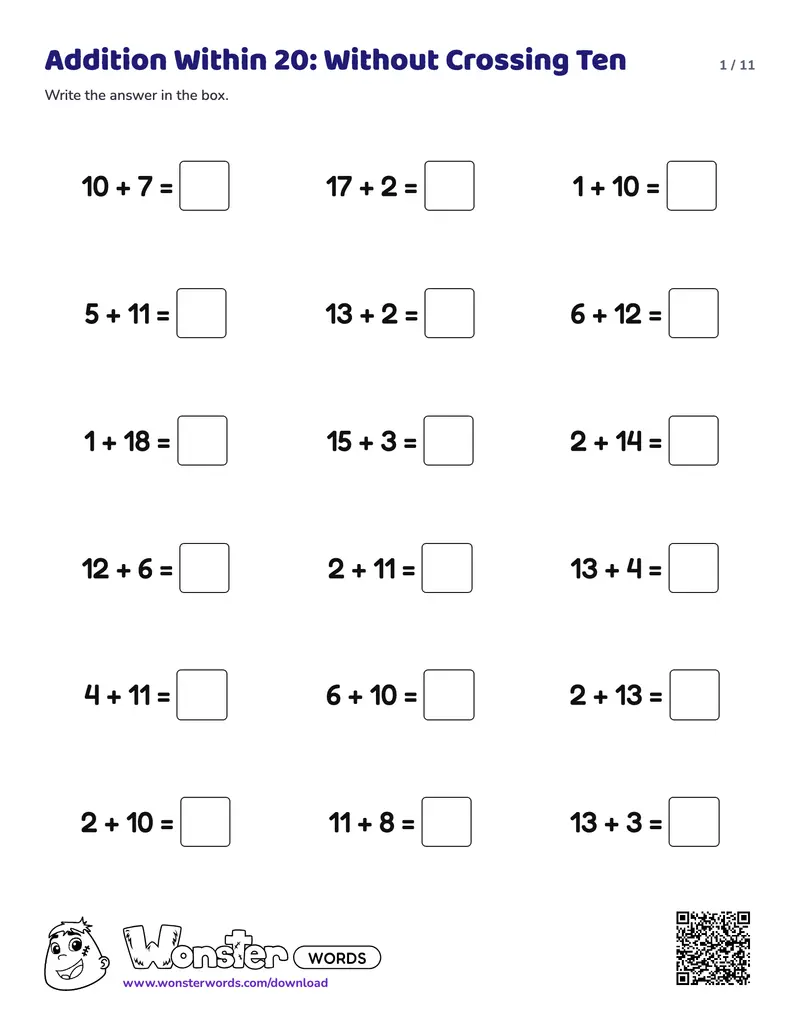
- Addition Within 20 (PDF)144 problems · answer key included · 11 pages
Preview page 1Preview
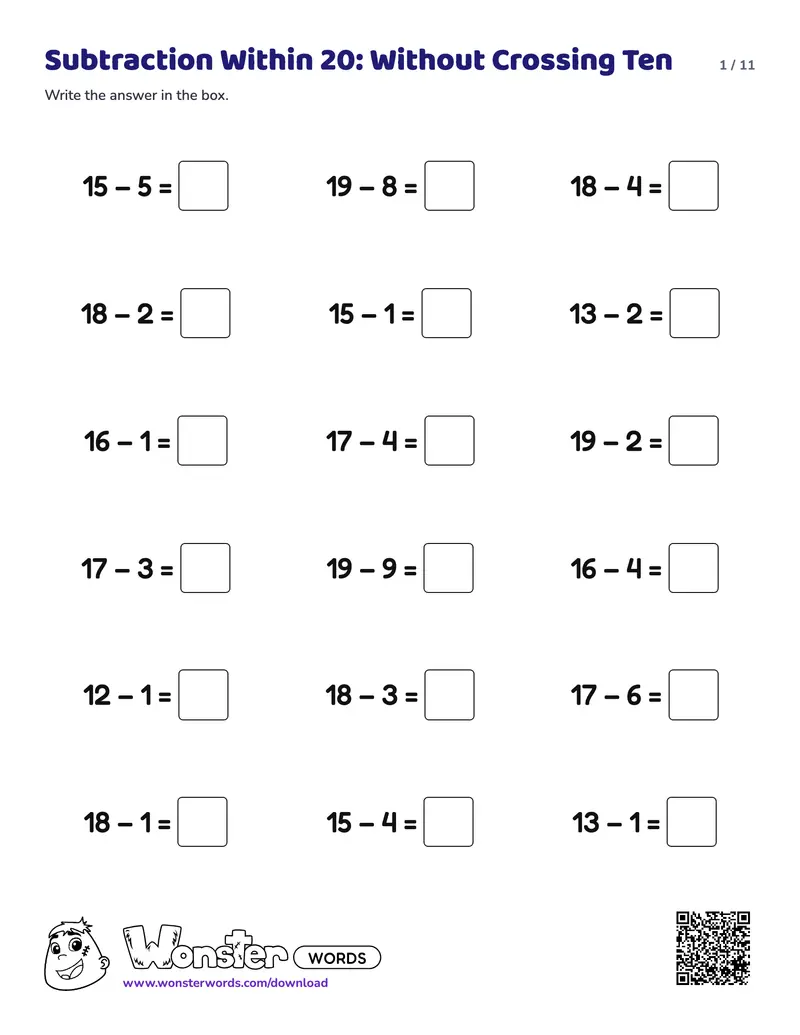
- Subtraction Within 20 (PDF)144 problems · answer key included · 11 pages
Preview page 1Preview
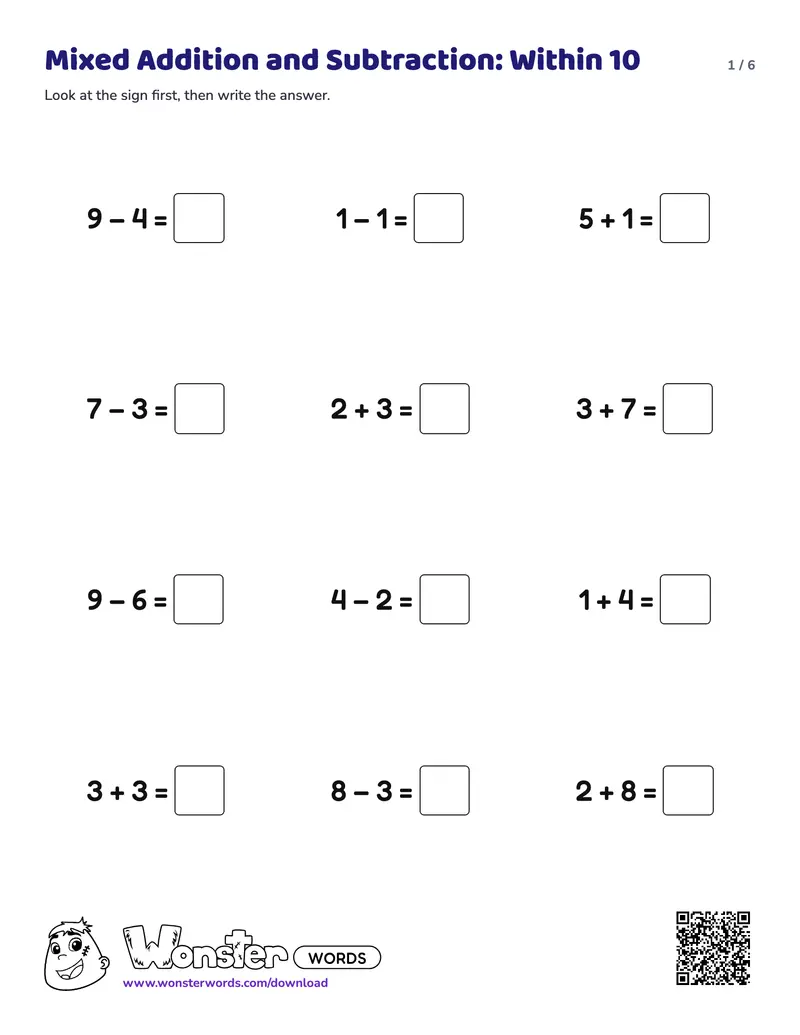
- Mixed Addition and Subtraction (PDF)60 problems · answer key included · 6 pages
Preview page 1Preview
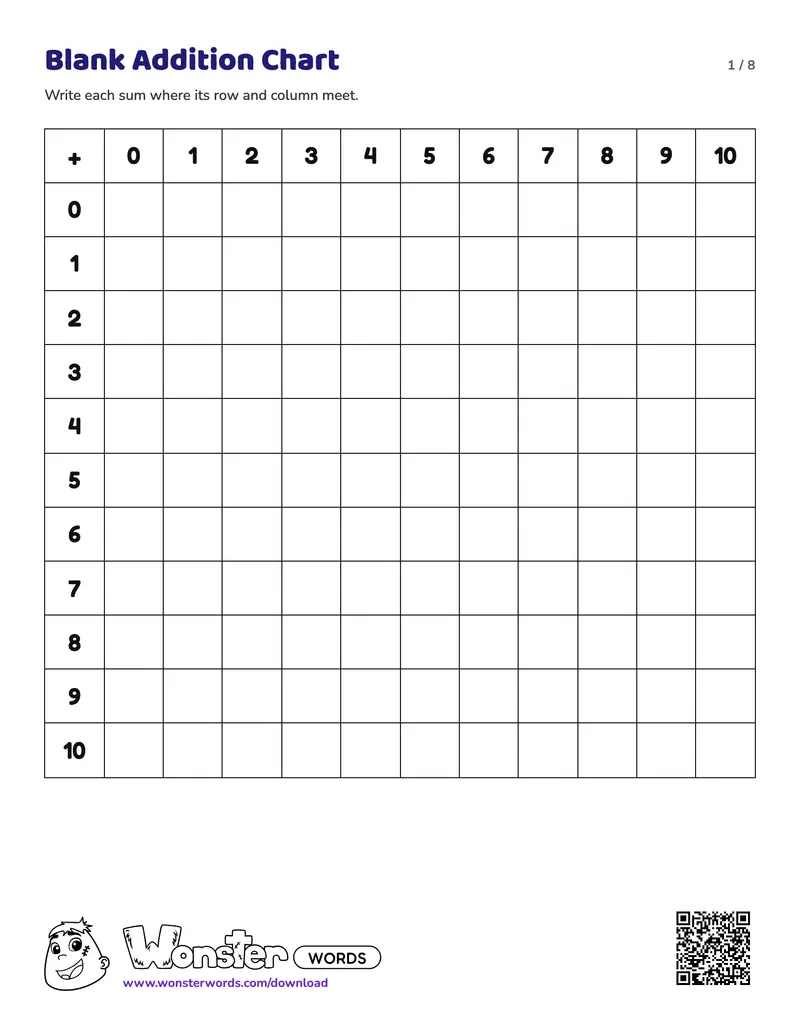
- Blank Addition Chart (PDF)227 facts · answer key included · 8 pages
Preview page 1Preview
2. Word problems
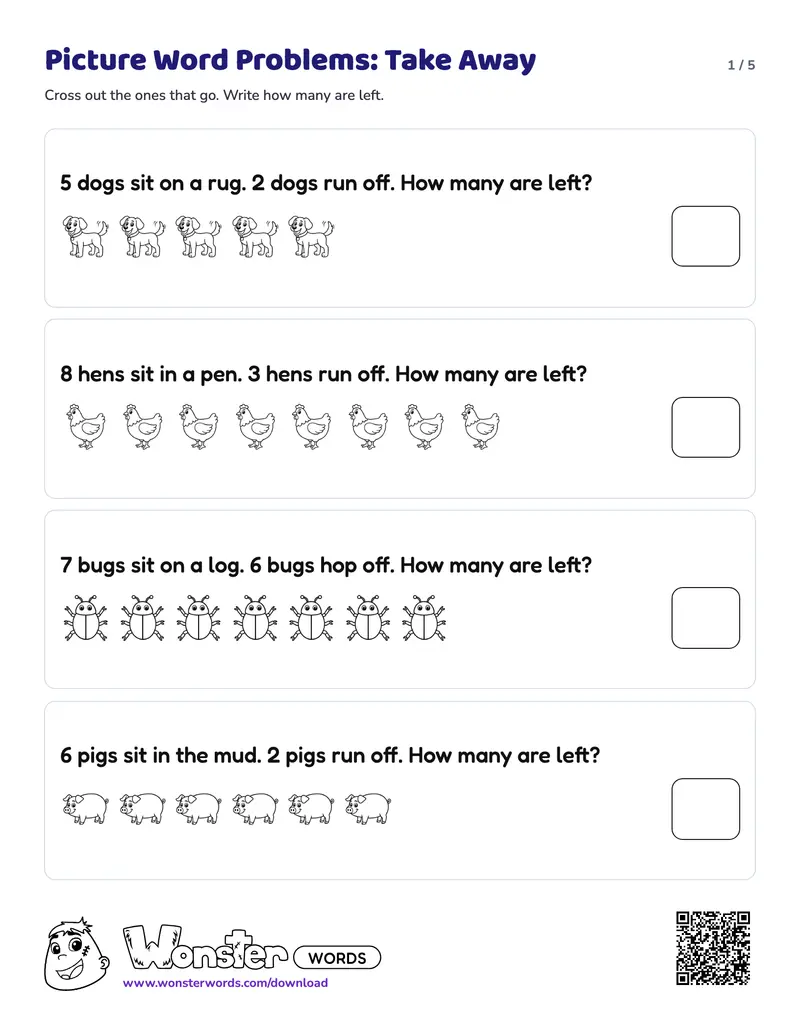
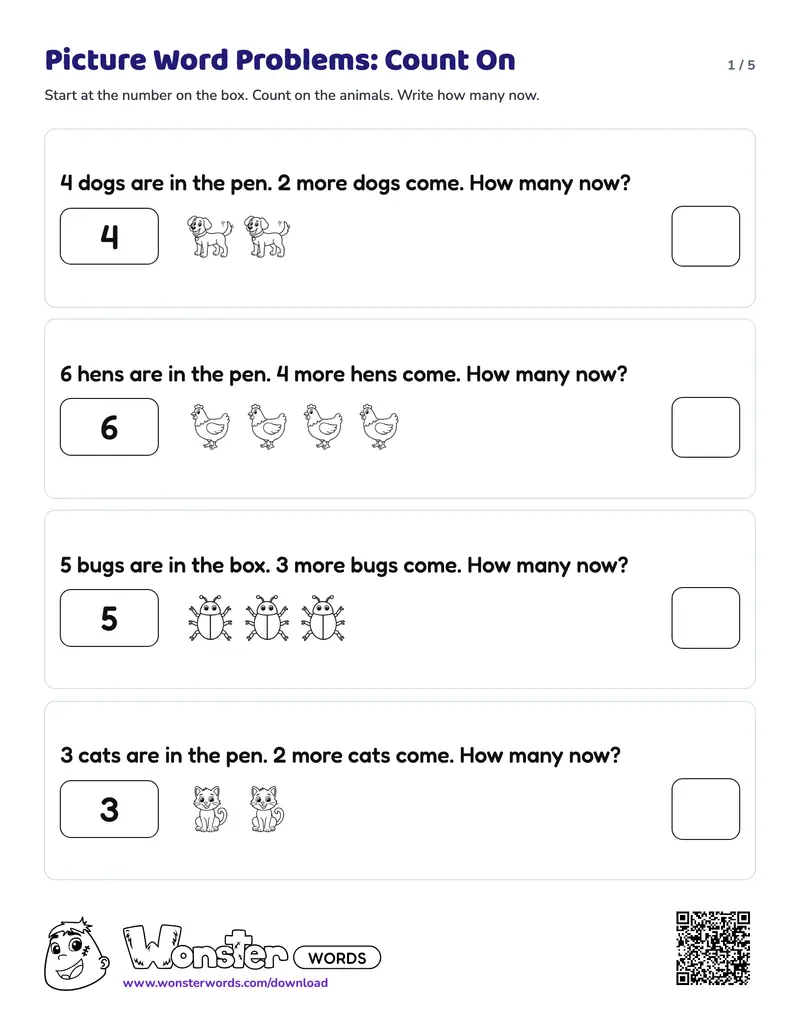
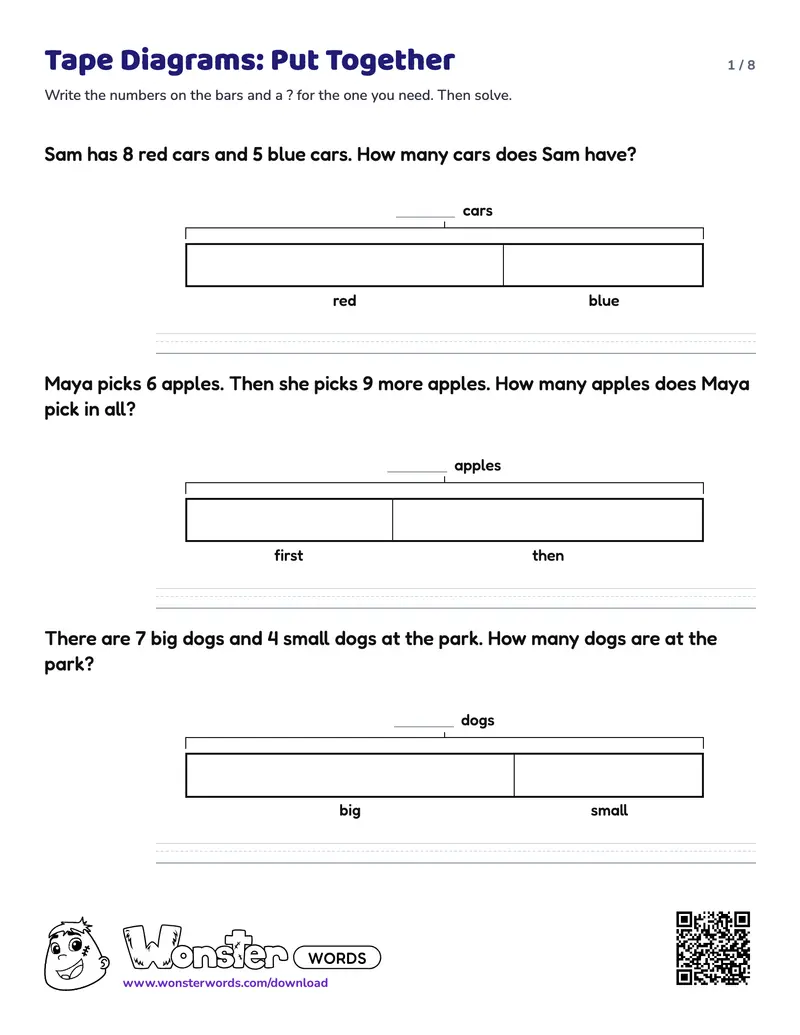
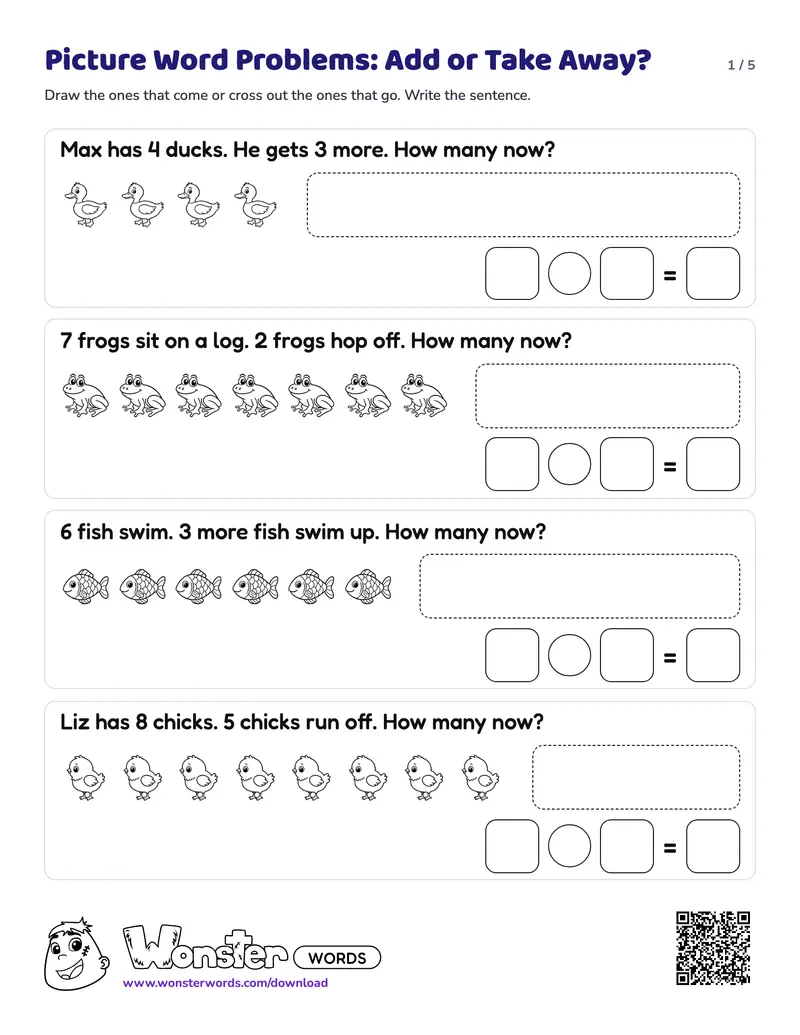
First graders solve word problems within 20 with the unknown in any place, and add three numbers (1.OA.A.1 and 1.OA.A.2). These 1st grade math problems run from picture stories to the bar drawings on the tape diagram page, which explains how to draw one. The picture sheets come from the addition and subtraction worksheets page: Put Together and Take Away for the start of the year, then Add or Take Away? and Count On.
Free PDF · no sign-up
Feedback?Word problems
Five free PDFs in black and white: four picture word problem sheets, then tape diagram word problems. Each ends with an answer key.
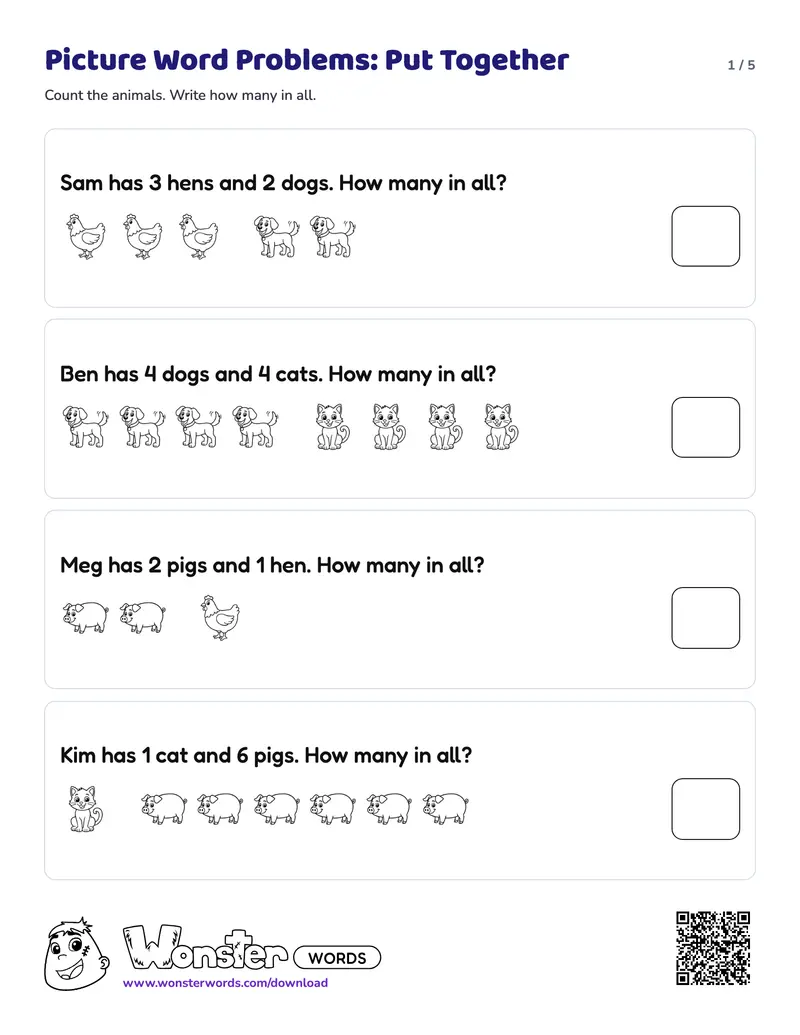
- Picture Word Problems: Put Together (PDF)12 problems · answer key included · 5 pages
Preview page 1Preview
- Picture Word Problems: Take Away (PDF)12 problems · answer key included · 5 pages
Preview page 1Preview
- Picture Word Problems: Count On (PDF)12 problems · answer key included · 5 pages
Preview page 1Preview
- Tape Diagram Word Problems (PDF)15 problems · answer key included · 8 pages
Preview page 1Preview
3. Counting to 120, tens and ones, and comparing
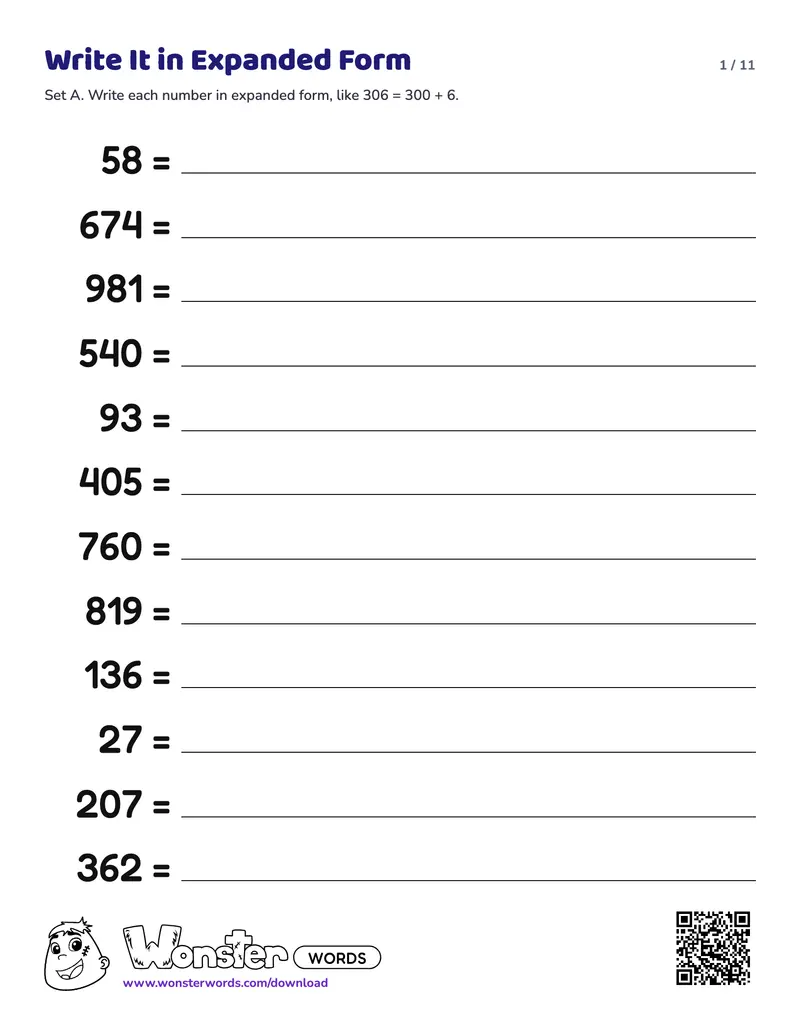
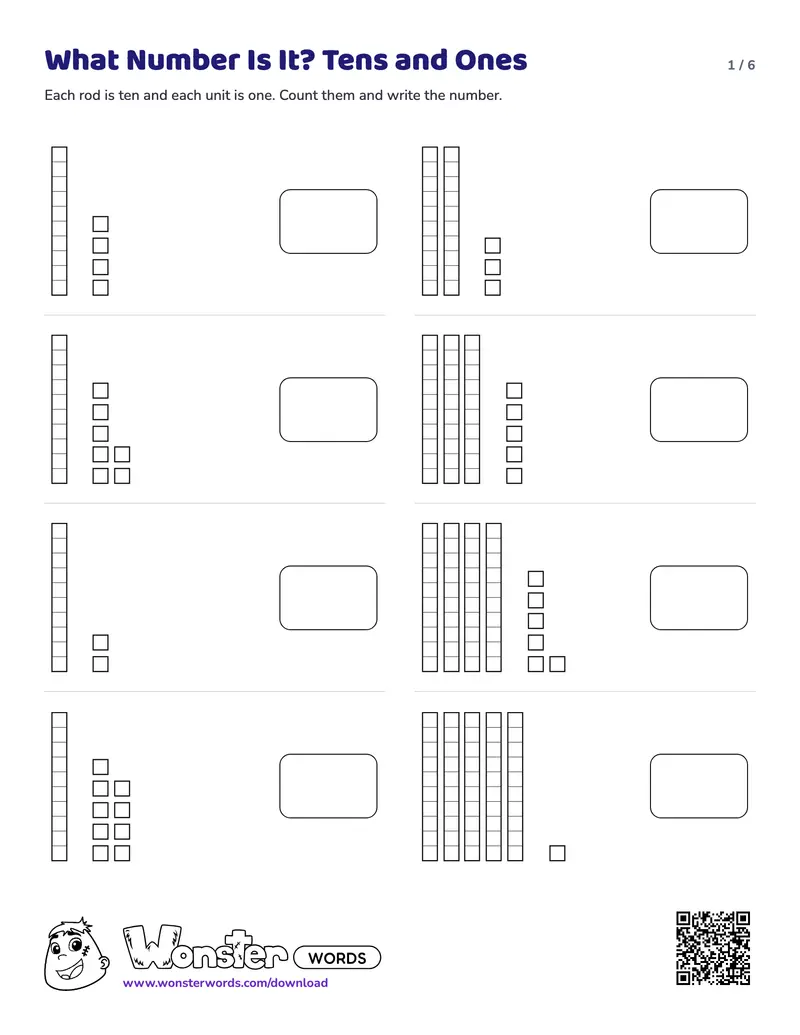
Counting to 120 from any number (1.NBT.A.1), tens and ones (1.NBT.B.2), and comparing two-digit numbers with >, =, and < (1.NBT.B.3) are first grade’s place value work. The sheets come from the counting to 100, hundreds chart, number line, one more, one less, place value chart, base ten blocks, greater than, less than, skip counting, and expanded form pages. Skip Counting and Expanded Form Worksheets are Texas first grade and Common Core second grade, and the place value guide explains tens and ones.
Free PDF · no sign-up
Feedback?Counting to 120, tens and ones, and comparing
Twelve free PDFs in black and white, from counting to 120 to tens and ones and comparing two-digit numbers. Skip Counting and Expanded Form Worksheets are Texas first grade. Each ends with an answer key.
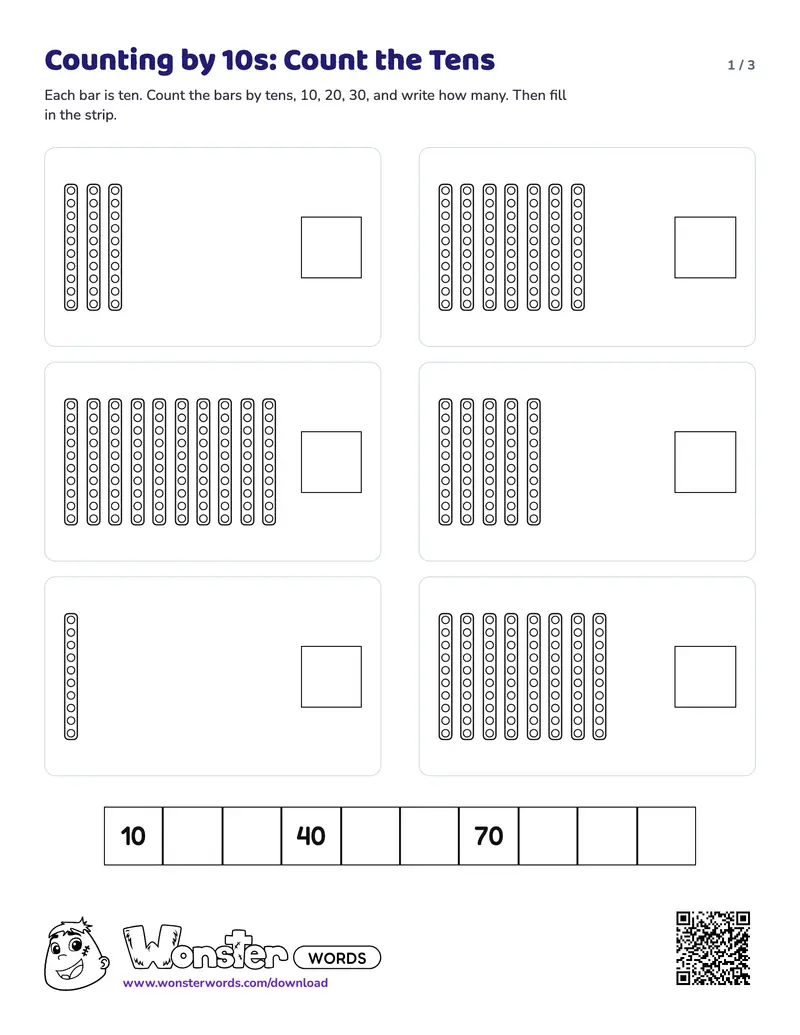
- Counting by 10s (PDF)64 numbers to write · answer key included · 7 pages
Preview page 1Preview
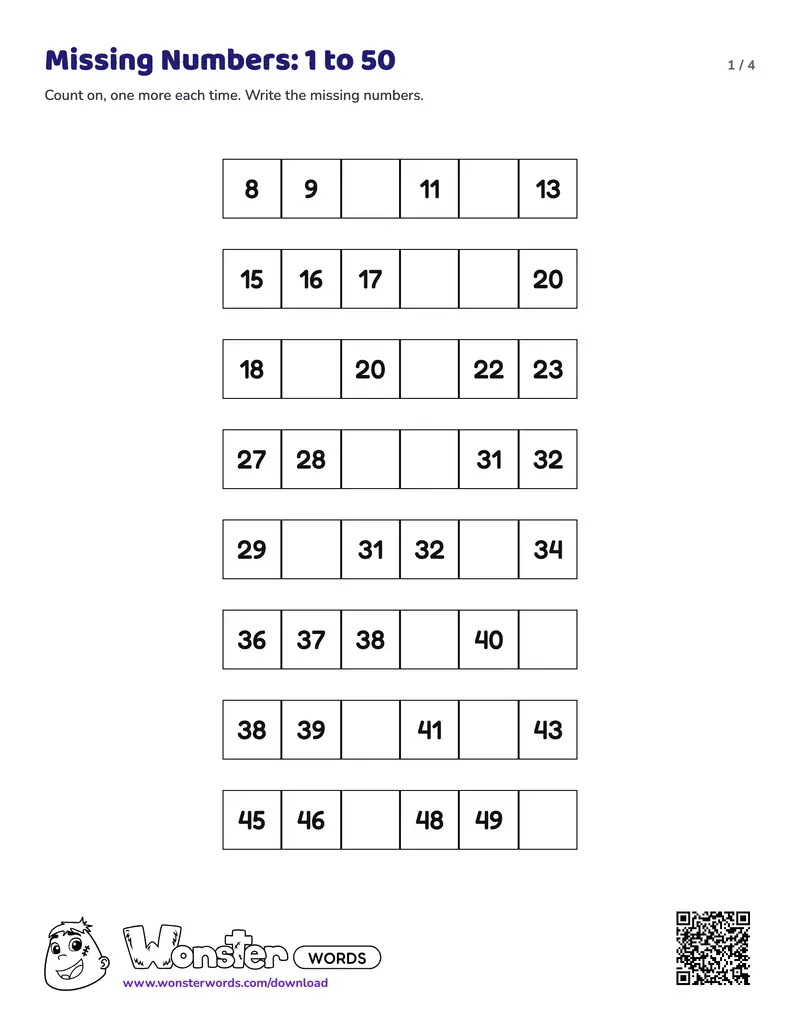
- Missing Numbers to 120 (PDF)48 missing numbers · answer key included · 5 pages
Preview page 1Preview
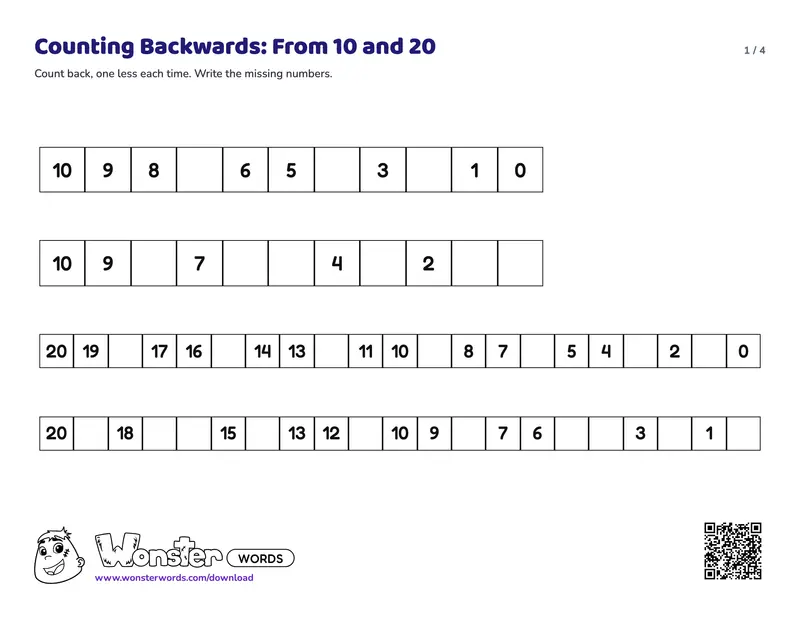
- Counting Backwards (PDF)64 missing numbers · answer key included · 5 pages
Preview page 1Preview
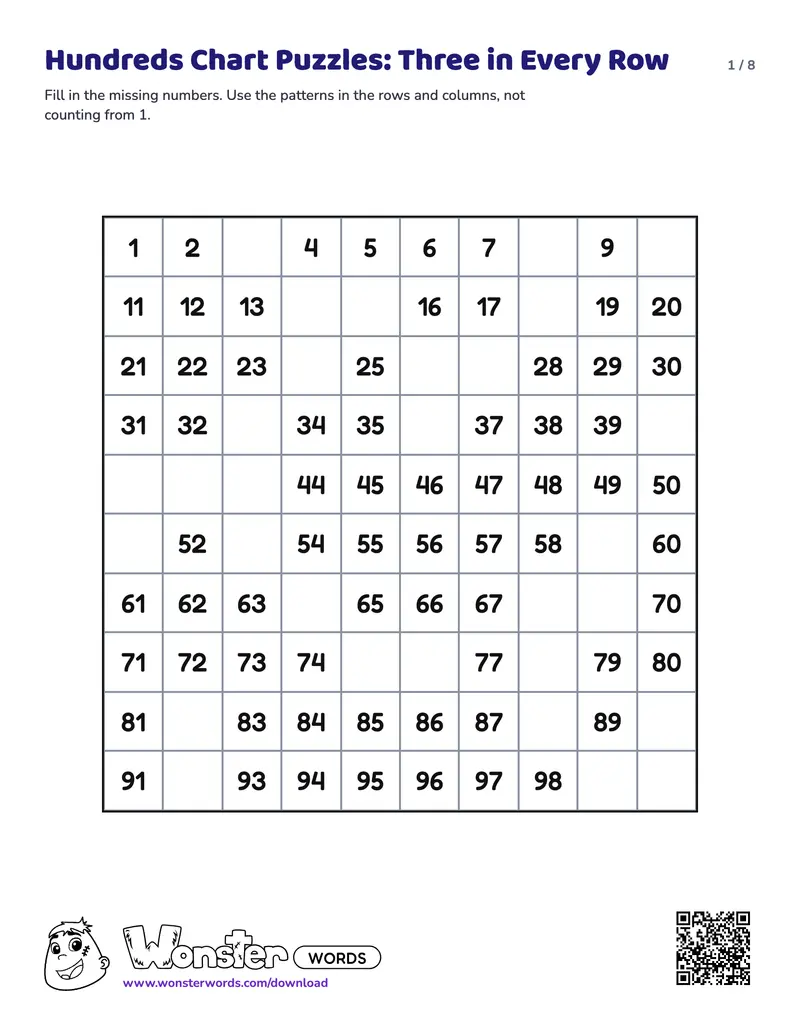
- Hundreds Chart Puzzles (PDF)200 missing numbers · answer key included · 17 pages
Preview page 1Preview
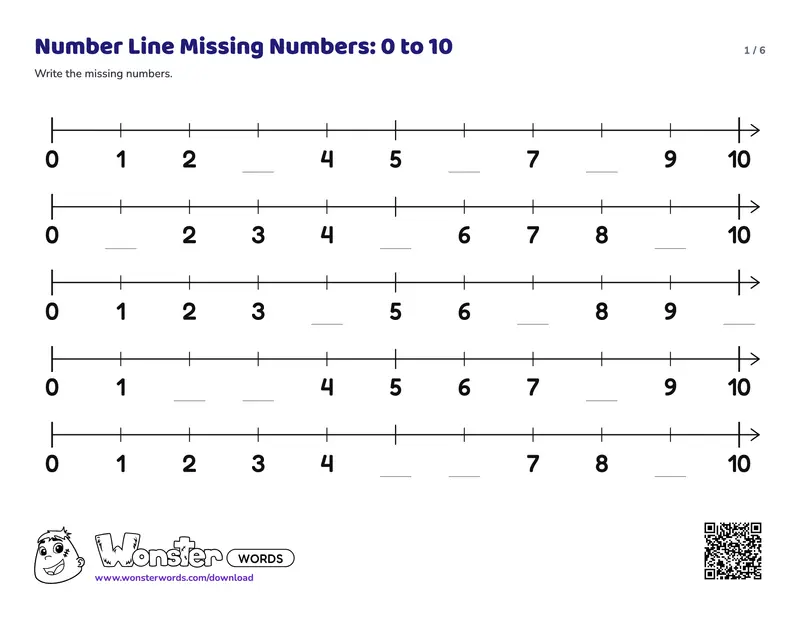
- Number Line Missing Numbers (PDF)98 missing numbers · answer key included · 6 pages
Preview page 1Preview
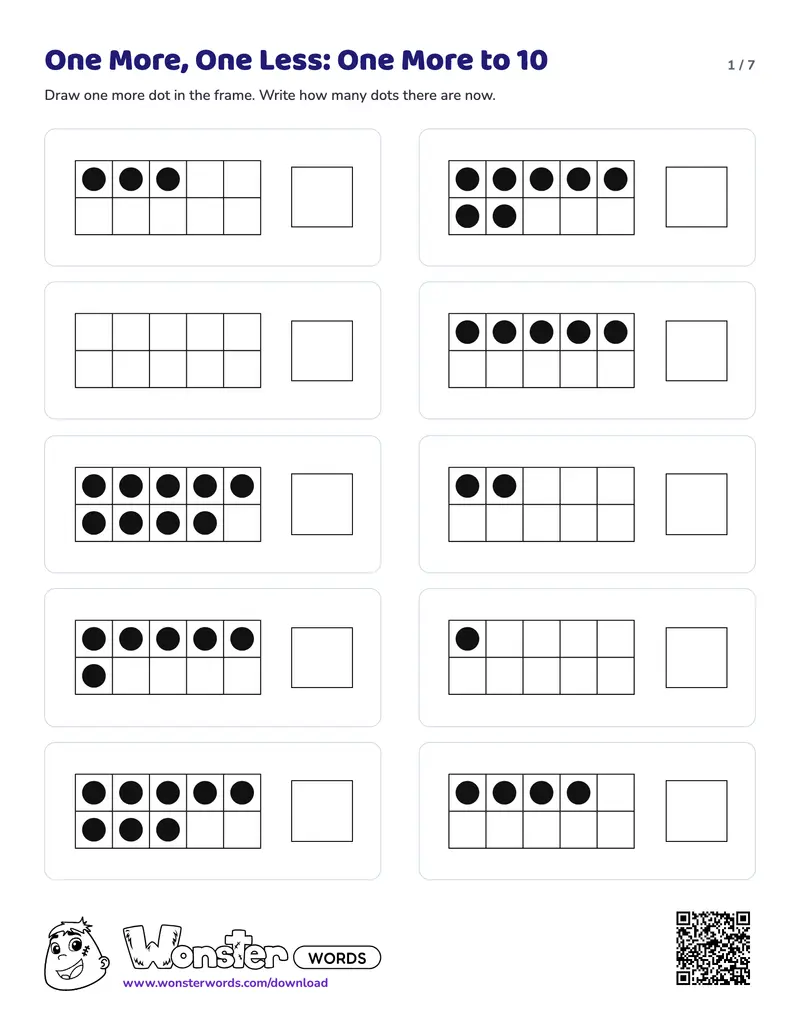
- One More, One Less (PDF)160 numbers to write · answer key included · 14 pages
Preview page 1Preview
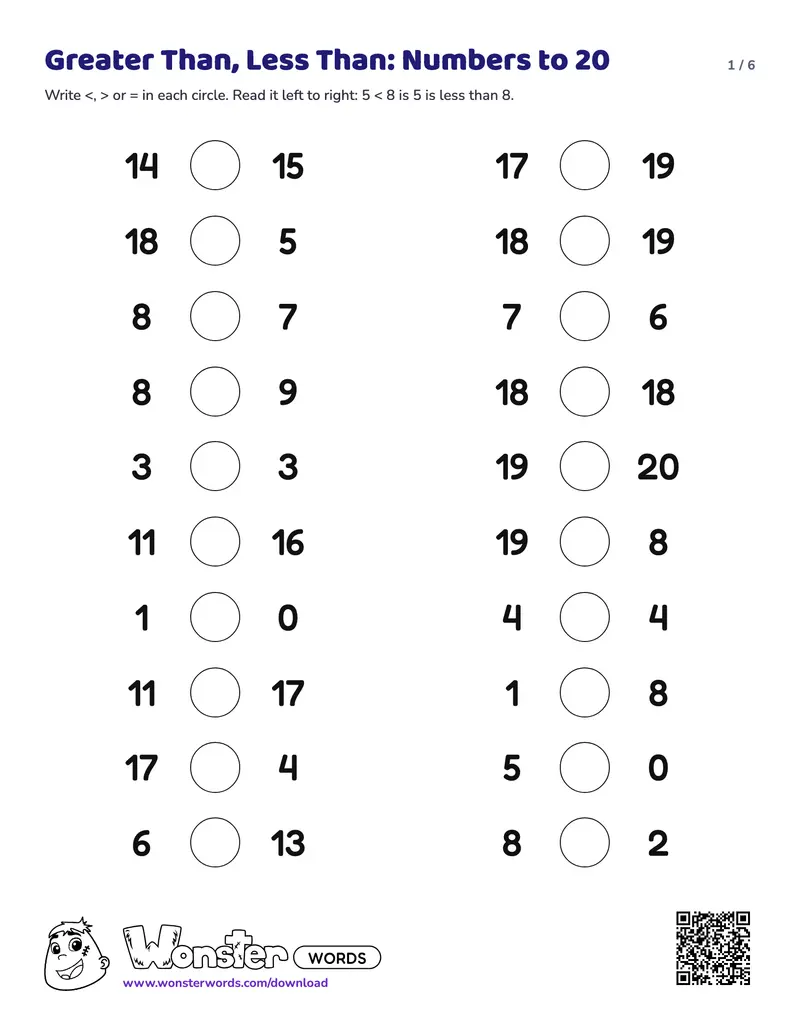
- Greater Than, Less Than (PDF)72 comparisons · answer key included · 7 pages
Preview page 1Preview
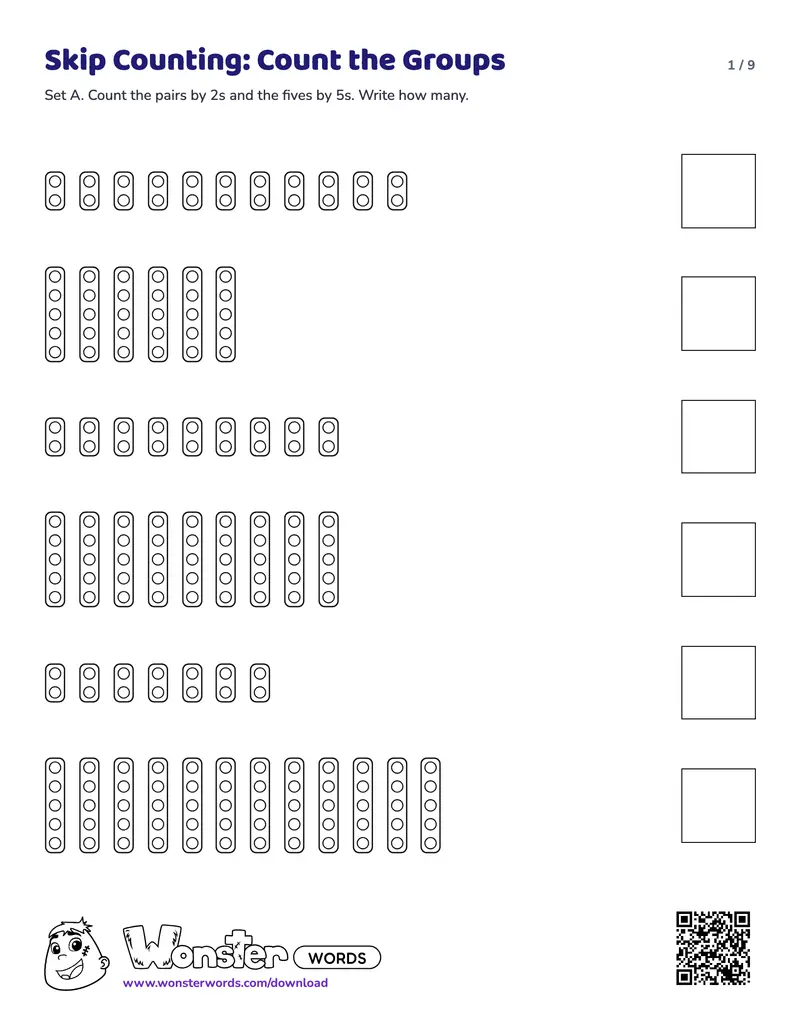
- Skip Counting (PDF)68 numbers to write · answer key included · 9 pages
Preview page 1Preview
- Expanded Form Worksheets (PDF)96 numbers · answer key included · 11 pages
Preview page 1Preview
4. Adding and subtracting within 100
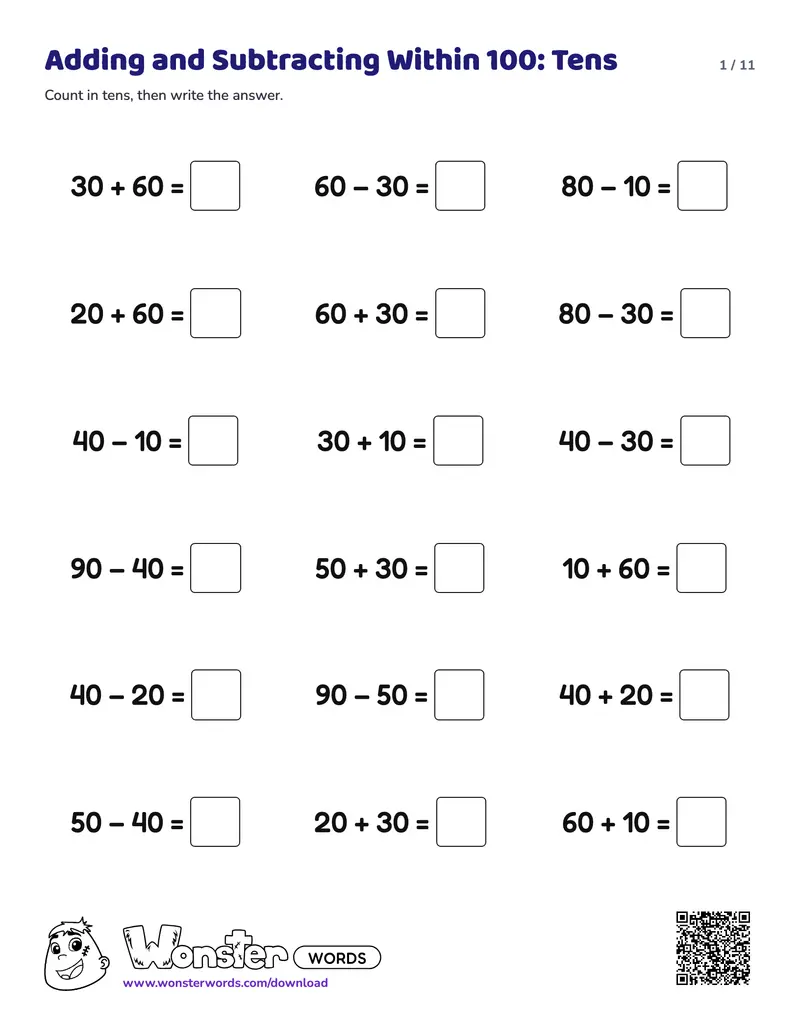
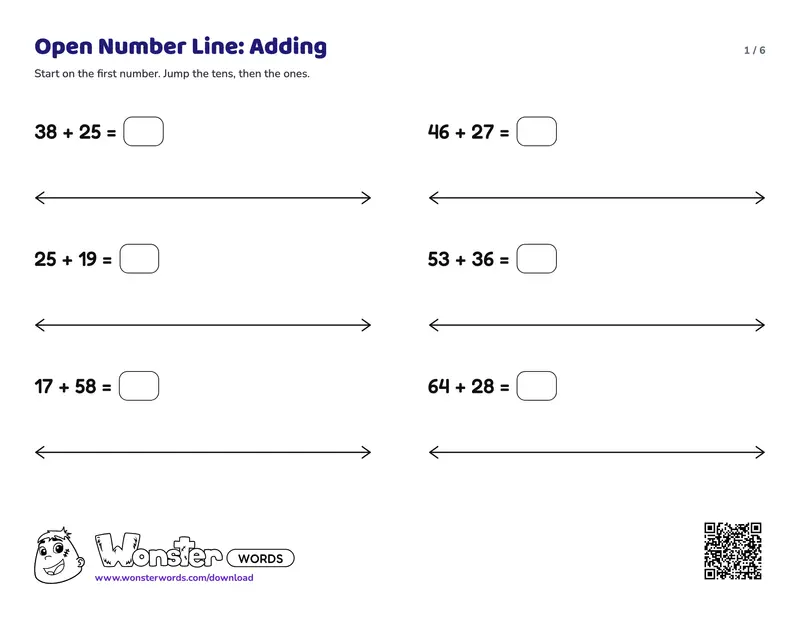
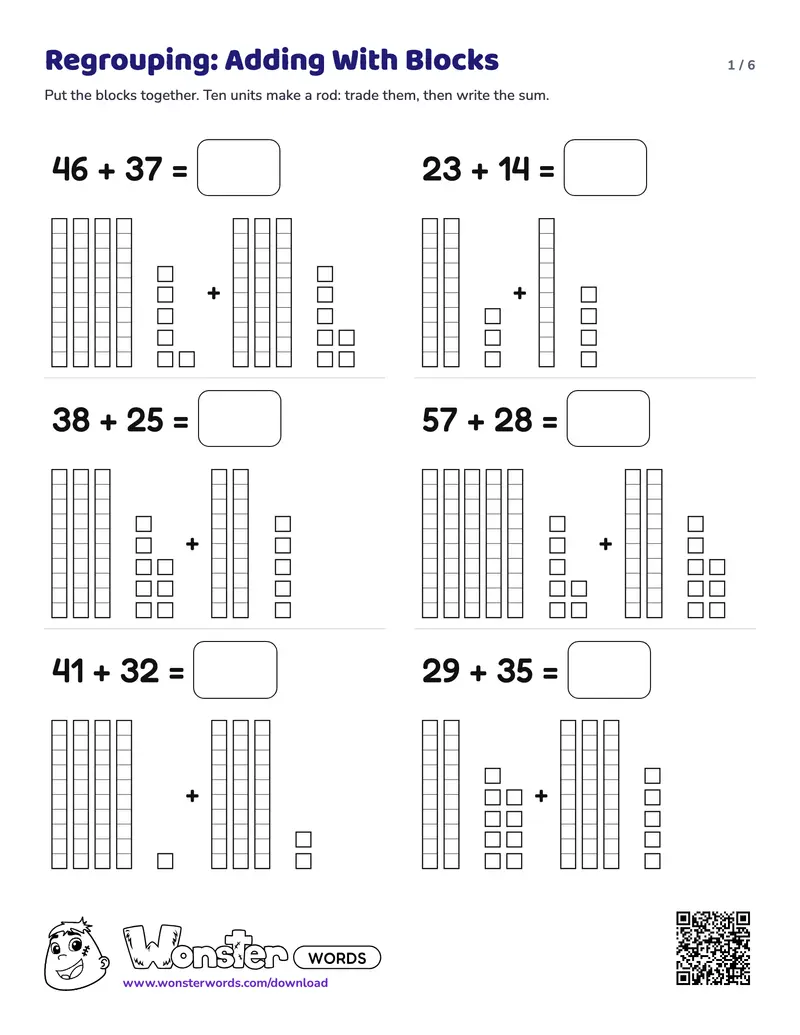
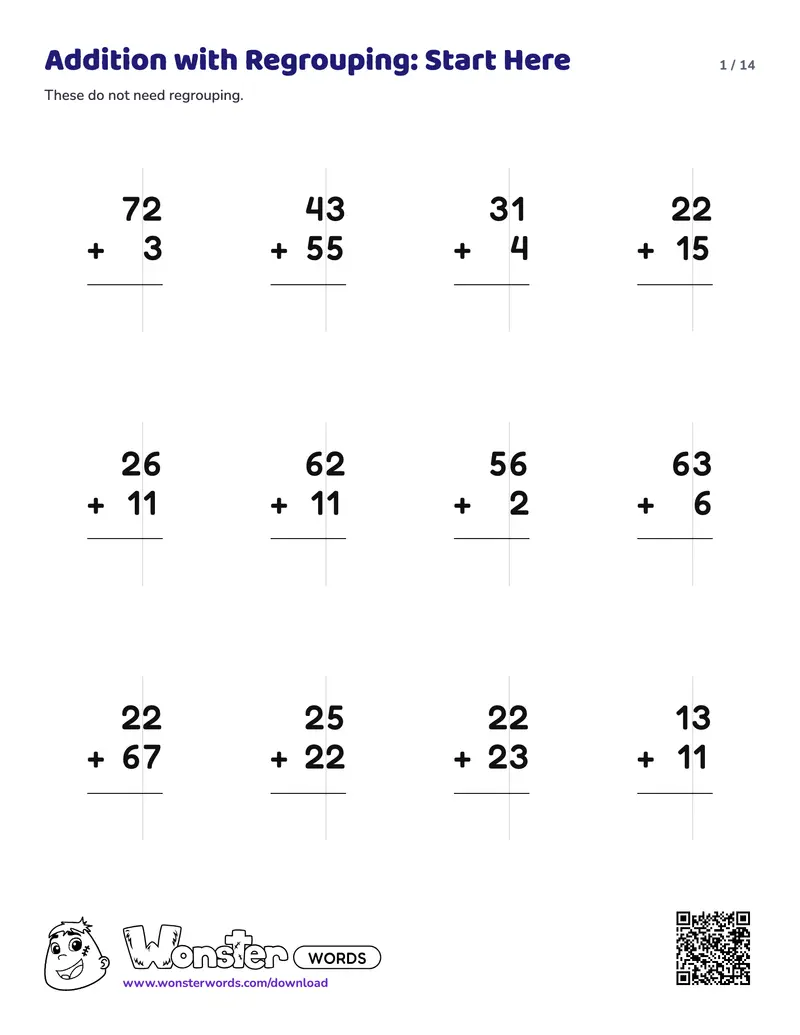
First graders add a two-digit number and a one-digit number or a ten, and subtract tens, within 100 (1.NBT.C.4 to 1.NBT.C.6). For first grade, Adding and Subtracting Within 100 is pages 1 to 6, and pages 7 and 8 are second grade’s. Addition with Regrouping’s first pages are for late first grade, and the rest are second grade work. The sheets come from the addition and subtraction worksheets, number line, base ten blocks, and addition with regrouping pages, and the regrouping guide explains making a new ten.
Free PDF · no sign-up
Feedback?Adding and subtracting within 100
Four free PDFs in black and white for adding and subtracting with tens and ones. Each ends with an answer key.
- Adding and Subtracting Within 100 (PDF)144 problems · answer key included · 11 pages
Preview page 1Preview
- Open Number Line (PDF)24 problems · answer key included · 6 pages
Preview page 1Preview
- Base Ten Blocks: Regrouping (PDF)24 numbers to write · answer key included · 6 pages
Preview page 1Preview
- Addition with Regrouping (PDF)108 problems · answer key included · 14 pages
Preview page 1Preview
5. Shapes and equal parts
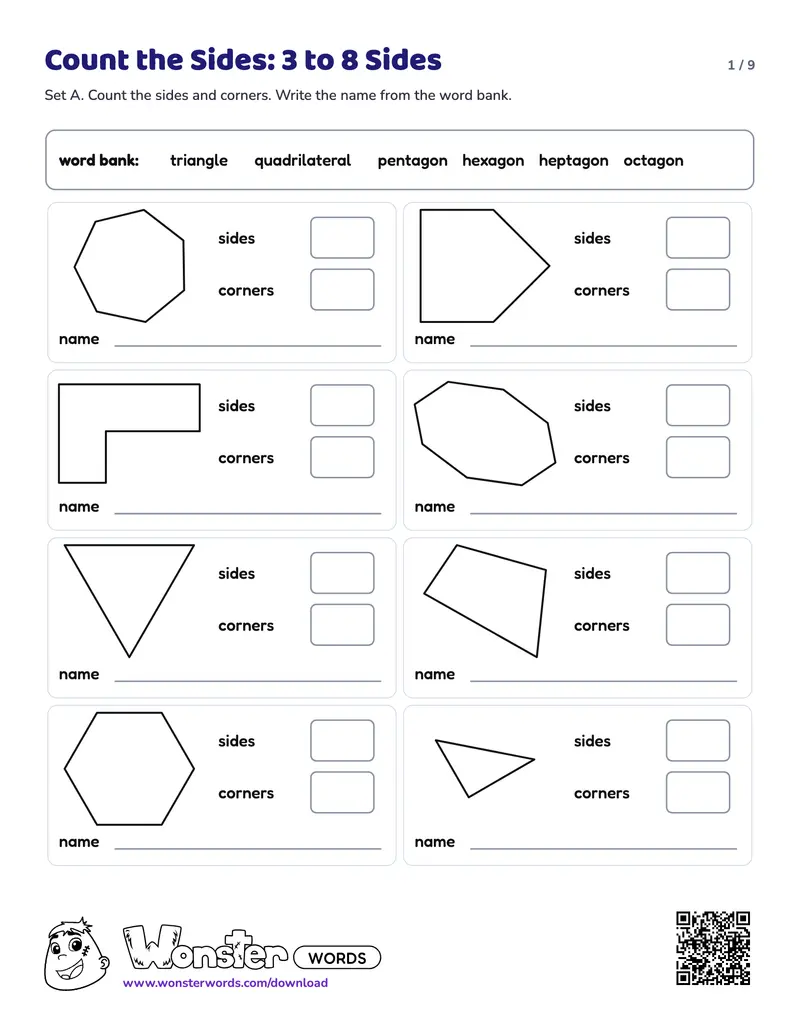
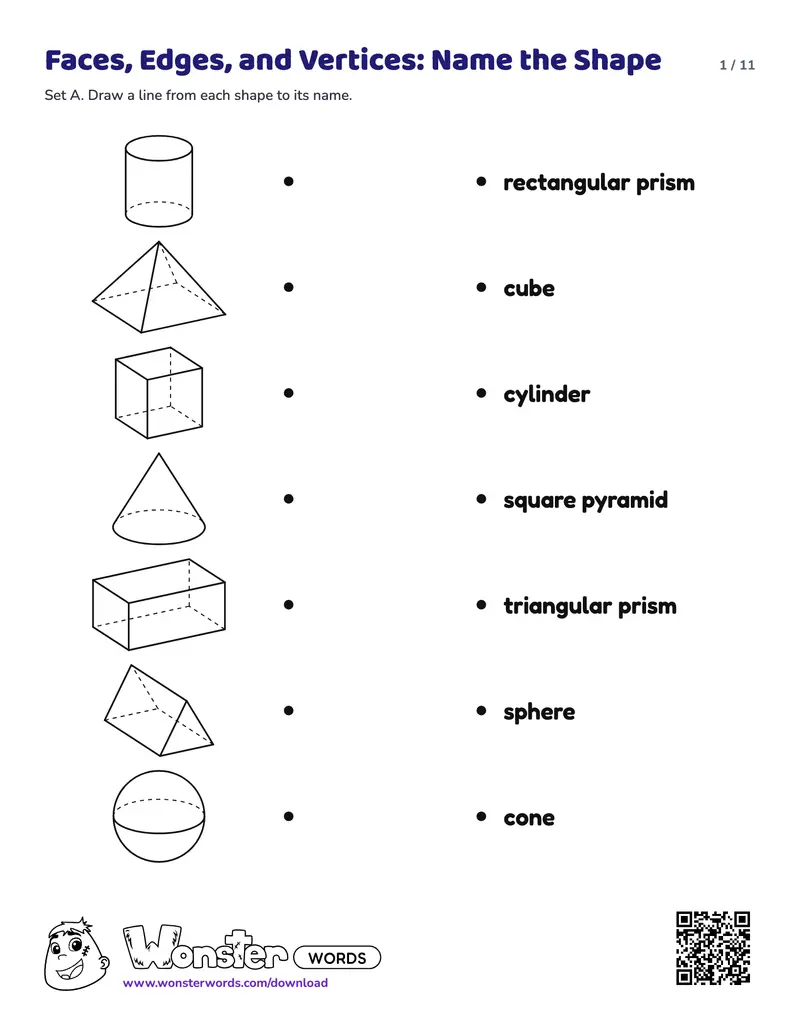
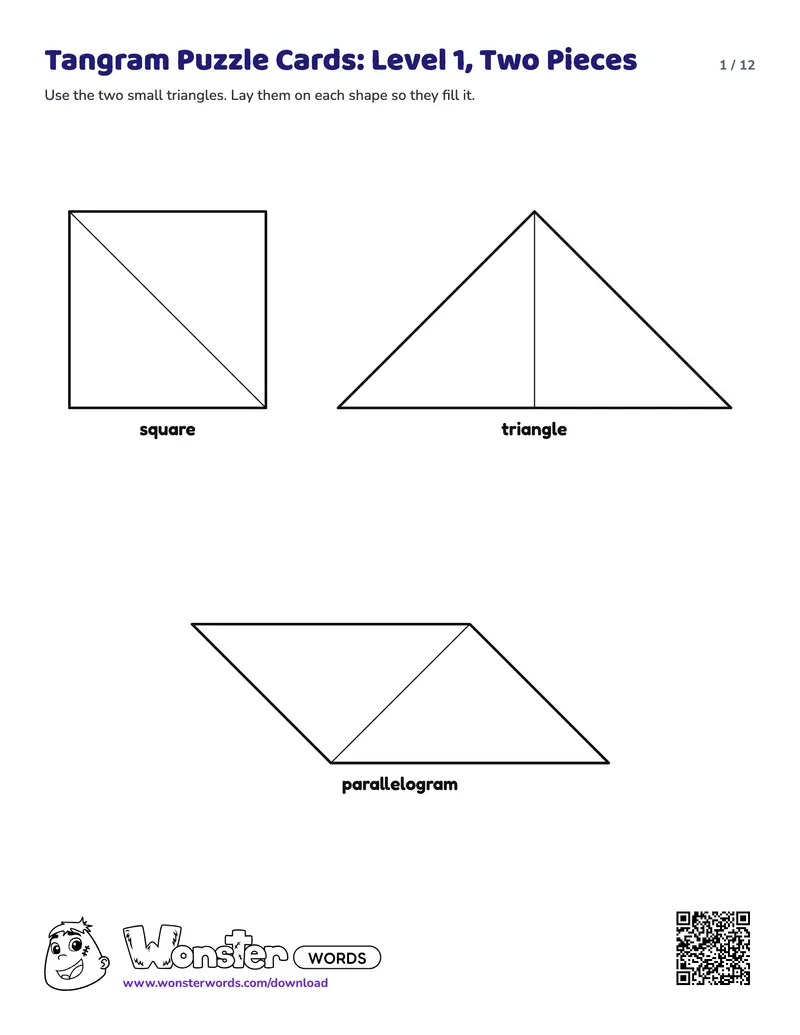
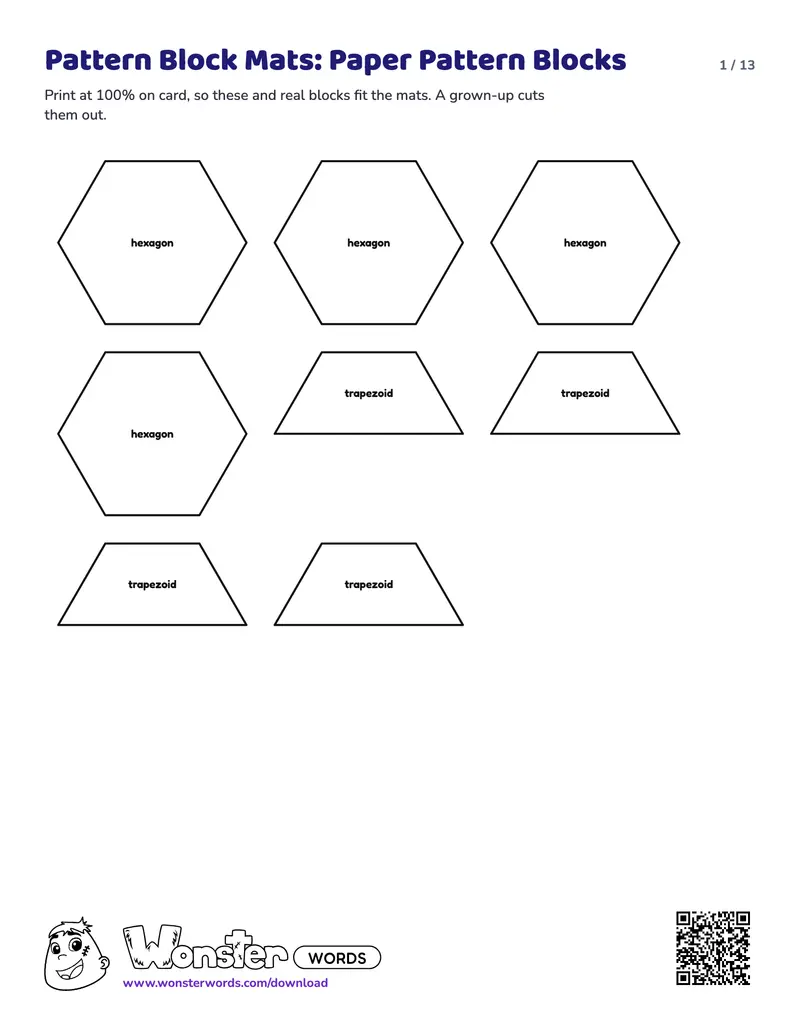
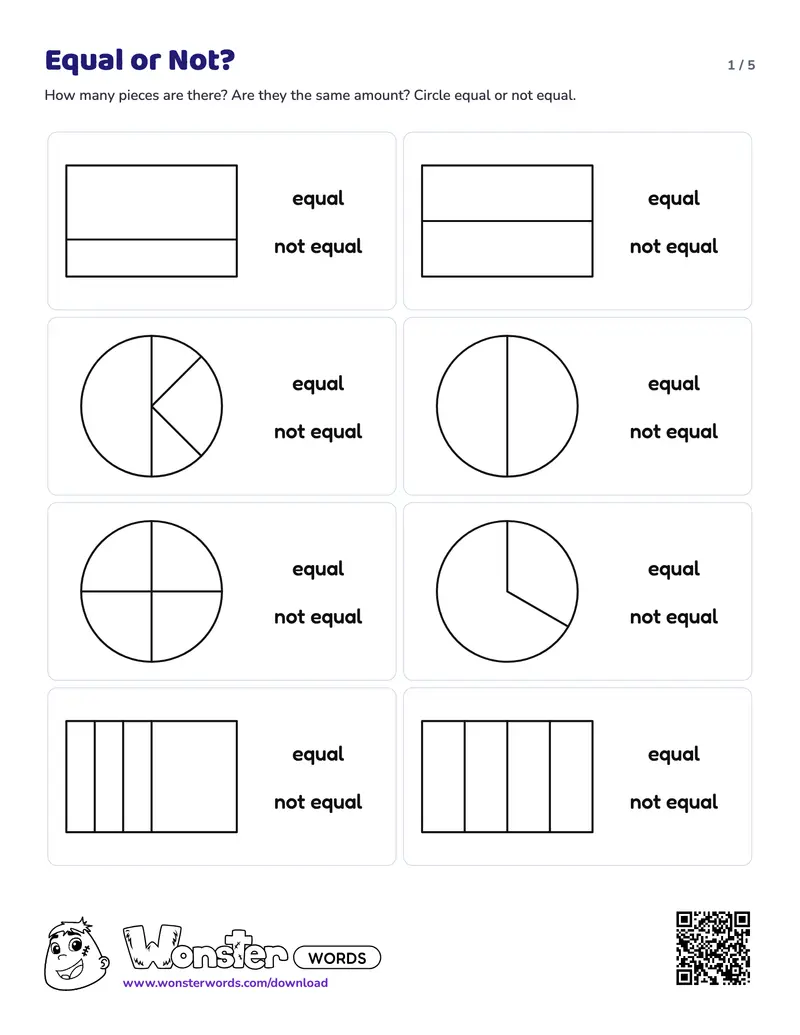
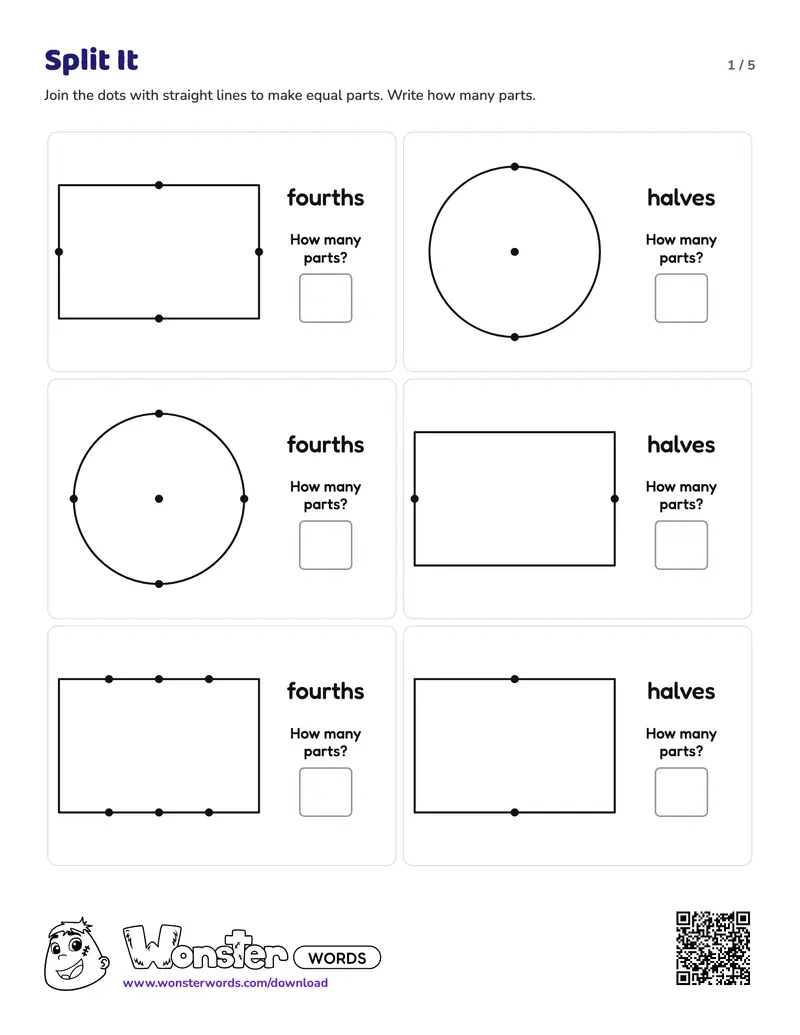
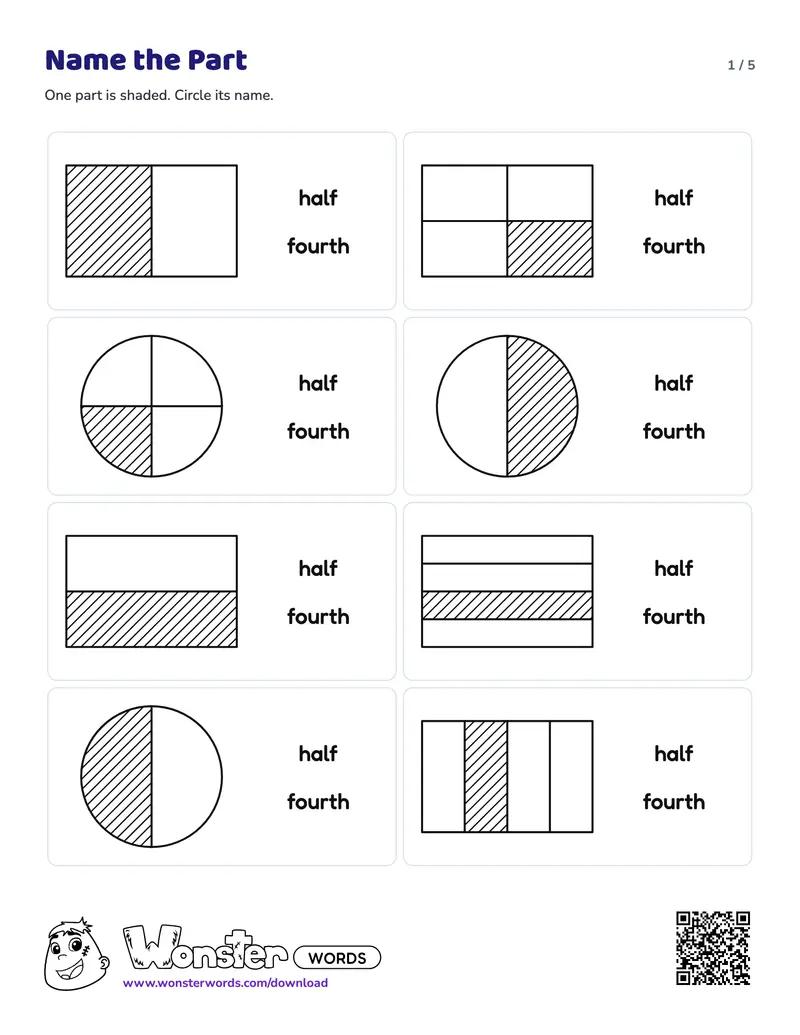
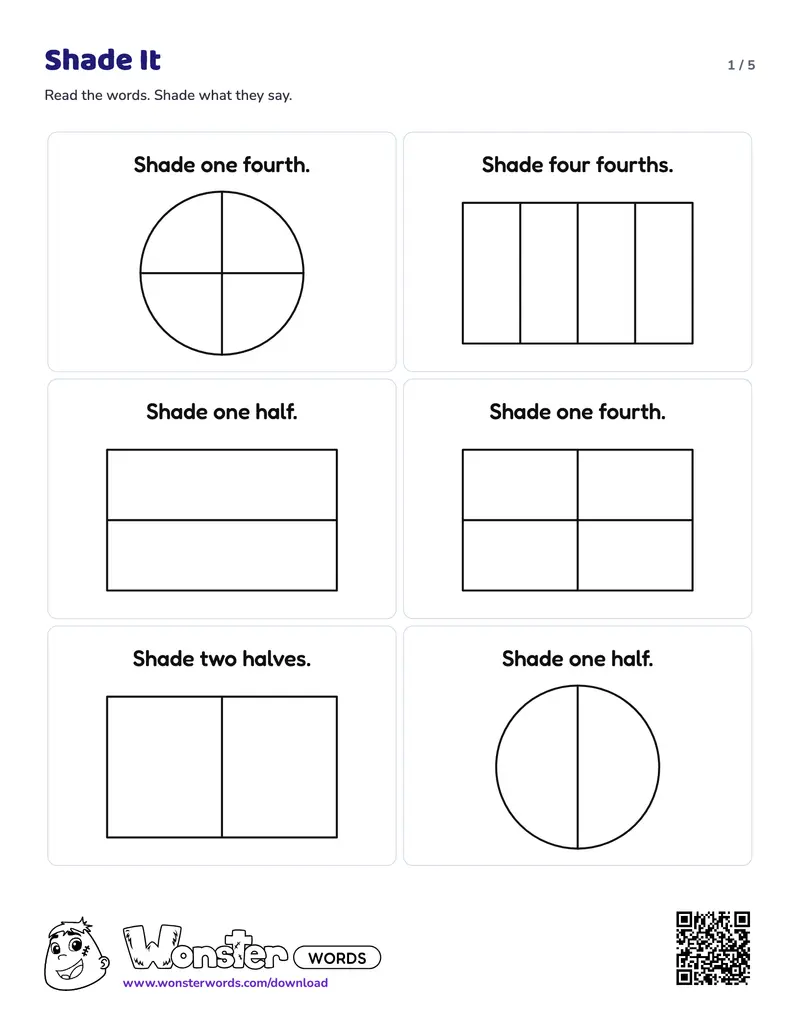
First graders name a shape by what makes it that shape, build shapes from shapes, and split circles and rectangles into halves and fourths (1.G.A.1 to 1.G.A.3). The sheets come from the shapes by number of sides, 3D shapes, and tangrams and pattern blocks pages, and the shapes guide sets out which shapes come when. The four equal parts sheets, from the equal parts page, run in stages: page 1 of each is first grade’s halves and fourths, and pages 2 and 3 add thirds and eighths, which are second grade’s.
Free PDF · no sign-up
Feedback?Shapes and equal parts
Eight free PDFs in black and white for naming shapes by their sides, faces, and corners, for building shapes from shapes, and for halves and fourths. Each ends with an answer key.
- Count the Sides (PDF)24 shapes · answer key included · 9 pages
Preview page 1Preview
- Faces, Edges, and Vertices (PDF)24 shapes · answer key included · 11 pages
Preview page 1Preview
- Tangram Puzzle Cards (PDF)20 puzzles · answer key included · 12 pages
Preview page 1Preview
- Pattern Block Mats (PDF)8 mats · answer key included · 13 pages
Preview page 1Preview
- Equal or Not? (PDF)24 shapes · answer key included · 5 pages
Preview page 1Preview
- Split It (PDF)18 shapes · answer key included · 5 pages
Preview page 1Preview
- Name the Part (PDF)24 shapes · answer key included · 5 pages
Preview page 1Preview
- Shade It (PDF)18 shapes · answer key included · 5 pages
Preview page 1Preview
6. Charts, mats, and cards
Charts, number lines, mats, and cards are tools to keep on the table beside any tray’s sheet. The hundreds chart, the number lines, the place value chart, and base ten blocks help with trays 3 and 4; the addition chart and flash cards with tray 1; and the shape charts with tray 5. Each is explained on its own page, linked above.
Free PDF · no sign-up
Feedback?Charts, mats, and cards
Sixteen free PDFs in black and white: charts to read from, blank charts and lines to fill in, cut-out blocks and cards, and flash cards. Charts and mats have nothing to answer, so they have no answer key. Each download line says what is in it.
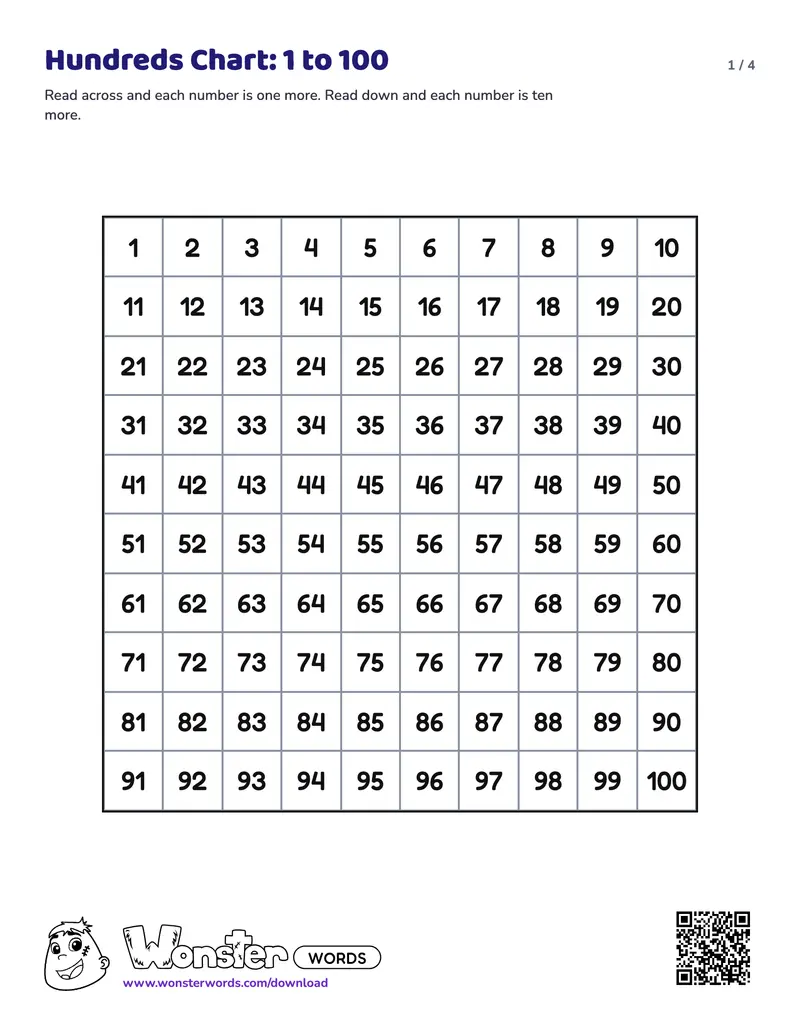
- Hundreds Chart (PDF)120 numbers · 5 pages
Preview page 1Preview
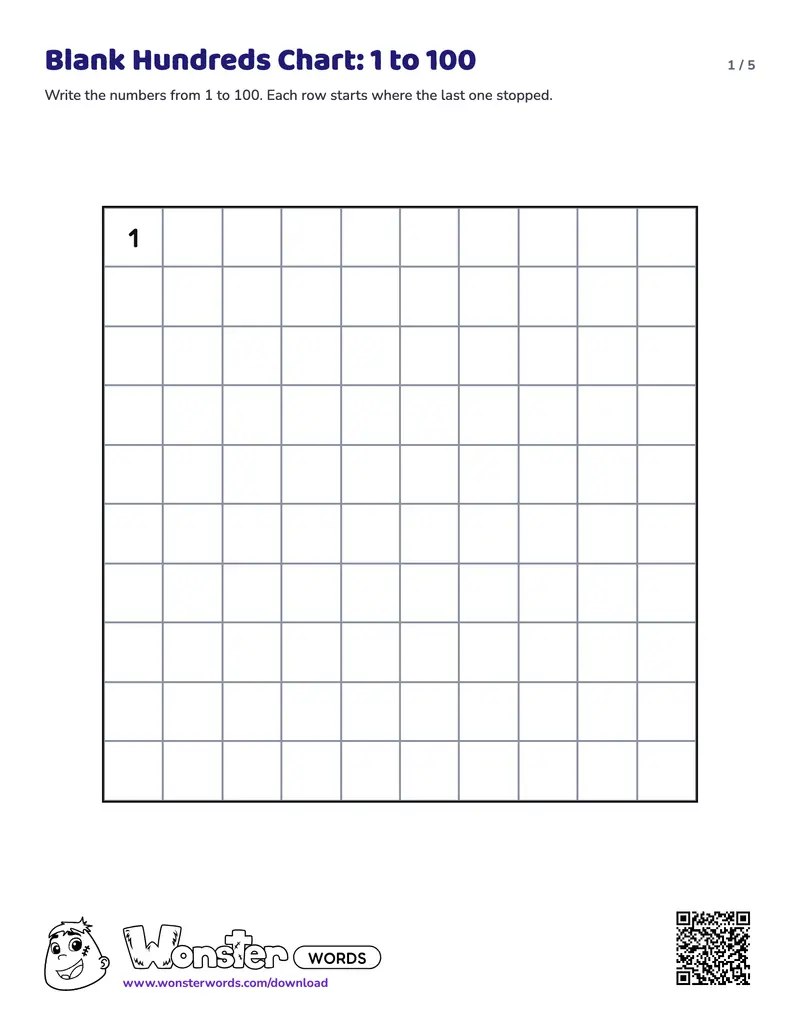
- Blank Hundreds Chart (PDF)120 numbers · answer key included · 6 pages
Preview page 1Preview
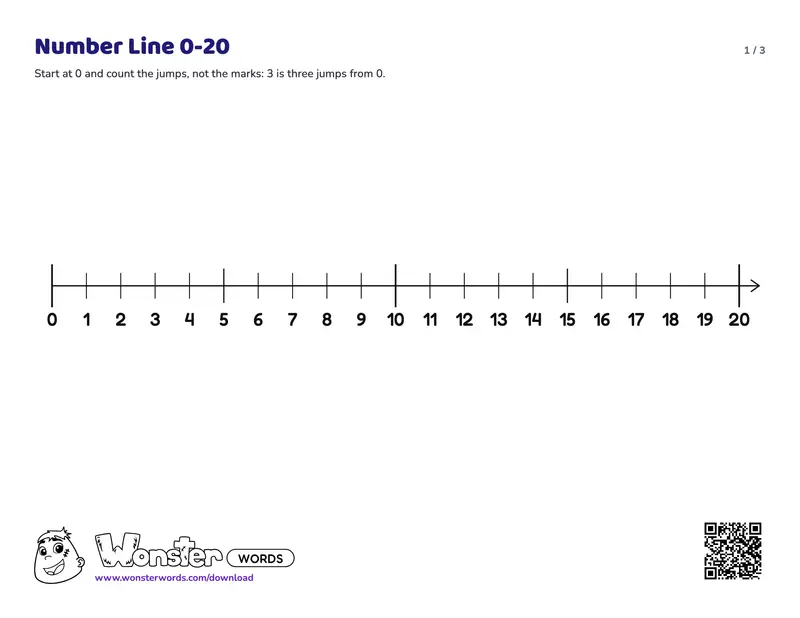
- Number Line 0-20 (PDF)21 numbers · 3 pages
Preview page 1Preview
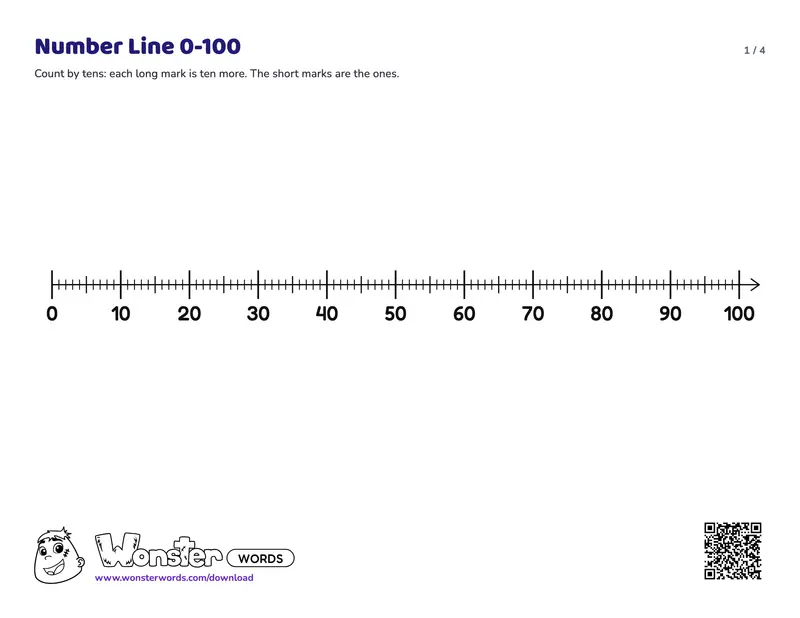
- Number Line 0-100 (PDF)101 numbers · 4 pages
Preview page 1Preview
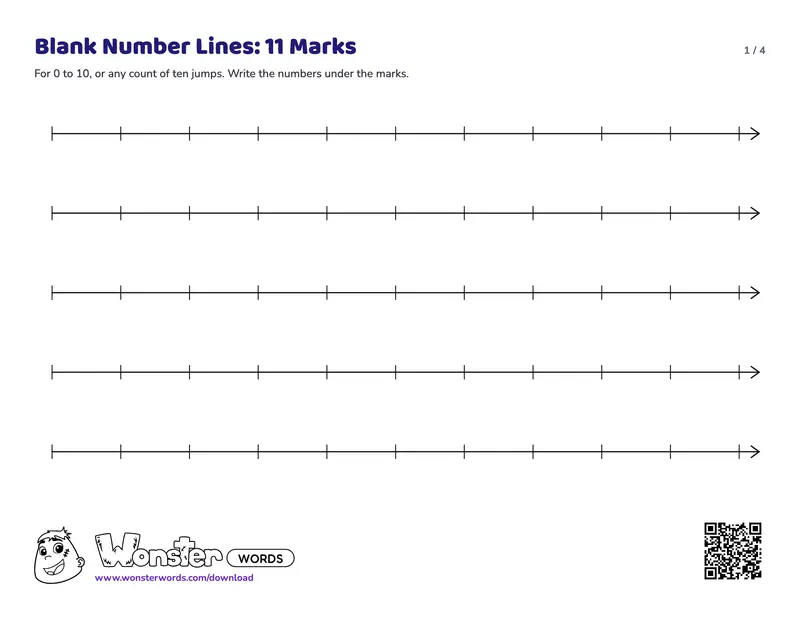
- Blank Number Lines (PDF)15 number lines · 4 pages
Preview page 1Preview
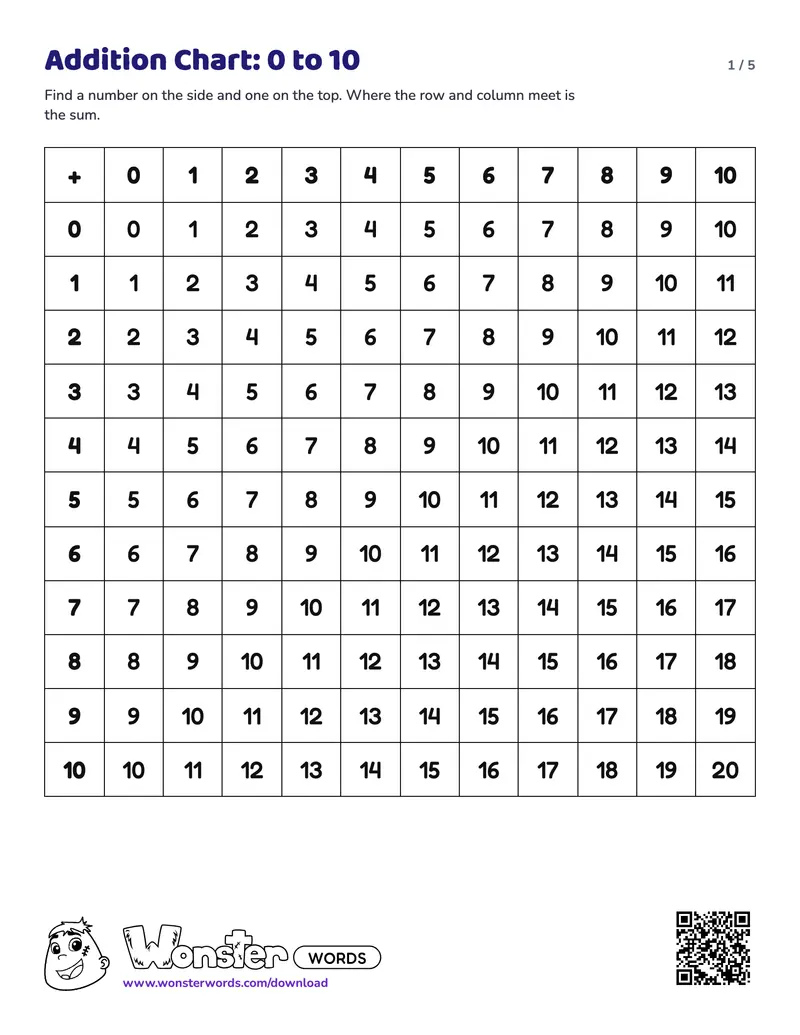
- Addition Chart (PDF)477 facts · 5 pages
Preview page 1Preview
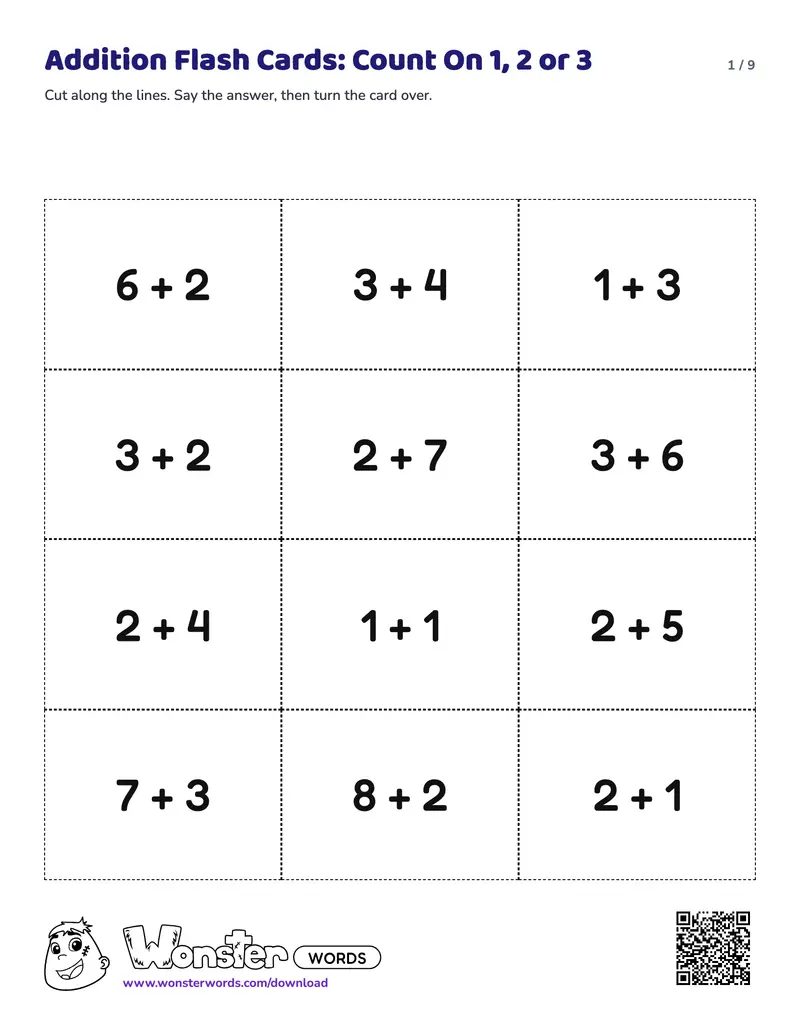
- Addition Flash Cards (PDF)45 cards · answer key included · 9 pages
Preview page 1Preview
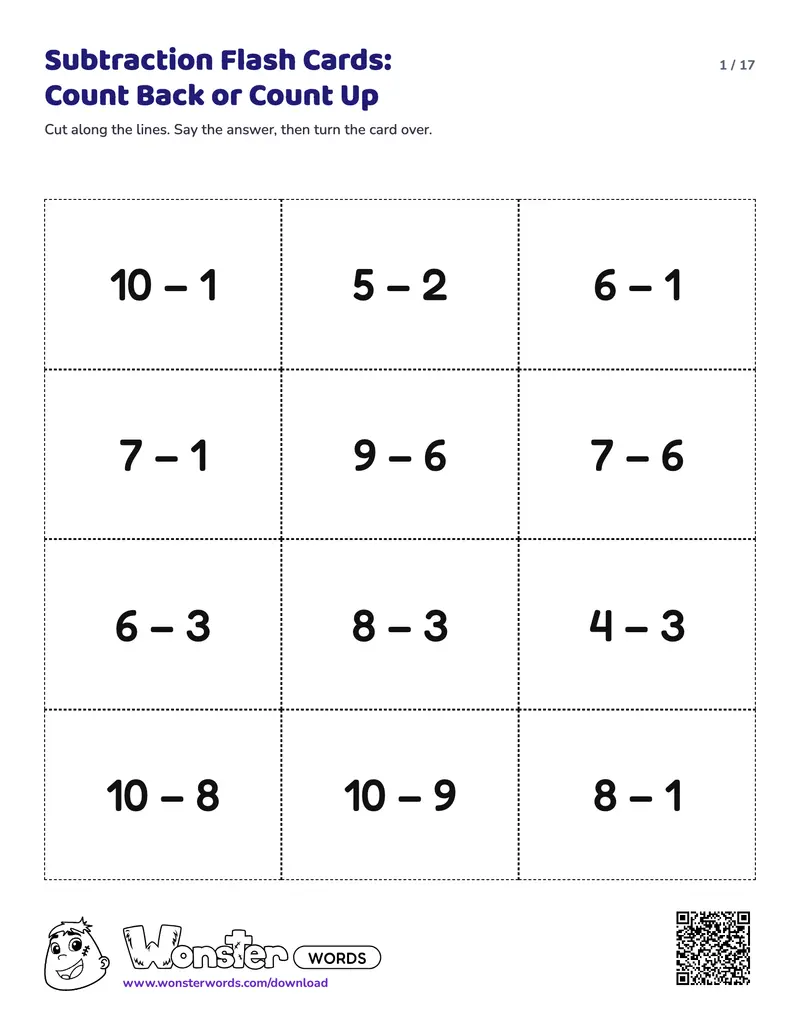
- Subtraction Flash Cards (PDF)81 cards · answer key included · 17 pages
Preview page 1Preview
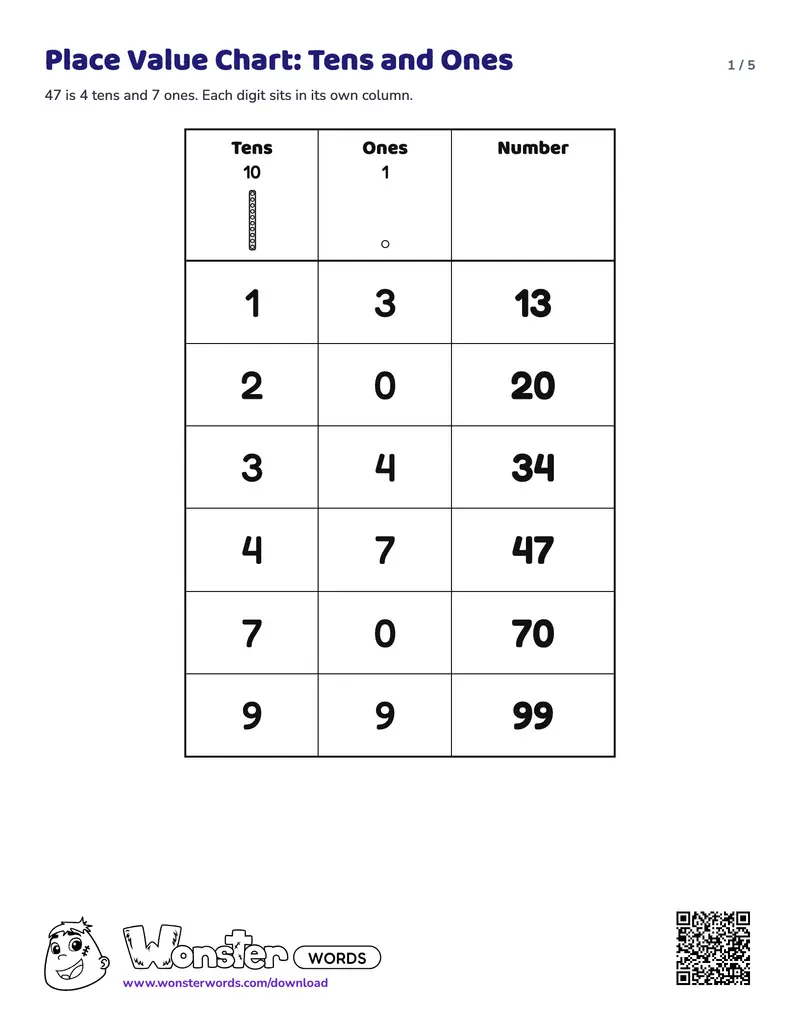
- Place Value Chart (PDF)17 numbers · 5 pages
Preview page 1Preview
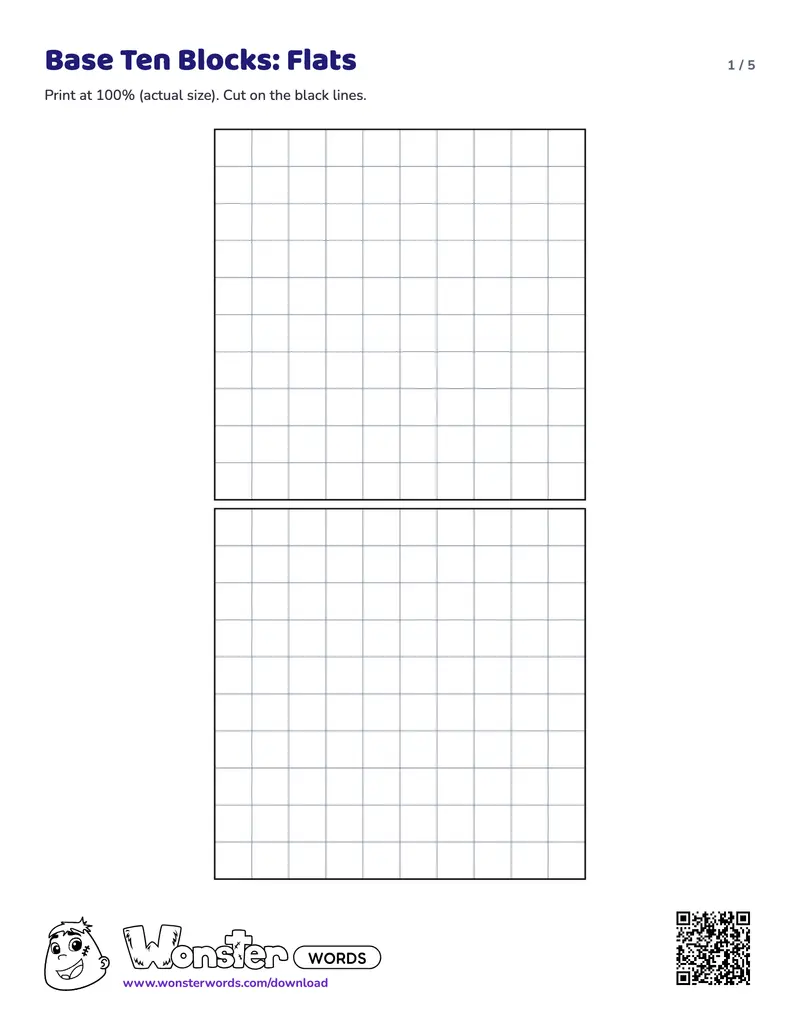
- Base Ten Blocks (PDF)370 pieces · 5 pages
Preview page 1Preview
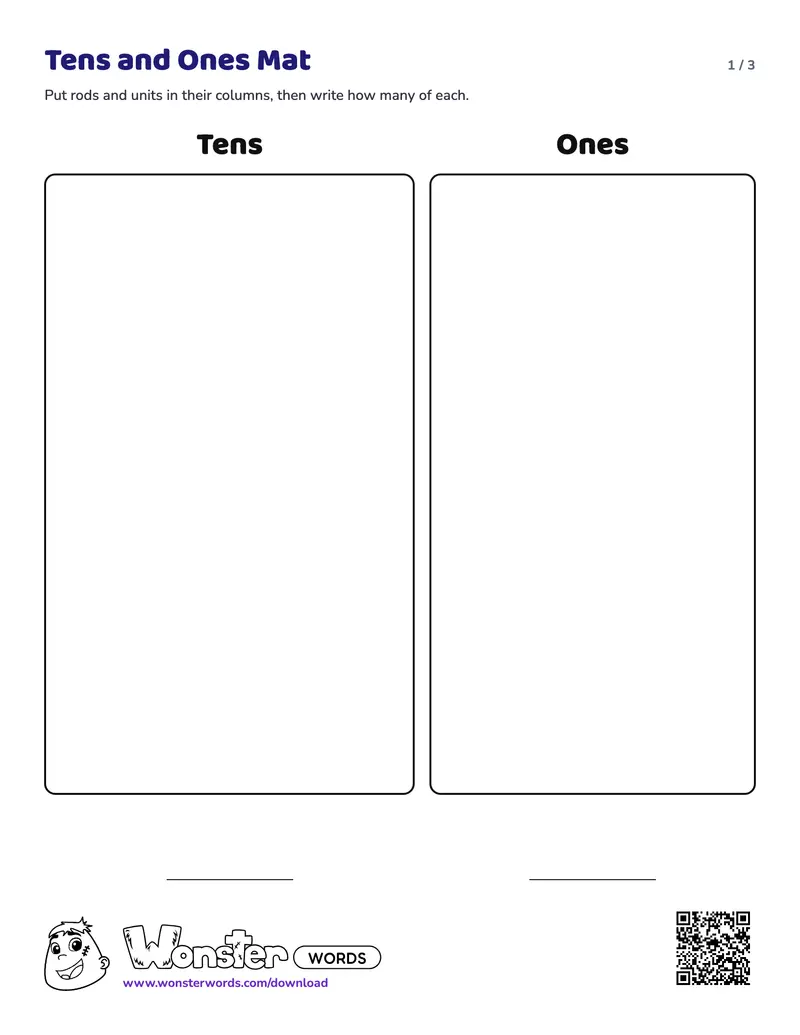
- Base Ten Mat (PDF)2 mats · 3 pages
Preview page 1Preview
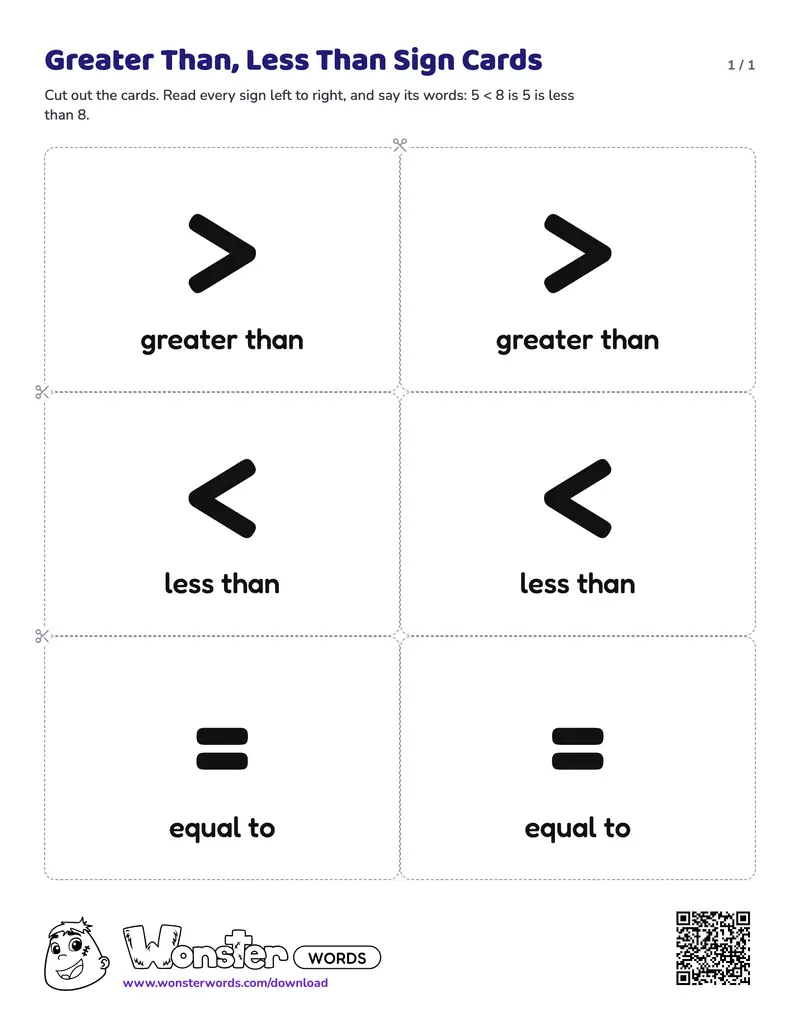
- Greater Than, Less Than Sign Cards (PDF)6 cards · 2 pages
Preview page 1Preview
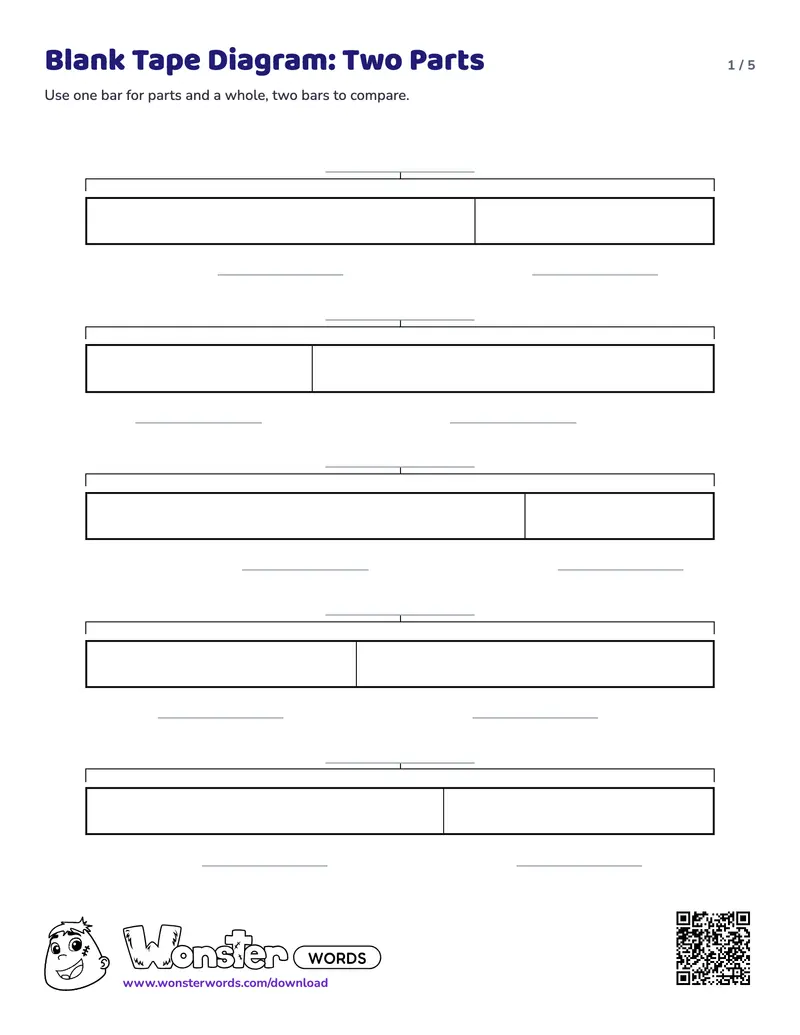
- Blank Tape Diagram (PDF)19 tape diagrams · 5 pages
Preview page 1Preview
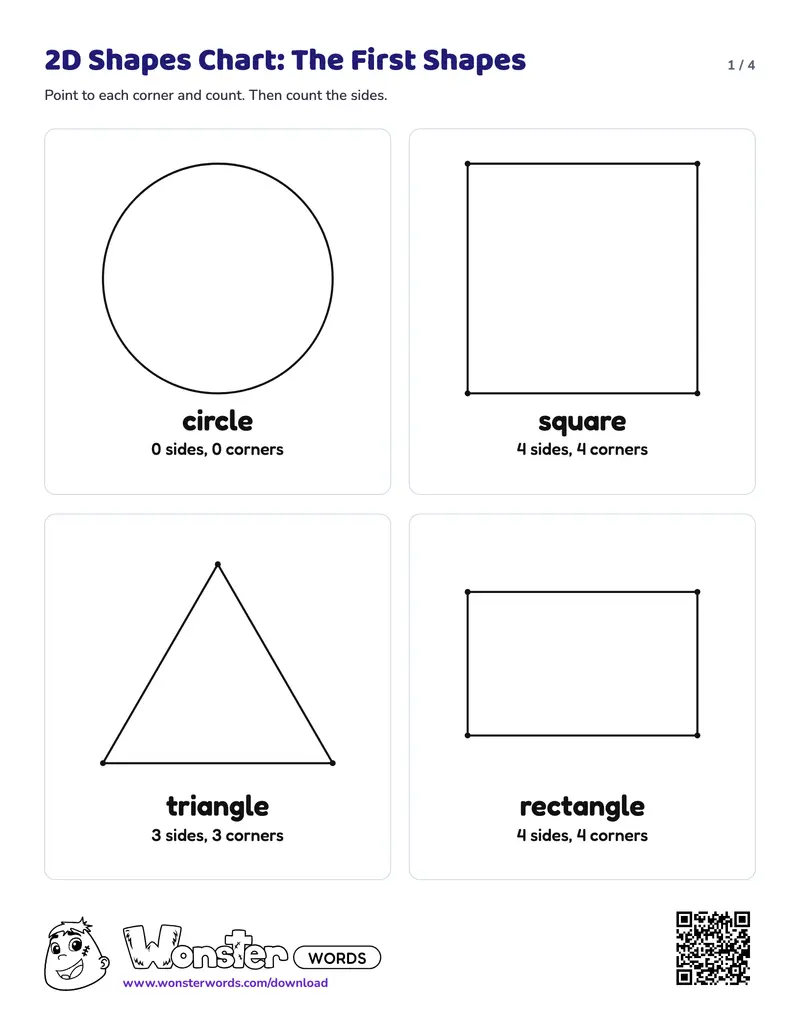
- 2D Shapes Chart (PDF)19 shapes · 4 pages
Preview page 1Preview
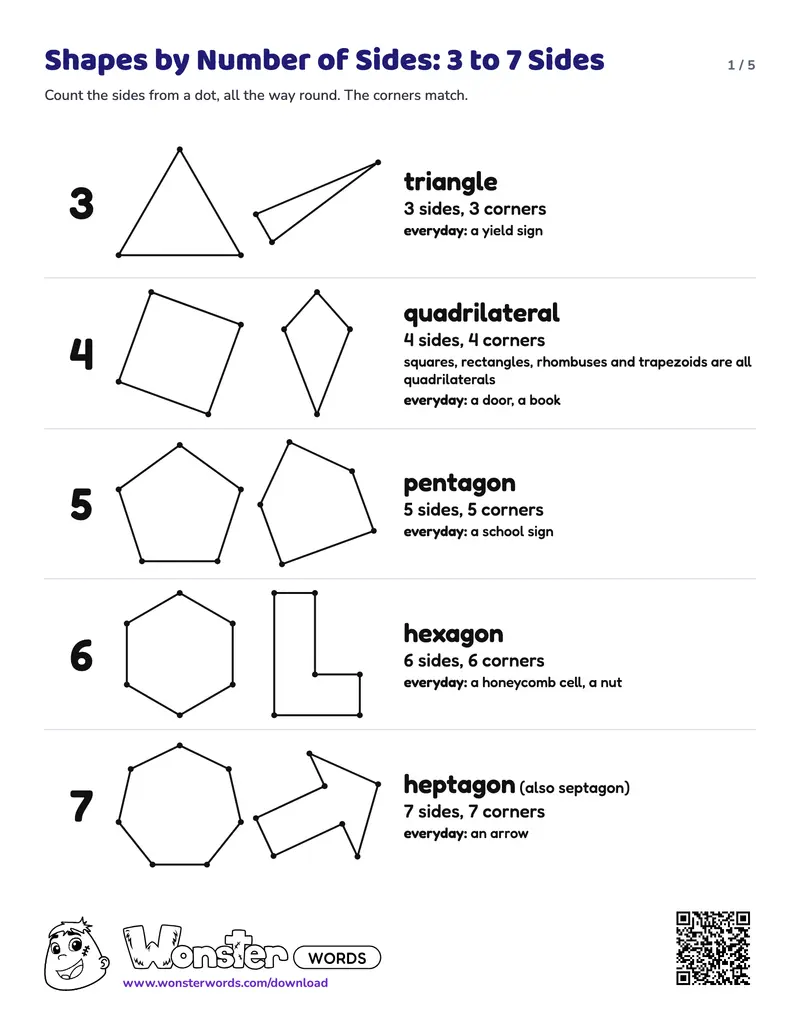
- Shapes by Number of Sides (PDF)34 shapes · 5 pages
Preview page 1Preview
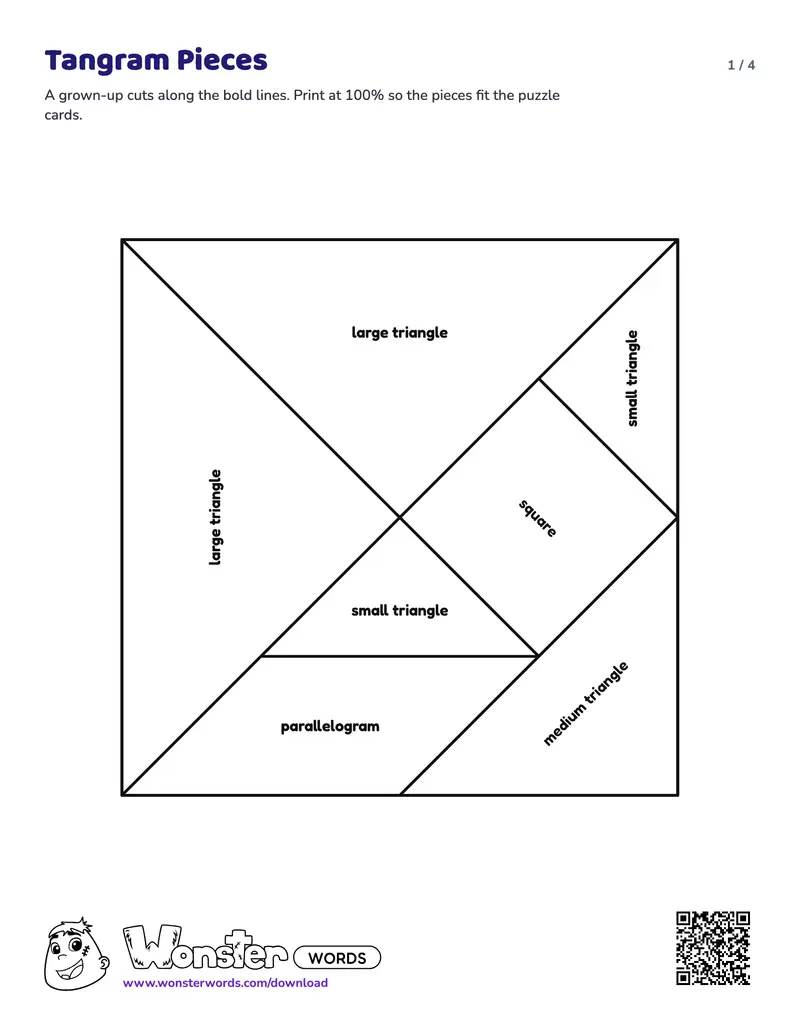
- Tangram Pieces (PDF)14 pieces · 4 pages
Preview page 1Preview
7. Telling time and counting coins
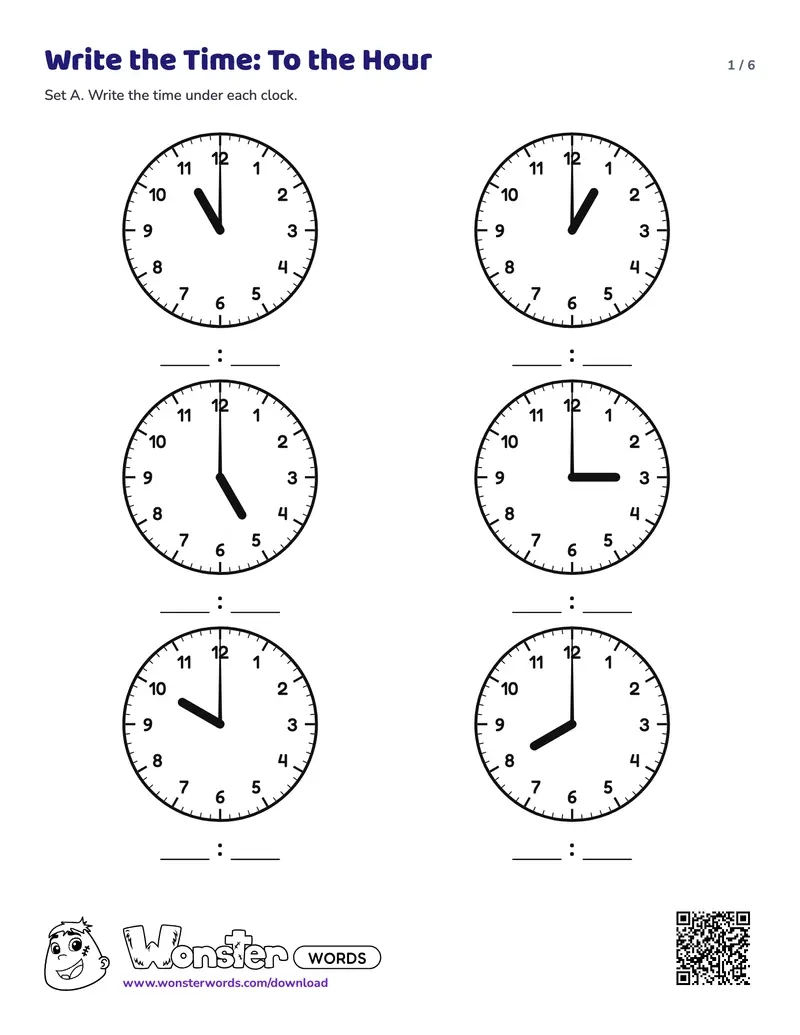
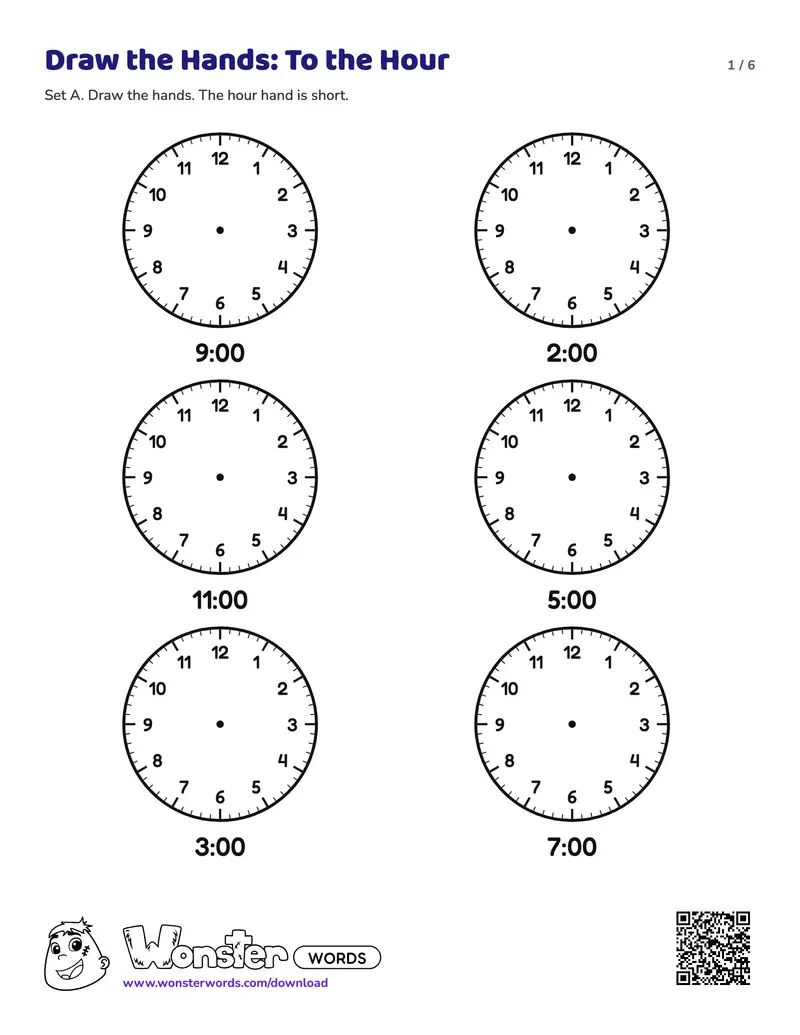
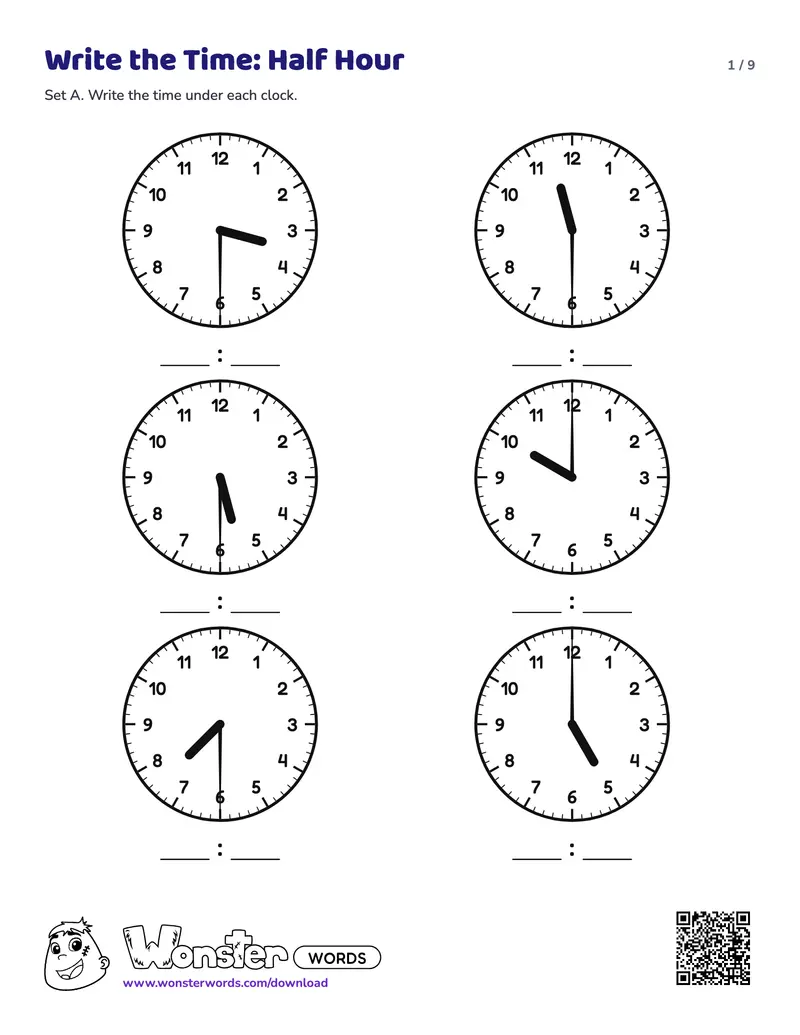
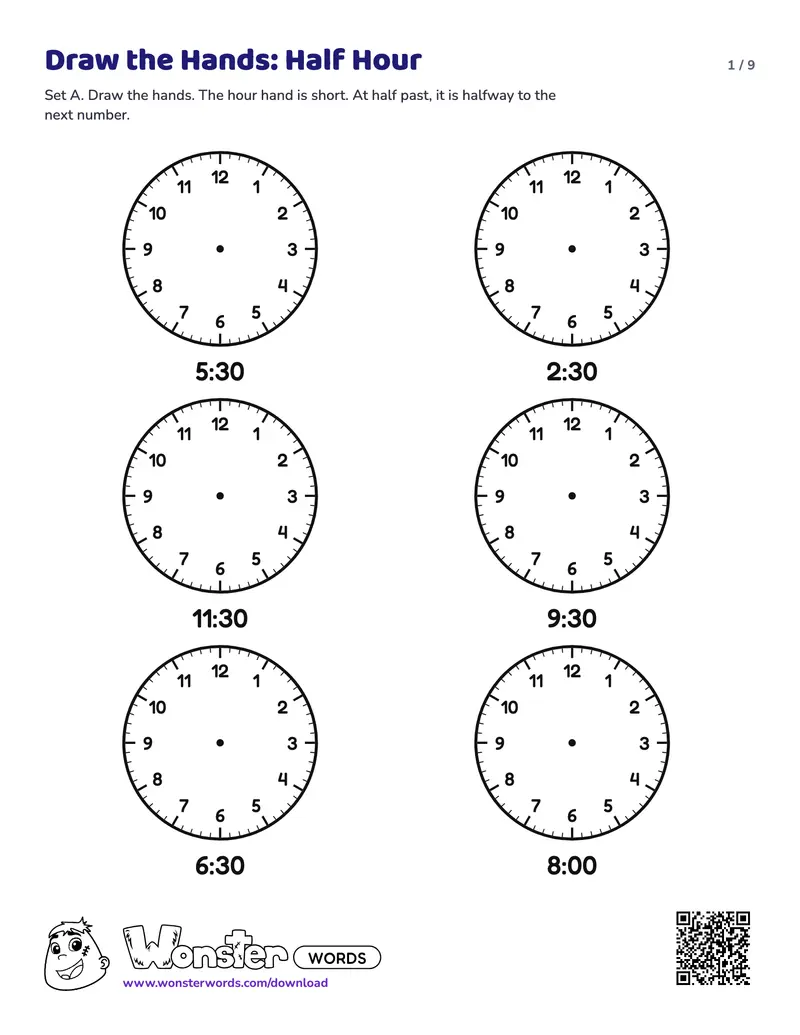
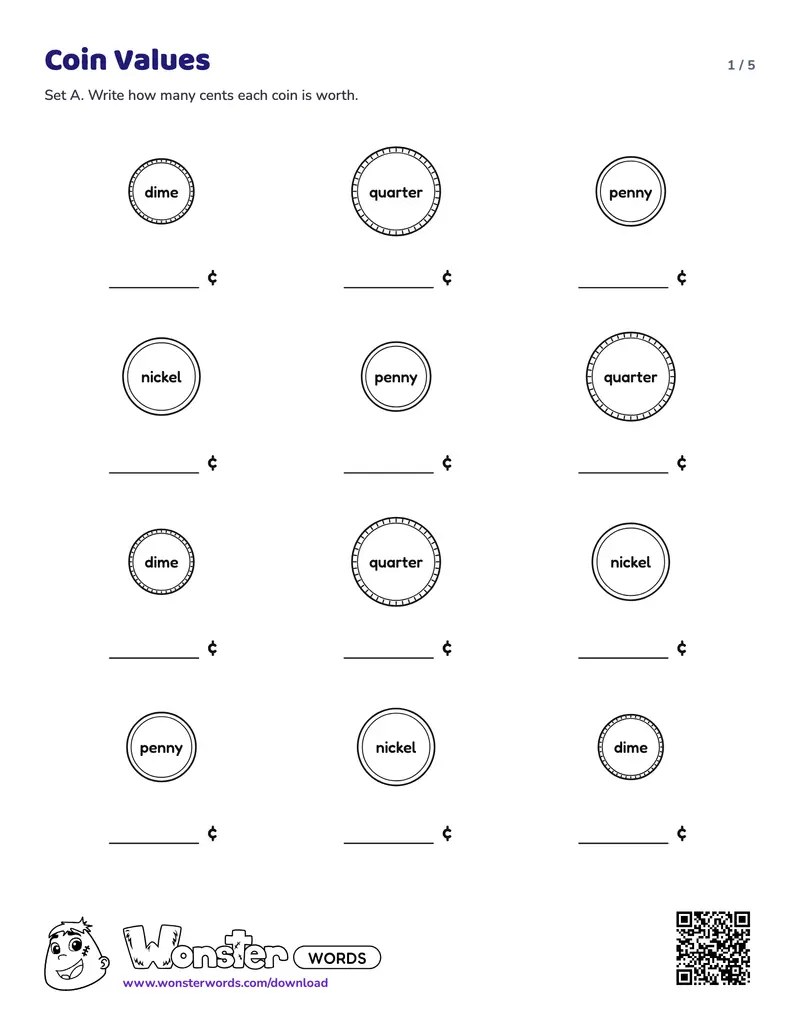
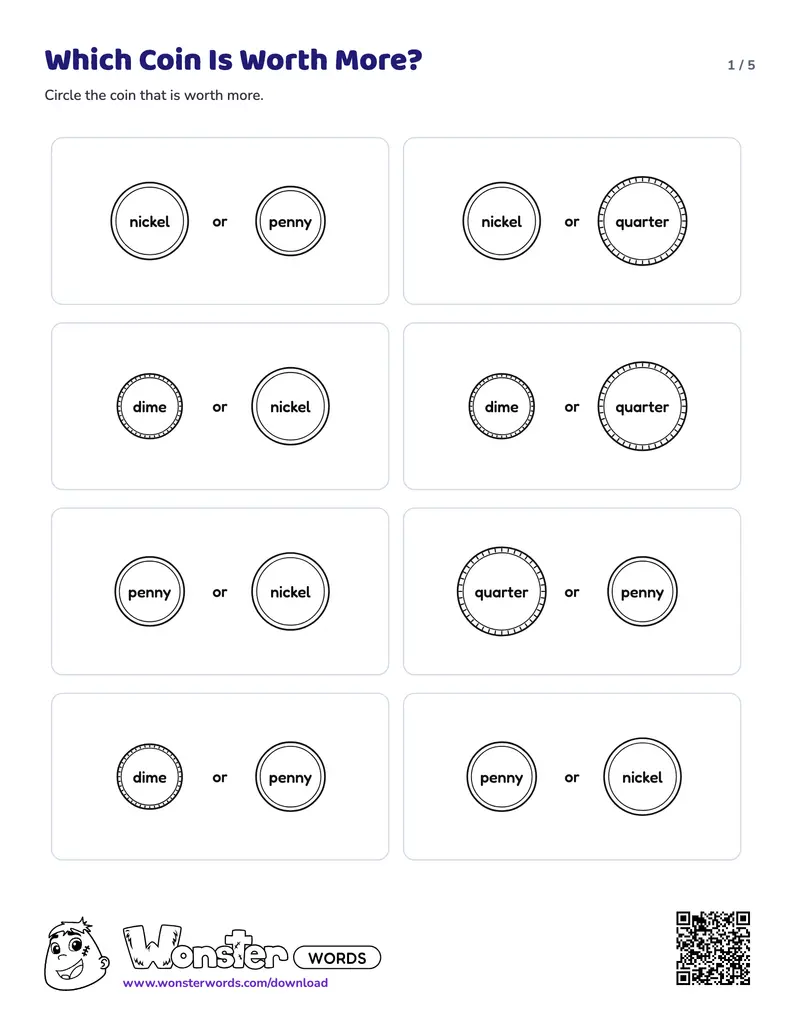
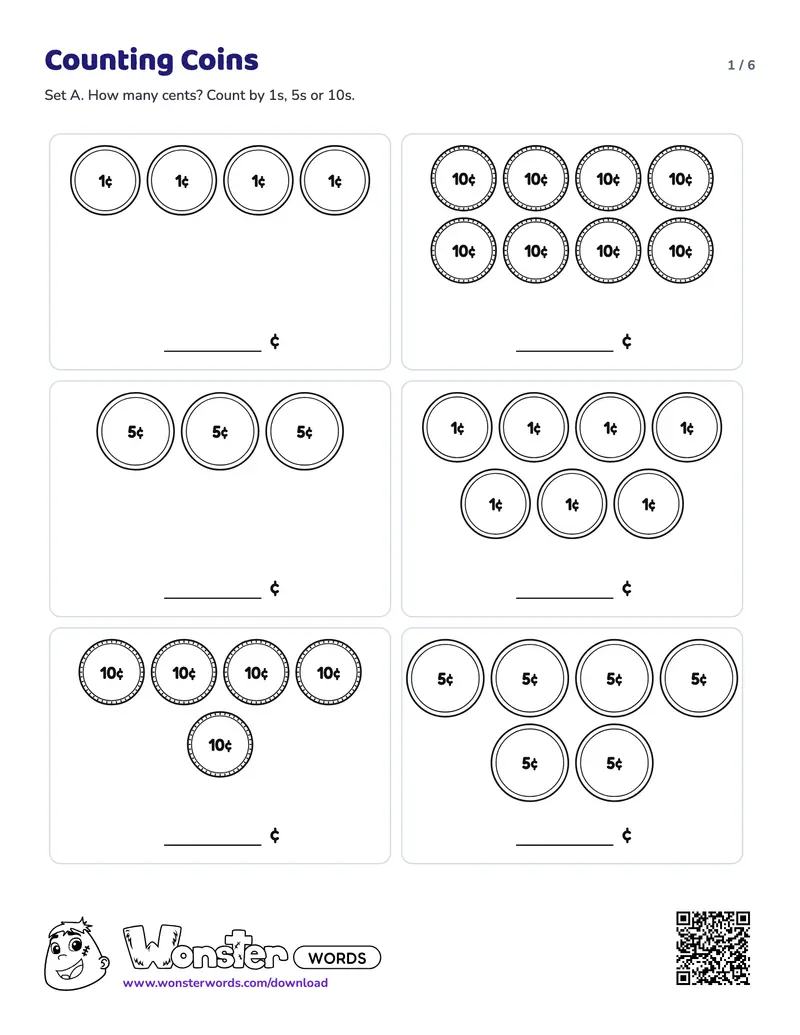
First graders tell and write time in hours and half hours on analog and digital clocks (1.MD.B.3), and Texas first graders also name coins by value and count collections of them (1.4). The clock sheets come from the telling time worksheets page: writing the time and drawing the hands to the hour first, then to the half hour. The coin sheets come from the money worksheets page: Coin Values, Which Coin Is Worth More?, and Counting Coins, whose collections are pennies, nickels, and dimes (1.4(C)). The Common Core leaves coins to second grade, so the coin sheets are for Texas and for a first grader who is curious about the coin jar.
Free PDF · no sign-up
Feedback?Telling time and counting coins
Seven free PDFs in black and white: four clock sheets, to the hour and then the half hour, and three coin sheets. Each ends with an answer key.
- Write the Time: To the Hour (PDF)24 clocks · answer key included · 6 pages
Preview page 1Preview
- Draw the Hands: To the Hour (PDF)24 clocks · answer key included · 6 pages
Preview page 1Preview
- Write the Time: Half Hour (PDF)36 clocks · answer key included · 9 pages
Preview page 1Preview
- Draw the Hands: Half Hour (PDF)36 clocks · answer key included · 9 pages
Preview page 1Preview
- Coin Values (PDF)36 coins · answer key included · 5 pages
Preview page 1Preview
- Which Coin Is Worth More? (PDF)24 pairs · answer key included · 5 pages
Preview page 1Preview
- Counting Coins (PDF)24 collections · answer key included · 6 pages
Preview page 1Preview
A child still on dot cards, ten frames, and number tracing is doing kindergarten review, and those sheets have their own pages. Two games to print sit on their own pages: the number path game to 100 and the roll and shade game for equal shares. The next step is second grade math.
Is my child on track in 1st grade math?
Most first graders reach the year’s skills by the end of the year, not the start. A first grader who still counts on for 8 + 5 in the fall is on time: the math facts page explains that learning the facts takes three school years.
A quick check of where to start. Not a screening or diagnostic tool. Ask these nine things in order, with paper and a pencil, and note whether each one is easy, takes some help, or is not yet there.
- “What is 8 + 5?” and “How did you get it?” Easily means counting on from 8 or making ten (8 + 2 + 3), not counting all 13 from 1 (1.OA.C.6). Tray 1; see doubles and make ten.
- “What is 9 − 4?” Easily means an answer without counting every one, by thinking 4 + 5 = 9 or counting back (1.OA.C.6). Tray 1; see fact families.
- “Is 7 = 8 − 1 true or false?” Easily means “true”, because both sides are 7: the equal sign means “the same as” (1.OA.D.7). See the activities at home.
- “Mia had 5 stickers, got some more, and now has 12. How many did she get?” Easily means 7, by counting on, a drawing, or a bar (1.OA.A.1). Tray 2; see tape diagrams.
- “Count aloud from 97 to 112,” then “Write 108.” Easily means no stall at 100 and 108 written as 108, not 1008 (1.NBT.A.1). Tray 3; see counting to 100.
- “What does the 4 in 46 mean? Which is more, 46 or 64?” Easily means “4 tens” and 64 (1.NBT.B.2 and 1.NBT.B.3). Tray 3; see place value.
- “What is 34 + 20? What is 50 − 30?” Easily means 54 and 20, by moving whole tens (1.NBT.C.4 and 1.NBT.C.6). Tray 4; see mental math.
- Show a clock at 3:30: “What time is it?” Easily means “half past 3” or “3:30” (1.MD.B.3). Tray 7, and the kitchen clock activity.
- Fold a paper square into four equal parts: “What is one part called?” Easily means “a fourth” or “a quarter” (1.G.A.3). See equal parts.
Start with the first item that was not easy. It names the tray and the page to use next. If every item was easy, your child has the year’s main skills; second grade’s place value to 1,000 and the facts from memory come next. If you have questions about how your child is doing, the teacher is the person to ask.
For counting and comparing, use the number sense check-in. Its first grade row asks items 5 to 9, from comparing two groups to ten more than a number, and this check repeats none of them.
When several items are still hard late in the year, talk to the teacher. Writing 13 as 31, or a 7 that faces backwards, is common at this age, and the number tracing page explains why. The struggling with math page lists what to ask the teacher.
A first grader who finds the whole year easy can go further without skipping a grade. Some programs reach numbers to 999 in first grade, as the place value guide’s going-further section describes.
1st grade math activities and games at home
First grade math practice at home works best with real things: a deck of cards, two dice, the kitchen clock, and snacks. Each activity below practices a row of the table.
- Make ten with cards (facts within 20). Take the face cards out of a deck and find pairs that make 10, the strategy Common Core names in 1.OA.C.6. More card games are on the math facts page and the doubles and make ten page.
- Dice and a ten frame race (facts within 20). Roll two dice, fill a ten frame with the total, and say how many more make 10.
- Story problems at dinner (word problems). “I had some grapes, ate 3, and have 5 left. How many did I have?” Move the unknown to a new place each time.
- True or false? (the equal sign). In the car, ask “Is 4 + 3 = 7 + 0 true?” and “Is 5 = 2 + 2 true?”
- The 100 path race (counting to 120). Play the number path game 1-100, counting on from the square you are on.
- Measure, read the clock, and sort coins (length, time, and coins). Measure a shoe with paper clips laid end to end, “with no gaps or overlaps”, as 1.MD.A.2 puts it. Read the kitchen clock on the hour and half hour (1.MD.B.3). In Texas, sort the coin jar by value (1.4).
- Halves and fourths of snacks, and a weather tally (equal parts and data). Cut a sandwich into halves, then fourths, and check the parts match. Tally the week’s weather in three groups, sunny, cloudy, and rainy, and say which has most (1.MD.C.4).
Worksheets or games? Both. A game is practice out loud, where you hear every number your child says, and a worksheet leaves a record you can look back at next week. More math games by grade sit beside the milestones for every age.
How often should my child practice 1st grade math at home?
A few minutes of first grade math on most days, on the one skill your child is on, is a routine that works. These five steps fit a short daily session with any practice sheet on this page.
Pick one skill, the first one not yet easy
Use the quick check on this page to find the first skill that is not yet easy, and print one sheet from the tray for it.
Do the first row together, out loud
Work the first row side by side and ask "How did you get that?" after each answer. Counting every one, counting on, and using a fact your child already knows are different routes to the same answer.
Let tools stay on the table
Fingers, a ten frame, base ten blocks, or a number line are allowed on every page. The aim is fewer tools over the weeks, not none tonight.
Check it together with the answer key
Check each answer against the key while the problems are fresh, and let your child fix the ones that are wrong. The same wrong answer twice is a pattern worth a conversation.
Stop while it is going well, and move on when your child is accurate and calm
Go to the next sheet when your child gets nearly every answer right without counting each one from 1, not when the page is finished. Timing comes last: only once your child is accurate, and only against their own last time.
For step 2, the addition and subtraction worksheets page explains the three routes children take to the same answer. For step 3, fingers are a normal tool in first grade. For step 5, the panel behind the What Works Clearinghouse guide Assisting Students Struggling with Mathematics (2021) “does not recommend merely giving students timed worksheets” (p. 51). Timing comes only after accuracy.
No research sets a number of minutes. A few minutes on most days, stopping while it is going well, is enough for one sheet.
For homework, ask how the class does it before showing another way. First grade homework often uses drawings, number bonds, and number lines that look new to a parent, and new math homework explains each one. Let your child explain the method first. If homework often takes much longer than the teacher expects, tell the teacher.
Frequently asked questions
What topics do 1st graders learn in math?
First graders learn to add and subtract within 20 using strategies such as counting on, doubles, and making ten; to solve word problems; to count, read, and write to 120; to see two-digit numbers as tens and ones and compare them; to add within 100; to measure length and tell time to the hour and half hour; to sort data into groups; and to name shapes and split them into halves and fourths.
How important is math fluency in 1st grade?
In the Common Core, fluency within 10 is first grade's one fluency standard: by the end of the year, a first grader adds and subtracts within 10 accurately and without counting every one. Fluency does not mean speed. Texas sets no first grade fluency target and asks for the strategies instead, including making 10. Knowing every sum within 20 from memory is second grade's goal in both.
Are word problems included in 1st grade math curriculum?
Yes. First graders solve word problems within 20 of every basic type: adding to, taking from, putting together, taking apart, and comparing, with the unknown number in any place. They also solve word problems that add three numbers. Pictures, objects, and drawings are expected tools.
How does the 1st grade math curriculum compare to 2nd grade?
First grade works with tens and ones to 120, and second grade with hundreds, tens, and ones to 1,000. First graders add and subtract within 20 with strategies and are fluent within 10; second graders know every sum of two one-digit numbers from memory and add and subtract within 100 fluently. Second grade also adds time to 5 minutes, money problems, and arrays.
What math skills should children have before moving to first grade?
By the end of kindergarten, most children count to 100 by ones and tens, read and write numbers to 20, count out a group of up to 20 objects, compare two groups, add and take away within 10 with objects or fingers, and add and subtract within 5 fluently. They also name flat and solid shapes.
Which math standards (like Common Core) apply to 1st grade?
Most states use the Common Core State Standards or standards built on them, and Texas uses its own, the TEKS. The two agree on most of first grade. Texas adds counting backward from 120, skip counting by 2s, 5s, and 10s, expanded form, and coins in first grade, which the Common Core leaves to second grade or does not ask for, and sets no first grade fluency target.
Are there free downloadable 1st grade math worksheet bundles?
These first grade math worksheets come as one free PDF per skill rather than one bundle, so you print only the sheet for the skill your child is on. Each practice sheet has its answer key at the back, and every PDF prints in black and white with no account.
Can 1st graders use free math worksheets independently?
Yes, once the first row is done together. Work the first row side by side and ask how your child got each answer, then let your child finish the page alone and check it together with the answer key while it is fresh.
Related guides
Standards this page teaches: Common Core: 1.OA.A.1, 1.OA.A.2, 1.OA.B.3, 1.OA.B.4, 1.OA.C.5, 1.OA.C.6, 1.OA.D.7, 1.OA.D.8, 1.NBT.A.1, 1.NBT.B.2, 1.NBT.B.3, 1.NBT.C.4, 1.NBT.C.5, 1.NBT.C.6, 1.MD.A.1, 1.MD.A.2, 1.MD.B.3, 1.MD.C.4, 1.G.A.1, 1.G.A.2, 1.G.A.3 · Texas: 1.2(B), 1.2(C), 1.2(D), 1.2(E), 1.2(F), 1.2(G), 1.3(A), 1.3(B), 1.3(C), 1.3(D), 1.3(E), 1.3(F), 1.4(A), 1.4(B), 1.4(C), 1.5(A), 1.5(B), 1.5(C), 1.5(D), 1.5(E), 1.5(F), 1.6(A), 1.6(B), 1.6(C), 1.6(D), 1.6(E), 1.6(F), 1.6(G), 1.6(H), 1.7(A), 1.7(B), 1.7(C), 1.7(D), 1.7(E), 1.8(A), 1.8(B), 1.8(C)
Last updated
Looking for something else?
Looking for something else?