
Math
Free Telling Time Worksheets
Clock worksheets by level, from the hour to the minute, for reading the clock and for drawing the hands, with answer keys, plus a.m. or p.m., blank clock faces, and a paper clock to cut out.
Grades: grade 1 to grade 3
These free printable telling time worksheets are clock worksheets for first to third grade, sorted by level from the hour to the minute. Every practice sheet has an answer key, and every sheet is designed to print in black and white, with no account and no email. The levels:
- The hour and half hour: first grade.
- 5 minutes: second grade, with a.m. and p.m.
- The minute: third grade, and second grade in Texas.
- Blank clock faces and a paper clock: for any level.
Every level has two clock worksheets: Write the Time, where your child reads a clock, and Draw the Hands, where your child shows a time on one. Reading comes first, so print the Write the Time sheet before the Draw the Hands sheet.
To choose, go through six small clock tasks with your child, starting at the top, and stop at the first one your child cannot do yet. That row names the sheet to print.
Telling time worksheets by grade level
Telling time worksheets match a grade by how finely the standards ask a child to read the minute hand. Children read the hour and half hour in first grade, the nearest 5 minutes in second grade, and the nearest minute in third grade, under the Common Core and under the Texas standards (TEKS).
| Grade (usual age) | Level | Common Core | Texas (TEKS) | |
|---|---|---|---|---|
| Preschool and kindergarten (usually 3–6) | No clock yet: the words for the day | None | None; Texas PreK asks for words about time in a day (PK4.V.D.4) | Nothing yet: talk about morning, afternoon, and night |
| 1st grade (usually 6–7) | The hour and half hour | 1.MD.B.3 | 1.7(E) | The hour and half hour sheets |
| 2nd grade (usually 7–8) | To 5 minutes; a.m. and p.m. | 2.MD.C.7 | 2.9(G): to the minute, and a.m. and p.m. | The 5 minutes sheets and a.m. or p.m.?; Texas adds the minute sheets |
| 3rd grade (usually 8–9) | To the minute | 3.MD.A.1, with time intervals | Second grade’s 2.9(G); third grade’s 3.7(C) is time intervals | The minute sheets |
Texas asks for the minute a year before the Common Core. Texas standard 2.9(G) asks second graders to read time “to the nearest one-minute increment”, and the Common Core puts “to the nearest minute” in third grade (3.MD.A.1). Both frameworks put a.m. and p.m. in second grade.
The standards name grades, not ages, so the ages in the table are the usual US ones. What your child can read on a clock decides the sheet, and age does not. A third grader who is still learning half past is on the right sheet with the half hour sheets.
How to choose the right telling time worksheet
To choose a telling time worksheet, ask your child to do each task in this table with a clock, starting at the top, and stop at the first one your child cannot do yet. That row names what to print. It takes a few minutes and a clock with hands, such as a kitchen clock or the paper clock on the Make a Clock sheet. Print one sheet, not a whole level.
| Ask your child to | If not yet, print |
|---|---|
| Point to the hour hand and the minute hand | Make a Clock, then Write the Time: To the Hour |
| Read 4:00 on a clock with hands | Write the Time: To the Hour, then Draw the Hands: To the Hour |
| Read 7:30 without calling it 8:30 | Write the Time: Half Hour, then Draw the Hands: Half Hour |
| Read 2:45 | Write the Time: Five Minutes, then Draw the Hands: Five Minutes |
| Say whether breakfast is at 7:00 a.m. or 7:00 p.m. | a.m. or p.m.? |
| Read 9:17 | Write the Time: To the Minute, then Draw the Hands: To the Minute |
A child who can do every row reads a clock to the nearest minute, which is all the clock reading third grade asks for. Elapsed time, how many minutes pass between two times, comes next. A Texas second grader goes on to the last row in second grade. A child stuck on several rows needs the step taught again, on a real clock, before another sheet.
Telling time to the hour and half hour worksheets
Telling time to the hour and half hour is first-grade work, on clocks with hands and on digital clocks (Common Core 1.MD.B.3, TEKS 1.7(E)). On the hour, the long hand points straight up at the 12. At half past, the long hand points down at the 6, the short hand sits halfway between two numbers, and the hour is the number the short hand has passed: halfway between 3 and 4 is 3:30.
The four sheets, in teaching order:
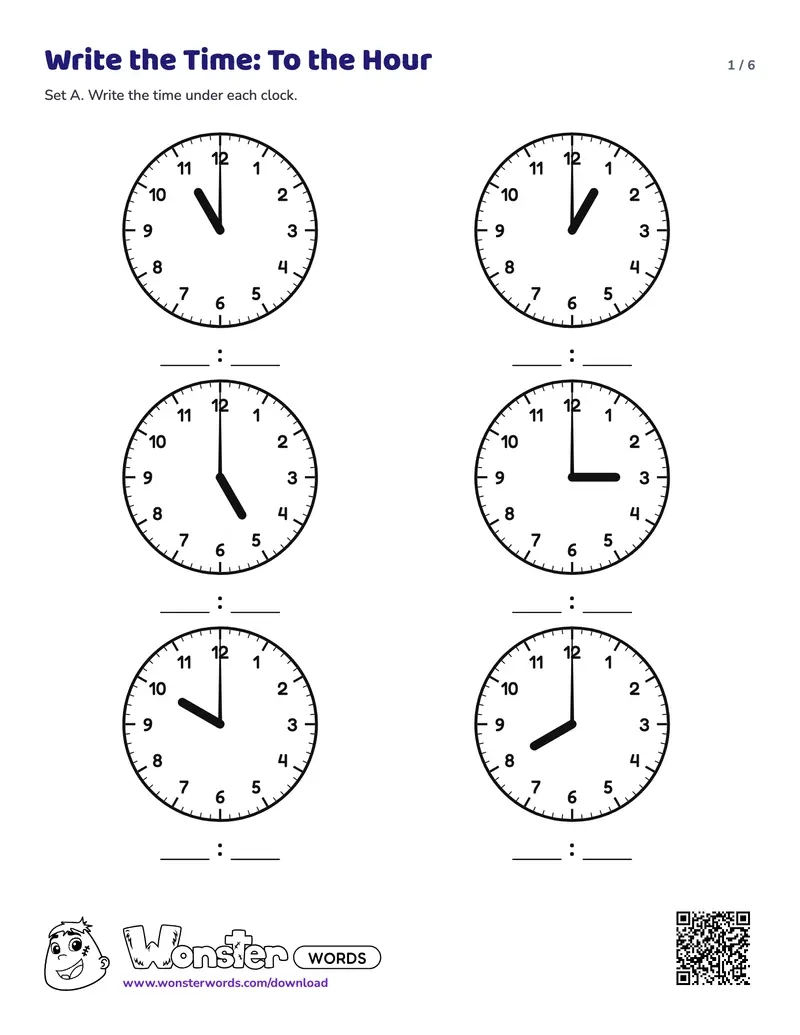
- Write the Time: To the Hour. Six clocks a page with the hands set, and your child writes the time under each, such as 4:00. All 12 hours, twice, in two mixed orders.
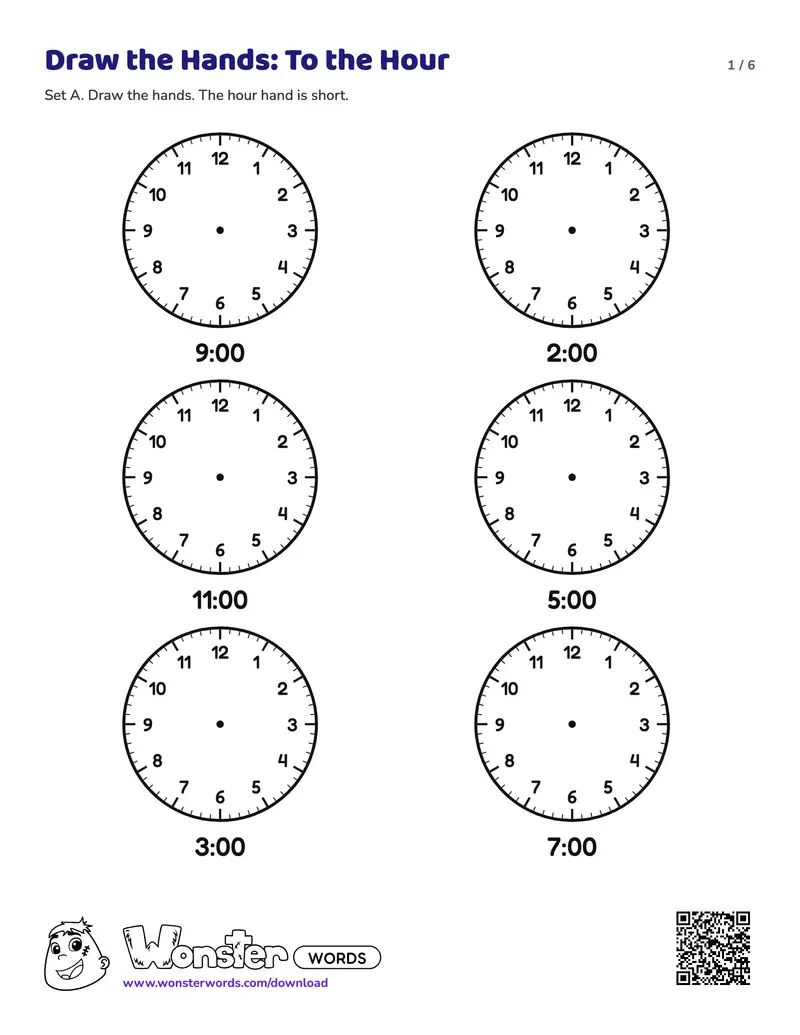
- Draw the Hands: To the Hour. A time under each empty clock, and your child draws the short hour hand and the long minute hand.
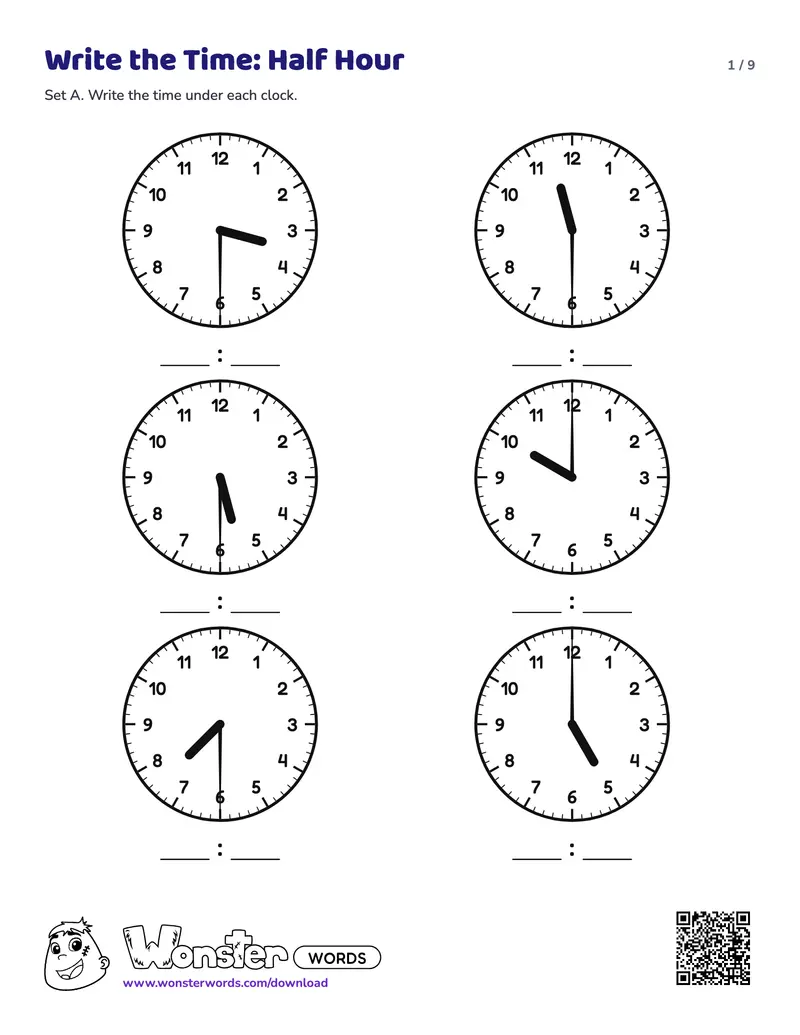
- Write the Time: Half Hour. All 12 half hours and 6 o’clock times, so your child has to look at the long hand every time.
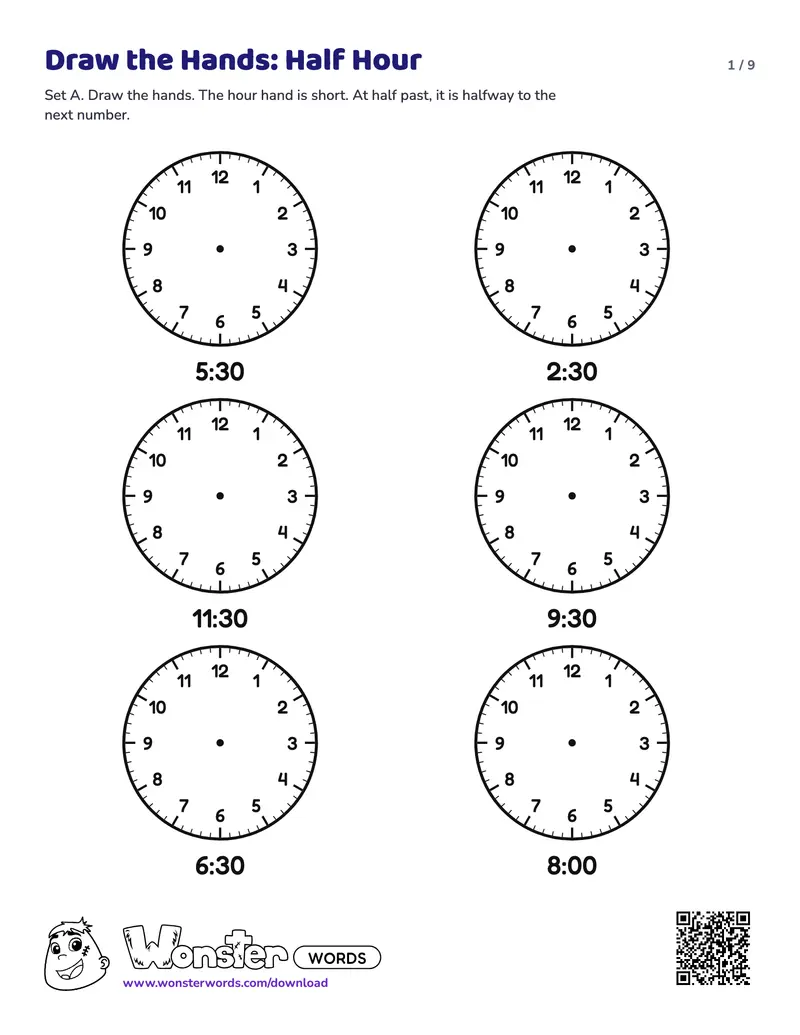
- Draw the Hands: Half Hour. The same 18 times to draw, with the short hand halfway to the next number at half past.
Free PDF · no sign-up
Feedback?Free printable hour and half hour worksheets
These first-grade PDFs are free and print in black and white. Each one prints its clocks twice in two orders, then the answer key, then a page for grown-ups.
- Write the Time: To the Hour (PDF)24 clocks · answer key included · 6 pages
Preview page 1Preview
- Draw the Hands: To the Hour (PDF)24 clocks · answer key included · 6 pages
Preview page 1Preview
- Write the Time: Half Hour (PDF)36 clocks · answer key included · 9 pages
Preview page 1Preview
- Draw the Hands: Half Hour (PDF)36 clocks · answer key included · 9 pages
Preview page 1Preview
Telling time to 5 minutes worksheets
Telling time to 5 minutes is second-grade work: reading and writing time “to the nearest five minutes, using a.m. and p.m.” (2.MD.C.7). Each number on the clock is 5 more minutes for the long hand, so your child counts by 5s from the 12: the long hand on the 9 is 45 minutes past.
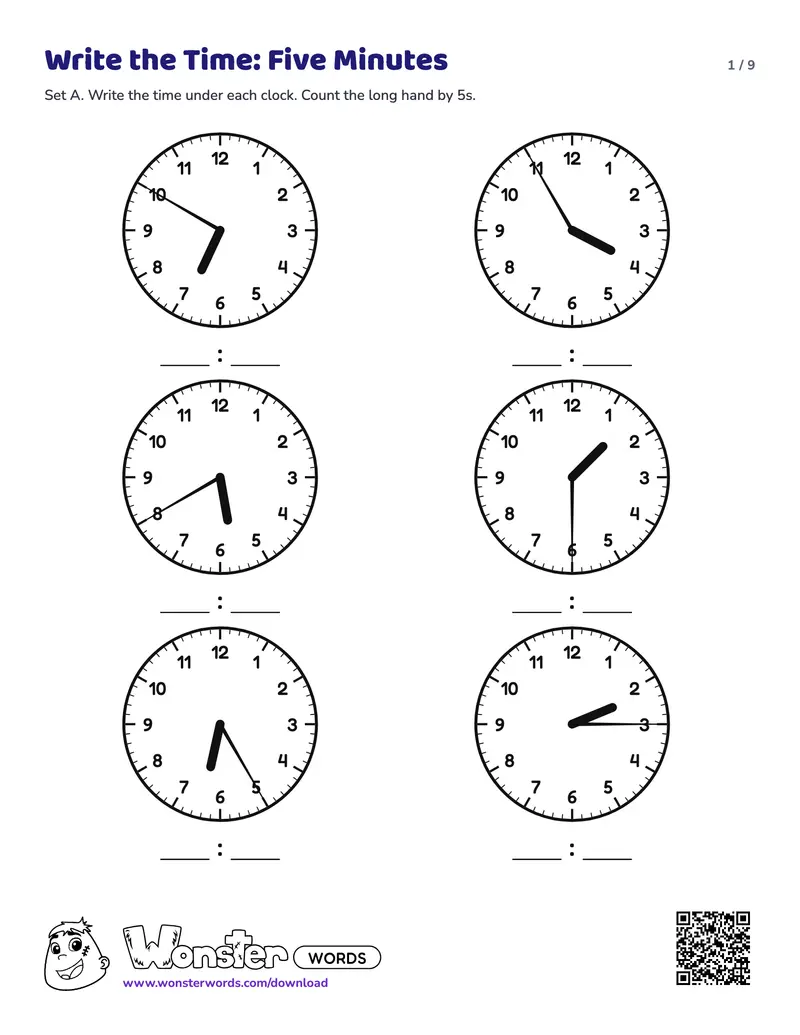
- Write the Time: Five Minutes. Six clocks a page and 18 times, with every five-minute position from :00 to :55 and every hour from 1 to 12, in an order that never runs round the clock.
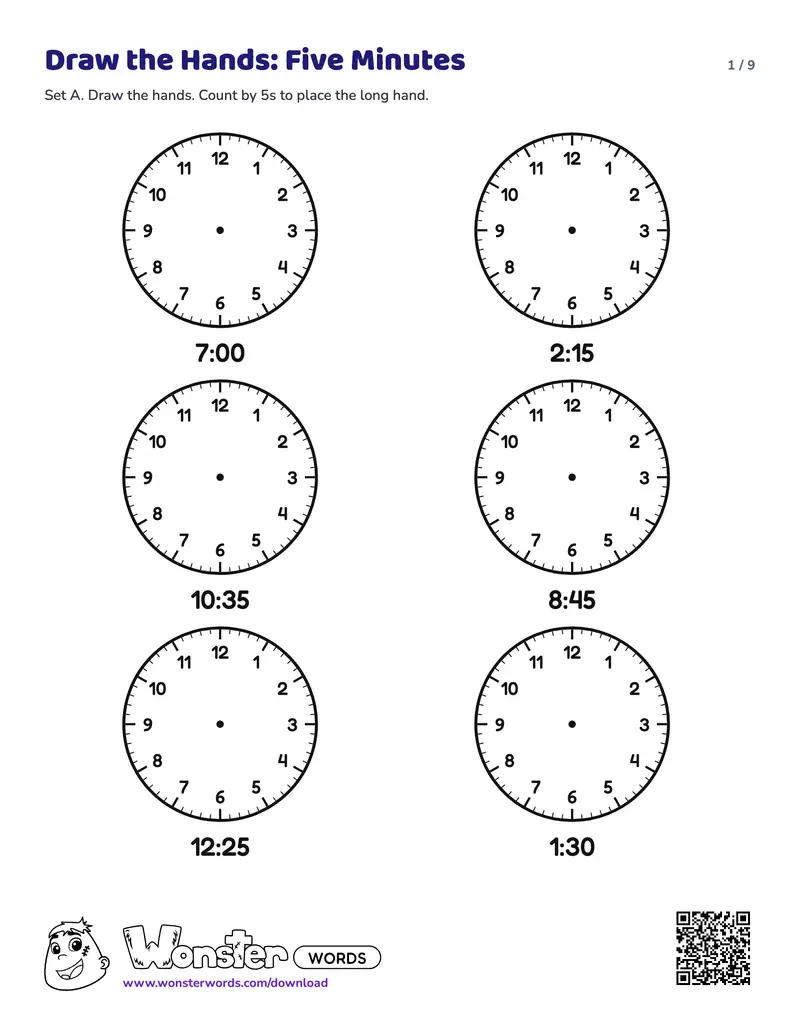
- Draw the Hands: Five Minutes. The same 18 times, and your child counts by 5s to place the long hand.
a.m. and p.m.
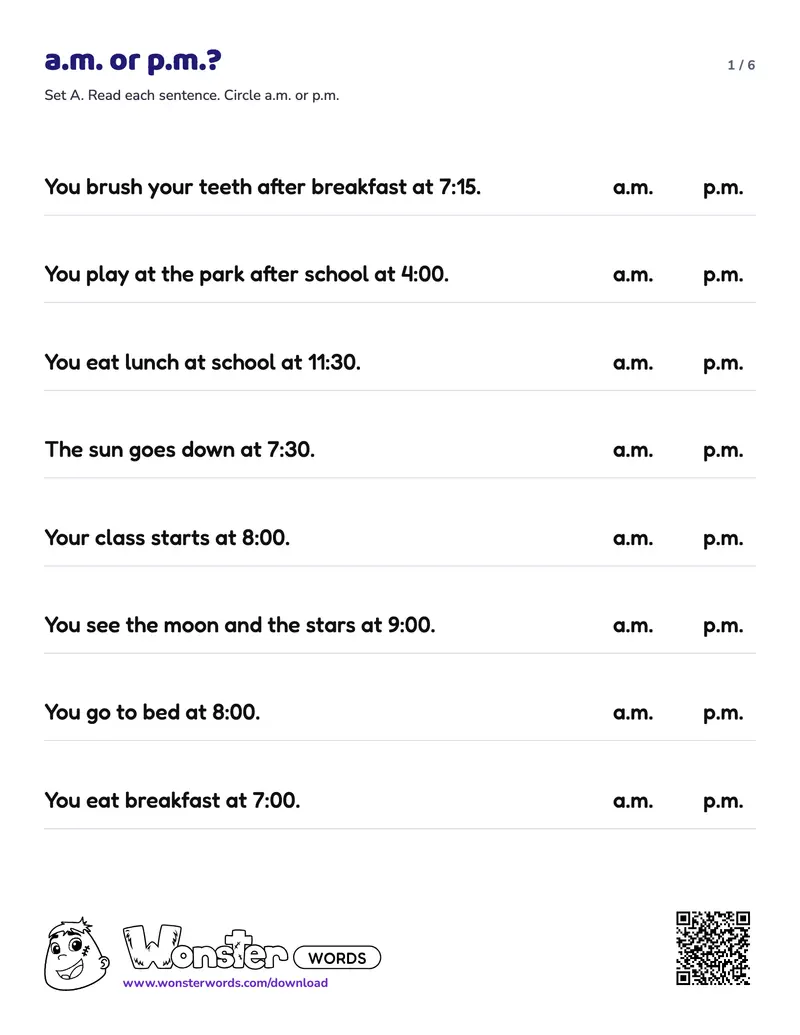
Second grade asks for a.m. and p.m. in both the Common Core and the Texas standards. The a.m. or p.m.? sheet has 16 sentences about a child’s day, such as “You eat breakfast at 7:00.”, and your child circles a.m. or p.m. Eight are a.m. and eight are p.m. No time falls in the 12 o’clock hour, which keeps noon and midnight off the sheet: NIST, the National Institute of Standards and Technology, says “12 a.m. and 12 p.m. are ambiguous and should not be used”.
Free PDF · no sign-up
Feedback?Free printable 5 minutes and a.m. or p.m. worksheets
These second-grade PDFs are free and print in black and white, and each one ends with its answer key and a page for grown-ups.
- Write the Time: Five Minutes (PDF)36 clocks · answer key included · 9 pages
Preview page 1Preview
- Draw the Hands: Five Minutes (PDF)36 clocks · answer key included · 9 pages
Preview page 1Preview
- a.m. or p.m.? (PDF)32 sentences · answer key included · 6 pages
Preview page 1Preview
Telling time to the minute worksheets
Telling time to the minute is third-grade work in the Common Core and second-grade work in Texas (3.MD.A.1, TEKS 2.9(G)). Your child counts by 5s to the last number the long hand has passed, then counts on by ones along the small marks: 20, 21, 22, 23 is 3:23 when the short hand is past the 3.
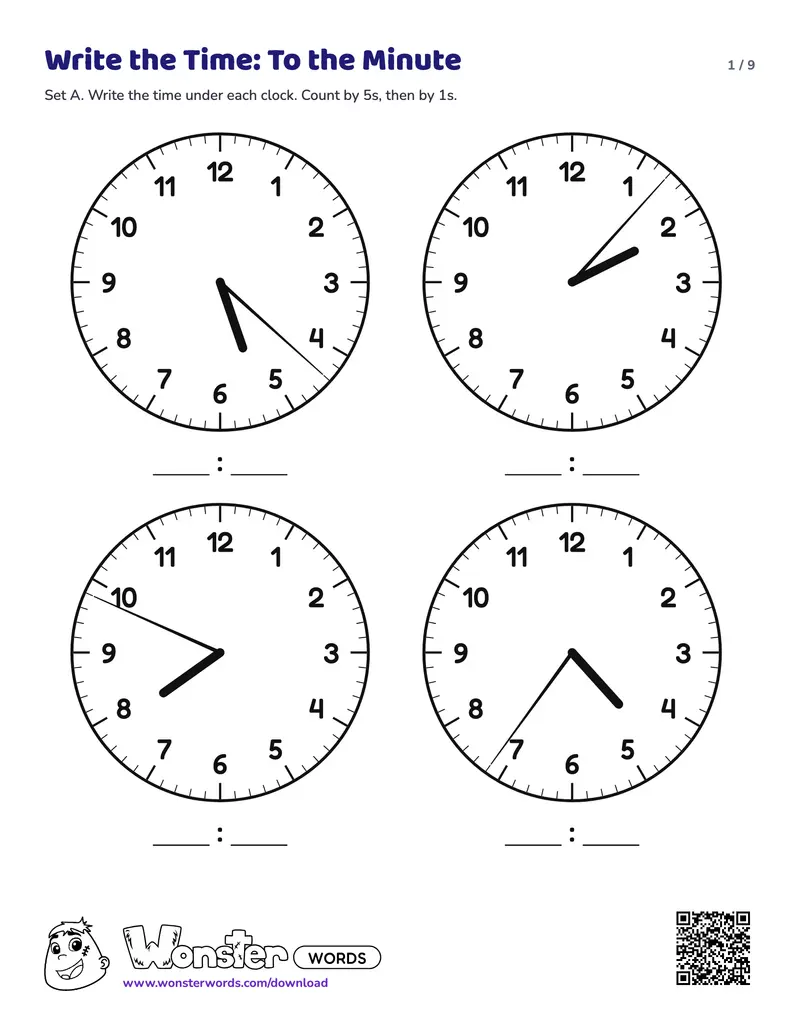
- Write the Time: To the Minute. Four larger clocks a page, so every minute mark can be counted. Of its 12 times, 9 fall between the five-minute marks.
- Draw the Hands: To the Minute. The same 12 times, and your child counts the marks to place the long hand.
The other half of 3.MD.A.1 is elapsed time, how many minutes pass between two times, which is its own step after these sheets.
Free PDF · no sign-up
Feedback?Free printable telling time to the minute worksheets
These PDFs are for third grade, and for second grade in Texas. They are free, print in black and white, and each one ends with its answer key and a page for grown-ups.
- Write the Time: To the Minute (PDF)24 clocks · answer key included · 9 pages
Preview page 1Preview
- Draw the Hands: To the Minute (PDF)24 clocks · answer key included · 9 pages
Preview page 1Preview
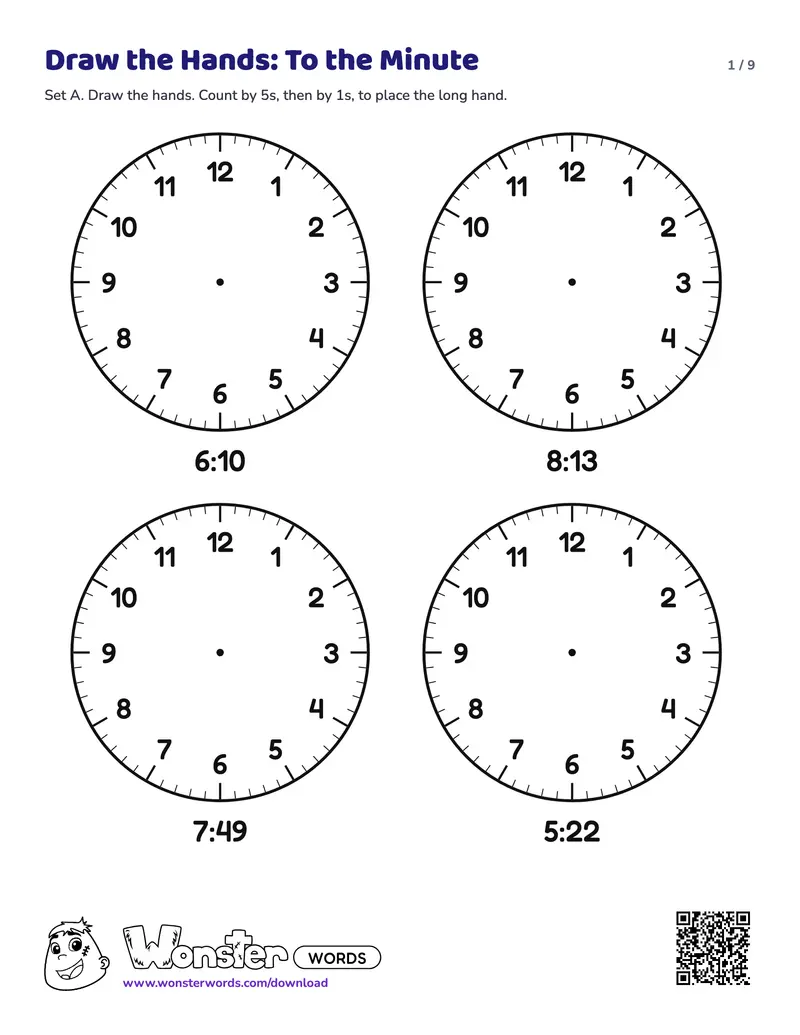
Printable clock face worksheets to practice drawing hands
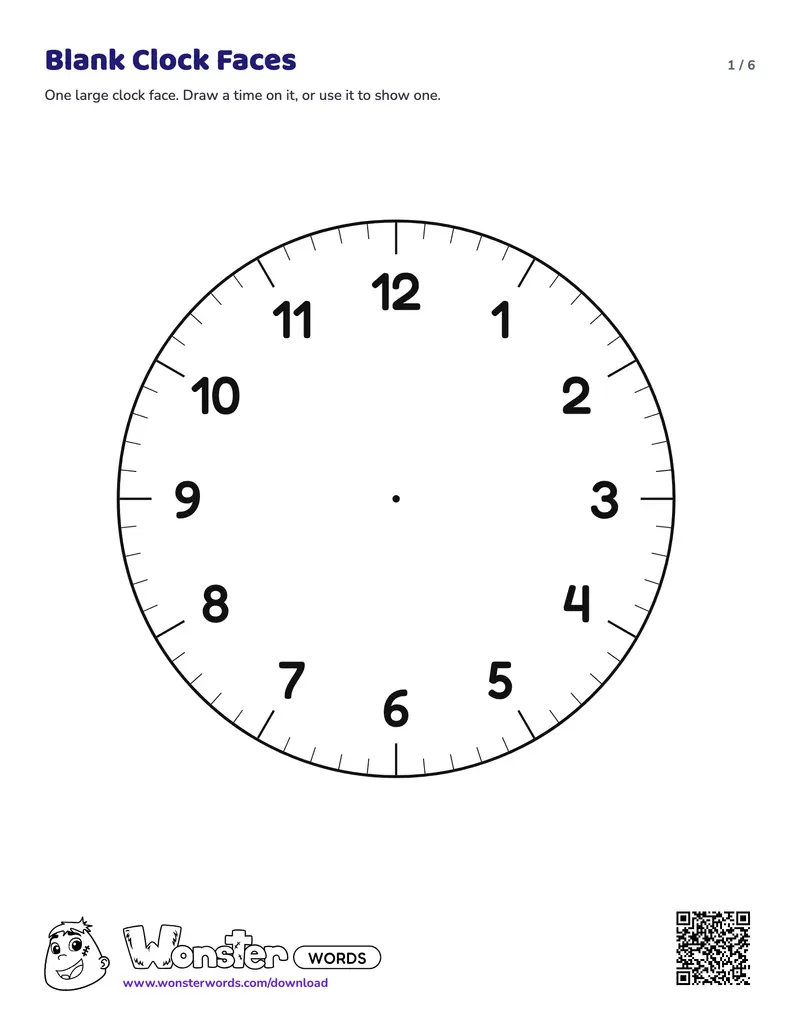
Blank clock faces let you practice any time at any level, and a paper clock lets your child set a time with their own hands.
- Blank Clock Faces. One large face, then pages of four and six faces with a line under each to write a time, six faces with the minute numbers 5 to 55 around the rim, and six faces with marks only and no numbers, a stretch for third grade. Every face has all 60 minute marks.
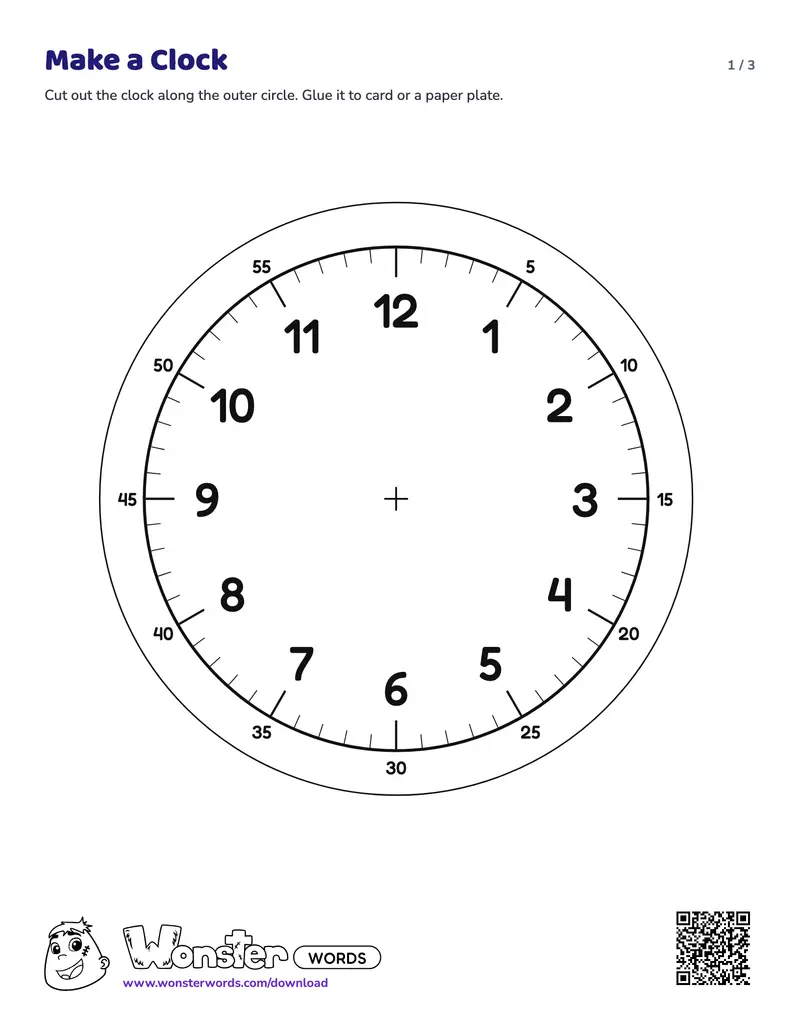
- Make a Clock. A large face with the numbers, the minute marks, and the minutes by 5s, to glue to card stock or a paper plate, and two hour hands and two minute hands to join with a paper fastener. The grown-up’s page shows how to put it together.
Write any time under a blank face for your child to draw, or set the paper clock and ask for the time. The two paper hands turn separately, so move the hour hand along as the minute hand goes round.
Free PDF · no sign-up
Feedback?Free printable blank clock faces and paper clock
Blank clock faces and the paper clock have no answer key because there is nothing to answer. Both PDFs are free, print in black and white, and end with a page for grown-ups.
- Blank Clock Faces (PDF)23 clock faces · 6 pages
Preview page 1Preview
- Make a Clock (PDF)5 pieces · 3 pages
Preview page 1Preview
How can parents effectively use telling time worksheets at home?
Parents can use telling time worksheets at home in five short steps, so a sheet practices a step a child has already been shown on a clock. The steps work on every practice sheet on this page.
Teach the step first, then hand over the sheet
A worksheet practices a step your child has already met; it does not teach a new one. Show the step on a clock together first, then print the sheet for it.
Use a real clock first
Set the paper clock or the kitchen clock to the first time on the sheet, and read it together before your child looks at the drawn clocks.
Do the first clock together, out loud
Work the first clock side by side and ask "Which hand did you look at first?" The answer shows whether your child reads the short hand for the hour.
Check it together with the answer key
Check each clock against the key while the times are fresh. Your child fixes each one that is wrong.
Move on when your child is accurate and calm
Go on when your child reads every clock right without rushing, not when a page is finished. Next comes the Draw the Hands sheet of the same level, then the next level.
Neither the Common Core nor the Texas standards set a number for how often to practice. One sheet at a sitting, a few minutes on most days, is a reasonable place to start, with real clocks read through the day in between. A worksheet adds a record you can look back at next week.
If a sheet is hard, make the task smaller. Go back one level, do the Write the Time sheet before the Draw the Hands sheet, cut a page in half so there are fewer clocks, and keep the paper clock on the table to set each time first. A child who still cannot read the hour at the end of first grade is a reason to talk to your child’s teacher. The guide to a child struggling with math lists what to ask.
The blank faces make two clock games. In set my clock, one player says a time and the other sets the paper clock. In clock pairs, a memory game, half the cards are faces with a time drawn on and half are the same times written out. Board games that practice counting are on the math board games page.
What should be included in a well-designed clock worksheet for teaching time?
A well-designed clock worksheet, from any source, passes seven checks:
- An hour hand clearly shorter and thicker than the minute hand, so the two never look alike.
- The hour hand drawn where it really sits. At 3:30 it is halfway between the 3 and the 4, not on the 3, and at 3:45 it is three quarters of the way from the 3 to the 4.
- All 60 minute marks, with the 12 hour marks longer.
- Large, upright numerals 1 to 12.
- The digital time beside the clock, printed or written by your child, because the standards ask for “analog and digital clocks” from first grade (1.MD.B.3). A Cambridge Mathematics research summary from 2020 also says moving between the two kinds of clock matters.
- Times in a mixed order, not 1:00, 2:00, 3:00 in a row, which a child can fill in without reading the clocks.
- An answer key.
To make your own clock worksheet, take four steps:
- Print the blank faces.
- Write the times your child is working on under them, in a mixed order.
- For a Write the Time sheet, draw the hands yourself, with the short hand where it really sits, and leave the line empty.
- Write the answer key before your child starts.
Frequently asked questions
What is the most effective age to introduce telling time worksheets?
First grade, usually ages 6–7, is when the Common Core and the Texas standards start telling time, with the hour and half hour on clocks with hands and on digital clocks. Neither framework asks a child to read a clock before first grade, so with a younger child, talk about the words for the day, such as morning, afternoon, and night.
Are there telling time worksheets for preschoolers?
Preschoolers do not need telling time worksheets. No Common Core or Texas standard asks a preschooler or a kindergartner to read a clock. Texas asks preschoolers to use words about the passing of time in a day, so talk about what comes before and after lunch, and save the clock worksheets for first grade.
Do these telling time worksheets have answer keys?
Every practice sheet has an answer key after its worksheet pages. Write the Time keys write each time in red on its line, and Draw the Hands keys draw both hands in red on each clock. The a.m. or p.m. sheet's key rings the right answer. Blank Clock Faces and Make a Clock have no key because there is nothing to answer. The last page of each PDF is a page for grown-ups.
Which telling time worksheets are for second grade?
Second graders read and draw times to the nearest 5 minutes and say whether a time is a.m. or p.m., in both the Common Core (2.MD.C.7) and the Texas standards (2.9(G)). That means the Write the Time: Five Minutes, Draw the Hands: Five Minutes, and a.m. or p.m.? worksheets. Texas also asks second graders for the time to the minute, so a Texas second grader goes on to the two To the Minute sheets.
Are there telling time worksheets past third grade?
Not on this page. Reading a clock ends at the nearest minute, which is third grade in the Common Core and second grade in Texas. After that, children work on elapsed time, how many minutes pass between two times, which is third-grade work in both frameworks.
How often should clock worksheets be used in a teaching plan?
Neither the Common Core nor the Texas standards set a number. One sheet at a sitting, a few minutes on most days, is a reasonable place to start, with real clocks read through the day in between. Stop while it is going well, and move up a level when your child reads every clock right.
Are there printable card games for teaching clock reading?
You can make one from Blank Clock Faces. For clock pairs, cut out 12 faces, draw a time on 6 of them, and write the same 6 times on 6 small cards. Lay them all face down and take turns turning over two to find a face and its time. Pick times from the level your child is on.
Related guides
Standards this page teaches: Common Core: 1.MD.B.3, 2.MD.C.7, 3.MD.A.1 · Texas: 1.7(E), 2.9(G)
Last updated
Looking for something else?
Looking for something else?