
Math
Third Grade Math
What third graders learn in math, the times tables milestone, the Common Core and Texas standards side by side, free worksheets sorted by skill, a quick check of where your child is, games, homework help, and what comes in fourth grade.
Grade 3
Third grade math is mostly multiplication and division, fractions written as numbers, and area, with adding and subtracting within 1,000, rounding, and shapes beside them. The one milestone is the times tables: by the end of third grade, a child knows every product of two one-digit numbers from memory, and the division facts that go with them. The grade placement on this page follows the Common Core, with Texas named wherever it differs.
Third grade is the year math moves from adding to multiplying, and from whole numbers to fractions.
- What 3rd grade math covers, skill by skill, with the Common Core and Texas standards.
- Free third grade math worksheets, sorted by skill, with answer keys.
- Is my child on track? An 8-question skill check.
- Games for home, from multiplication bingo to fraction games.
- Homework help, and how much practice is enough.
What math do kids learn in 3rd grade?
Third grade math covers multiplication and division within 100, fractions as numbers, area, rounding, adding and subtracting within 1,000, two-step word problems, time, measurement, graphs, and quadrilaterals. The table below gives the whole year by strand, in the order most schools teach it, with the Common Core code and the Texas (TEKS) code beside each skill, and a skill with a page on this site links to it. Third grade builds on second grade’s adding within 1,000 and its arrays.
| What children learn | Common Core | Texas |
|---|---|---|
| Multiplication and division | ||
| Multiplication as equal groups and arrays | 3.OA.A.1 | 3.4(D)–(E) |
| Division as sharing and as grouping; division as a missing factor | 3.OA.A.2, 3.OA.B.6 | 3.4(H), 3.4(J) |
| Word problems with equal groups, arrays, and measures; the unknown number | 3.OA.A.3–4 | 3.4(K), 3.5(D) |
| Properties: turnarounds, grouping, and breaking a fact apart | 3.OA.B.5 | None |
| Multiplication facts by family: 2, 5, 10, then 0, 1, then 3, 4, then 6, 8, then 9, then 7 | 3.OA.C.7 | 3.4(F) |
| Multiply a one-digit number by a multiple of 10 | 3.NBT.A.3 | 3.4(G); two-digit by one-digit, with the standard algorithm |
| Measurement, time, and money | ||
| Area by counting unit squares | 3.MD.C.5–6, 3.MD.C.7d | 3.6(D) |
| Area as multiplication; the area model | 3.MD.C.7a–c | 3.6(C) |
| Tell time to the minute | 3.MD.A.1 | 3.7(C) |
| Elapsed time in minutes | 3.MD.A.1 | 3.7(C) |
| Mass and liquid volume: grams, kilograms, liters | 3.MD.A.2 | 3.7(D)–(E) |
| Perimeter | 3.MD.D.8 | 3.7(B) |
| Coins and bills | Second grade, 2.MD.C.8 | 3.4(C) |
| Saving, credit, and spending plans | Not in Common Core | 3.9(A)–(F) |
| Fractions | ||
| Unit fractions like 1/4, then fractions like 3/4 | 3.NF.A.1 | 3.3(C)–(D) |
| Fractions on a number line | 3.NF.A.2 | 3.3(A)–(B), 3.7(A); fractions stay at or below 1 |
| Equivalent fractions; whole numbers as fractions | 3.NF.A.3a–c | 3.3(F)–(G) |
| Compare fractions with the same top or bottom number | 3.NF.A.3d | 3.3(H) |
| Shapes split into equal parts, each part a unit fraction | 3.G.A.2 | 3.3(E), 3.6(E) |
| Addition and subtraction | ||
| Add and subtract within 1,000 | 3.NBT.A.2 | 3.4(A) |
| Two-step word problems with all four operations, checked by estimating | 3.OA.D.8 | 3.5(A)–(B) |
| Place value | ||
| Round to the nearest 10 and 100 | 3.NBT.A.1 | 3.2(C), 3.4(B) |
| Place value to 100,000 | Fourth grade | 3.2(A)–(B) |
| Patterns, data, and the equal sign | ||
| Patterns in the multiplication table | 3.OA.D.9 | Related: 3.5(E) |
| Scaled picture and bar graphs; line plots to the half and quarter inch | 3.MD.B.3–4 | 3.8(A)–(B) |
| Shapes and space | ||
| Quadrilaterals: rhombus, rectangle, square | 3.G.A.1 | 3.6(A)–(B) |
The Common Core’s grade 3 introduction names four critical areas: multiplication and division within 100, fractions “beginning with unit fractions”, area as rectangular arrays, and two-dimensional shapes. Texas’s grade 3 standards name the same core as “place value, operations of whole numbers, and understanding fractional units”, which is why one page serves both.
Texas differs from the Common Core in third grade in five places. Place value goes to 100,000 in Texas (3.2(A)); the Common Core reaches that in fourth grade. Texas teaches two-digit by one-digit multiplication in third grade, standard written method included (3.4(G)). The Common Core teaches it in fourth grade with place value methods (4.NBT.B.5) and the standard written method in fifth (5.NBT.B.5). Texas third graders count coins and bills (3.4(C)) and learn about saving and credit (3.9), while the Common Core counts money in second grade (2.MD.C.8) and has no money standard in third. Texas fractions stay at or below 1 (3.3(A)). And thirds arrive in third grade in Texas, a year after the Common Core.
Rows of the table without a link are skills whose pages are still being written: telling time to the minute, elapsed time, area by counting squares, perimeter, mass and liquid volume, graphs, and Texas’s coins and saving. Time to the minute has its worksheets in tray 6, and Texas’s coins and bills have theirs on the money worksheets page.
Arrays, the area model, the number line, and bar models are how schools show this year’s math on paper. A parent who learned it another way will find each model explained, with the same problem solved both ways, on new math.
The milestone: times tables from memory by the end of third grade
By the end of third grade, children are expected to know their times tables from memory. The Common Core says it in 3.OA.C.7: “Fluently multiply and divide within 100” and “By the end of Grade 3, know from memory all products of two one-digit numbers.” Texas asks third graders to “recall facts to multiply up to 10 by 10 with automaticity and recall the corresponding division facts” (3.4(F)).
From memory means the answer comes at once, without counting or skip counting to it. It comes after strategies, one family at a time, in the order the times tables page teaches: 2, 5, and 10; then 0 and 1; then 3 and 4; then 6 and 8; then 9; then 7. Each family leans on one already known. The milestone matters because fourth grade’s multi-digit multiplication and division and its fraction work are built on these facts. When kids should know their multiplication facts has the detail, and our guide to math facts apps compares five that practice the times tables.
Fractions become numbers
Fractions become numbers in third grade. Before it, children cut shapes into halves, thirds, and fourths and name the parts in words; this year they write 1/4 and 3/4, “beginning with unit fractions”, as the Common Core’s introduction puts it. Third graders place fractions on a number line, find simple equivalent fractions, and compare fractions with the same top or bottom number, with the bottom numbers 2, 3, 4, 6, and 8. Adding fractions waits for fourth grade.
Free 3rd grade math worksheets by skill, with answer keys
These third grade math worksheets are free, print in black and white, and need no account or email. Every practice sheet ends with its answer key and a page for grown-ups; charts and cards have nothing to answer. Print the sheet for the skill your child is on now, not the grade. A good sheet mixes the order, keeps to one skill, and has a key, and each tray below lists its sheets in teaching order.
1. Multiplication and division
Start with equal groups and arrays, then division as sharing. The times tables sheets come in the strategy order above, from the 2s, 5s, and 10s to the 7s; the skip counting by 3s to 9s comes just before them. Then the properties of multiplication, mixed facts, missing factors, the division facts, and the multiplication chart with numbers missing. Last is the area model, a one-digit number times a two-digit one: Texas third grade (3.4(G)), and Common Core fourth grade beyond a multiple of 10.
Free PDF · no sign-up
Feedback?Free printable third grade multiplication and division worksheets
From equal groups to every times table, the division facts, and the area model, in teaching order. Each PDF is free, prints in black and white, and ends with its answer key and a page for grown-ups.
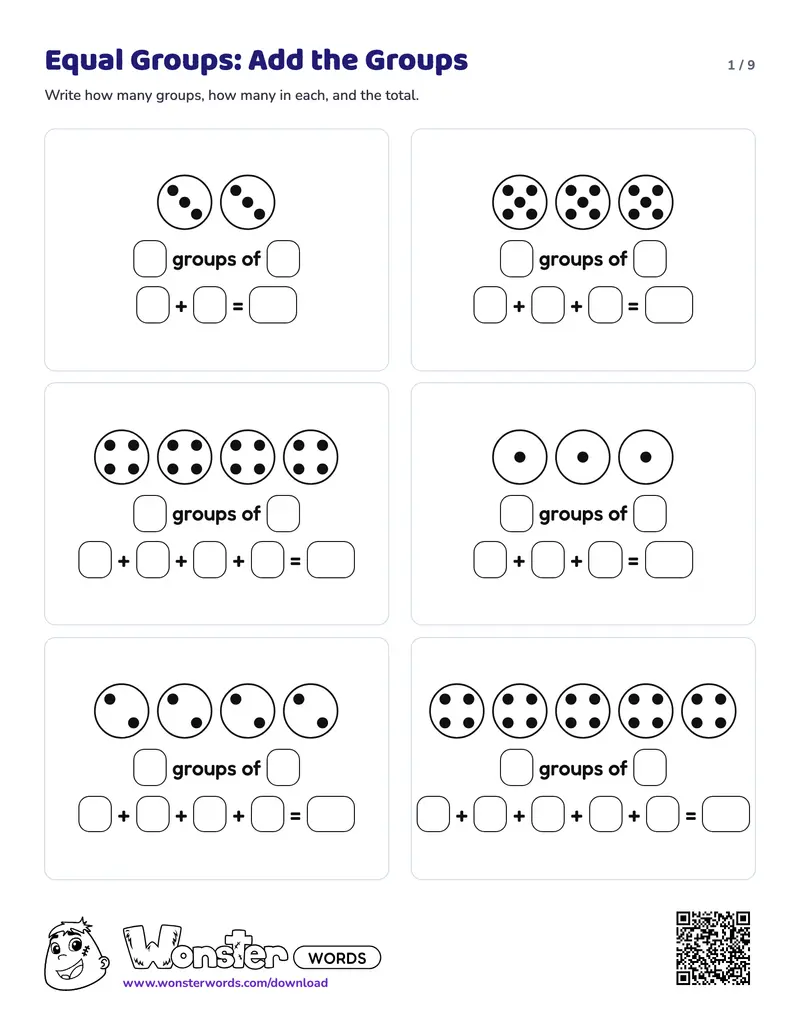
- Equal Groups (PDF)36 problems · answer key included · 9 pages
Preview page 1Preview
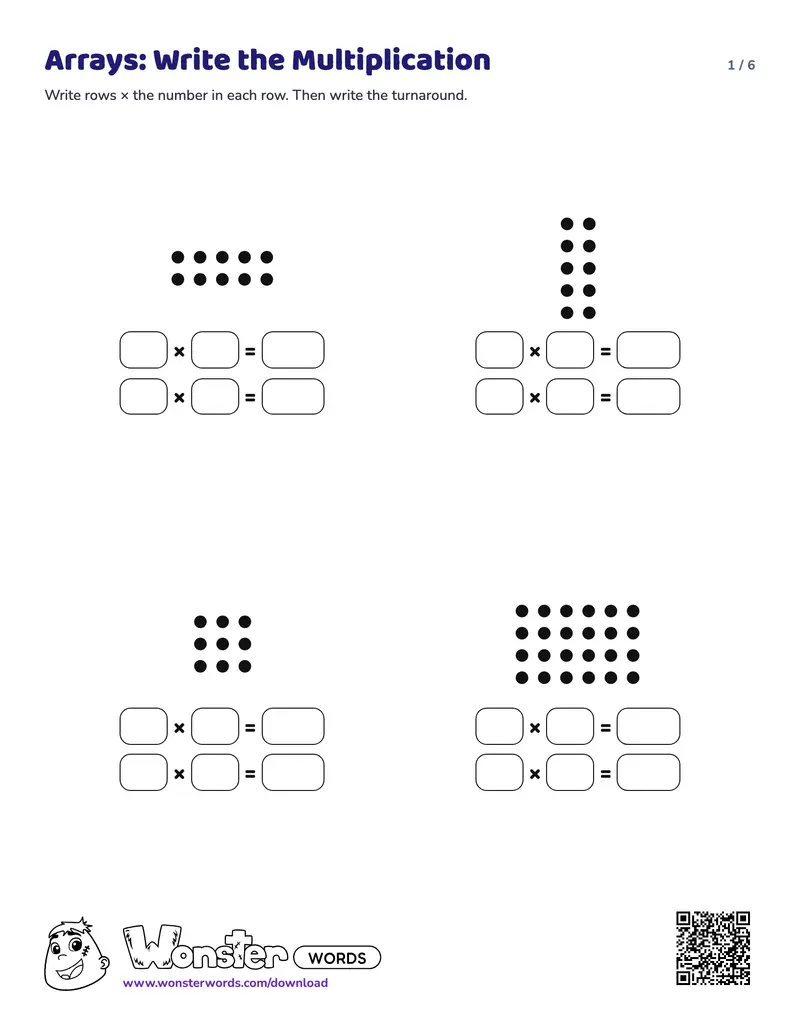
- Arrays: Write the Multiplication (PDF)16 arrays · answer key included · 6 pages
Preview page 1Preview
- Division Sharing Mats (PDF)4 mats · answer key included · 10 pages
Preview page 1Preview
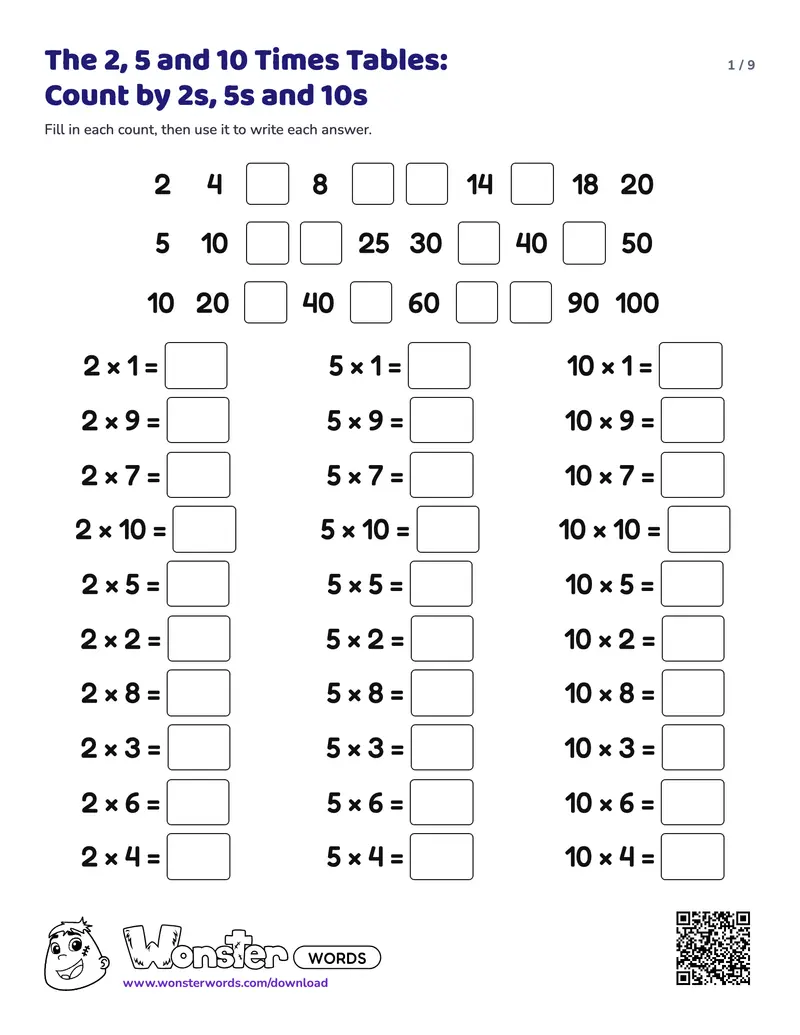
- The 2, 5 and 10 Times Tables (PDF)180 facts · answer key included · 9 pages
Preview page 1Preview
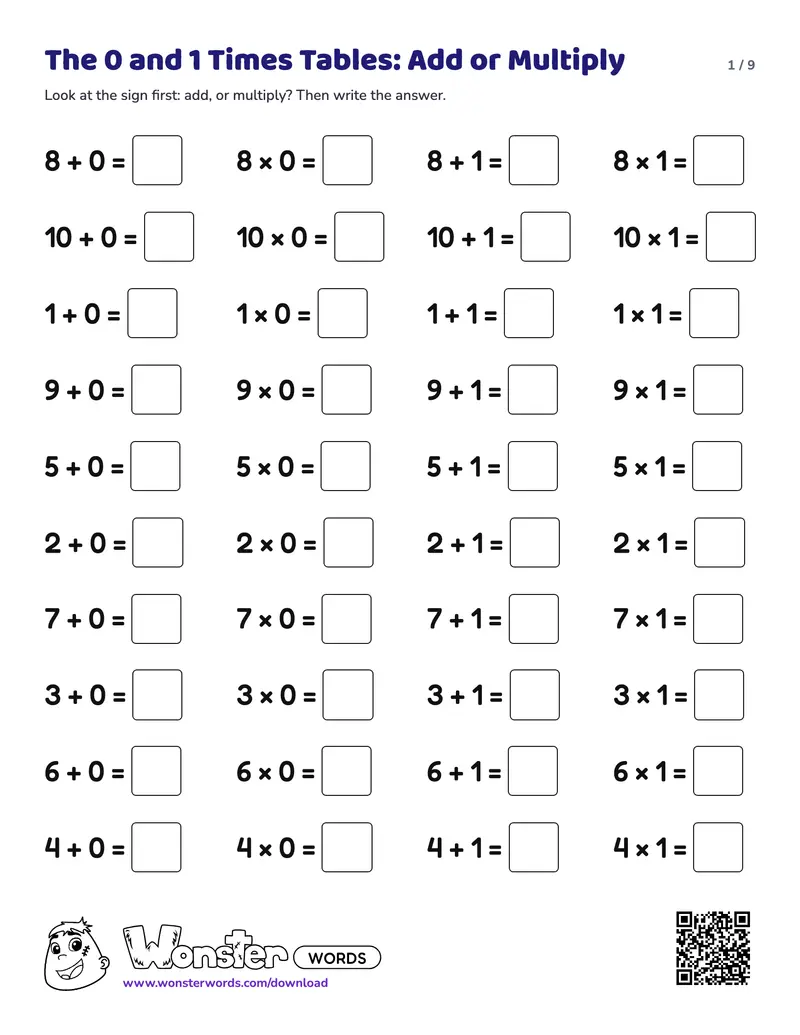
- The 0 and 1 Times Tables (PDF)100 facts · answer key included · 9 pages
Preview page 1Preview
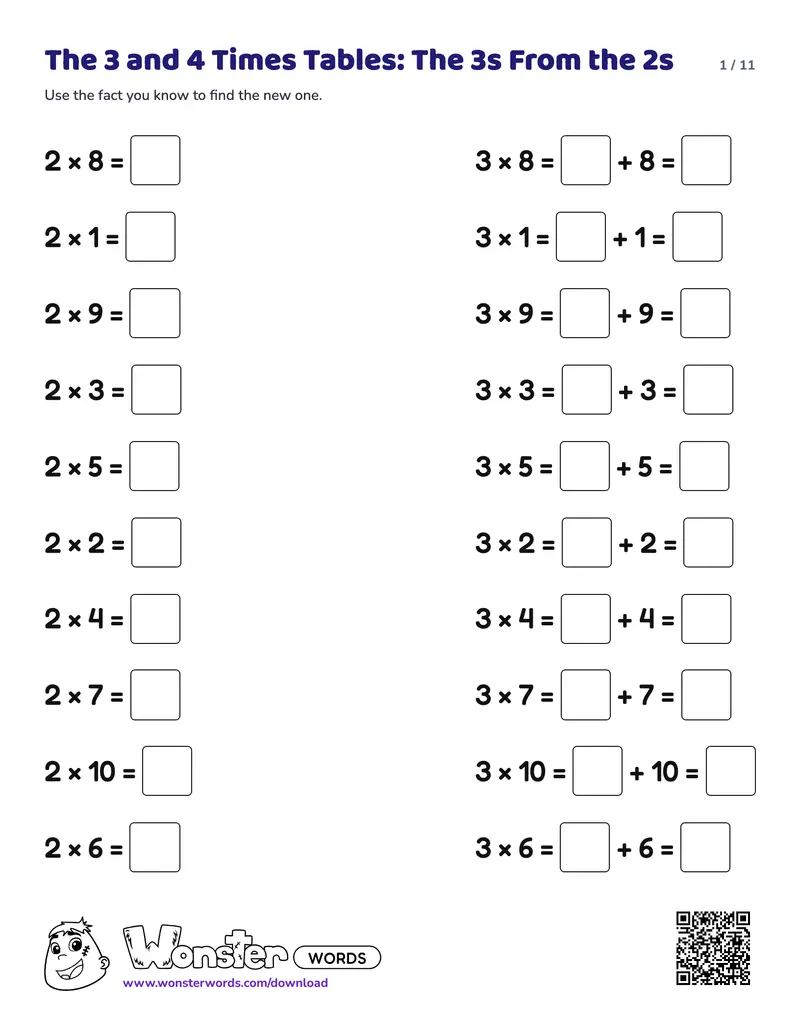
- The 3 and 4 Times Tables (PDF)120 facts · answer key included · 11 pages
Preview page 1Preview
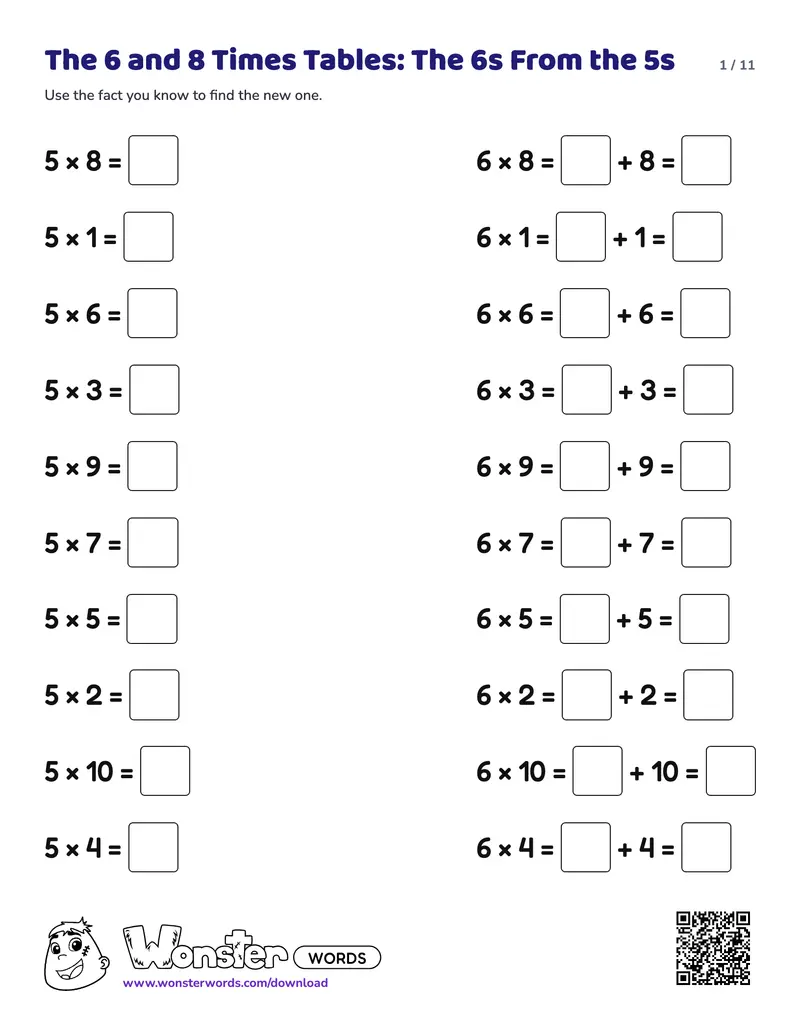
- The 6 and 8 Times Tables (PDF)120 facts · answer key included · 11 pages
Preview page 1Preview
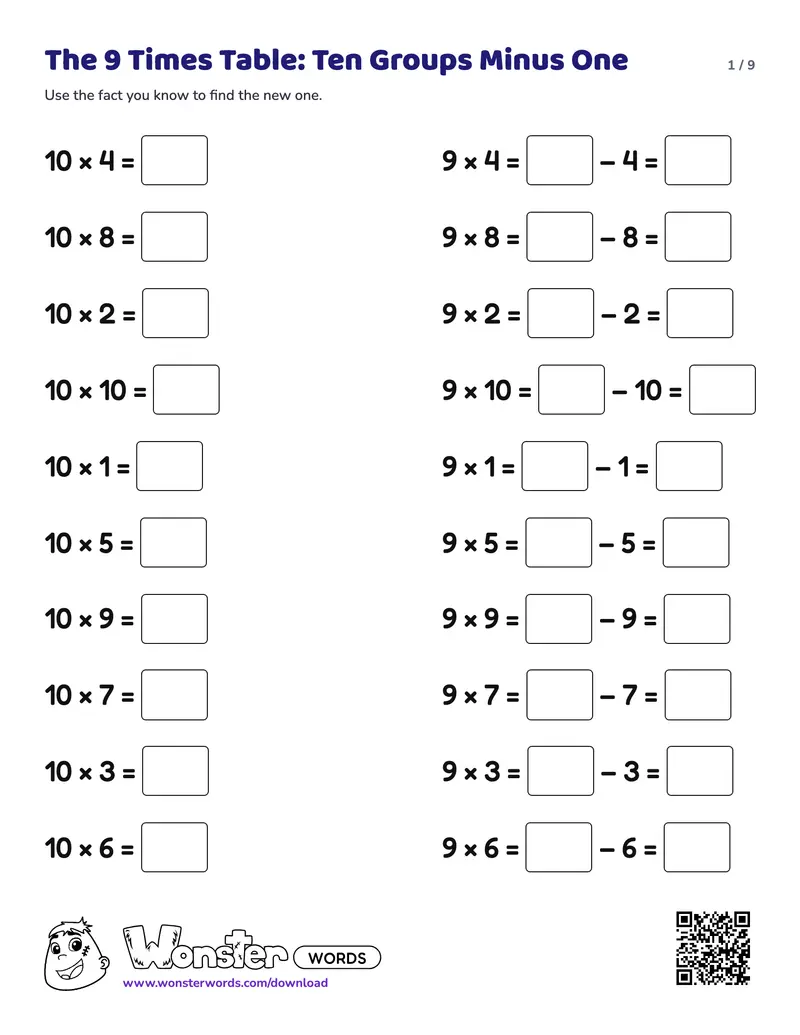
- The 9 Times Table (PDF)100 facts · answer key included · 9 pages
Preview page 1Preview
- The 7 Times Table (PDF)100 facts · answer key included · 9 pages
Preview page 1Preview
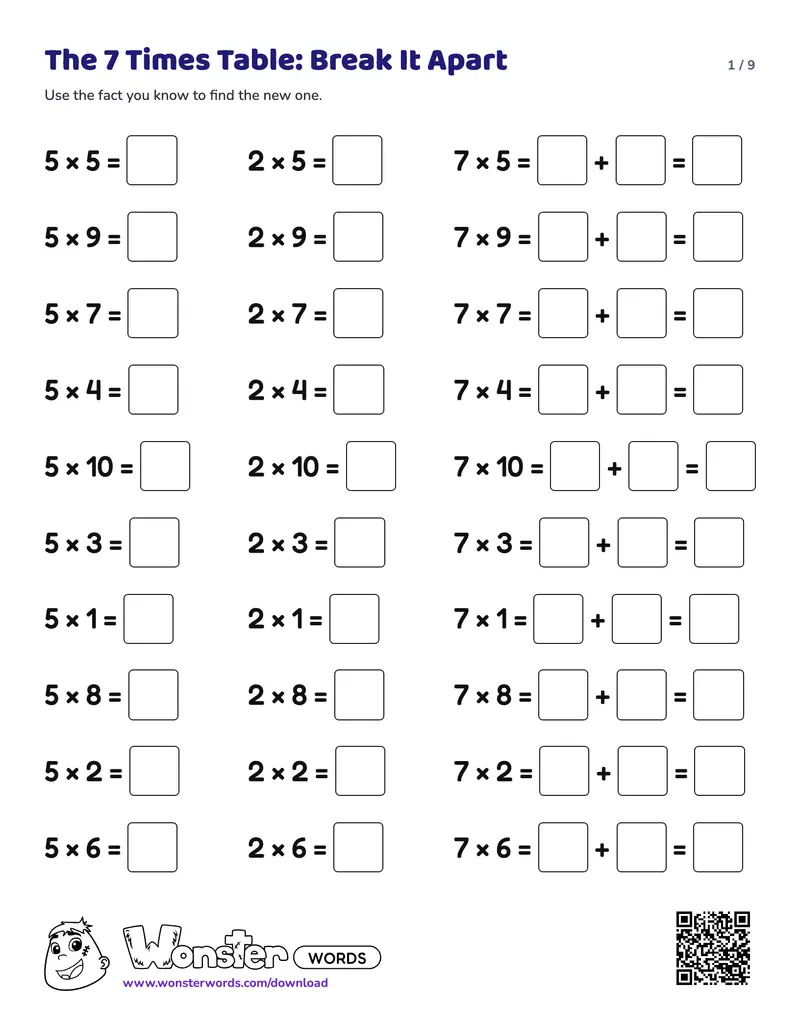
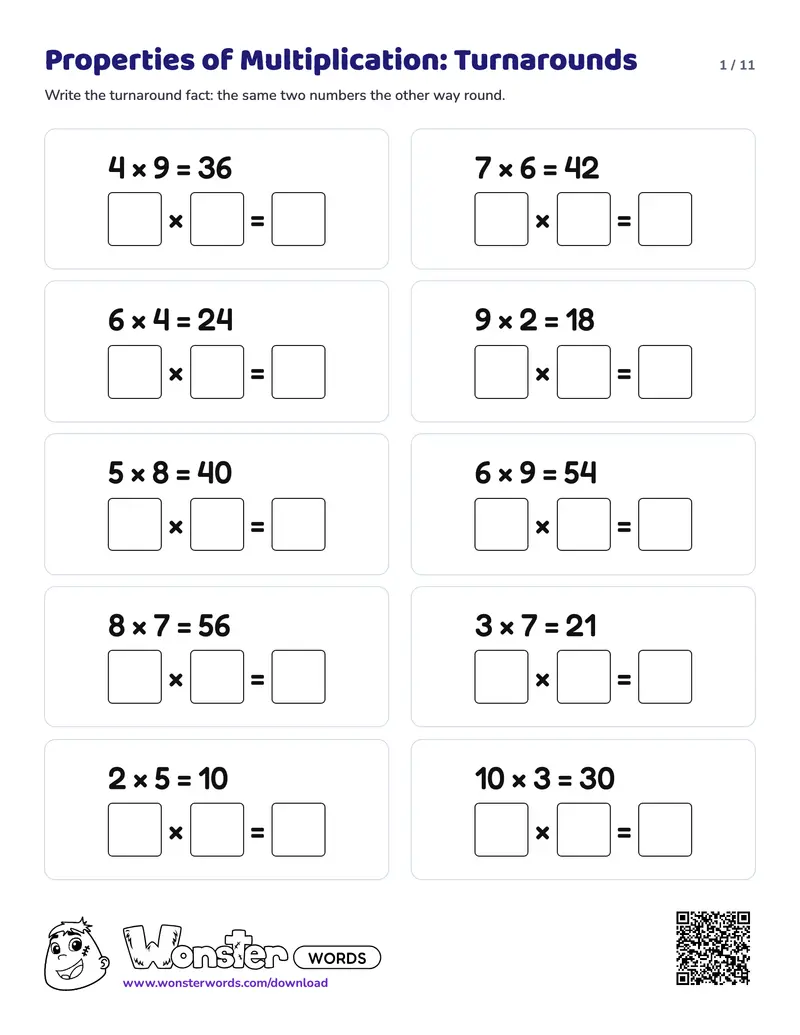
- Properties of Multiplication (PDF)80 facts · answer key included · 11 pages
Preview page 1Preview
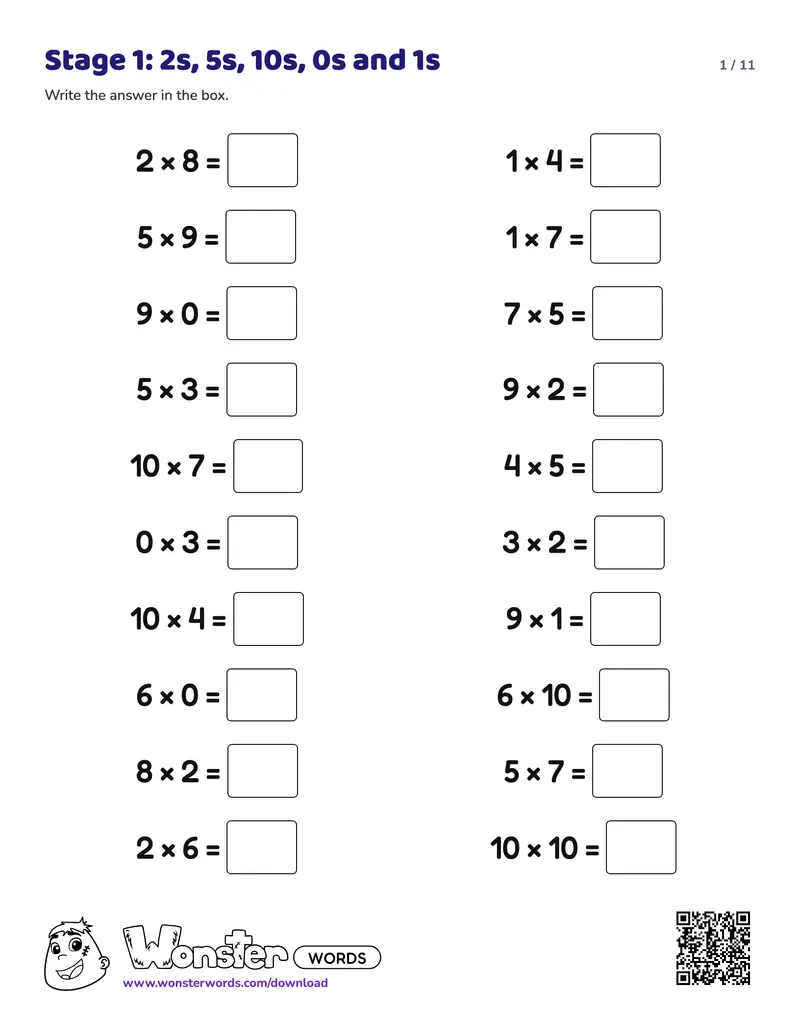
- Mixed Multiplication Facts (PDF)160 problems · answer key included · 11 pages
Preview page 1Preview
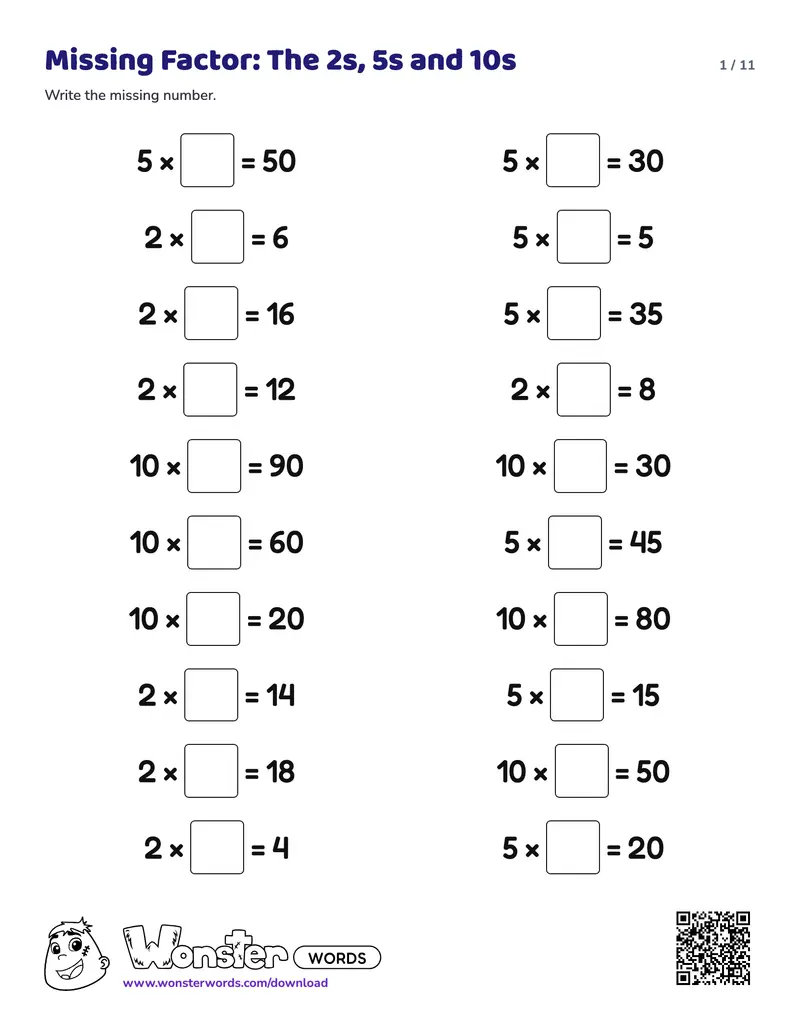
- Missing Factor (PDF)160 problems · answer key included · 11 pages
Preview page 1Preview
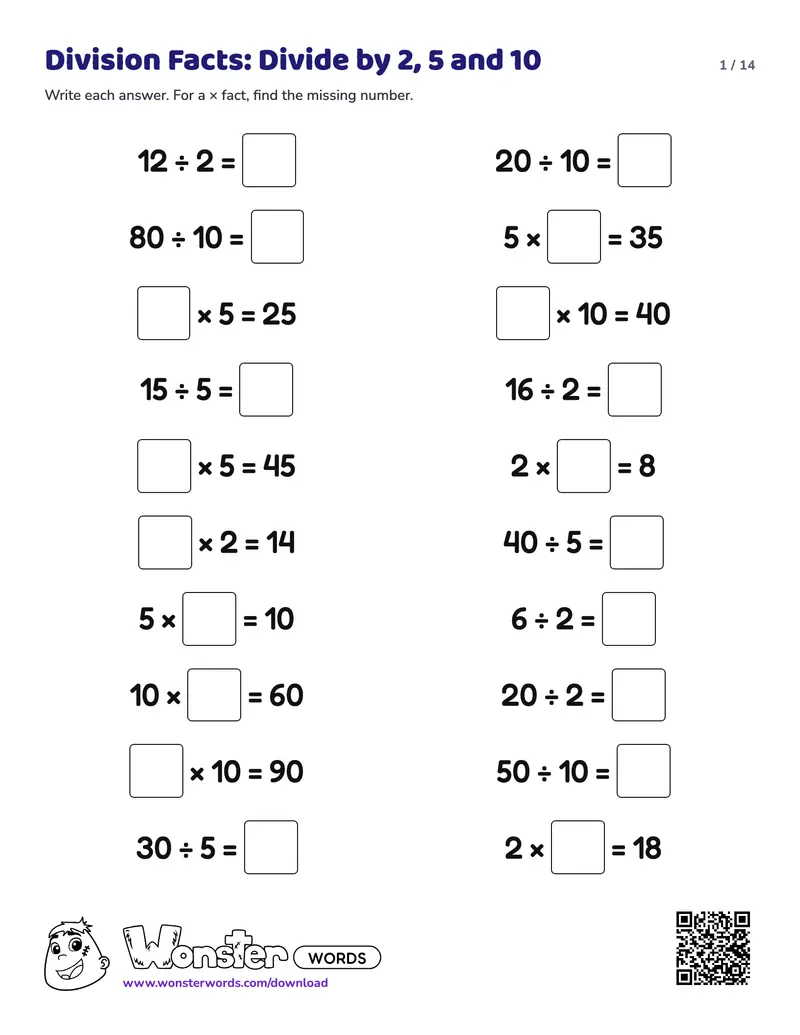
- Division Facts (PDF)200 facts · answer key included · 14 pages
Preview page 1Preview
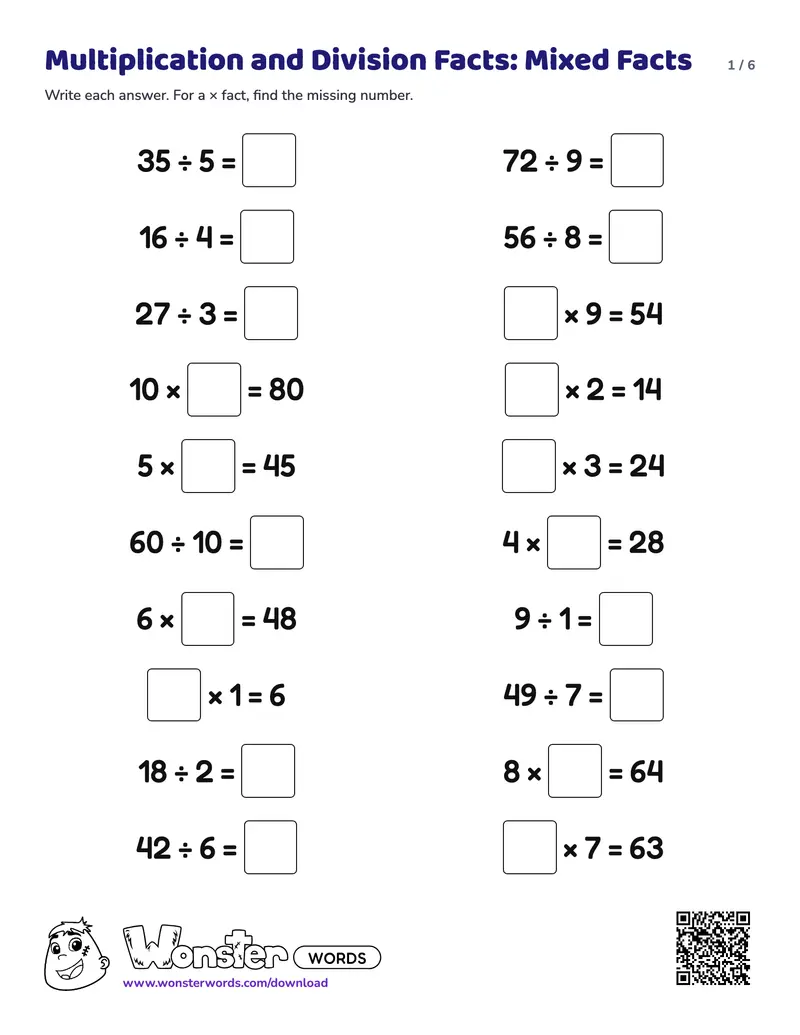
- Multiplication and Division Facts (PDF)88 facts · answer key included · 6 pages
Preview page 1Preview
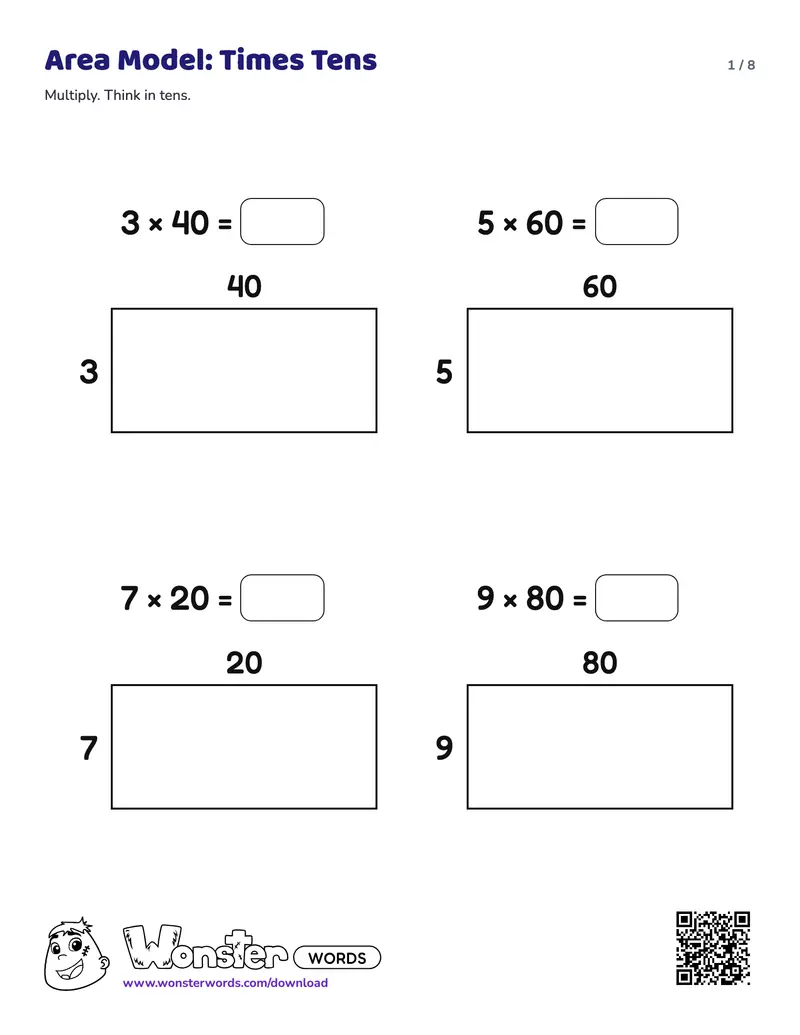
- Area Model Multiplication (PDF)24 problems · answer key included · 8 pages
Preview page 1Preview
Neither framework asks for the 11 and 12 times tables in third grade.
2. Fractions
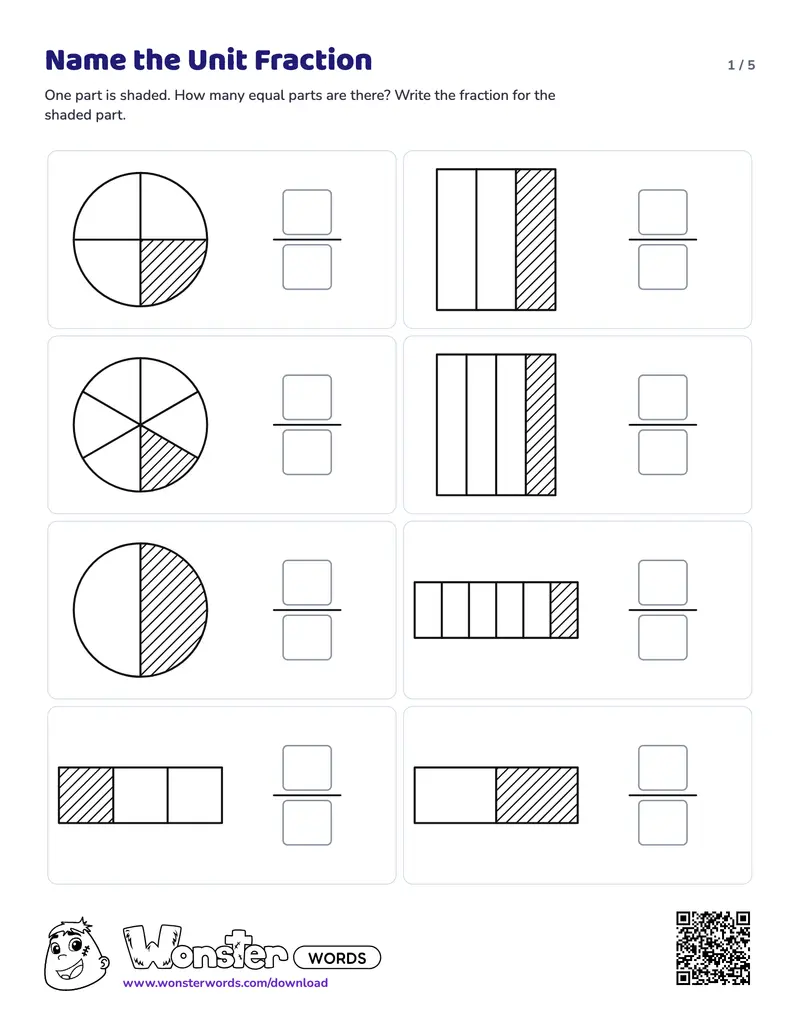
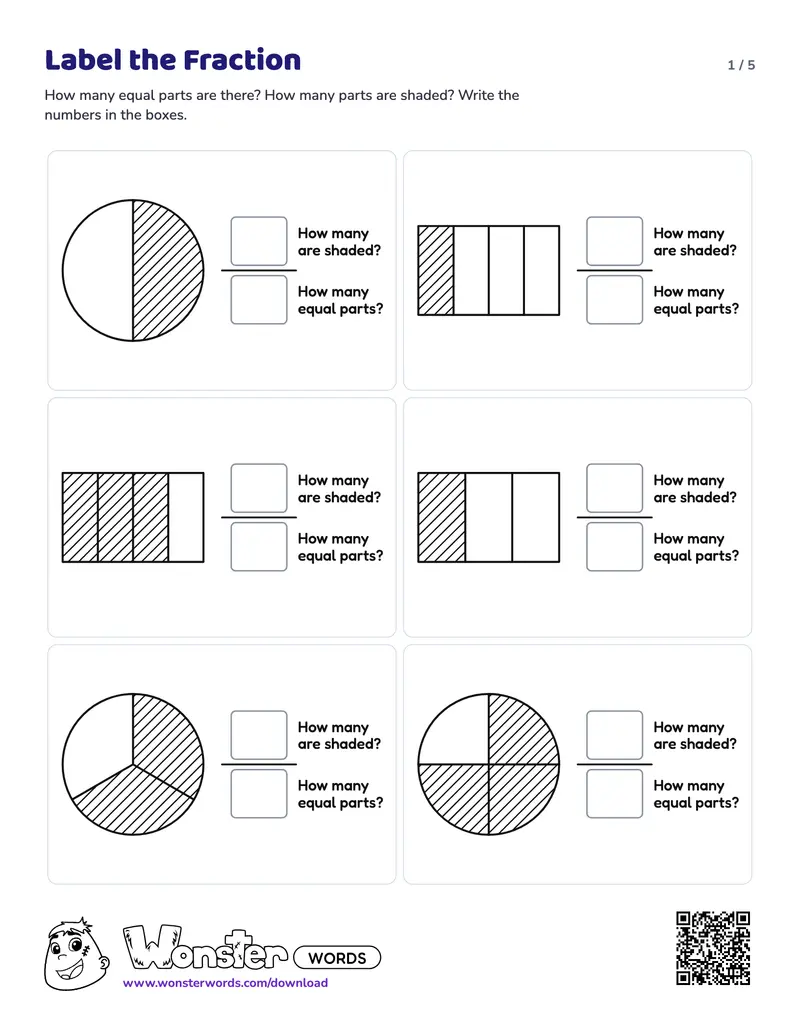
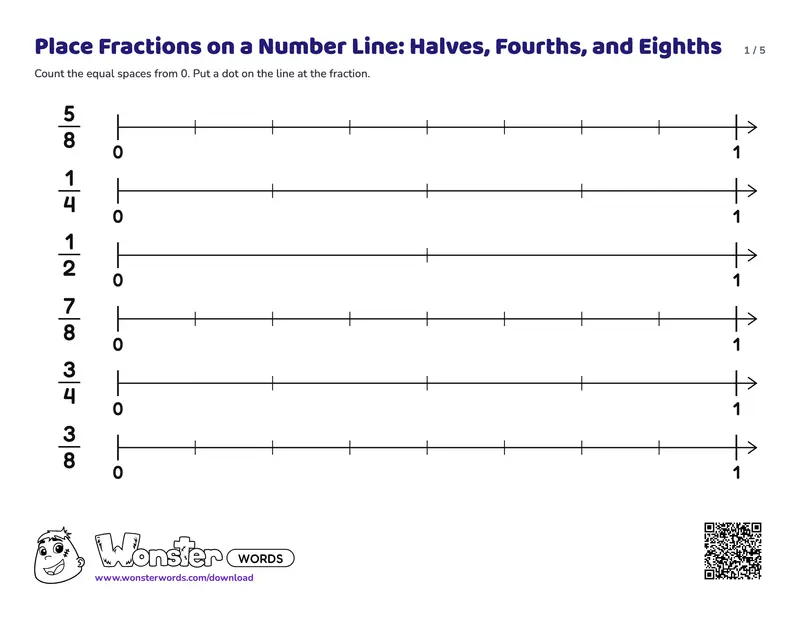
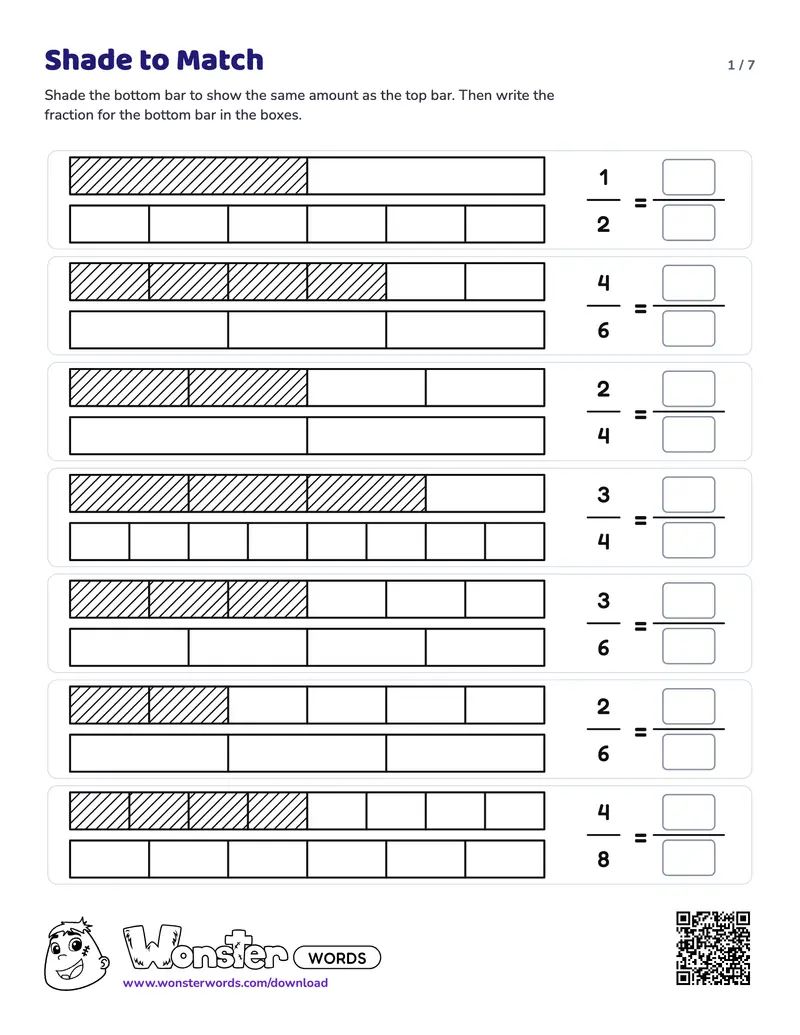
Third grade’s fraction sheets come in five steps, each on the page that teaches it: unit fractions, the top and bottom numbers, the number line, equivalent fractions, and comparing fractions with the same bottom number. The fraction worksheets page has every third grade fraction sheet in one place.
Free PDF · no sign-up
Feedback?Free printable third grade fraction worksheets
Unit fractions, the top and bottom numbers, fractions on a number line, equivalent fractions, and comparing, in teaching order. Each PDF is free, prints in black and white, and ends with its answer key and a page for grown-ups.
- Name the Unit Fraction (PDF)24 pictures · answer key included · 5 pages
Preview page 1Preview
- Label the Fraction (PDF)18 fractions · answer key included · 5 pages
Preview page 1Preview
- Place Fractions on a Number Line (PDF)18 fractions · answer key included · 5 pages
Preview page 1Preview
- Equivalent Fractions: Shade to Match (PDF)20 items · answer key included · 7 pages
Preview page 1Preview
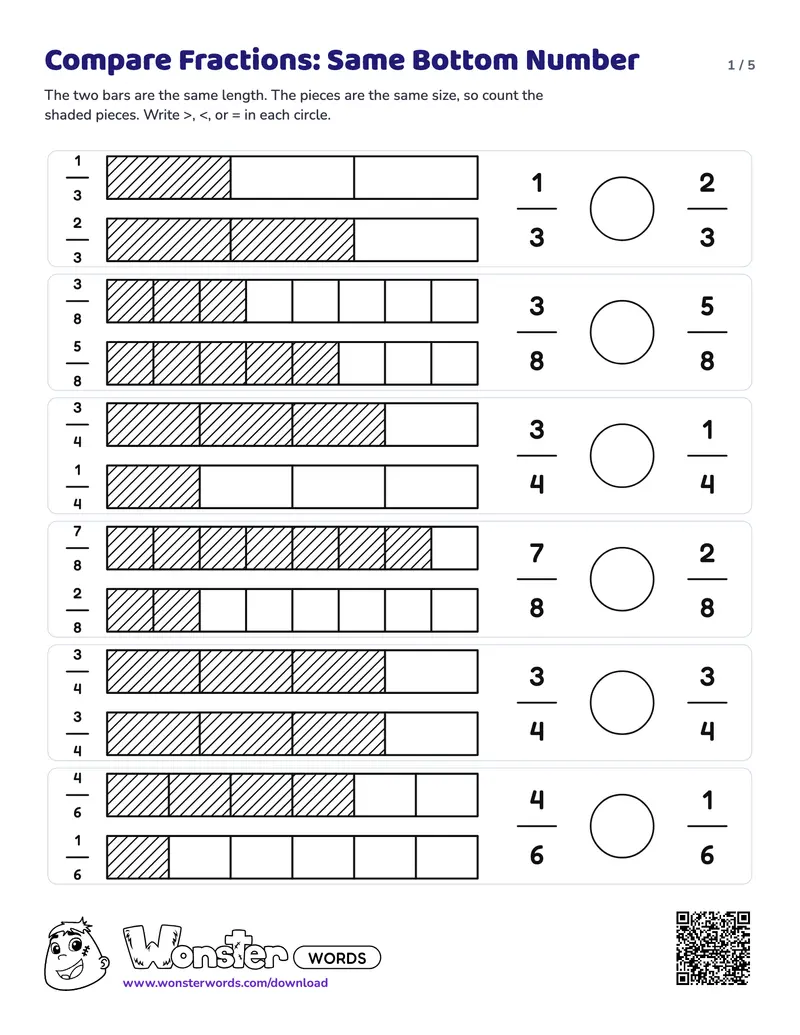
- Compare Fractions: Same Bottom Number (PDF)18 pairs · answer key included · 5 pages
Preview page 1Preview
3. Place value, rounding, adding and subtracting
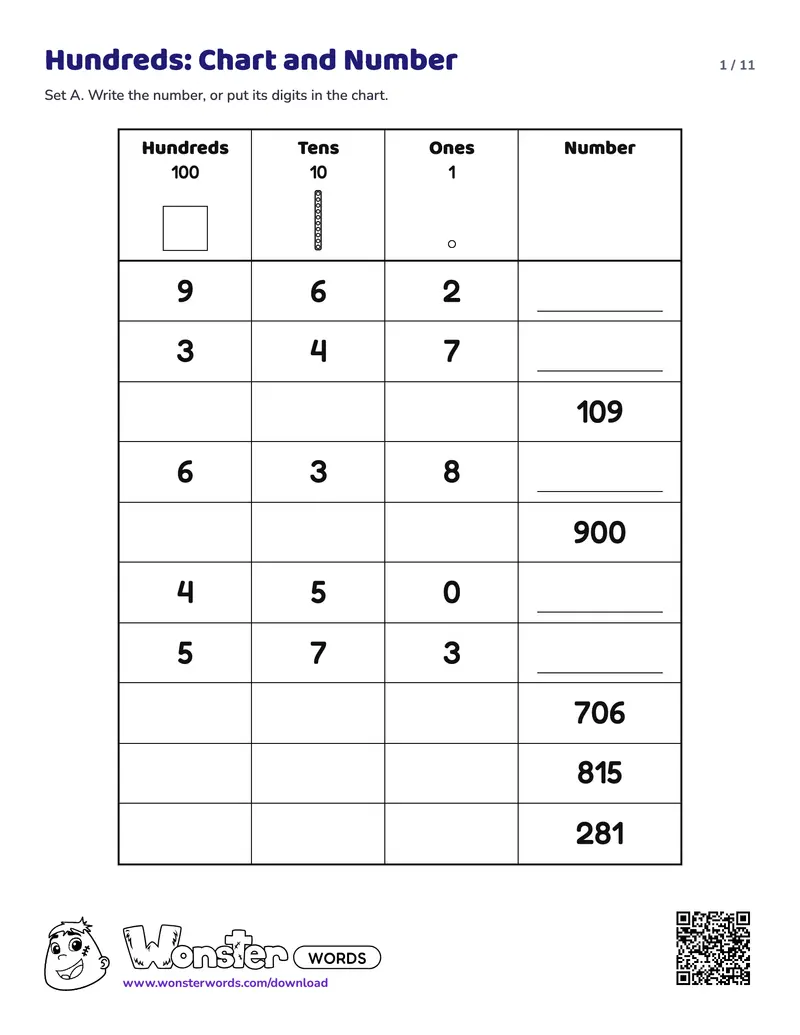
Hundreds, tens, and ones on the place value chart come first, then rounding to the nearest 10 and 100 on a number line and without one (3.NBT.A.1). Then addition with regrouping and subtraction with regrouping, whose pages 7–10 subtract across zeros, within 1,000 (3.NBT.A.2). Even and Odd Numbers, from the even and odd page, fits beside the times tables: Texas asks third graders to sort numbers “using divisibility rules” (3.4(I)).
Free PDF · no sign-up
Feedback?Free printable third grade place value, rounding, and regrouping worksheets
Place value to 1,000, rounding to 10 and 100, adding and subtracting within 1,000 with regrouping, and odd and even. Each PDF is free, prints in black and white, and ends with its answer key and a page for grown-ups.
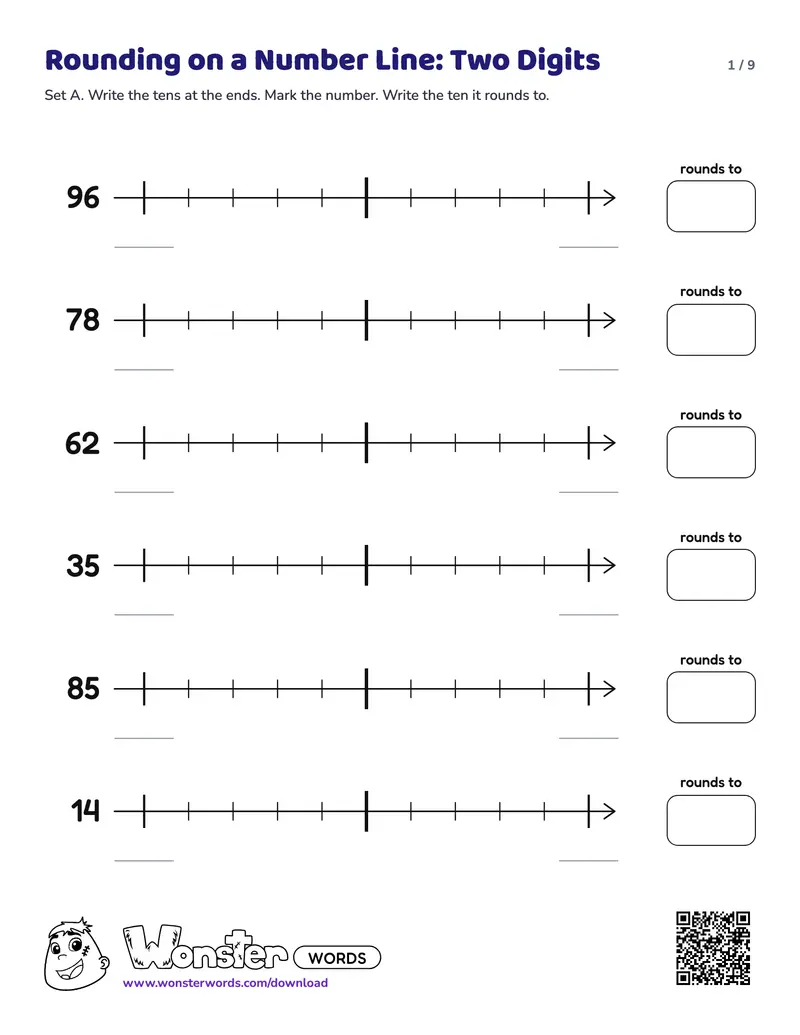
- Rounding on a Number Line (PDF)36 numbers · answer key included · 9 pages
Preview page 1Preview
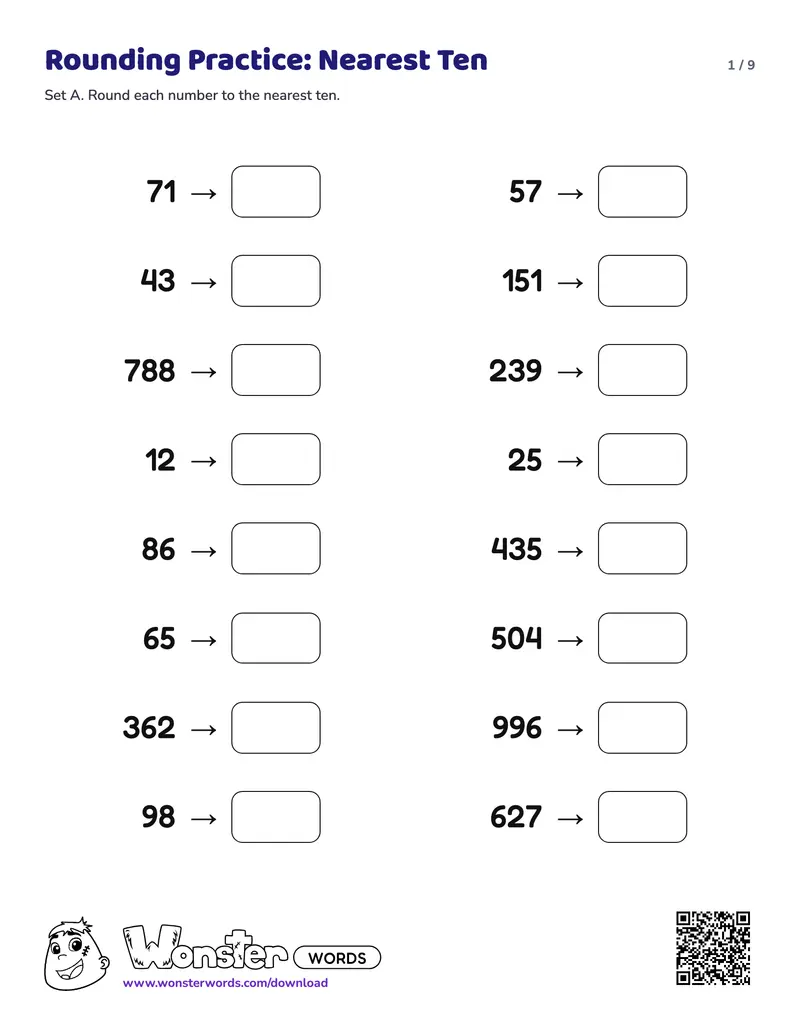
- Rounding Practice (PDF)84 numbers · answer key included · 9 pages
Preview page 1Preview
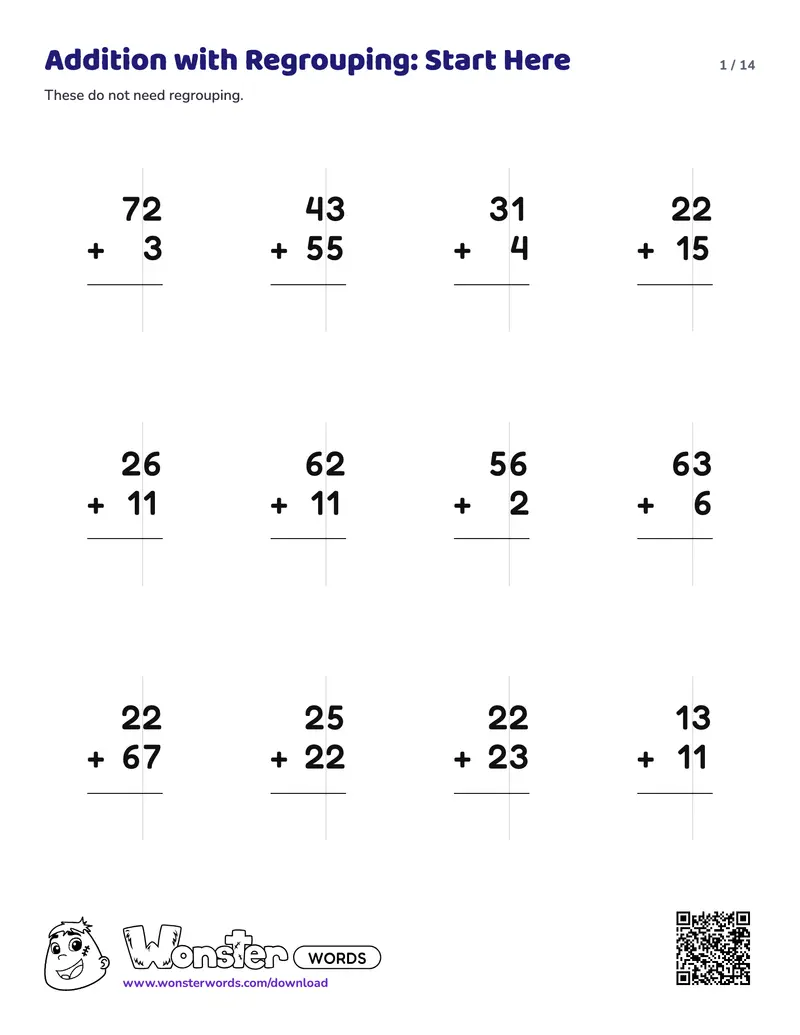
- Addition with Regrouping (PDF)108 problems · answer key included · 14 pages
Preview page 1Preview
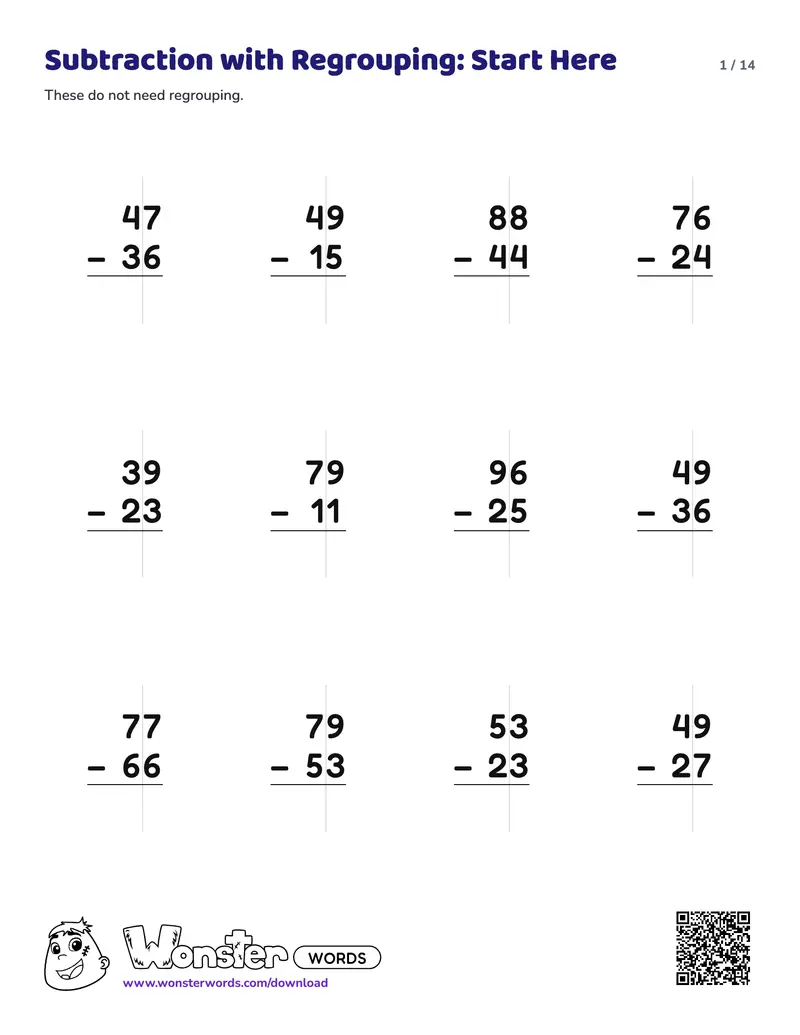
- Subtraction with Regrouping (PDF)102 problems · answer key included · 14 pages
Preview page 1Preview
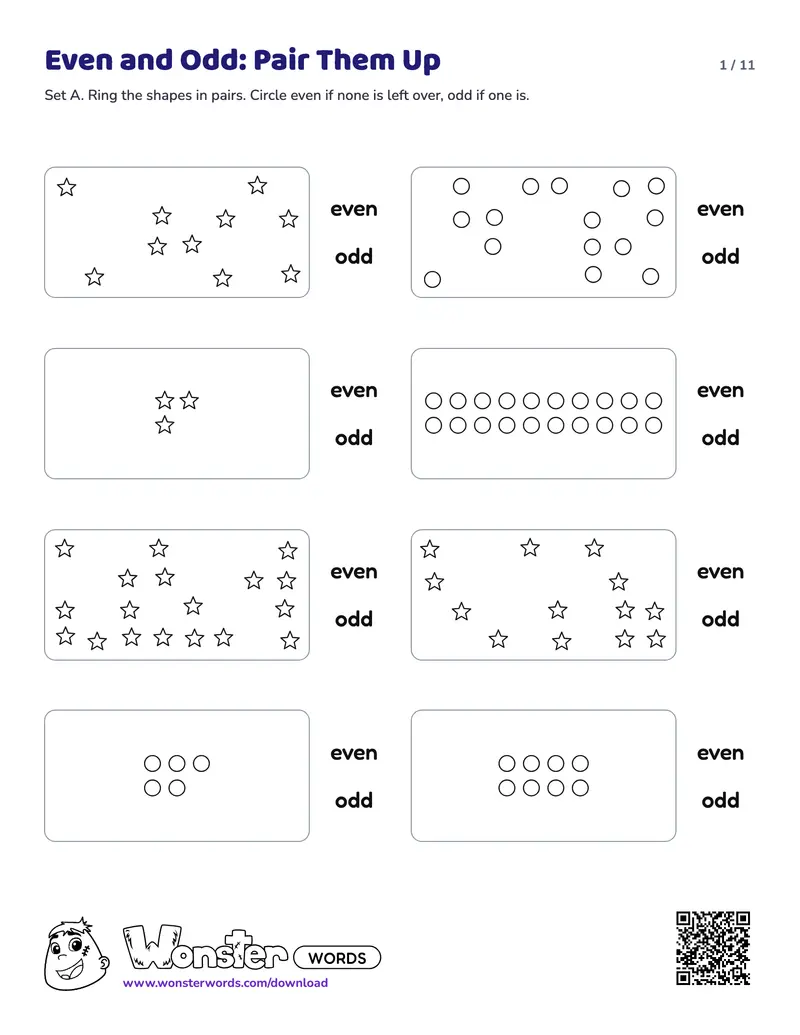
- Even and Odd Numbers (PDF)96 even or odd questions · answer key included · 11 pages
Preview page 1Preview
4. Word problems and shapes
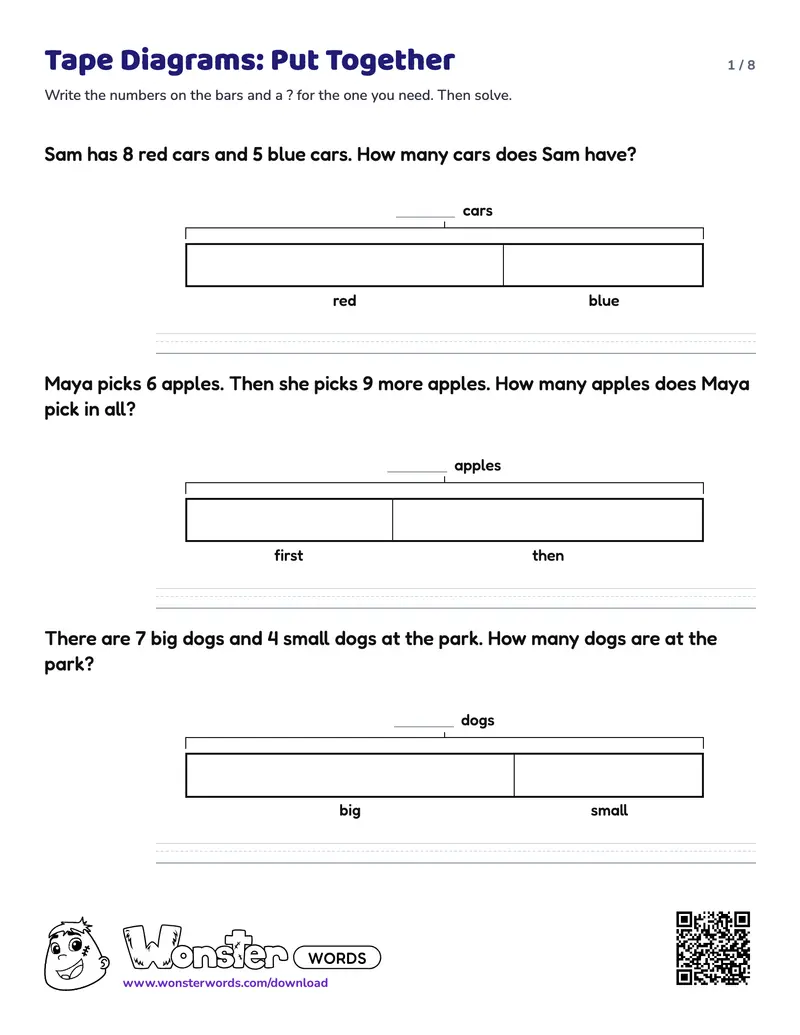
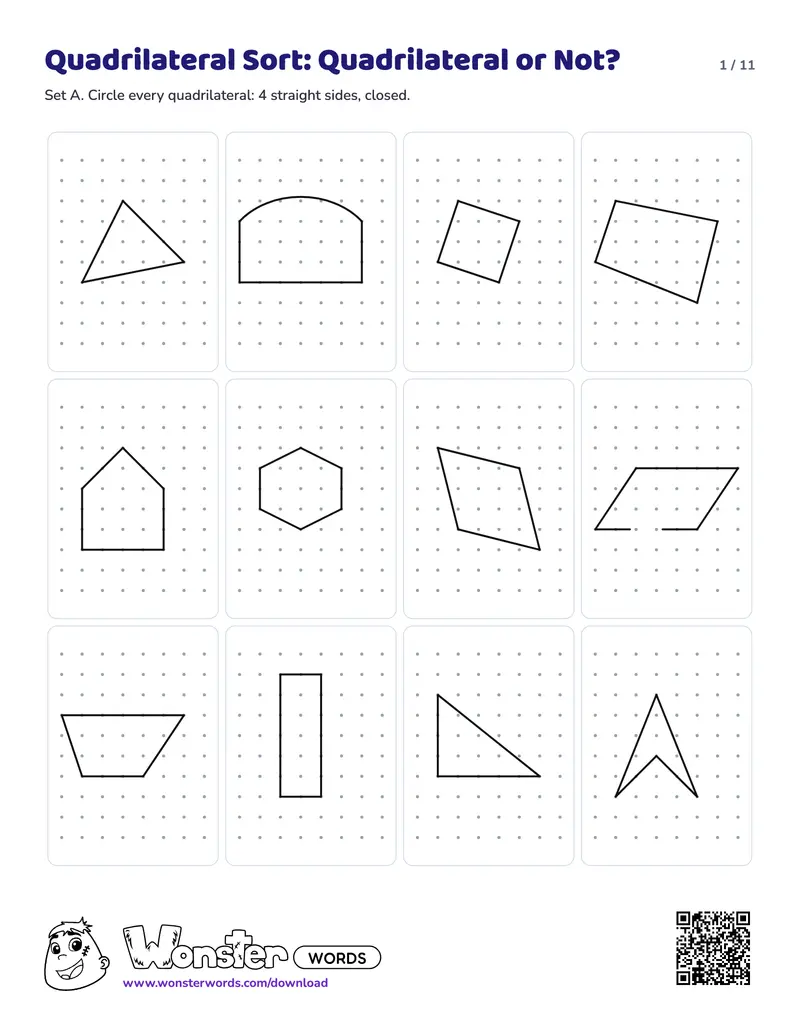
The tape diagram sheet draws word problems as bars, the model schools use for the two-step problems of 3.OA.D.8. The Quadrilateral Sort, from the quadrilaterals page, sorts rhombuses, rectangles, and squares (3.G.A.1).
Free PDF · no sign-up
Feedback?Free printable third grade word problem and shape worksheets
Word problems drawn as bars, and quadrilaterals sorted by their sides and angles. Each PDF is free, prints in black and white, and ends with its answer key and a page for grown-ups.
- Tape Diagram Word Problems (PDF)15 problems · answer key included · 8 pages
Preview page 1Preview
- Quadrilateral Sort (PDF)30 shapes · answer key included · 11 pages
Preview page 1Preview
5. Charts and cards
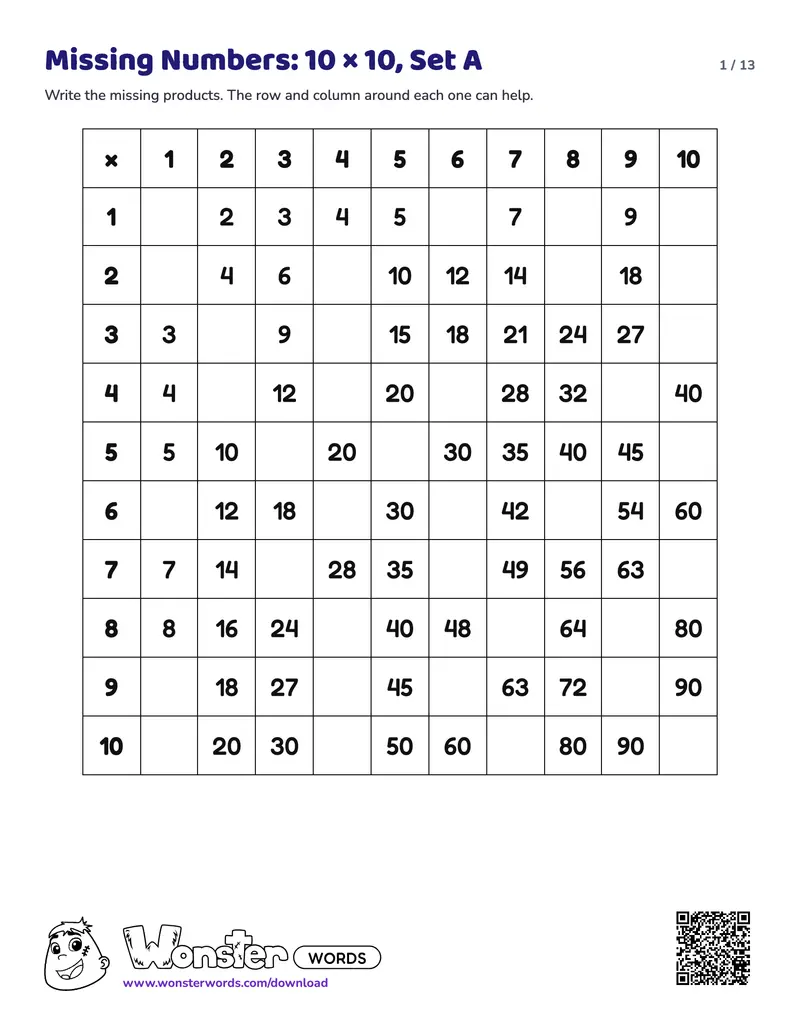
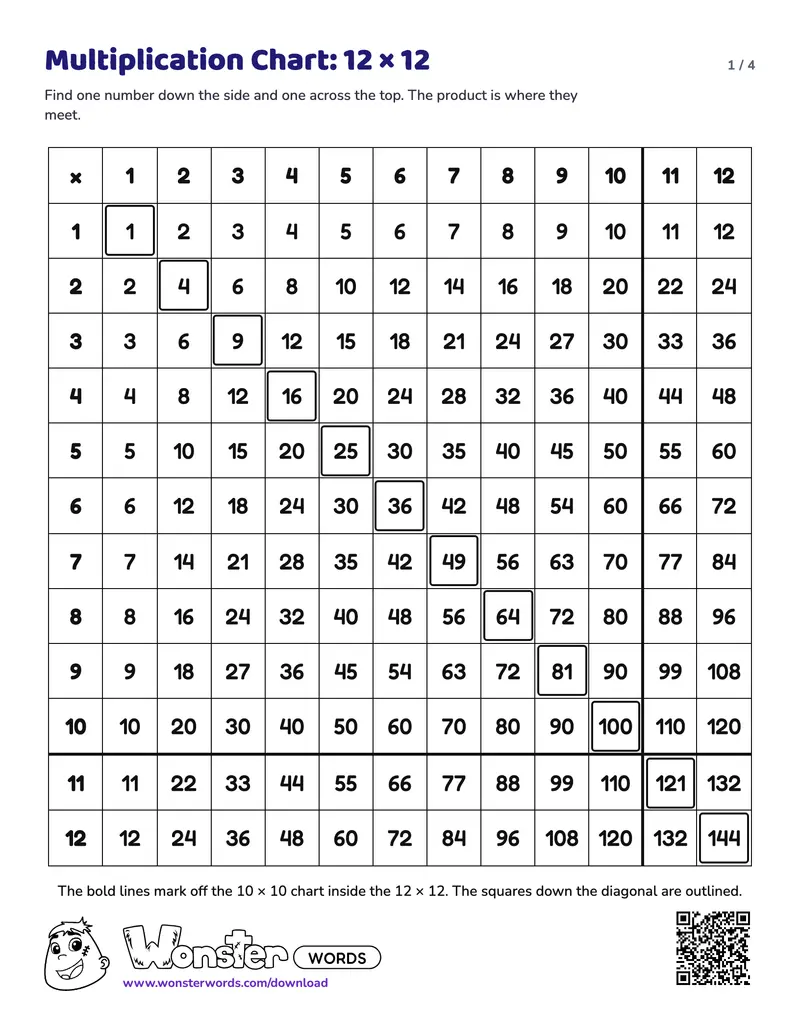
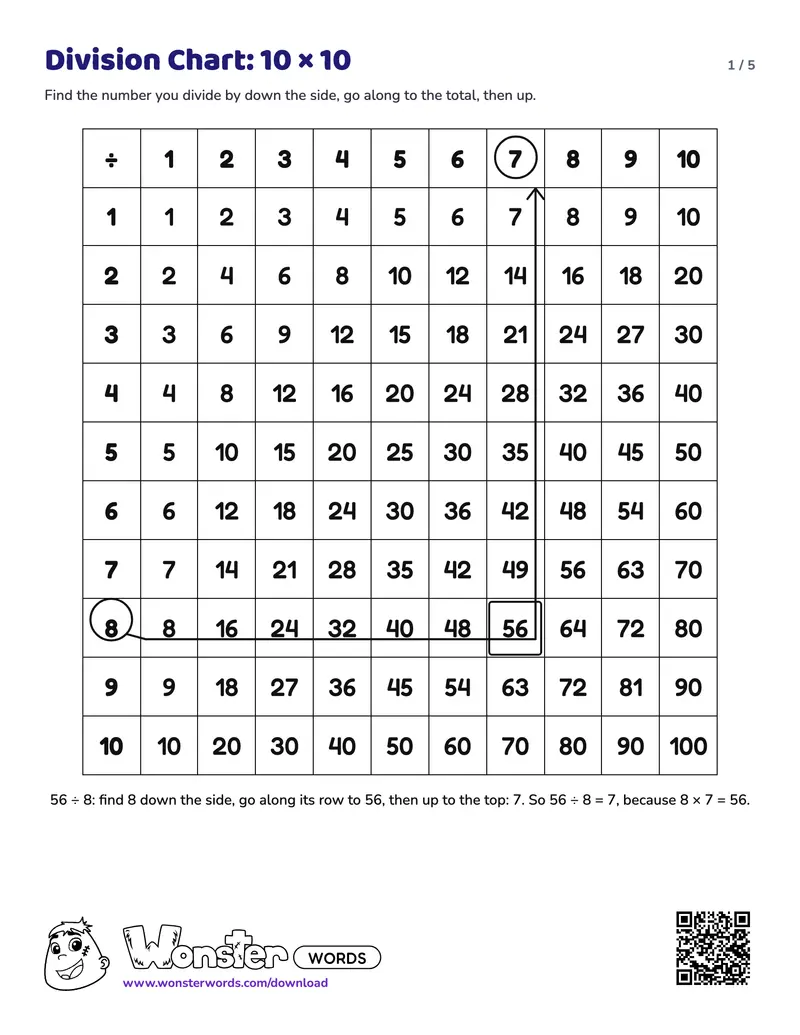
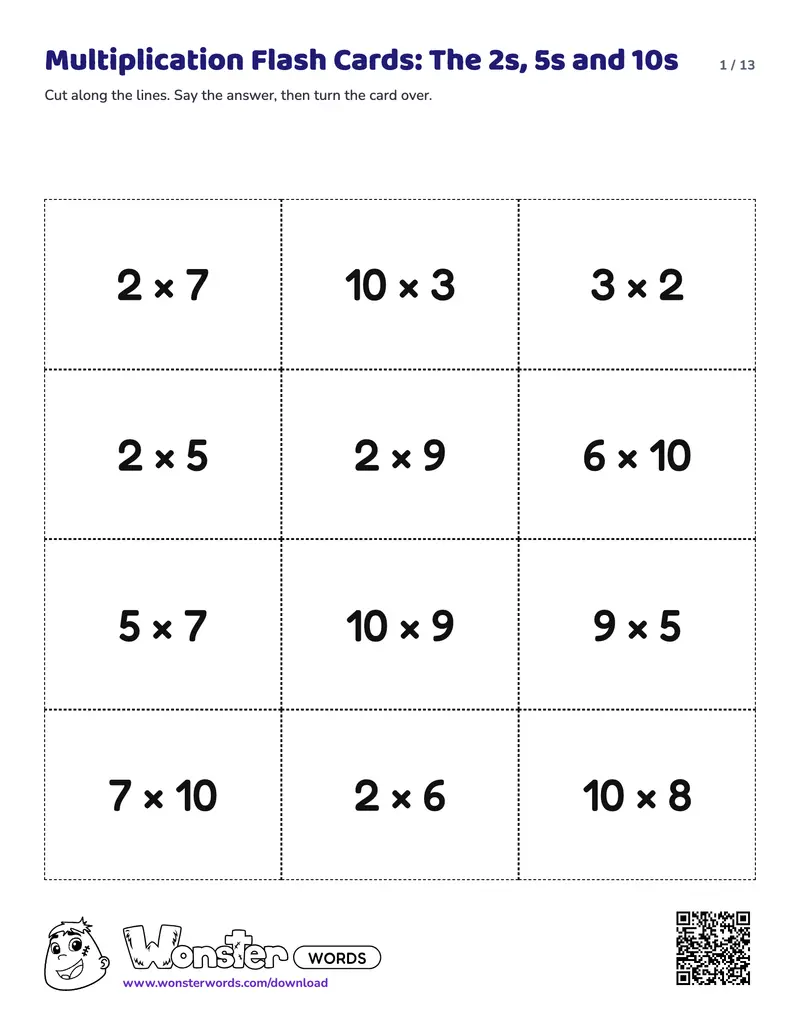
The multiplication and division charts, the multiplication flash cards and division flash cards, the rounding chart, and the quadrilaterals chart sit beside any sheet above.
Free PDF · no sign-up
Feedback?Free printable third grade math charts and flash cards
Charts have no answer key because there is nothing to answer; the two flash card decks end with an answer key. Each PDF is free and prints in black and white.
- Multiplication Chart (PDF)344 numbers · 4 pages
Preview page 1Preview
- Division Chart (PDF)144 facts · 5 pages
Preview page 1Preview
- Multiplication Flash Cards (PDF)66 cards · answer key included · 13 pages
Preview page 1Preview
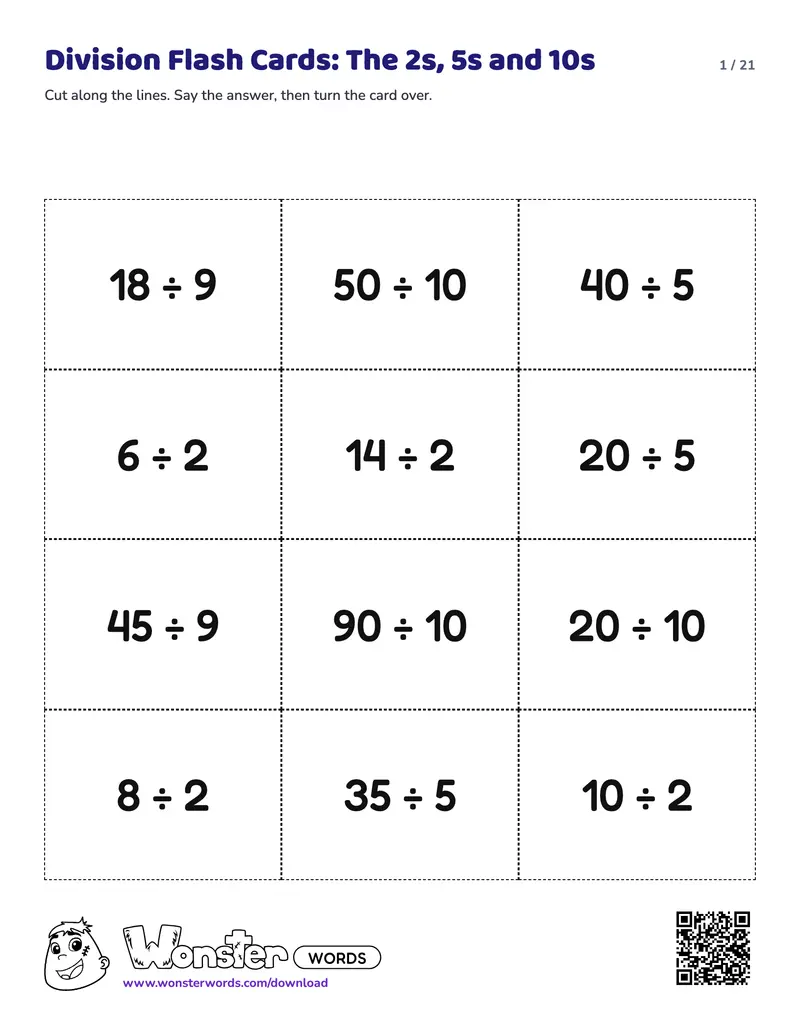
- Division Flash Cards (PDF)100 cards · answer key included · 21 pages
Preview page 1Preview
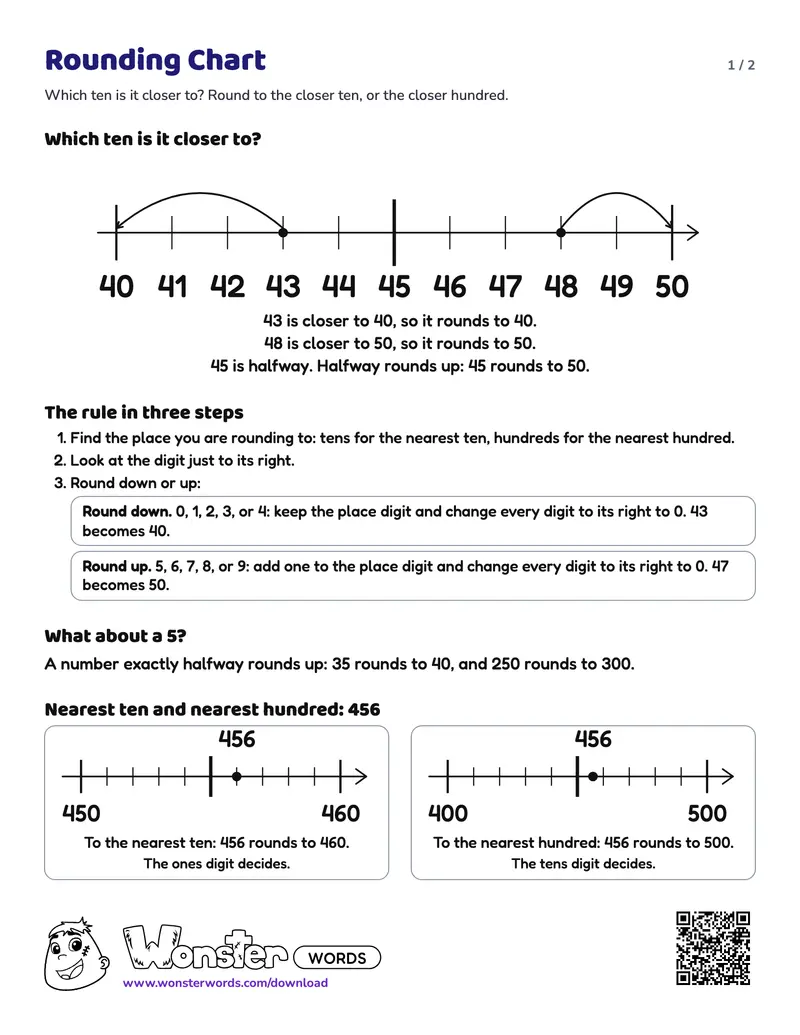
- Rounding Chart (PDF)9 worked examples · 2 pages
Preview page 1Preview
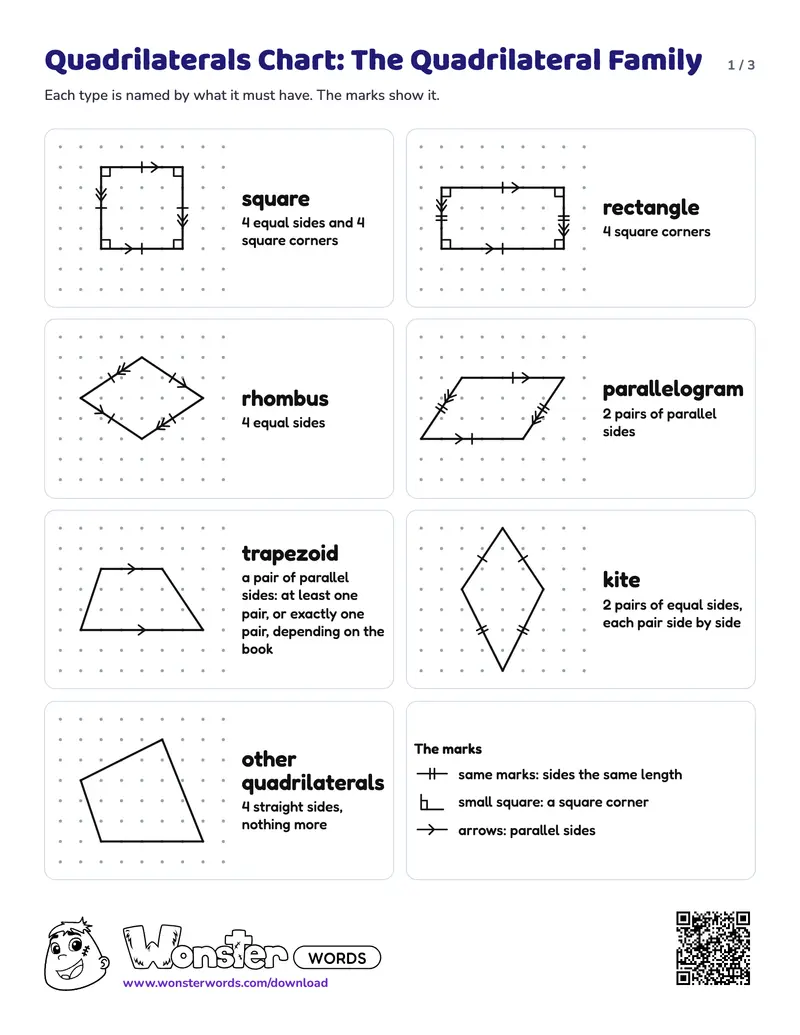
- Quadrilaterals Chart (PDF)7 shapes · 3 pages
Preview page 1Preview
6. Telling time to the minute
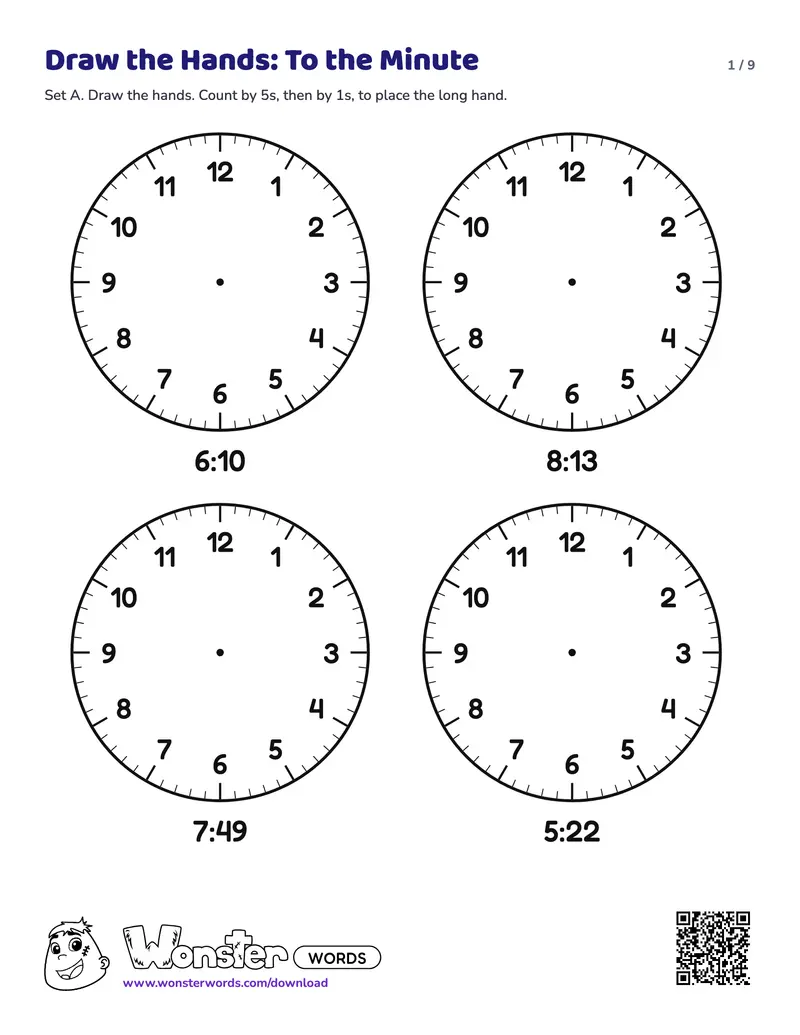
Third graders tell and write time “to the nearest minute” (3.MD.A.1), which Texas teaches in second grade (2.9(G)). Both sheets come from the telling time worksheets page: Write the Time first, where your child reads the clock, then Draw the Hands, where your child sets it. A child counts the minutes by 5s from the 12, then on by 1s, with skip counting by 5s.
Free PDF · no sign-up
Feedback?Free printable third grade telling time worksheets
Reading and drawing clocks to the minute. Each PDF is free, prints in black and white, and ends with its answer key and a page for grown-ups.
- Write the Time: To the Minute (PDF)24 clocks · answer key included · 9 pages
Preview page 1Preview
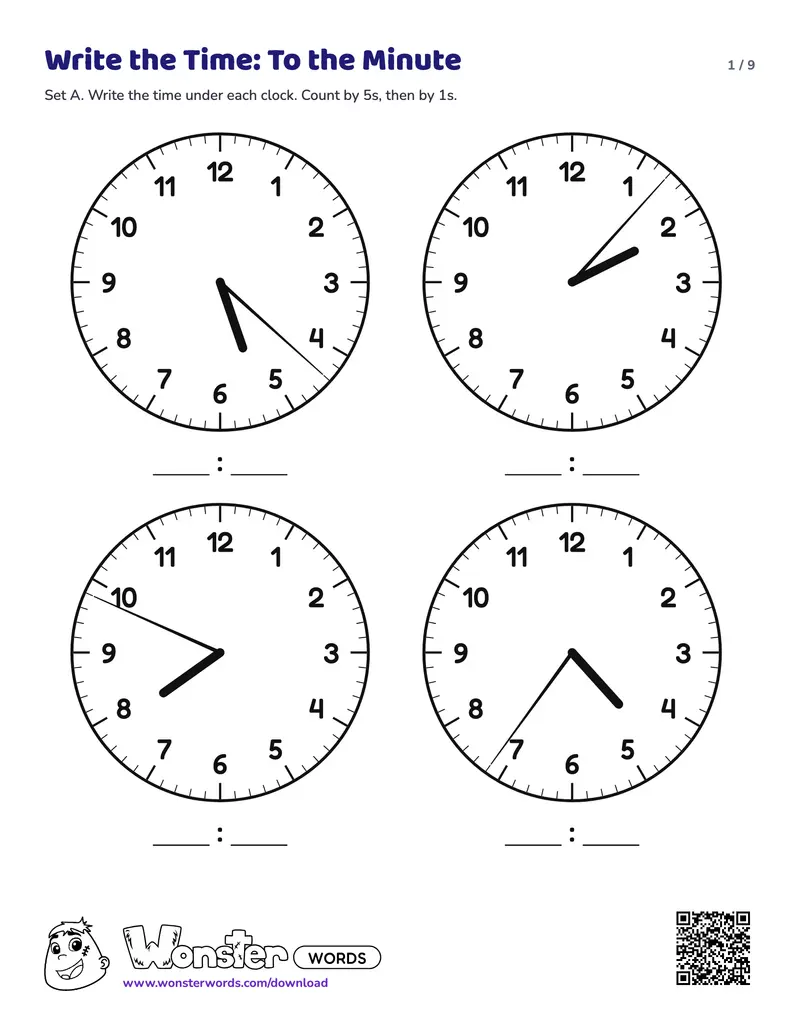
- Draw the Hands: To the Minute (PDF)24 clocks · answer key included · 9 pages
Preview page 1Preview
More multiplication sheets are on the multiplication worksheets page, and more addition and subtraction sheets on the addition and subtraction worksheets page. The fraction worksheets page has every fraction sheet by grade.
Is my child on track in 3rd grade math?
To tell whether a third grader is on track in math, ask these 8 questions near the end of the year, in order, and stop at the first one your child cannot yet do easily. A quick check of where to start. Not a screening or diagnostic tool. Each question is a row of the table above.
- Say 7 × 8 and 6 × 9 straight away, without counting (3.OA.C.7).
- Say 56 ÷ 8 by thinking of the times table (3.OA.B.6).
- Draw 3 × 4 as an array or as equal groups, and say what each number counts (3.OA.A.1).
- Round 347 to the nearest ten and to the nearest hundred (3.NBT.A.1).
- Work out 503 − 276 and explain the regrouping (3.NBT.A.2).
- Shade 3/4 of a bar, and put 3/4 on a number line from 0 to 1 (3.NF.A.1–2).
- Say whether 1/3 or 1/4 of the same whole is greater, and why (3.NF.A.3d).
- Solve a two-step story: “24 stickers are shared by 4 friends, and then each friend gets 3 more. How many does each friend have now?” (3.OA.D.8).
The first question that is not yet easy is the skill to work on next, and its row in the table links the page that teaches it. There is no score and no level. Read the check at the end of the year: in the middle of the year, a child who has not met fractions yet has simply not met them. A child who finds all 8 easy is ready for fourth grade’s first steps. If you have questions about how your child is doing, your child’s teacher is the best person to ask how this looks in class.
Four things are hard for many third graders, and each skill page teaches the usual fix:
- The facts past the 5s. The common times table mistakes section builds them one family at a time.
- Telling sharing apart from grouping. The division page shows both with real objects.
- Thinking a bigger bottom number means a bigger piece. It means a smaller one, so 1/4 is less than 1/3, and comparing fractions with the same top number shows why.
- Subtracting across a zero, as in 503 − 276. Subtraction with regrouping takes it step by step.
Confidence grows from practice a child can win. Keep sessions short, start from a fact your child knows, praise the way your child worked it out rather than speed, and let your child explain the answer to you. If several questions are hard, or math has become a fight, talk to your child’s teacher. The guide to a child struggling with math covers what to ask and what helps at home. For a child who has started to worry about math itself, a gentler approach comes first.
3rd grade math activities and games at home
Third grade math games need only a deck of cards, a few dice, or a free printable board, and each one below practices one skill in the table.
- Multiplication bingo. The free printable bingo boards practice the times tables a few families at a time.
- Multiplication War. Each player turns over two cards and says the whole fact, “4 times 7 is 28”, and the bigger product takes all four cards. The multiplication card games give the rules and three more games.
- Division games. Sharing a pile of counters into equal groups, and the card games on the division page.
- Round and win. Each player rolls two dice, makes a two-digit number, and rounds it to the nearest ten; the bigger rounded number wins. It is one of three rounding games.
- Everyday math. Count the change after a purchase, pack snacks into equal bags (“4 bags of 3”), and halve or double a recipe with measuring cups.
- Family game night. A third grader can play on the 1–100 path beside a younger child on the 1–10 path, as math board games describes.
- Fraction games. Roll and Shade: Unit Fractions, Fraction Bingo, and Fraction Dominoes are three of the free printable fraction games for third graders.
A game is practice out loud, where you hear how your child thinks, and a worksheet leaves a record you can look back at. Multiplication games or worksheets weighs the two.
How often should my child practice 3rd grade math at home?
A third grader can practice math at home for a few minutes on most days, one skill at a time, on top of any homework. No research sets a number of worksheets for home practice, and a game counts as practice. Timed fact practice comes only once your child is accurate. The What Works Clearinghouse recommends brief timed activities, each lasting “between 1 and 5 minutes”, with the goal of beating a previous score. How often to practice multiplication facts has a six-step routine for the times tables.
How much homework is normal in third grade? A common rule of thumb, the “10-minute rule”, adds 10 minutes of homework a night for each grade, about 30 minutes in all in third grade. Duke University, reporting on Harris Cooper’s review of homework research, calls it “a commonly accepted practice”. The review found the link between homework and achievement “much stronger for secondary students” than for elementary ones.
To help with 3rd grade math homework without doing the work for your child, take five steps. They fit any homework sheet and any sheet on this page.
Read the problem together, then let your child start
Read the problem aloud together and ask "What is it asking?" before you offer any help. Then let your child make the first move, even a wrong one.
Ask, do not tell
Ask "How did you get that?" and "Can you draw it?" instead of showing the answer. Explaining the work is how your child finds a mistake on their own.
Use the school's method
If the sheet shows arrays, an area model, a number line, or bar models, help with that model rather than the one you learned. The method is part of what the class is practicing.
Check one or two answers together
Pick one or two answers and check them together while the work is fresh, by estimating or by working them another way. Fix any mistake together straight away.
Stop while it is going well
End before homework turns into a fight, and tell the teacher if it often runs long or ends in tears. The teacher wants to know.
For step 3, new math homework explains each model schools use, from arrays to the area model.
How does 3rd grade math prepare students for 4th grade?
Third grade math prepares students for fourth grade by giving them the facts and the fractions that fourth grade builds on. In the Common Core’s fourth grade, children multiply numbers of up to four digits by a one-digit number and two two-digit numbers together (4.NBT.B.5), and divide with remainders (4.NBT.B.6). In fourth grade fractions, they find equivalent fractions by multiplying the top and bottom (4.NF.A.1), compare fractions with different tops and bottoms (4.NF.A.2), and add and subtract fractions with the same bottom number (4.NF.B.3). Every one of those steps uses the times tables, and every fraction step starts from unit fractions.
For a child already there, the multiplication page’s going further section gives something new without skipping a grade, and so does the fractions guide’s fractions of a set.
Frequently asked questions
What skills should a 3rd grader have by the end of the year?
By the end of third grade, a child is expected to know every product of two one-digit numbers from memory with the division facts that go with them, multiply and divide within 100, write fractions such as 3/4 and place them on a number line, round to the nearest 10 and 100, add and subtract within 1,000 fluently, find area by counting squares and by multiplying, and solve two-step word problems.
What math facts should a 3rd grader know?
Every multiplication fact from 0 × 0 to 9 × 9 from memory, and the division facts that go with them, such as 56 ÷ 8 = 7. The Common Core asks for every product of two one-digit numbers. Texas asks for the facts up to 10 × 10 with automaticity, with the matching division facts. The 11 and 12 times tables are not third grade work in either.
What are the key differences between Common Core and traditional math for 3rd graders?
The answers are the same, and the facts are still learned from memory. The difference is that children draw the math first: equal groups, arrays, area models, number lines, and bar models come before the short written method. Under the Common Core, the standard written method for multiplying is fifth grade work, after place value methods in fourth grade; Texas teaches it in third grade for a two-digit number times a one-digit number.
How many worksheets are too many for a 3rd grader each week?
No research sets a number. A few minutes of practice on most days, one skill and one sheet at a time, is enough at home, on top of any homework. Stop a session while it is going well, and if homework already takes most of the evening, skip the extra sheet.
Is there a printable 3rd grade math test?
Not here. A test gives a score, and a score says little about what to practice next. This page has an 8-question skill check instead, which shows the first skill to work on, and the mixed multiplication fact sheets show which tables are known. Your child's teacher can say how your child is doing against the class's own assessments.
How old is a child in third grade?
Usually 8 to 9 years old in the United States. The standards name grades, not ages, so what a child can do decides which skill to practice next, not the child's age.
What are common challenges students face in 3rd grade math?
Four come up most: the multiplication facts past the 5s, telling sharing apart from grouping in division, understanding that a bigger bottom number means a smaller piece, so 1/4 is less than 1/3, and subtracting across a zero, as in 503 − 276. Each one has a usual fix, starting with a drawing or real objects.
Related guides
Standards this page teaches: Common Core: 3.OA.A.1, 3.OA.A.2, 3.OA.A.3, 3.OA.A.4, 3.OA.B.5, 3.OA.B.6, 3.OA.C.7, 3.OA.D.8, 3.OA.D.9, 3.NBT.A.1, 3.NBT.A.2, 3.NBT.A.3, 3.NF.A.1, 3.NF.A.2, 3.NF.A.3a, 3.NF.A.3b, 3.NF.A.3c, 3.NF.A.3d, 3.MD.A.1, 3.MD.A.2, 3.MD.B.3, 3.MD.B.4, 3.MD.C.5, 3.MD.C.6, 3.MD.C.7, 3.MD.D.8, 3.G.A.1, 3.G.A.2 · Texas: 3.2(A), 3.2(B), 3.2(C), 3.3(A), 3.3(B), 3.3(C), 3.3(D), 3.3(E), 3.3(F), 3.3(G), 3.3(H), 3.4(A), 3.4(B), 3.4(C), 3.4(D), 3.4(E), 3.4(F), 3.4(G), 3.4(H), 3.4(J), 3.4(K), 3.5(A), 3.5(B), 3.5(D), 3.6(A), 3.6(B), 3.6(C), 3.6(D), 3.6(E), 3.7(A), 3.7(B), 3.7(C), 3.7(D), 3.7(E), 3.8(A), 3.8(B), 3.9(A), 3.9(B), 3.9(C), 3.9(D), 3.9(E), 3.9(F)
Last updated
Looking for something else?
Looking for something else?