
Math
What Math Should My Child Know?
What most children learn in math each year from preschool to third grade, the best games for each step, everyday math at home, what to do when a child is not meeting the milestones, and our full PreK-3 scope and sequence with the Common Core and Texas codes.
Grades: pre-K to grade 3
By the end of kindergarten, children are expected to count to 100 by ones and tens and add and subtract within 5 fluently. By the end of first grade they are fluent within 10 and add within 20 with strategies; by the end of second grade they know every sum of two one-digit numbers from memory and work with numbers to 1,000; and third grade adds the multiplication facts from memory and fractions as numbers. Before that, preschoolers learn to count a small group and say how many there are.
A grade is where a skill lands by the end of the year, so a child partway through a year is not behind for not having it yet. The one habit that follows: find your child’s next step and practice it a few minutes a day, often as a game.
- The milestones, year by year, with the Common Core and Texas standards.
- The best math games for each grade, with cards, dice, and paper.
- Everyday math at home, by age.
- Our PreK-3 math scope and sequence: every topic, its grade, and its code.
What math should my child know by each age and grade?
The Common Core sets one fluency milestone for each grade from kindergarten to third grade, and this table gives the rest of each year’s math beside it. Preschool has no Common Core standards, so its row comes from the Head Start framework and the Texas Prekindergarten Guidelines. Texas teaches most of the same skills in the same year, and the last column names where it does not.
| Age or grade | What children learn by the end of the year | Fluency milestone (Common Core) | Where Texas differs |
|---|---|---|---|
| Preschool (about 3–5) | Count to 20; see up to 5 things without counting; count 10 objects and say how many; compare two small groups; name circles, squares, and triangles; copy an AB pattern | None (Common Core starts at kindergarten) | Rote count to 30 (PK4.V.A.1); see up to 6 without counting (PK4.V.A.4) |
| Kindergarten | Count to 100 by ones and tens; write numbers to 20; add and take away within 10 with objects and story problems; find the partner that makes 10; see 11 to 19 as ten and some ones; name flat and solid shapes | Add and subtract within 5 (K.OA.A.5) | Count backward from 20 (K.2(A)); name the coins (K.4); teen numbers as ten and ones wait for first grade (1.2(B)) |
| 1st grade | Add and subtract within 20 using strategies (count on, doubles, make ten); count to 120; tens and ones; the equal sign as “the same as”; time to the hour and half hour; halves and fourths of a shape | Add and subtract within 10 (1.OA.C.6) | Coin values and counting coins (1.4); skip count by 2s, 5s, and 10s (1.5(B)) |
| 2nd grade | Hundreds, tens, and ones to 1,000; add and subtract within 100 with regrouping; skip count by 5s, 10s, and 100s; time to 5 minutes; money problems; odd and even; arrays up to 5 by 5; thirds | Every sum of two one-digit numbers from memory (2.OA.B.2); add and subtract within 100 (2.NBT.B.5) | Place value to 1,200 (2.2(A)); time to the minute (2.9(G)); eighths (2.3); area by covering with squares (2.9(F)) |
| 3rd grade | Multiply and divide within 100; fractions as numbers on a number line; area and perimeter; round to 10 and 100; time to the minute and elapsed time; two-step word problems | Every product of two one-digit numbers from memory (3.OA.C.7); add and subtract within 1,000 (3.NBT.A.2) | Place value to 100,000 (3.2(A)); two-digit by one-digit multiplication with the standard algorithm (3.4(G)); fractions stay at or below 1 (3.3(A)) |
The milestone column answers the two questions parents ask most. Basic addition and subtraction are known from memory by the end of second grade: the Common Core says “By end of Grade 2, know from memory all sums of two one-digit numbers.” Multiplication starts in second grade as equal groups and arrays, and the facts come in third. Kindergarten is usually ages 5–6 and third grade ages 8–9, so “by age 7” is the end of first grade for most children.
Is my child on track? The table says what lands by the end of the year, so compare your child with June, not with today. Children reach the same skill months apart, so an end-of-year line is fairer than an age in months. The two best sources on one child are the teacher and the report card, which lists these same skills at a school that grades by standards. For preschool to first grade, the number sense check-in is a two-minute check you can do at home. Reading has its own milestones by age, on is my child on track with reading?.
Why does early math matter?
Early math matters because the number skills children bring to kindergarten predict their later school achievement. Greg Duncan and colleagues (2007) analyzed six long-term studies. Math skills at school entry were the strongest predictor of later achievement, ahead of early reading skills and attention. That is a link, not proof that teaching math earlier causes later success; the number sense guide has the rest of that research.
The What Works Clearinghouse practice guide Teaching Math to Young Children, written for preschool and kindergarten teachers, recommends two things a parent can copy at home: “Teach children to view and describe their world mathematically” and “Dedicate time each day to teaching math”. Both are rated Minimal evidence, which means the panel’s judgment rather than a tested effect. At home, the first one is math talk. And in kindergarten the work is mostly number: the Common Core kindergarten introduction says “More learning time in Kindergarten should be devoted to number than to other topics.”
The best math games for kindergarten and the early grades
The best math games for kindergarten to third grade are card, dice, and paper games matched to the skill your child is on, not the grade on the box. Each game below is explained on the page that teaches its skill, and each needs only things most homes already have.
| Grade | Skill | Game | What you need |
|---|---|---|---|
| PreK–K | Seeing small amounts | Dot card and dice flash games | Dice, dominoes, or dot cards |
| PreK–K | Counting on a path | Number path race, 1 to 10 | The free printable board and 1 die |
| PreK–K | Counting and how many | Counting games with dice and cards | Dice, cards, small things |
| PreK–K | Shapes | Shape sorts and shape hunts | Paper shapes, or nothing |
| K | Comparing numbers | Greater wins (War) | A deck of cards |
| K–1 | Making 10 | Make ten and doubles games | Cards, dice |
| K–1 | Counting to 100 | Hundreds chart games | A hundreds chart |
| 1 | Addition and subtraction facts | Addition war, Salute, make ten Go Fish | Cards, 2 dice |
| 1–2 | Tens and ones | Biggest number, tens and ones war | Cards, dice, straws |
| 2 | Odd and even | Evens win, roll it | Cards, a die |
| 2–3 | Arrays and equal groups | Roll and build, array war | 2 dice, beans |
| 3 | Multiplication facts | Card games and printable bingo | Cards; the free bingo |
More games by skill: one more, one less, ten frames, number bonds, fact families, skip counting, mental math, division, rounding, position words, number sense, and fraction games.
The best board games for counting, and how to play them so they build number sense, are on math board games. For family game night, that page also covers cooperative or competitive games; for an older brother or sister, the second- and third-grade rows above are the strategy end of the table.
A deck of cards, 2 dice, a sheet of paper, and a handful of beans run every game on the table. Take out the face cards and count the ace as 1. Outside, chalk a number path on the sidewalk for hopscotch, or count steps to the corner by 2s.
Why games help young children learn math
A math game gives a parent what a worksheet does not: your child says the numbers aloud, you hear every one, and the next turn repeats the practice. That is our advice for any game, and it is the test to play by: a game counts when your child says or works out the numbers, not when the dice do it for them.
One kind of game has been tested. In a 2008 study by Geetha Ramani and Robert Siegler, 4- and 5-year-olds who played a board game numbered 1 to 10 in a straight line got better at counting, reading numerals, and comparing numbers, and the gains held 9 weeks later. Children who played the same board with colors in place of numbers did not improve. The math board games page has the details. The study tested one kind of game with preschoolers, so it shows nothing yet about other games or older children.
Physical or digital? A game at the table lets you hear your child’s thinking; a screen game can give practice too, judged by the same test. Games and worksheets do different jobs: a game is practice out loud, and a worksheet leaves a record to look back at. The board games page weighs board games against math apps, and the multiplication games page weighs games against worksheets. For sums and times tables on a screen, our guide to math facts apps compares five practice apps.
Everyday math at home: routines and real-life math
Everyday math is a few minutes of math inside something your family already does, matched to the step your child is on. It is what the What Works Clearinghouse’s preschool and kindergarten guide means by teaching children to “view and describe their world mathematically”, done in the kitchen.
Preschool and kindergarten. Count the stairs on the way up. Set the table with one plate per person, and ask how many more you need. Ask “How many grapes? Who has more?” and check by lining them up. Sort the laundry into piles and count each pile.
First and second grade. Ask “How many more until 10?” with spoons or blocks. Read the clock at the hour and half hour, then at 5 minutes past. Count the coins in a jar by 5s and 10s. Double a recipe that serves 2.
Third grade. Pack snacks in equal groups (“4 bags of 3”) and say the multiplication. Halve or quarter a recipe with measuring cups. Work out the minutes left before the bus, and round the shopping total to the nearest 10.
Keeping it fun. Keep practice short and often, and stop while it is going well. Praise the try and the way your child worked it out, not speed, and leave timing out until your child is accurate. A game counts as practice. For a child who already dreads math, a different approach helps.
Homework that uses drawings you do not recognize is explained on new math. Every child moves from objects to pictures to numbers, so the steps here do not depend on a child being a “visual learner”. For a child who is struggling or has a diagnosed learning difference, start with the teacher.
Math talk: questions to ask your child
Math talk is any conversation with your child about numbers, shapes, or amounts, and the most useful kind asks how as well as how many. “How many grapes?” gets a number; “How do you know?” makes your child put the math into words. It is not a lesson and needs no worksheet: a minute inside something already happening. A number talk is one routine inside it, a problem solved in the head and several ways shared.
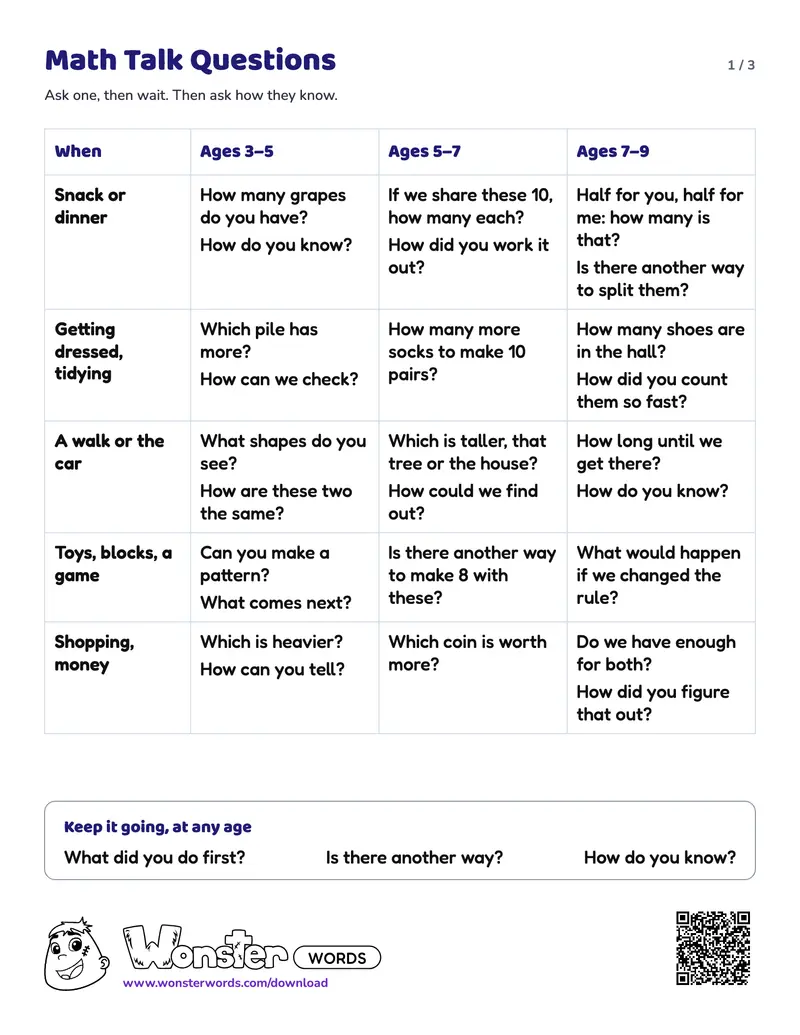
Ask the question in your child’s age column, and where a cell has a second question, ask that one next:
| When | Ages 3–5 | Ages 5–7 | Ages 7–9 |
|---|---|---|---|
| Snack or dinner | How many grapes do you have? How do you know? | If we share these 10, how many each? How did you work it out? | Half for you, half for me: how many is that? Is there another way to split them? |
| Getting dressed, tidying | Which pile has more? How can we check? | How many more socks to make 10 pairs? | How many shoes are in the hall? How did you count them so fast? |
| A walk or the car | What shapes do you see? How are these two the same? | Which is taller, that tree or the house? How could we find out? | How long until we get there? How do you know? |
| Toys, blocks, a game | Can you make a pattern? What comes next? | Is there another way to make 8 with these? | What would happen if we changed the rule? |
| Shopping, money | Which is heavier? How can you tell? | Which coin is worth more? | Do we have enough for both? How did you figure that out? |
Three follow-ups keep any question going: “What did you do first?”, “Is there another way?”, and “How do you know?” Then wait. Count to five in your head before you help, say your child’s steps back to them (“So you counted the big ones first”), and treat two different right answers as two right answers.
These are the open “what”, “why”, and “how” questions the What Works Clearinghouse’s Teaching Math to Young Children asks for under its recommendation to teach children to describe their world mathematically, rated Minimal evidence. At home, the evidence is a link. In a 2010 study by Susan Levine and colleagues that filmed families at home, how much parents talked about numbers with their toddlers predicted how well the children understood what number words mean by preschool. The link held even allowing for family income and education. That is a link, not proof that the talk caused it, and it is reason enough to try two minutes a day.
Free PDF · no sign-up
Feedback?Free math talk question cards
This PDF is free and prints in black and white. Page 1 is the questions above for the fridge, page 2 is the same questions as cards to cut out for the car or a snack drawer, and the last page is for grown-ups. There is no answer key, because any answer your child gives is worth talking about.
- Math Talk Questions (PDF)26 questions · 3 pages
Preview page 1Preview
What if my child is not meeting math milestones?
A missing skill in October is not a missing skill in June. The milestones are where a skill lands by the end of the year, and children land them months apart. Start with one step back: find your child’s skill in our scope and sequence, go to the step before it, and play that step’s game a few minutes a day. Then talk to the teacher about what the class is working on and what they see.
When it is more than one step, or the teacher raises it, there is more to do at home and at school. When math and reading are both behind, the reading side is on when your child is behind in reading.
Our PreK-3 math scope and sequence
Our PreK-3 math scope and sequence is the order this site teaches math in, from preschool to third grade: each year’s topics by strand, the Common Core and Texas codes beside each one, and the page that teaches it. Common Core decides the grade; the order within a grade follows the majority of US school curricula; and Texas sits beside it on every row. It is the website’s sequence, built from the standards and the curricula, not an app’s.
The spine is the one progression every program agrees on, with the grade where each step lands:
- See up to 5 things at a glance (subitizing): preschool.
- Count with cardinality to 10, the last number counted telling how many (how children learn to count): preschool.
- Put together and break apart numbers to 10 (number bonds, ten frames): kindergarten.
- Teen numbers as ten and some ones (place value): kindergarten, first grade in Texas.
- Make-ten strategies within 20 (doubles and make ten): first grade.
- Tens and ones to 120 (place value): first grade.
- Place value to 1,000 and the number line (number line): second grade.
- Equal groups, skip counting, and arrays (arrays): second grade.
- Multiplication facts and area (times tables, area model): third grade.
- Fractions as numbers on the number line (fractions on a number line): third grade.
The five tables below give every topic. Topics with no page on this site yet, mostly measurement, time, money, and graphs, are plain text. In Texas, money starts earlier and place value reaches further, and the rows say so.
Preschool math scope and sequence
Kindergarten math scope and sequence
| What children learn | Common Core | Texas |
|---|---|---|
| Counting and number sense | ||
| Count to 100 by ones and by tens | K.CC.A.1 | K.5 |
| Count forward from any number | K.CC.A.2 | K.2(A); forward and backward to 20 |
| Read and write numbers 0 to 20 | K.CC.A.3 | K.2(B) |
| Count objects and say how many; count out a number | K.CC.B.4–5 | K.2(C) |
| See small amounts without counting | None | K.2(D) |
| Compare groups and numbers to 10 | K.CC.C.6–7 | K.2(E), K.2(G)–(H); to 20 |
| One more (and, in Texas, one less) | K.CC.B.4c | K.2(F) |
| Addition and subtraction | ||
| Add and take away within 10 with objects, fingers, and story problems | K.OA.A.1–2 | K.3(A)–(C) |
| Break numbers to 10 into two parts in more than one way, and find the partner that makes 10 | K.OA.A.3–4 | K.2(I) |
| Add and subtract within 5 without counting every one | K.OA.A.5 | No kindergarten fluency target |
| Place value | ||
| See 11 to 19 as ten ones and some more ones | K.NBT.A.1 | First grade, 1.2(B) |
| Measurement, time, and money | ||
| Compare length, weight, and how much a container holds | K.MD.A.1–2 | K.7(A)–(B) |
| Name the coins: penny, nickel, dime, quarter | Second grade, 2.MD.C.8 | K.4 |
| Earning, gifts, wants, and needs | Not in Common Core | K.9(A)–(D) |
| Shapes and space | ||
| Name flat and solid shapes whatever their size or turn | K.G.A.2–3 | K.6(A)–(C) |
| Describe, compare, build, and join shapes | K.G.B.4–6 | K.6(D)–(F) |
| Position words: above, below, beside, in front of, behind, next to | K.G.A.1 | Pre-K only |
| Patterns, data, and the equal sign | ||
| Sort things, count each group, and compare the groups | K.MD.B.3 | K.8(A)–(C) |
| Copy, extend, and make patterns | None | Pre-K only (PK4.V.E.3) |
The worksheets and games for this year are on the kindergarten math page.
1st grade math scope and sequence
| What children learn | Common Core | Texas |
|---|---|---|
| Addition and subtraction | ||
| Add and subtract within 20 by strategy: count on, doubles, near doubles, make ten | 1.OA.B.3, 1.OA.C.5–6 | 1.3(C)–(E) |
| Fact families, and subtraction as a missing addend ("think addition") | 1.OA.B.4 | Related: 1.5(F)–(G) |
| Word problems of every type within 20, the unknown in any place; adding three numbers | 1.OA.A.1–2 | 1.3(B), 1.3(F), 1.5(D) |
| Add within 100: a two-digit number plus a one-digit number or a ten | 1.NBT.C.4 | 1.3(A) |
| Ten more and ten less in your head; subtract tens | 1.NBT.C.5–6 | 1.5(C) |
| Patterns, data, and the equal sign | ||
| The equal sign means "the same as"; true or false equations; the missing number | 1.OA.D.7–8 | 1.5(E)–(F) |
| Sort data into up to 3 groups and read the counts | 1.MD.C.4 | 1.8(A)–(C) |
| Counting and number sense | ||
| Count, read, and write to 120 from any number | 1.NBT.A.1 | 1.5(A); forward and backward |
| Place value | ||
| Tens and ones: 10 as a bundle of ten ones | 1.NBT.B.2 | 1.2(B)–(C) |
| Compare two-digit numbers with >, =, and < | 1.NBT.B.3 | 1.2(D)–(G) |
| Skip count by 2s, 5s, and 10s | Second grade, 2.NBT.A.2 | 1.5(B) |
| Measurement, time, and money | ||
| Order things by length; measure with same-size units, no gaps or overlaps | 1.MD.A.1–2 | 1.7(A)–(D) |
| Tell time to the hour and half hour | 1.MD.B.3 | 1.7(E) |
| Coin names and values; count coins (most schools start coins this year) | Second grade, 2.MD.C.8 | 1.4(A)–(C) |
| Earning, saving, spending, and giving | Not in Common Core | 1.9(A)–(D) |
| Shapes and space | ||
| Name a shape by what makes it that shape (sides, corners, faces), flat and solid | 1.G.A.1 | 1.6(A)–(E) |
| Build new shapes from shapes | 1.G.A.2 | 1.6(F) |
| Fractions | ||
| Halves and fourths (quarters) of circles and rectangles | 1.G.A.3 | 1.6(G)–(H) |
The worksheets and games for this year are on the 1st grade math page.
2nd grade math scope and sequence
| What children learn | Common Core | Texas |
|---|---|---|
| Addition and subtraction | ||
| Every sum of two one-digit numbers from memory (within 20) | 2.OA.B.2 | 2.4(A) |
| One- and two-step word problems within 100 | 2.OA.A.1 | 2.4(C)–(D), 2.7(C); within 1,000 |
| Add and subtract within 100, with regrouping | 2.NBT.B.5–6, 2.NBT.B.9 | 2.4(B) |
| Add and subtract within 1,000 with models | 2.NBT.B.7 | Within 1,000 in word problems, 2.4(C) |
| 10 or 100 more or less in your head | 2.NBT.B.8 | 2.7(B) |
| Place value | ||
| Hundreds, tens, and ones to 1,000 | 2.NBT.A.1 | 2.2(A); to 1,200 |
| Count to 1,000; skip count by 5s, 10s, and 100s | 2.NBT.A.2 | Skip counting is first grade, 1.5(B) |
| Expanded form | 2.NBT.A.3 | 2.2(B) |
| Compare three-digit numbers | 2.NBT.A.4 | 2.2(C)–(D) |
| Measurement, time, and money | ||
| Measure with a ruler in inches, feet, centimeters, and meters; estimate | 2.MD.A.1–4 | 2.9(A)–(E) |
| Whole numbers on a number line | 2.MD.B.5–6 | None |
| Tell time to the nearest 5 minutes; a.m. and p.m. | 2.MD.C.7 | 2.9(G); to the minute |
| Money word problems with bills and coins | 2.MD.C.8 | 2.5(A)–(B) |
| Area by covering a shape with squares | Third grade, 3.MD.C.5 | 2.9(F) |
| Saving, spending, and borrowing | Not in Common Core | 2.11(A)–(F) |
| Patterns, data, and the equal sign | ||
| Odd and even numbers | 2.OA.C.3 | 2.7(A); to 40 |
| Picture graphs, bar graphs, and line plots | 2.MD.D.9–10 | 2.10(A)–(D) |
| Multiplication and division | ||
| Equal groups and arrays to 5 by 5, as repeated addition; rectangles in rows and columns | 2.OA.C.4, 2.G.A.2 | 2.6(A) |
| Sharing equally (the start of division) | Third grade, 3.OA.A.2 | 2.6(B) |
| Shapes and space | ||
| Triangles, quadrilaterals, pentagons, hexagons, and cubes | 2.G.A.1 | 2.8(A)–(E) |
| Fractions | ||
| Halves, thirds, and fourths of shapes; equal shares need not look the same | 2.G.A.3 | 2.3(A)–(D); halves, fourths, and eighths |
The worksheets and games for this year are on the 2nd grade math page.
3rd grade math scope and sequence
| What children learn | Common Core | Texas |
|---|---|---|
| Multiplication and division | ||
| Multiplication as equal groups and arrays | 3.OA.A.1 | 3.4(D)–(E) |
| Division as sharing and as grouping; division as a missing factor | 3.OA.A.2, 3.OA.B.6 | 3.4(H), 3.4(J) |
| Word problems with equal groups, arrays, and measures; the unknown number | 3.OA.A.3–4 | 3.4(K), 3.5(D) |
| Properties: turnarounds, grouping, and breaking a fact apart | 3.OA.B.5 | None |
| Multiplication facts by family: 2, 5, 10, then 0, 1, then 3, 4, then 6, 8, then 9, then 7 | 3.OA.C.7 | 3.4(F) |
| Multiply a one-digit number by a multiple of 10 | 3.NBT.A.3 | 3.4(G); two-digit by one-digit, with the standard algorithm |
| Measurement, time, and money | ||
| Area by counting unit squares | 3.MD.C.5–6, 3.MD.C.7d | 3.6(D) |
| Area as multiplication; the area model | 3.MD.C.7a–c | 3.6(C) |
| Tell time to the minute | 3.MD.A.1 | 3.7(C) |
| Elapsed time in minutes | 3.MD.A.1 | 3.7(C) |
| Mass and liquid volume: grams, kilograms, liters | 3.MD.A.2 | 3.7(D)–(E) |
| Perimeter | 3.MD.D.8 | 3.7(B) |
| Coins and bills | Second grade, 2.MD.C.8 | 3.4(C) |
| Saving, credit, and spending plans | Not in Common Core | 3.9(A)–(F) |
| Fractions | ||
| Unit fractions like 1/4, then fractions like 3/4 | 3.NF.A.1 | 3.3(C)–(D) |
| Fractions on a number line | 3.NF.A.2 | 3.3(A)–(B), 3.7(A); fractions stay at or below 1 |
| Equivalent fractions; whole numbers as fractions | 3.NF.A.3a–c | 3.3(F)–(G) |
| Compare fractions with the same top or bottom number | 3.NF.A.3d | 3.3(H) |
| Shapes split into equal parts, each part a unit fraction | 3.G.A.2 | 3.3(E), 3.6(E) |
| Addition and subtraction | ||
| Add and subtract within 1,000 | 3.NBT.A.2 | 3.4(A) |
| Two-step word problems with all four operations, checked by estimating | 3.OA.D.8 | 3.5(A)–(B) |
| Place value | ||
| Round to the nearest 10 and 100 | 3.NBT.A.1 | 3.2(C), 3.4(B) |
| Place value to 100,000 | Fourth grade | 3.2(A)–(B) |
| Patterns, data, and the equal sign | ||
| Patterns in the multiplication table | 3.OA.D.9 | Related: 3.5(E) |
| Scaled picture and bar graphs; line plots to the half and quarter inch | 3.MD.B.3–4 | 3.8(A)–(B) |
| Shapes and space | ||
| Quadrilaterals: rhombus, rectangle, square | 3.G.A.1 | 3.6(A)–(B) |
The worksheets and games for this year are on the 3rd grade math page.
Where parents trip. Coin names come in first grade at most schools and money problems in second (Common Core has money only in second grade; Texas names the coins in kindergarten). Time goes to the hour and half hour in first grade, 5 minutes in second, and the minute in third. Multiplication starts as arrays in second grade, with the facts in third. Fractions start as equal shares of shapes in first and second grade and become numbers in third. Practice is untimed until a child is accurate, and fingers are a legitimate tool on the way to seeing groups (“5 and 3”).
Some programs go faster in places. Singapore Math’s Dimensions Math teaches the multiplication tables of 2, 5, 10, 3, and 4 in second grade, and Beast Academy’s Level 1 books, for ages 6–8, reach numbers to 999.
Frequently asked questions
What math concepts should my child master by the end of each grade?
By the end of kindergarten, children are expected to add and subtract within 5 fluently and count to 100. By the end of first grade, they add and subtract within 10 fluently and within 20 with strategies. By the end of second grade, they know every sum of two one-digit numbers from memory and add and subtract within 100. By the end of third grade, they know every product of two one-digit numbers from memory, add and subtract within 1,000, and understand fractions as numbers.
What math skills should my child have by age 7?
Most 7-year-olds are at the end of first grade or the start of second. By the end of first grade, children add and subtract within 20 using strategies such as counting on, doubles, and making ten, are fluent within 10, count to 120, understand tens and ones, and tell time to the hour and half hour.
At what age should children master basic addition and subtraction?
By the end of second grade, usually around age 8, children are expected to know every sum of two one-digit numbers from memory and add and subtract within 20 fluently. Kindergartners are fluent within 5 and first graders within 10, so the facts build over three years.
What age should children be introduced to multiplication concepts?
Equal groups, skip counting, and arrays come in second grade, usually ages 7–8, as repeated addition. The multiplication facts themselves are third-grade work, and the Common Core expects every product of two one-digit numbers from memory by the end of third grade.
How can I tell if my child is progressing in math?
Ask the teacher what the class is working on and what they see, and read the report card, which at a school that grades by standards lists the grade's skills. Compare your child with what the grade expects by the end of the year, not today: children reach the same skill months apart. For preschool to first grade, a short number sense check-in at home shows which step your child is on.
Can early exposure to math affect later academic success?
Early math skills predict later school achievement. A 2007 analysis of six long-term studies by Greg Duncan and colleagues found the math skills children had at school entry were the strongest predictor of their later achievement. That is a link, not proof that teaching math earlier causes later success.
What are some popular kindergarten math games?
Card War played as greater wins, dice games that count dots without counting one by one, a race on a board numbered 1 to 10, and Go Fish where a pair is two cards that make 10. Each needs only cards, dice, or paper, and each works best when your child says the numbers aloud.
Are physical math games better than digital ones for kindergarten?
The one kind of math game that has been tested with young children is a physical board game numbered 1 to 10 in a straight line, played while saying each number aloud. A game at the table lets an adult hear every number the child says. A screen game can give practice too; judge any game by whether your child says or works out the numbers.
How can parents incorporate math learning into daily chores?
Count the plates as you set the table, one per person; sort the laundry and count the socks by 2s; ask how many more spoons are needed to make 10; and have an older child double a recipe or share snacks into equal bags. A few minutes inside something you already do counts.
What is the definition of math talk?
Math talk is everyday conversation with a child about numbers, shapes, and amounts, such as counting the stairs or asking who has more grapes. The most useful kind asks how as well as how many: after the answer, ask how your child knows, so the math goes into words. It is not a lesson and needs no worksheet.
How can I help my child enjoy learning math?
Keep practice short and often, play it as a game, and praise the try and the way your child worked it out rather than speed. Leave timing out until your child is accurate, and stop while it is still going well.
What if my child is not meeting math milestones?
Remember that a grade's milestones are where a skill lands by the end of the year. Go back one step in the sequence and practice that step for a few minutes a day, and talk to your child's teacher about what the class is on and what they see. If your child is more than one step behind, or the teacher raises it, ask the school what support is available.
Related guides
Last updated
Looking for something else?
Looking for something else?