
Math
Kindergarten Math
What children learn in kindergarten math by the end of the year, with the Common Core and Texas standards, free worksheets sorted by skill, how to tell if your child is on track, games for home, and how often to practice.
Kindergarten
Kindergarten math is mostly number. By the end of the year, most kindergartners count to 100 by ones and by tens, count a group of objects and say how many, read and write numbers to 20, compare two groups, and add and take away within 10 with objects, fingers, or drawings. They also name flat and solid shapes and say where things are.
The kindergarten standards describe the end of the year, and most of them are about number. A child partway through kindergarten is not behind for not having the list yet.
These free kindergarten math worksheets print in black and white with no account, in five trays by skill. The page covers:
- What kids learn in kindergarten math, with the Common Core and Texas standards.
- The worksheets: counting and numbers to 20, counting to 100, comparing and one more, adding and taking away within 10, and shapes, position words, and patterns.
- Is my child on track?, activities and games at home, and how often to practice.
Print from the tray for the skill your child is on now, not the hardest one.
What math do kids learn in kindergarten?
Kindergarten math covers two areas: numbers, with objects first, and shapes and space. The Common Core kindergarten introduction names them as “(1) representing and comparing whole numbers” and “(2) describing shapes and space”, and adds: “More learning time in Kindergarten should be devoted to number than to other topics.”
The table gives each topic a kindergartner works toward by the end of the year, by strand, number first, with the Common Core code and the Texas (TEKS) code beside it. Each topic links to the page that teaches it.
| What children learn | Common Core | Texas |
|---|---|---|
| Counting and number sense | ||
| Count to 100 by ones and by tens | K.CC.A.1 | K.5 |
| Count forward from any number | K.CC.A.2 | K.2(A); forward and backward to 20 |
| Read and write numbers 0 to 20 | K.CC.A.3 | K.2(B) |
| Count objects and say how many; count out a number | K.CC.B.4–5 | K.2(C) |
| See small amounts without counting | None | K.2(D) |
| Compare groups and numbers to 10 | K.CC.C.6–7 | K.2(E), K.2(G)–(H); to 20 |
| One more (and, in Texas, one less) | K.CC.B.4c | K.2(F) |
| Addition and subtraction | ||
| Add and take away within 10 with objects, fingers, and story problems | K.OA.A.1–2 | K.3(A)–(C) |
| Break numbers to 10 into two parts in more than one way, and find the partner that makes 10 | K.OA.A.3–4 | K.2(I) |
| Add and subtract within 5 without counting every one | K.OA.A.5 | No kindergarten fluency target |
| Place value | ||
| See 11 to 19 as ten ones and some more ones | K.NBT.A.1 | First grade, 1.2(B) |
| Measurement, time, and money | ||
| Compare length, weight, and how much a container holds | K.MD.A.1–2 | K.7(A)–(B) |
| Name the coins: penny, nickel, dime, quarter | Second grade, 2.MD.C.8 | K.4 |
| Earning, gifts, wants, and needs | Not in Common Core | K.9(A)–(D) |
| Shapes and space | ||
| Name flat and solid shapes whatever their size or turn | K.G.A.2–3 | K.6(A)–(C) |
| Describe, compare, build, and join shapes | K.G.B.4–6 | K.6(D)–(F) |
| Position words: above, below, beside, in front of, behind, next to | K.G.A.1 | Pre-K only |
| Patterns, data, and the equal sign | ||
| Sort things, count each group, and compare the groups | K.MD.B.3 | K.8(A)–(C) |
| Copy, extend, and make patterns | None | Pre-K only (PK4.V.E.3) |
How much addition and subtraction does a kindergartner do? Common Core asks kindergartners to add and subtract within 10 with objects, fingers, or drawings, and to be fluent within 5: its standard K.OA.A.5 says “Fluently add and subtract within 5.” Texas asks for sums up to 10 and differences within 10 with objects and drawings, and an explanation of the strategy, and sets no kindergarten fluency target. A kindergartner who still counts on fingers within 10 is doing what kindergarten asks. The addition and subtraction worksheets page sets each grade’s range beside its sheets, and the addition and subtraction guide explains the strategies in the order children learn them.
Texas places five things in kindergarten that Common Core does not. Texas asks kindergartners to count backward as well as forward to at least 20 (K.2(A)). It asks them to recognize small amounts instantly, without counting (K.2(D)). It has them name pennies, nickels, dimes, and quarters (K.4), where Common Core waits for second grade. It adds real-object and picture graphs (K.8). And it teaches earning, gifts, and wants and needs (K.9), which has no Common Core match. Texas also moves two things to first grade: teen numbers as ten and some ones (1.2(B)), and the hexagon (1.6(D)).
Teen numbers are where kindergarten meets place value. Common Core’s K.NBT.A.1 asks a kindergartner to see 11 to 19 as ten ones and some more ones. The place value guide explains why 13 is ten and three, and the ten frame shows it with a full frame and some more.
The year before is mostly objects and talk: counting a small group and saying how many. The year after, first grade adds and subtracts within 20 with strategies, counts to 120, splits two-digit numbers into tens and ones, and treats the equal sign as “the same as”. The standards name skills, not a program, so a school’s curriculum may teach them in a different order. Our PreK-3 math scope and sequence sets out one order, year by year.
Free kindergarten math worksheets by skill, with answer keys
These free kindergarten math worksheets are sorted by the skill they practice, in five trays. Each PDF prints in black and white and needs no account and no email. Each sheet comes from the page that teaches its skill, named above its tray. Each download line says whether the sheet has an answer key: practice sheets do, at the back, and charts and cards have nothing to answer.
To choose a tray: start with tray 1 if your child still counts objects one by one, and tray 2 once your child counts past 20. Tray 3 suits a child who can count out a number on request, and tray 4 follows it. Shapes, position words, and patterns, in tray 5, fit at any point in the year. Print one sheet, not a whole tray.
1. Counting and numbers to 20
Counting and numbers to 20 are the first kindergarten skills: seeing small amounts, counting objects, and reading and writing the numerals. The sheets come from subitizing, how children learn to count, number tracing, and the ten frame pages.
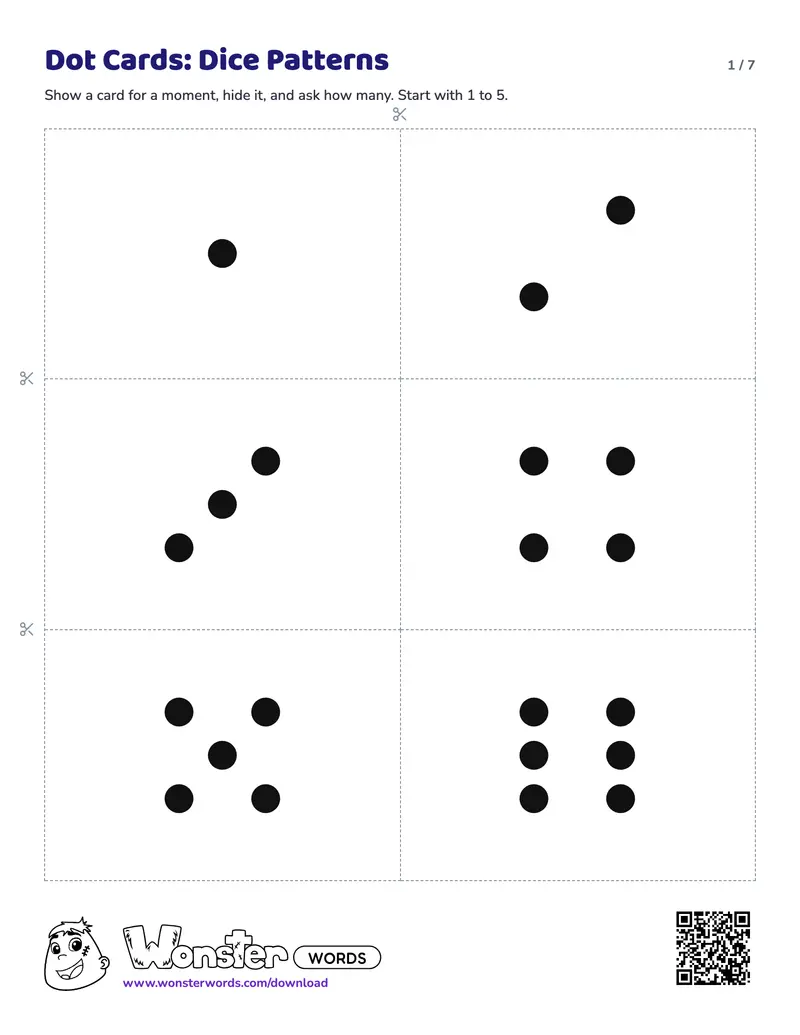
- Dot Cards. Dice patterns and scattered dots from 1 to 10 to cut out, to name at a glance and match to numerals.
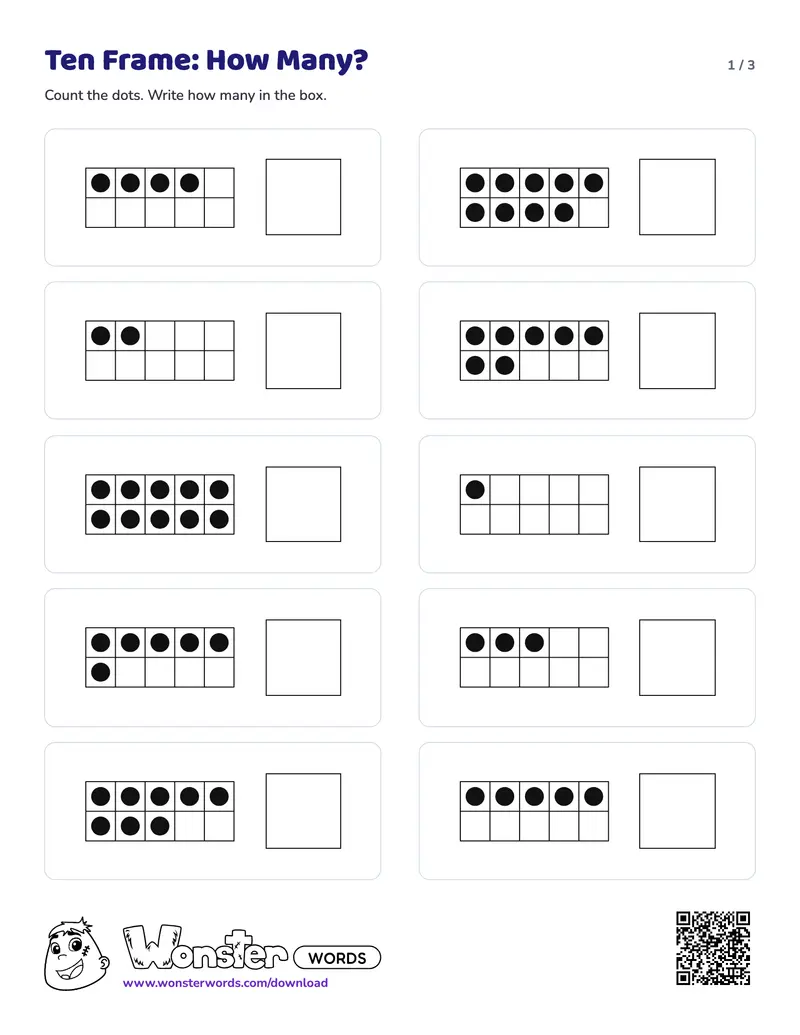
- Ten Frame: Count and Write. Your child writes how many dots are in each frame, then draws the dots a numeral asks for.
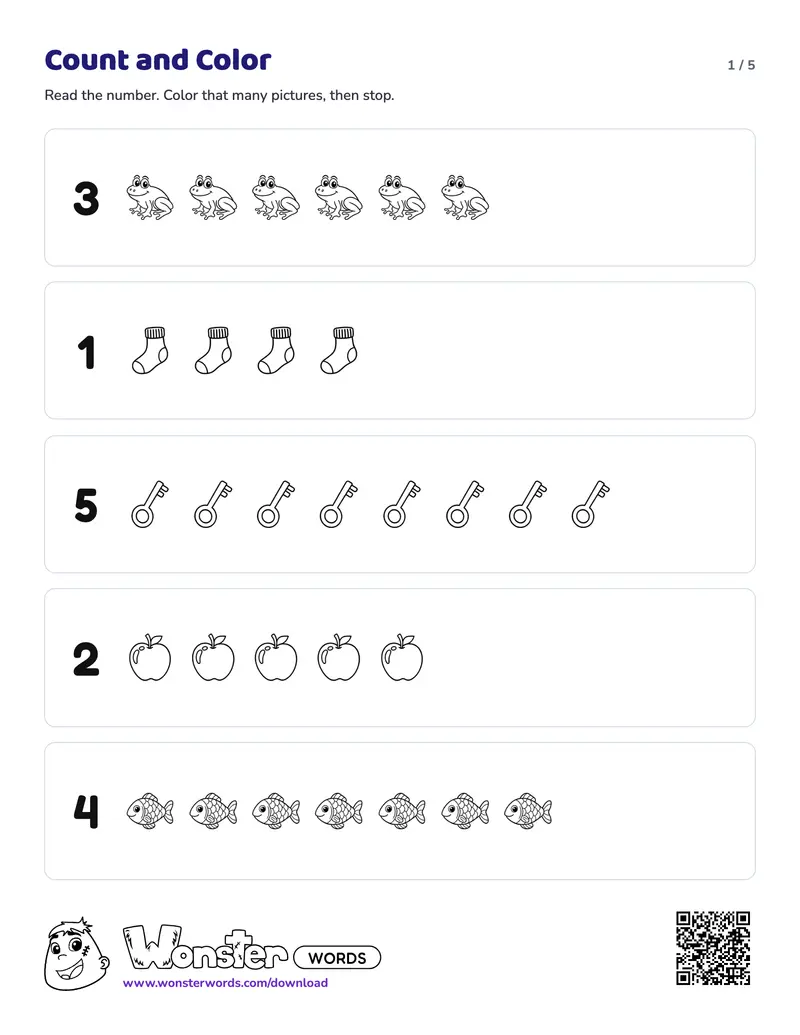
- Count and Color. Your child colors just the number of pictures each row asks for, out of more than that.
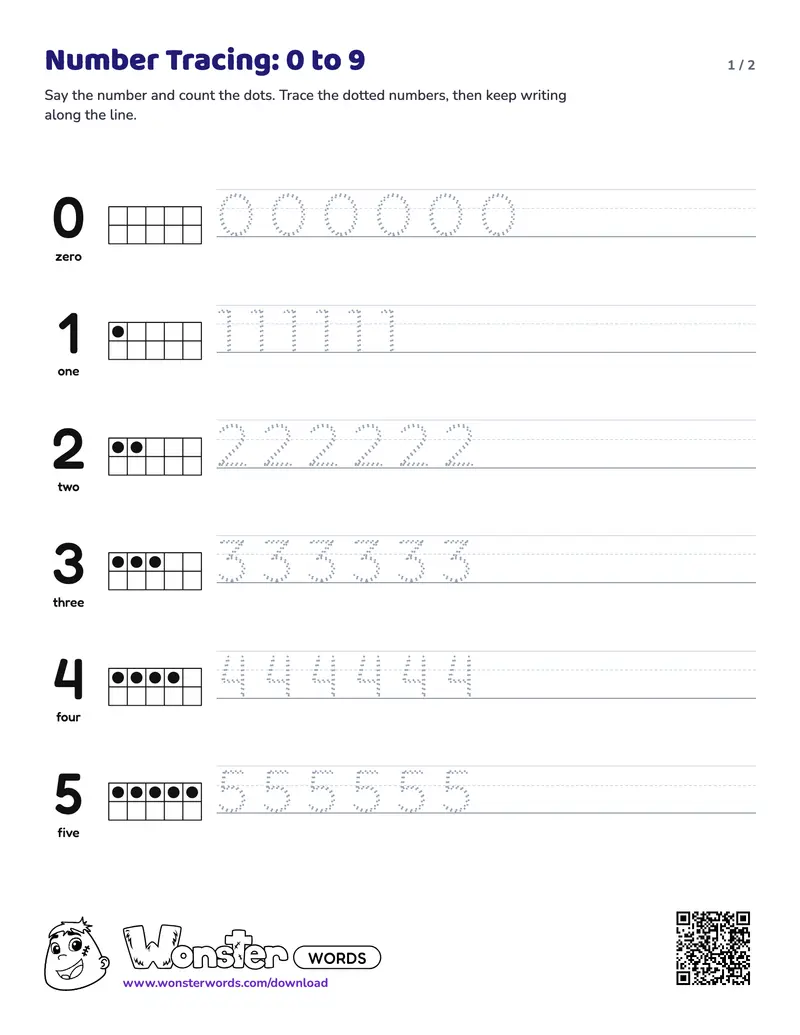
- Number Tracing 0-9. Each numeral with a ten frame and its word, to trace. It suits the start of the year.
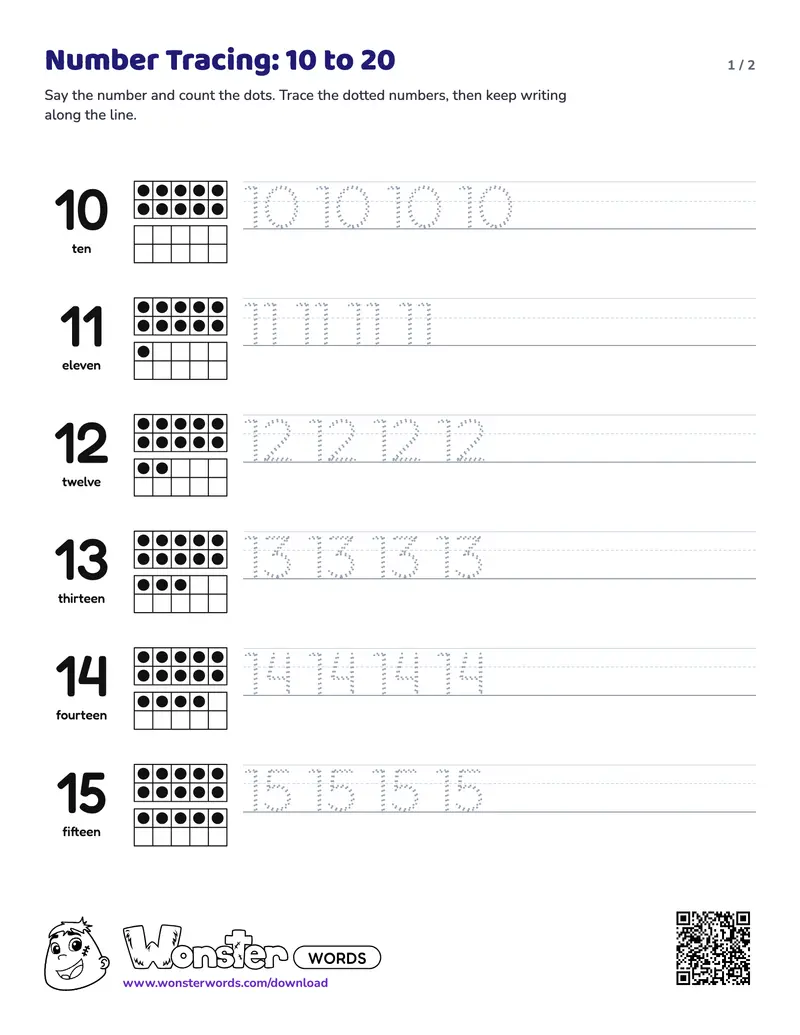
- Number Tracing 10-20. The teen numbers, each shown as a full ten frame and some more.
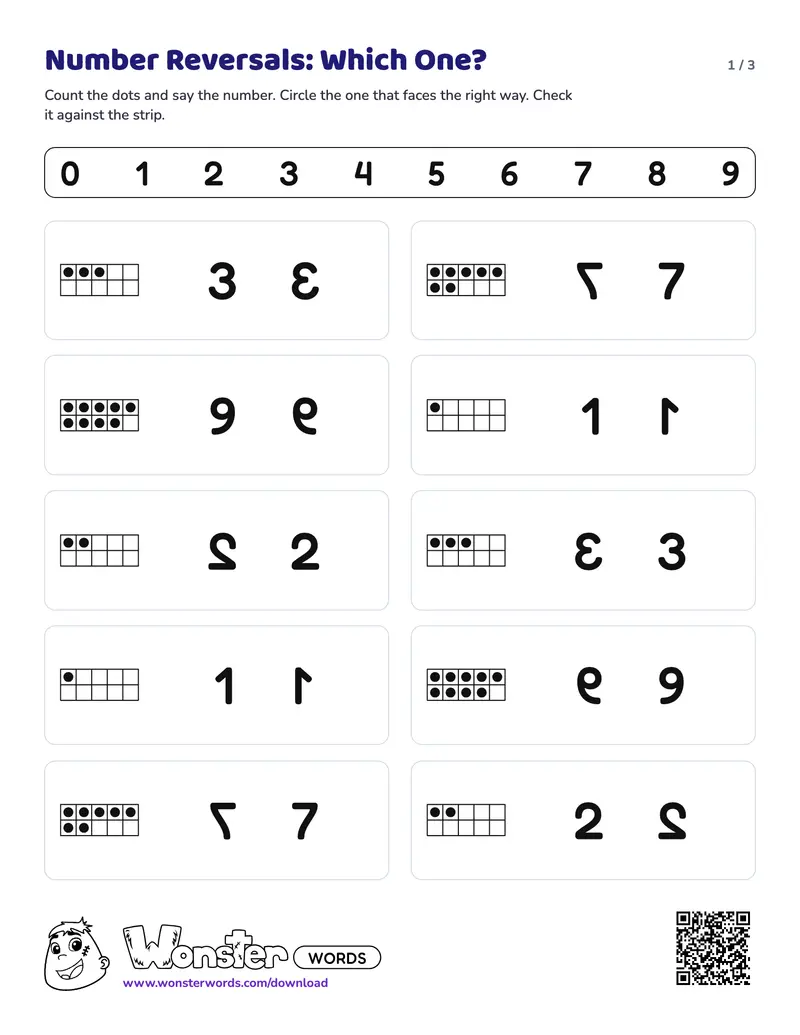
- Number Reversals: Which One? Your child circles the digit that faces the right way, for 1, 2, 3, 7, and 9, the digits children write backwards most.
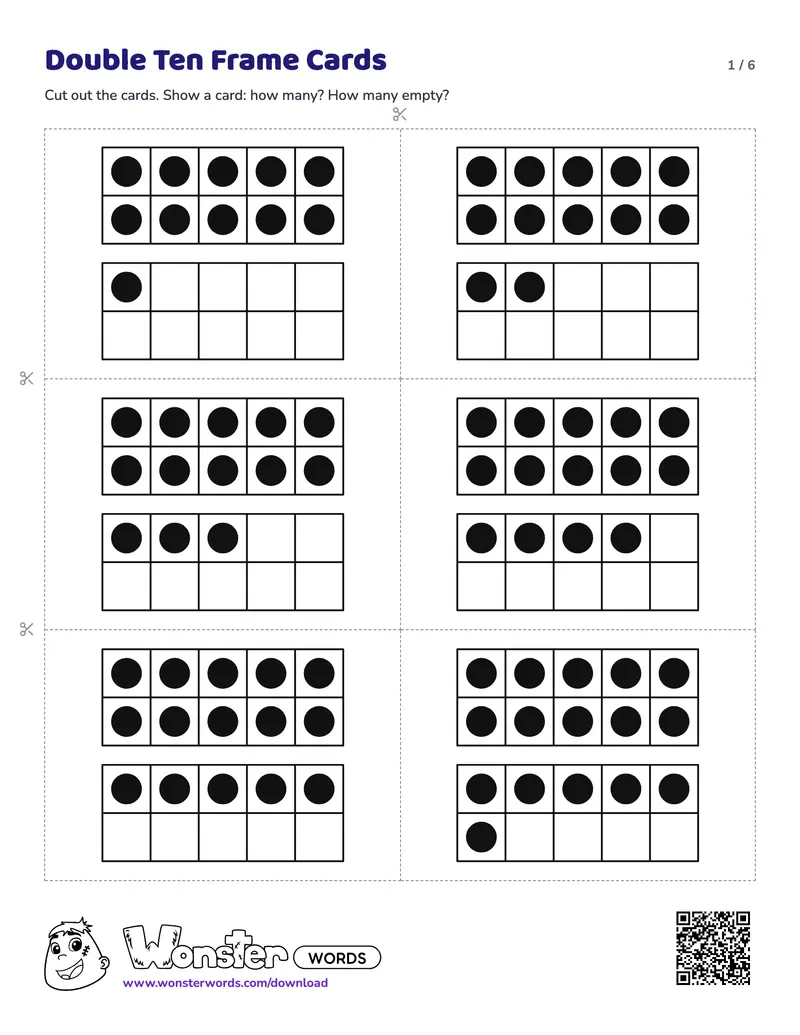
- Double Ten Frame Cards. Cards for 11 to 20, the first frame always full, so a teen number reads as ten and some more (K.NBT.A.1).
Free PDF · no sign-up
Feedback?Counting and numbers to 20
Seven free PDFs in black and white, from seeing amounts at a glance to writing the teen numbers. Each download line says whether the sheet has an answer key.
- Dot Cards (PDF)30 cards · answer key included · 8 pages
Preview page 1Preview
- Ten Frame: Count and Write (PDF)40 ten-frames · answer key included · 7 pages
Preview page 1Preview
- Count and Color (PDF)25 rows to color · 6 pages
Preview page 1Preview
- Number Tracing 0-9 (PDF)10 numbers · 3 pages
Preview page 1Preview
- Number Tracing 10-20 (PDF)11 numbers · 3 pages
Preview page 1Preview
- Number Reversals: Which One? (PDF)5 digits · answer key included · 7 pages
Preview page 1Preview
- Double Ten Frame Cards (PDF)10 cards · answer key included · 6 pages
Preview page 1Preview
2. Counting to 100
Counting to 100 by ones and by tens is the kindergarten counting standard (K.CC.A.1), and counting on from any number is the next (K.CC.A.2). The sheets come from the counting to 100 and hundreds chart pages.
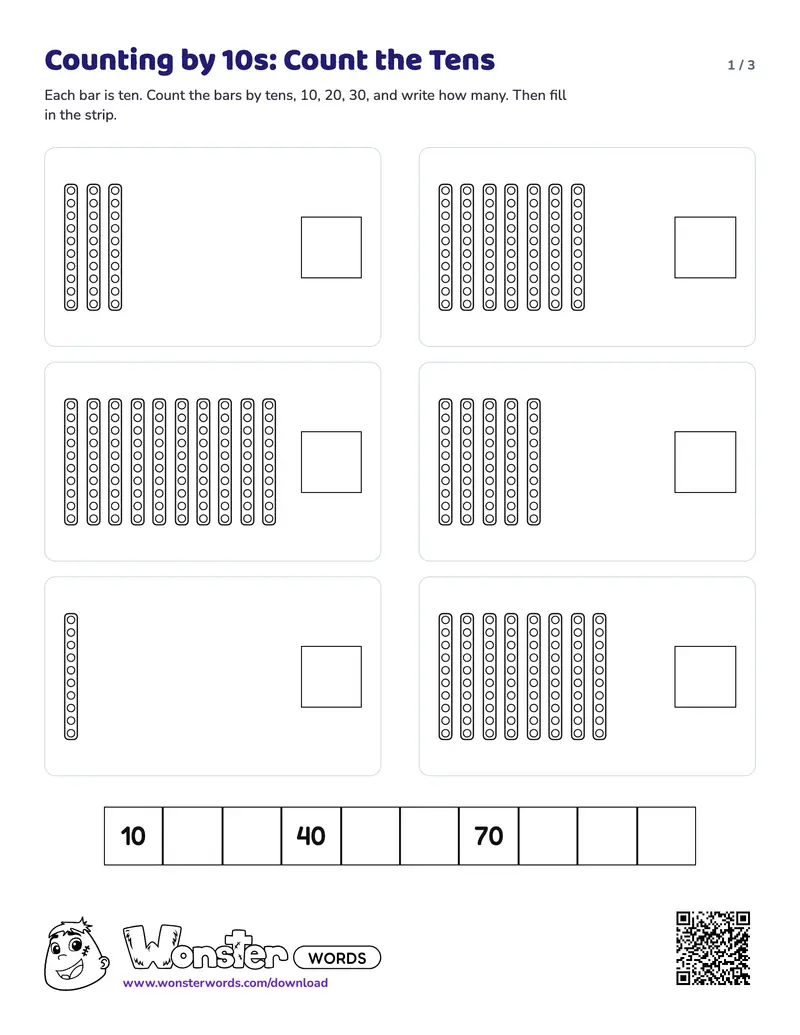
- Counting by 10s. Your child counts bars of ten by tens and fills in a 10 to 100 strip.
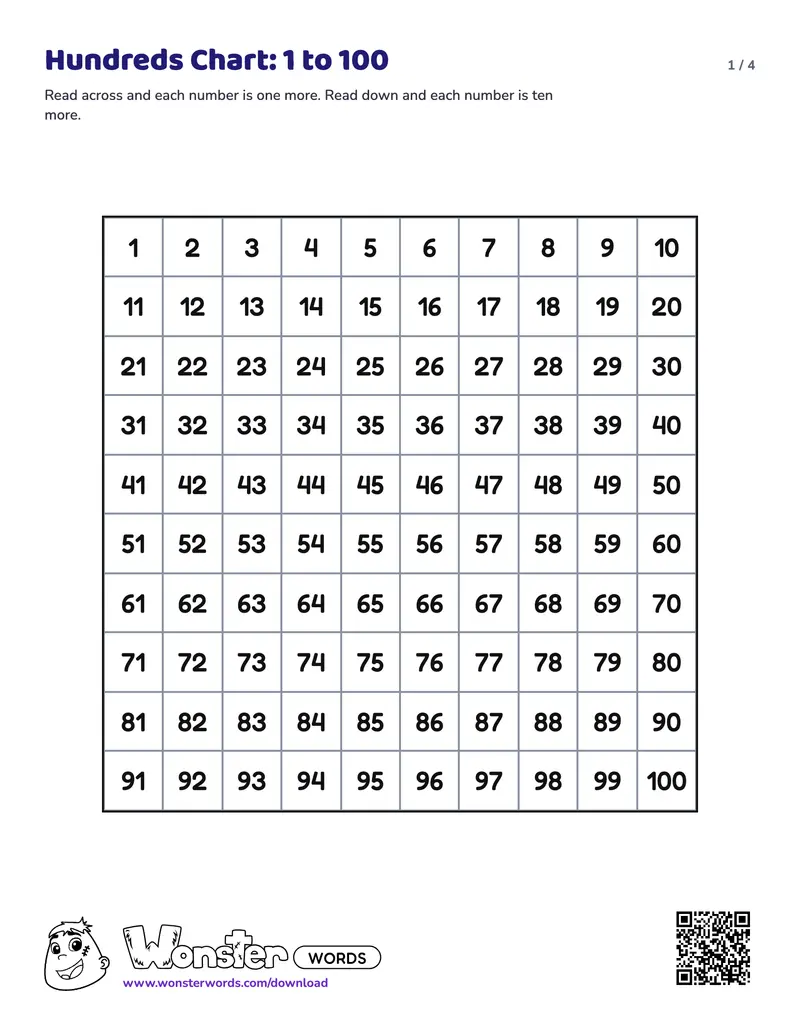
- Hundreds Chart. A 1 to 100 chart to read from, with a 1 to 120 chart for later.
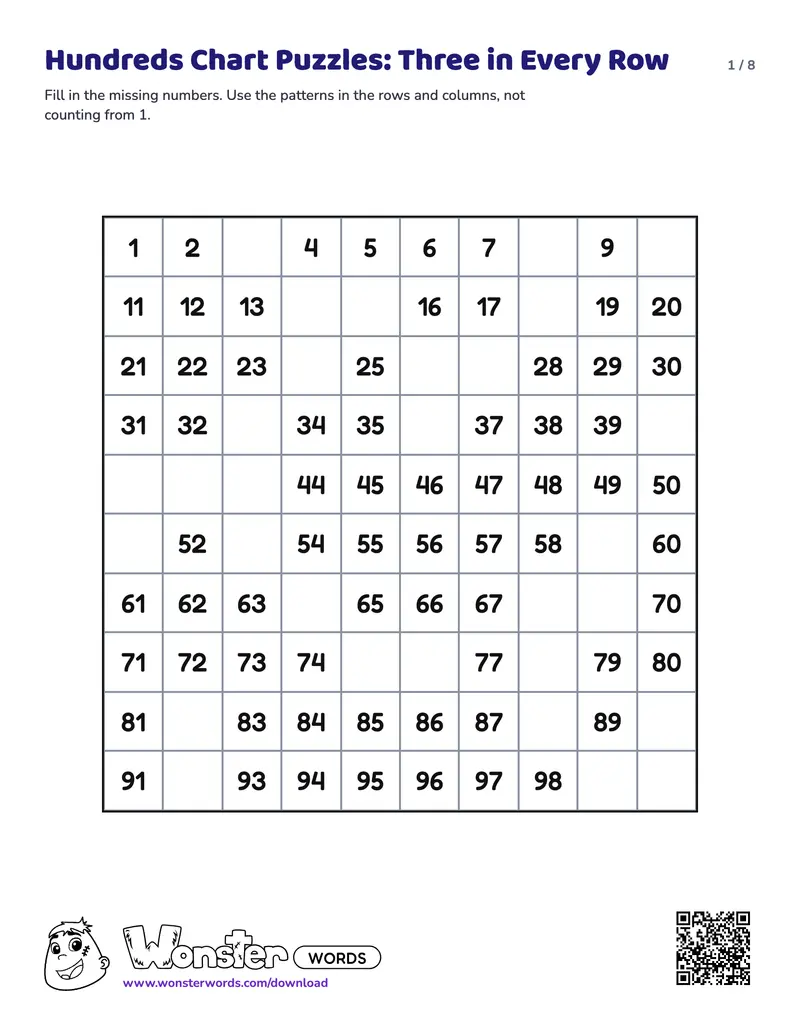
- Hundreds Chart Puzzles. Charts with numbers missing, easiest first.
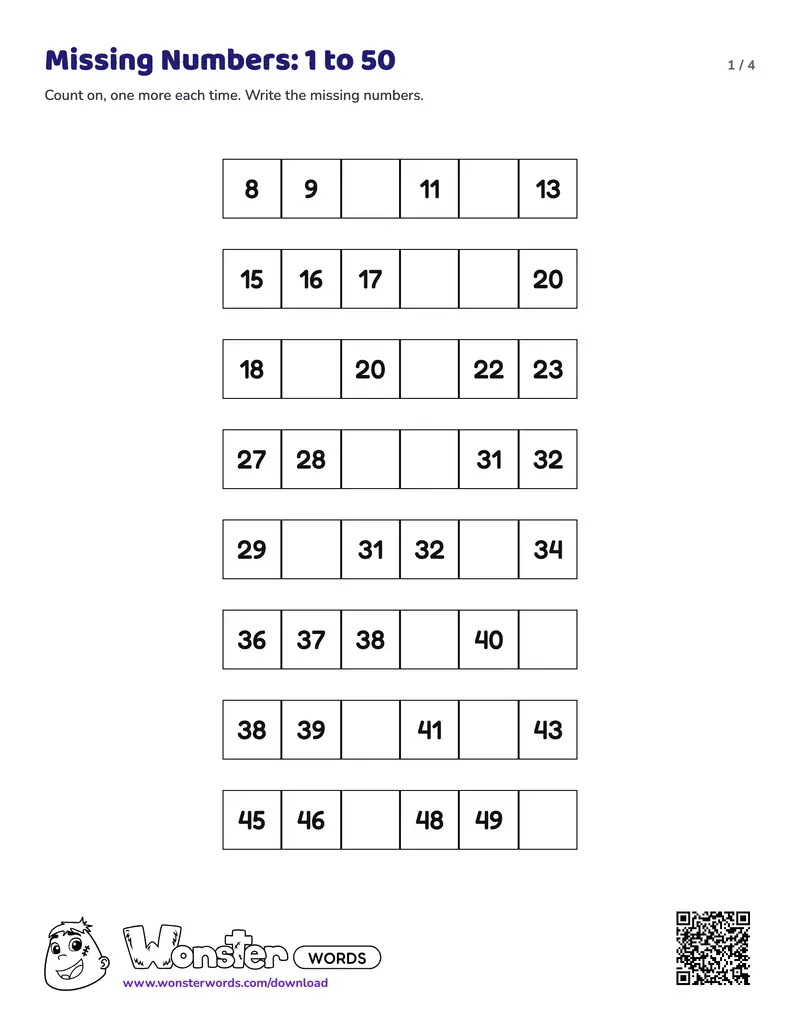
- Missing Numbers to 120. Number strips with two numbers missing, each crossing a ten.
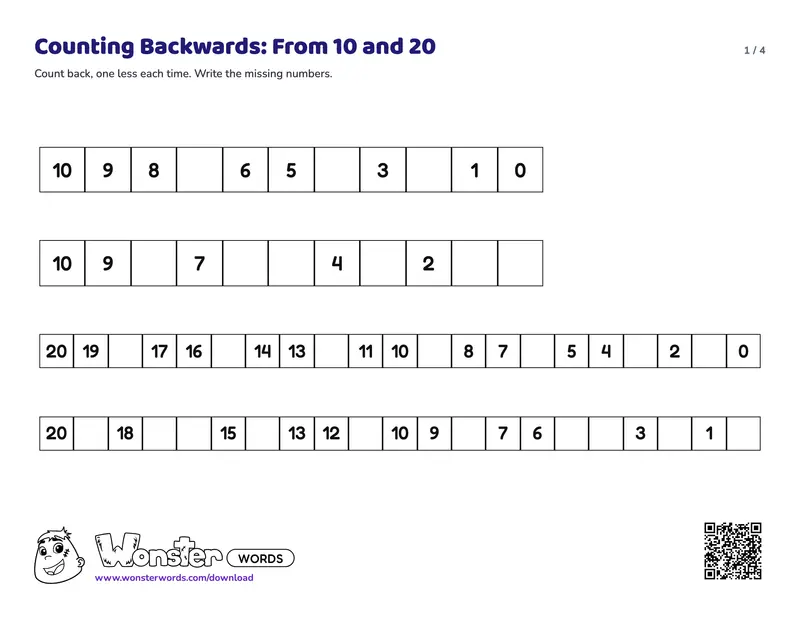
- Counting Backwards. Strips counting down from 10 and from 20, the Texas kindergarten standard K.2(A).
Missing Numbers to 120 and Counting Backwards go past 100 on their last pages, which are first grade work.
Free PDF · no sign-up
Feedback?Counting to 100
Five free PDFs in black and white for counting by ones and tens, filling in the hundreds chart, and counting back. Each download line says whether the sheet has an answer key.
- Counting by 10s (PDF)64 numbers to write · answer key included · 7 pages
Preview page 1Preview
- Hundreds Chart (PDF)120 numbers · 5 pages
Preview page 1Preview
- Hundreds Chart Puzzles (PDF)200 missing numbers · answer key included · 17 pages
Preview page 1Preview
- Missing Numbers to 120 (PDF)48 missing numbers · answer key included · 5 pages
Preview page 1Preview
- Counting Backwards (PDF)64 missing numbers · answer key included · 5 pages
Preview page 1Preview
3. Comparing and one more
Comparing two groups and knowing one more are kindergarten number sense (K.CC.C.6 and K.CC.B.4c). The sheets come from the greater than, less than and one more, one less pages.
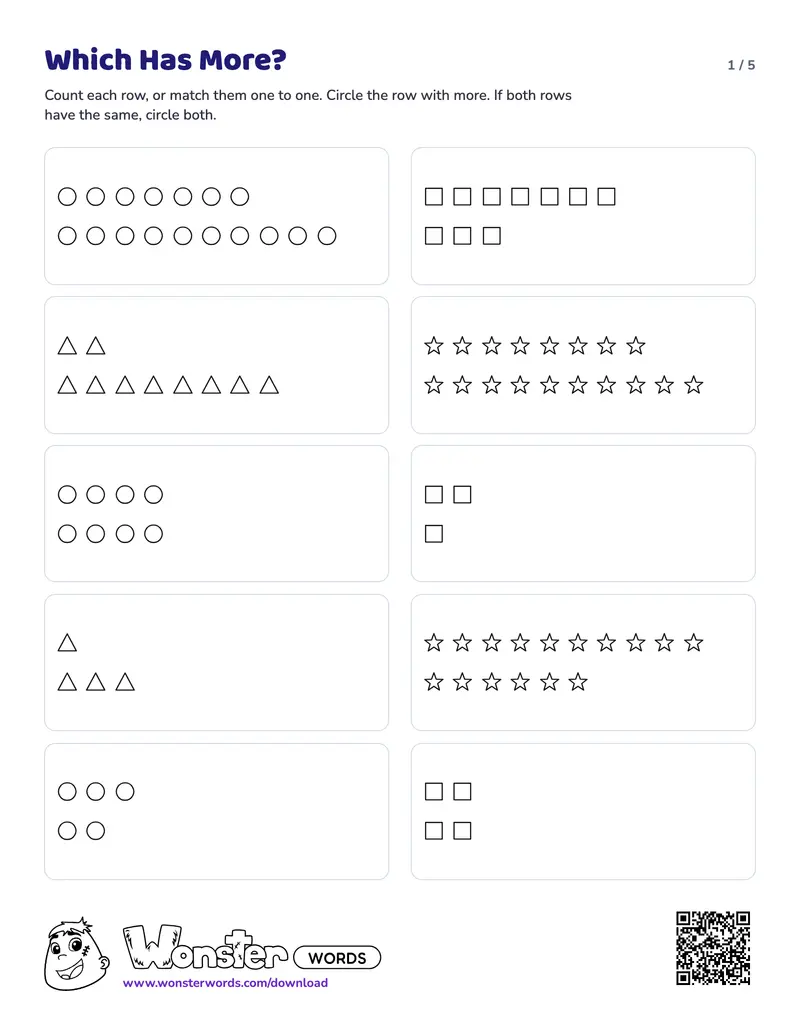
- Which Has More? Two rows of shapes lined up to match one to one, and your child circles the row with more, or both when they are the same.
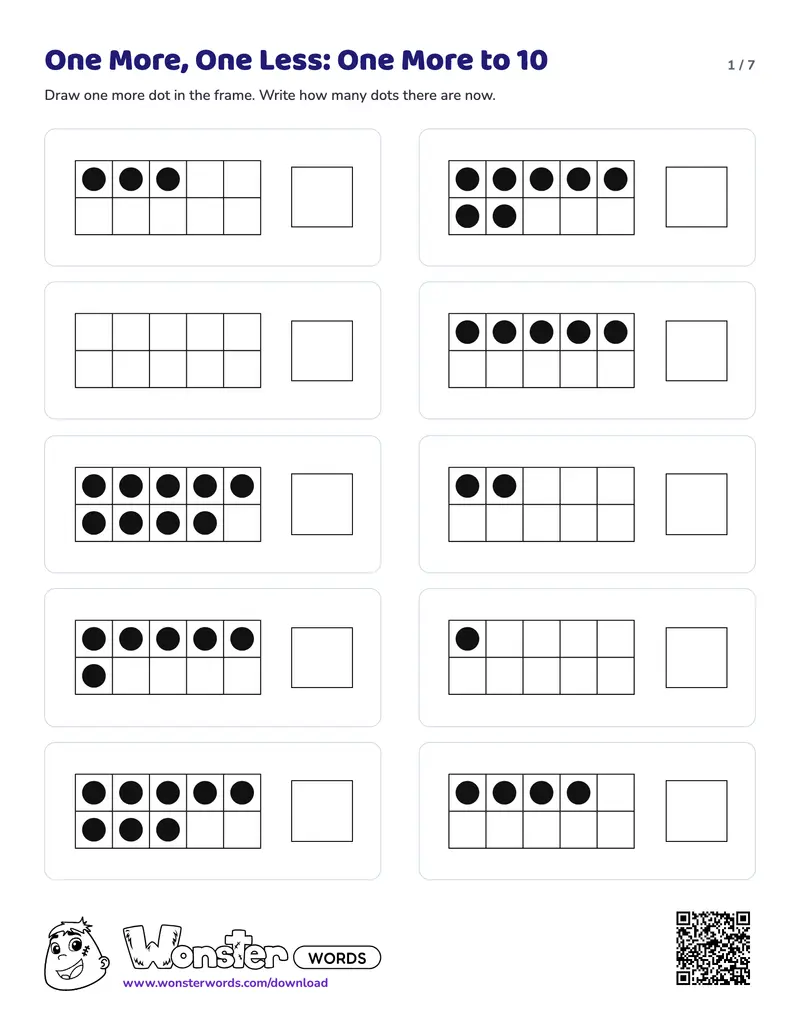
- One More, One Less. Ten frames to 10 and number tracks to 20. Its last pages, ten more and ten less, are first grade work.
Free PDF · no sign-up
Feedback?Comparing and one more
Two free PDFs in black and white for comparing groups before numbers, and for one more and one less. Both end with an answer key.
- Which Has More? (PDF)40 comparisons · answer key included · 6 pages
Preview page 1Preview
- One More, One Less (PDF)160 numbers to write · answer key included · 14 pages
Preview page 1Preview
4. Adding and taking away within 10
Adding and taking away within 10, and the story problems that go with them, are the kindergarten operations standards (K.OA.A.1 to K.OA.A.5). The sheets come from the addition and subtraction worksheets and number bonds pages.
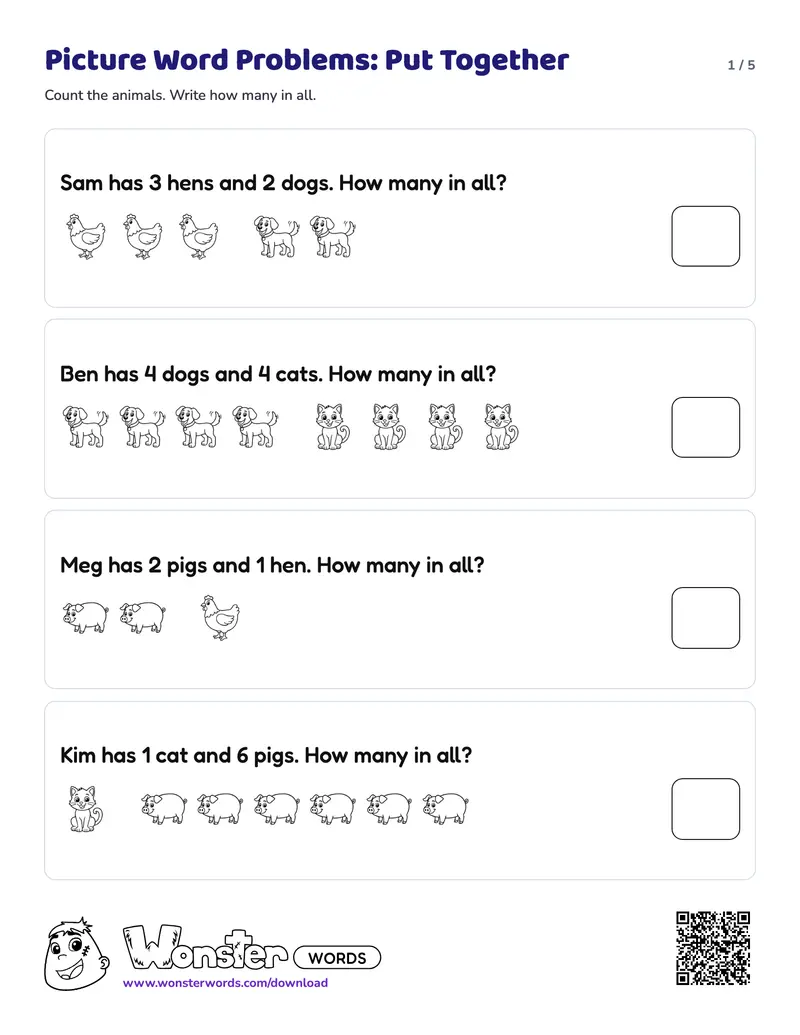
- Picture Word Problems: Put Together. Kindergarten math problems in pictures: two groups of animals to count and write how many in all.
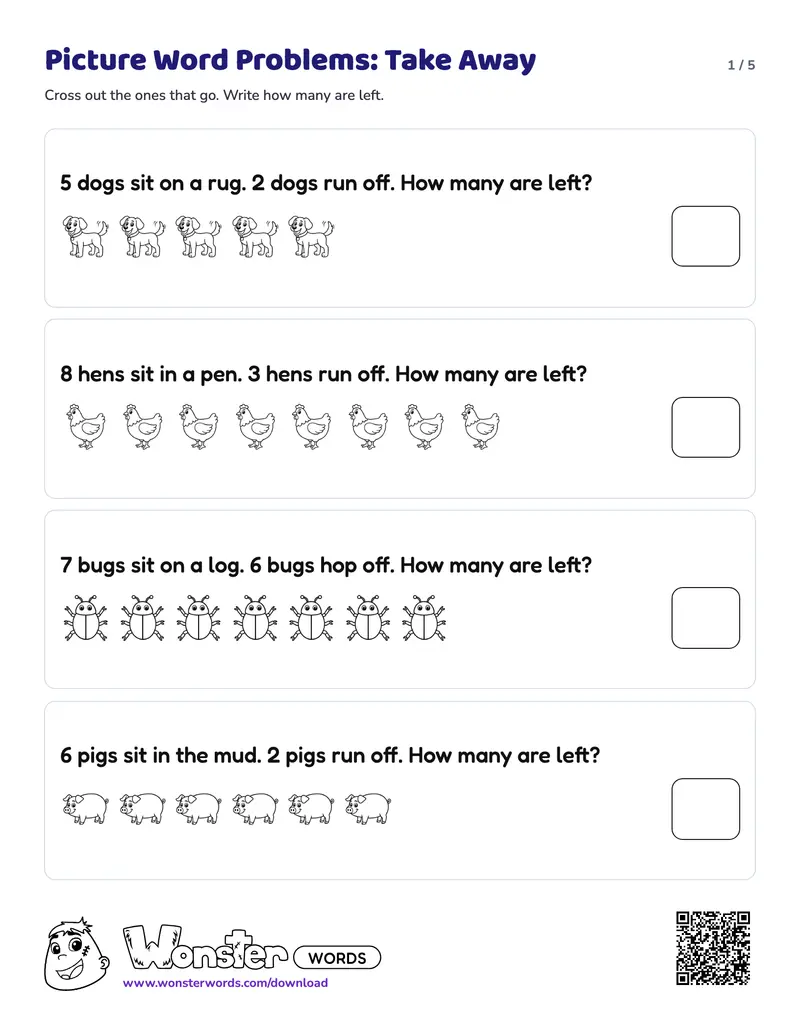
- Picture Word Problems: Take Away. Your child crosses out the animals that go and writes how many are left.
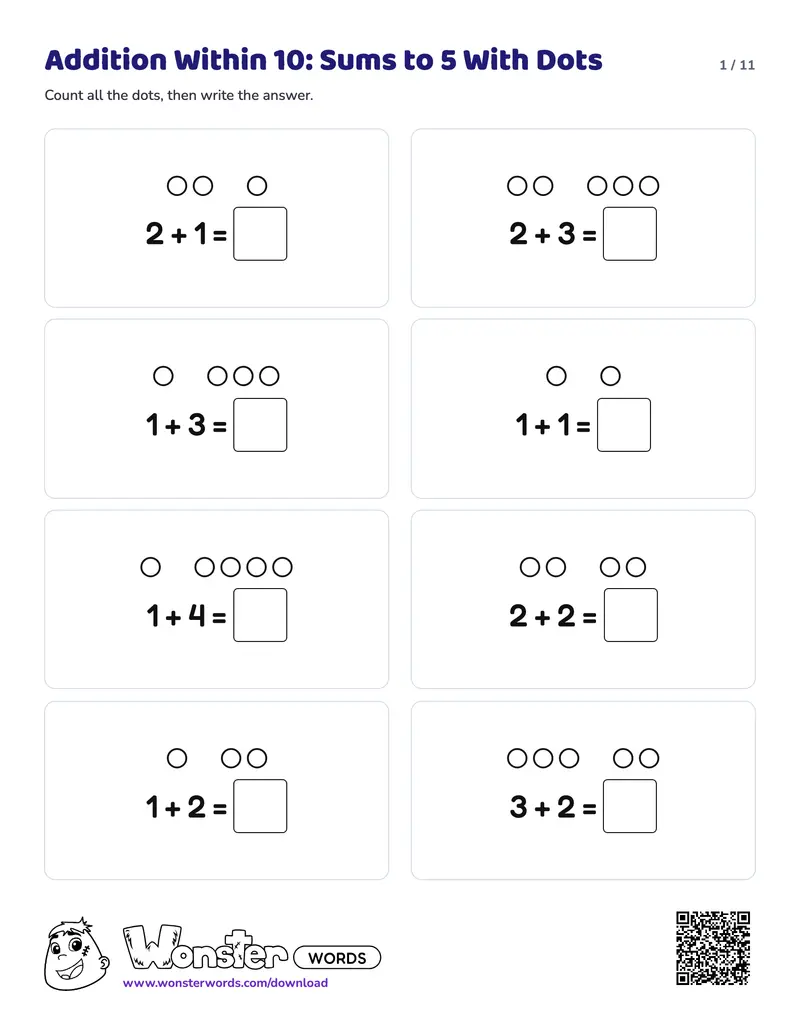
- Addition Within 10. Sums to 5 with dots to count, then sums to 10.
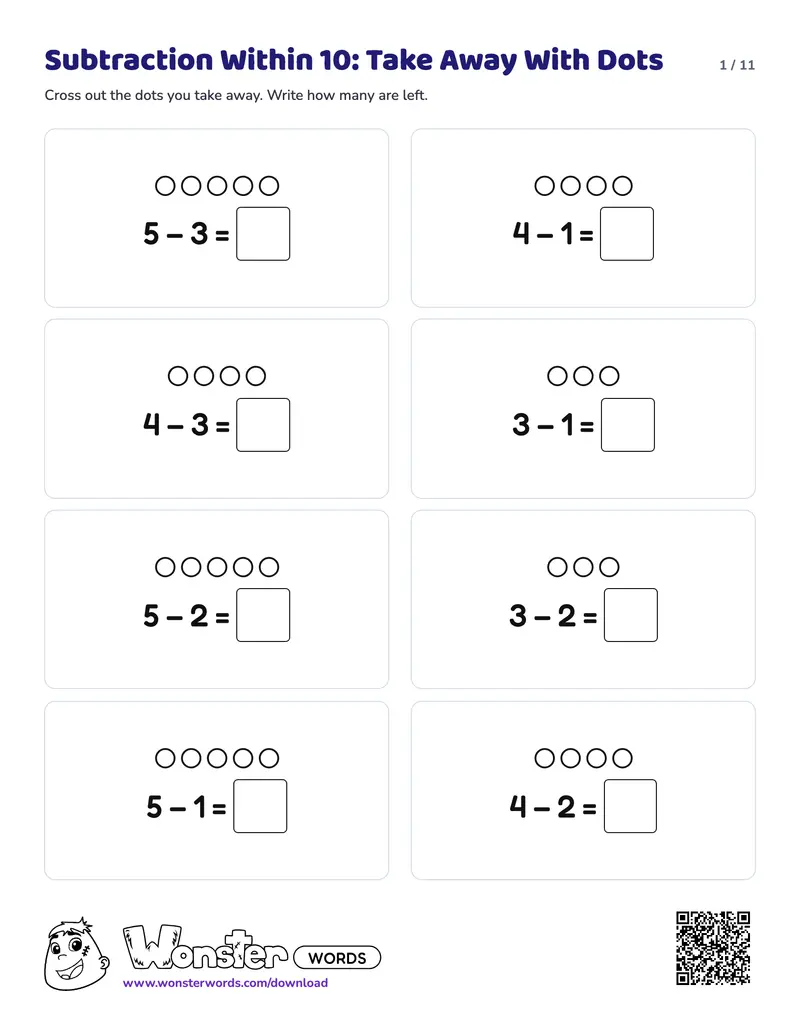
- Subtraction Within 10. Taking away within 5 by crossing out dots, then within 10.
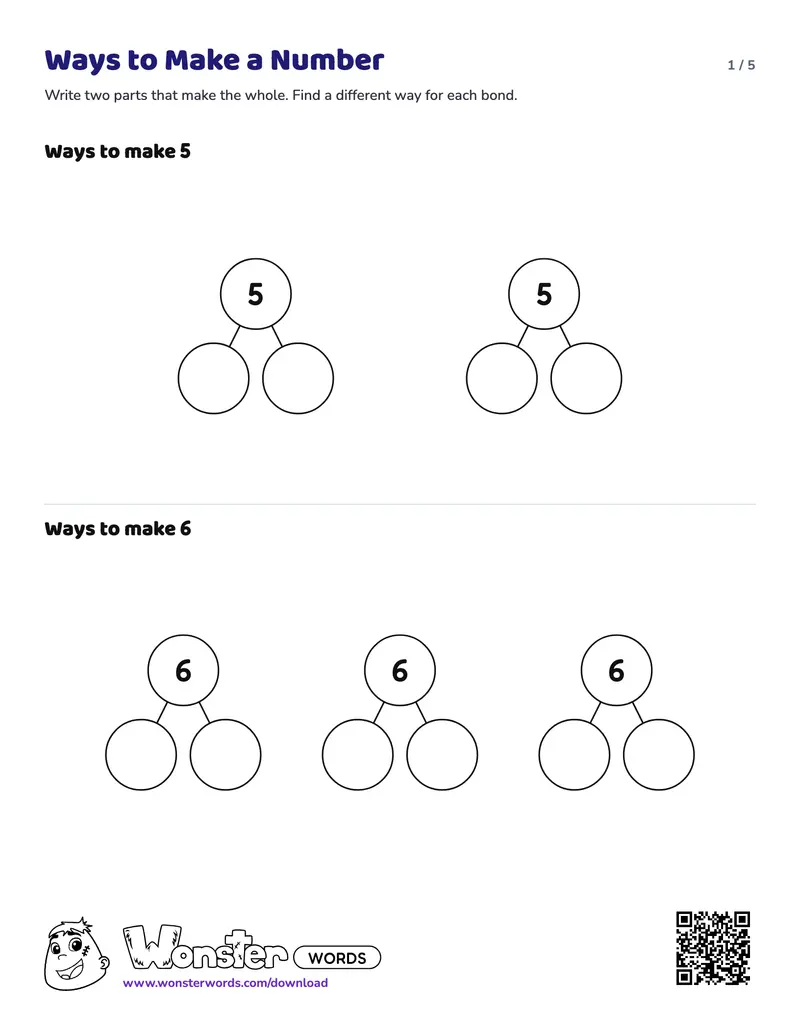
- Ways to Make a Number. Every way to split 5 to 10 into two parts (K.OA.A.3 and K.OA.A.4).
Free PDF · no sign-up
Feedback?Adding and taking away within 10
Five free PDFs in black and white, from picture word problems to written facts within 10. Each ends with an answer key.
- Picture Word Problems: Put Together (PDF)12 problems · answer key included · 5 pages
Preview page 1Preview
- Picture Word Problems: Take Away (PDF)12 problems · answer key included · 5 pages
Preview page 1Preview
- Addition Within 10 (PDF)88 problems · answer key included · 11 pages
Preview page 1Preview
- Subtraction Within 10 (PDF)88 problems · answer key included · 11 pages
Preview page 1Preview
- Ways to Make a Number (PDF)21 number bonds · answer key included · 5 pages
Preview page 1Preview
5. Shapes, position words, and patterns
Naming shapes whatever their size or turn, building them, and using position words are the kindergarten geometry standards (K.G.A.1 to K.G.B.6). The sheets come from the shapes worksheets, 2D shapes, 3D shapes, position words, tangrams and pattern blocks, and patterns pages. The shapes guide sets out which shapes come when.
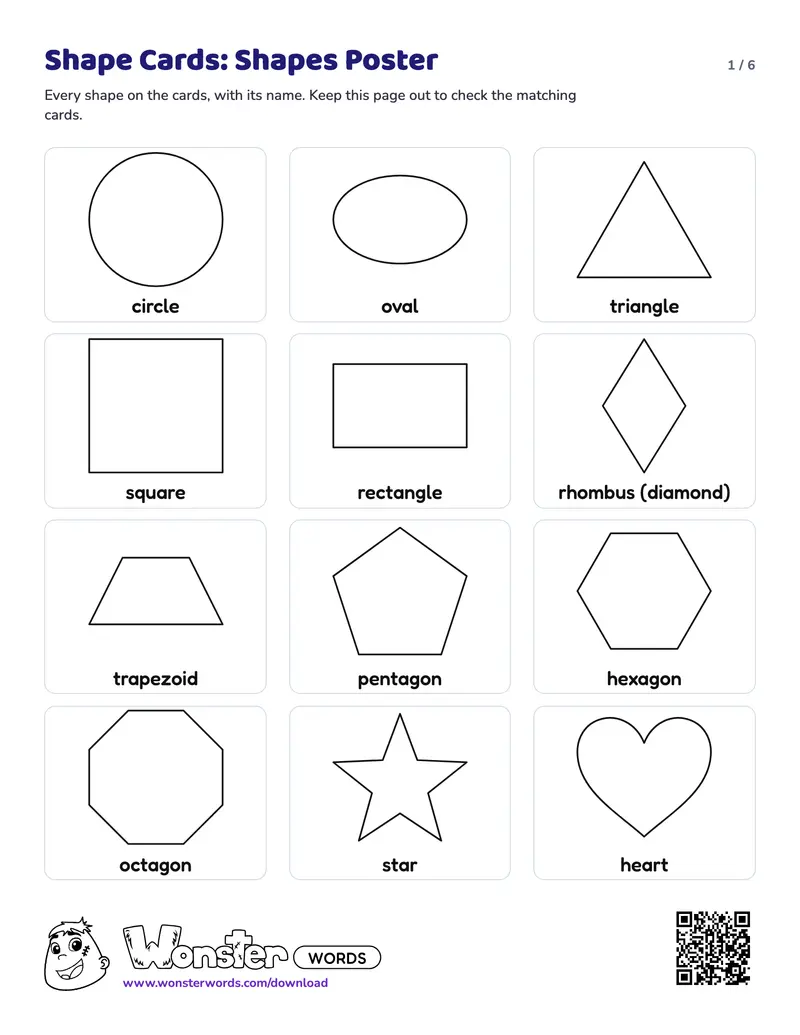
- Shape Cards. Shape flash cards with their names, and matching cards with the same shapes turned or stretched.
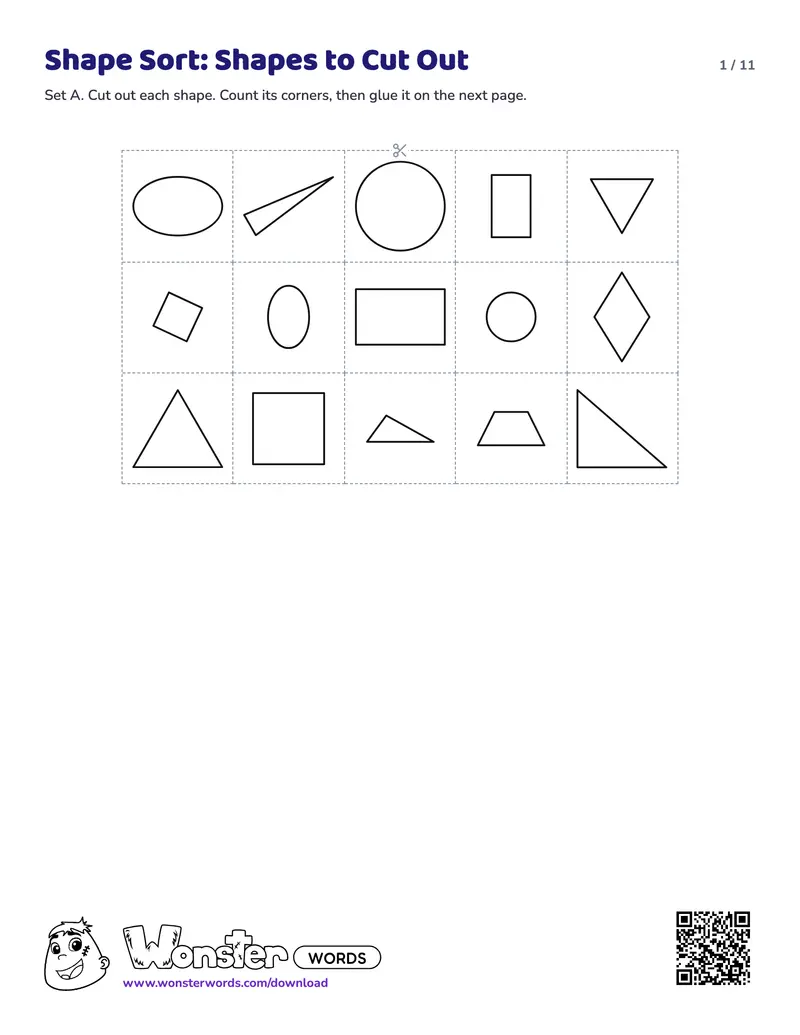
- Shape Sort. Shapes to cut out and glue under no corners, 3 corners, or 4 corners.
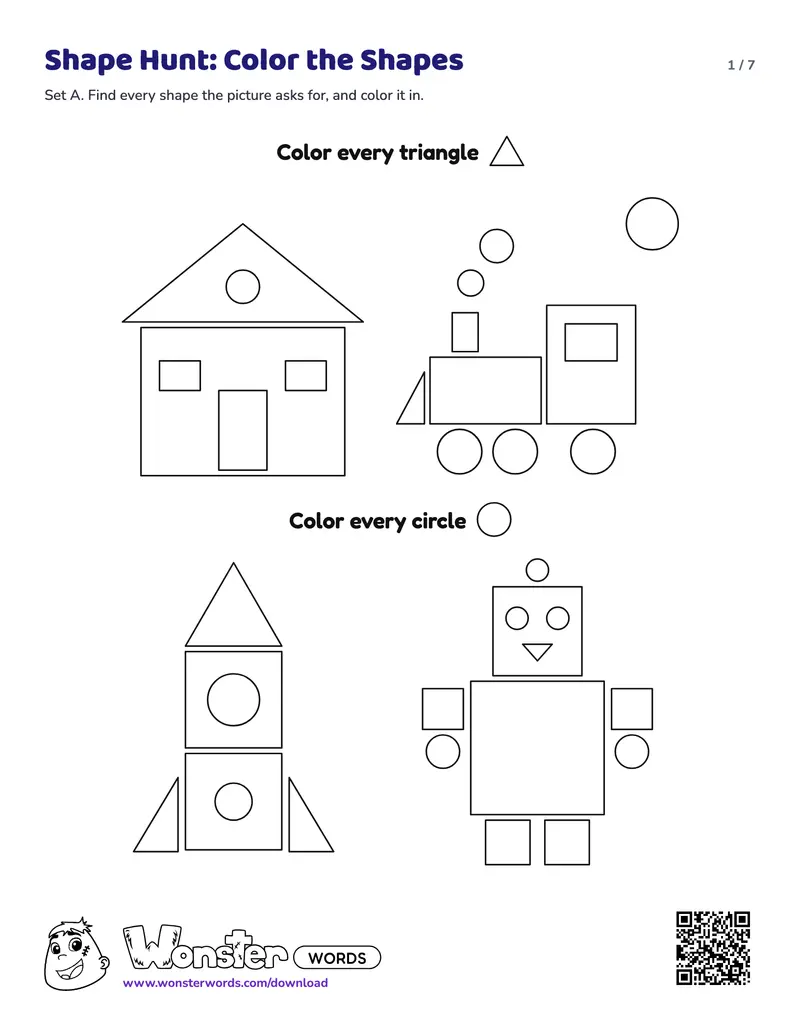
- Shape Hunt. Pictures built from circles, triangles, squares, and rectangles: color one kind, then count each kind.
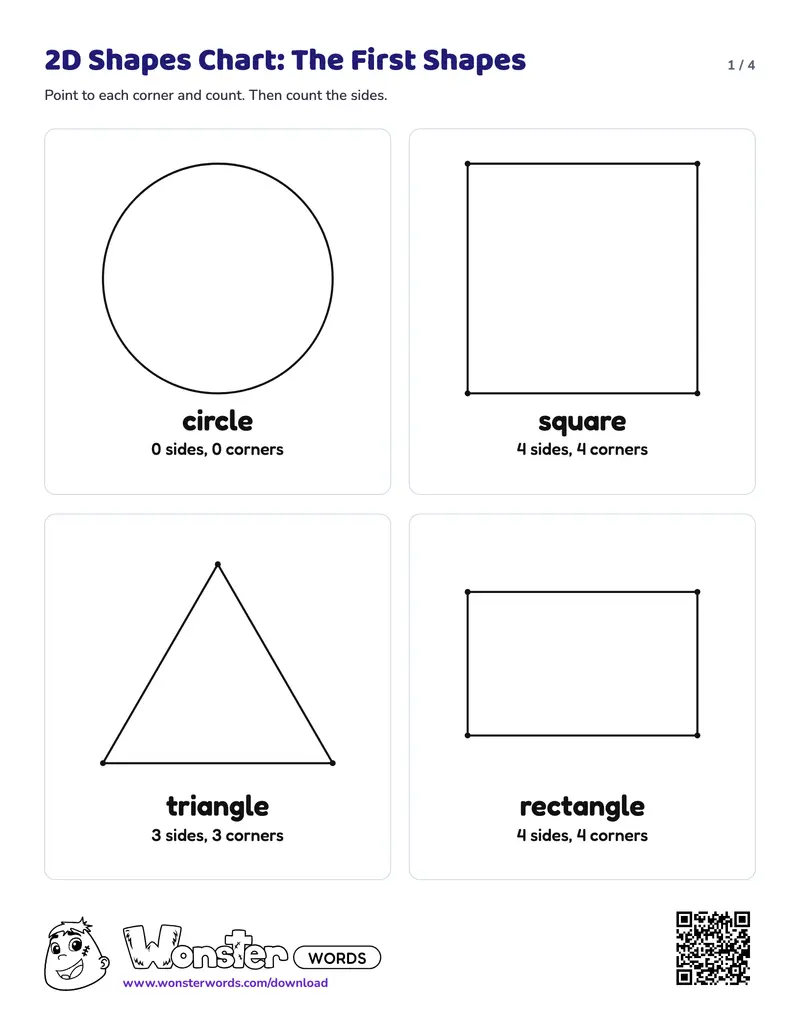
- 2D Shapes Chart. The flat shapes with their names, sides, and corners.
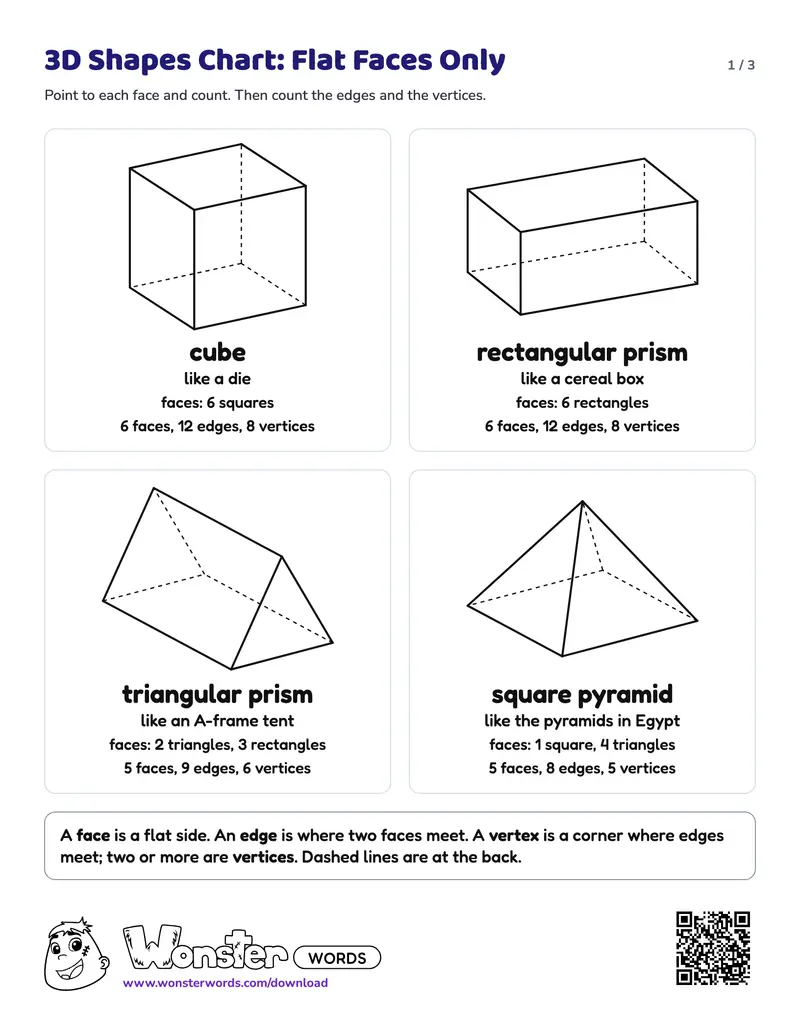
- 3D Shapes Chart. The solid shapes, each with an everyday example.
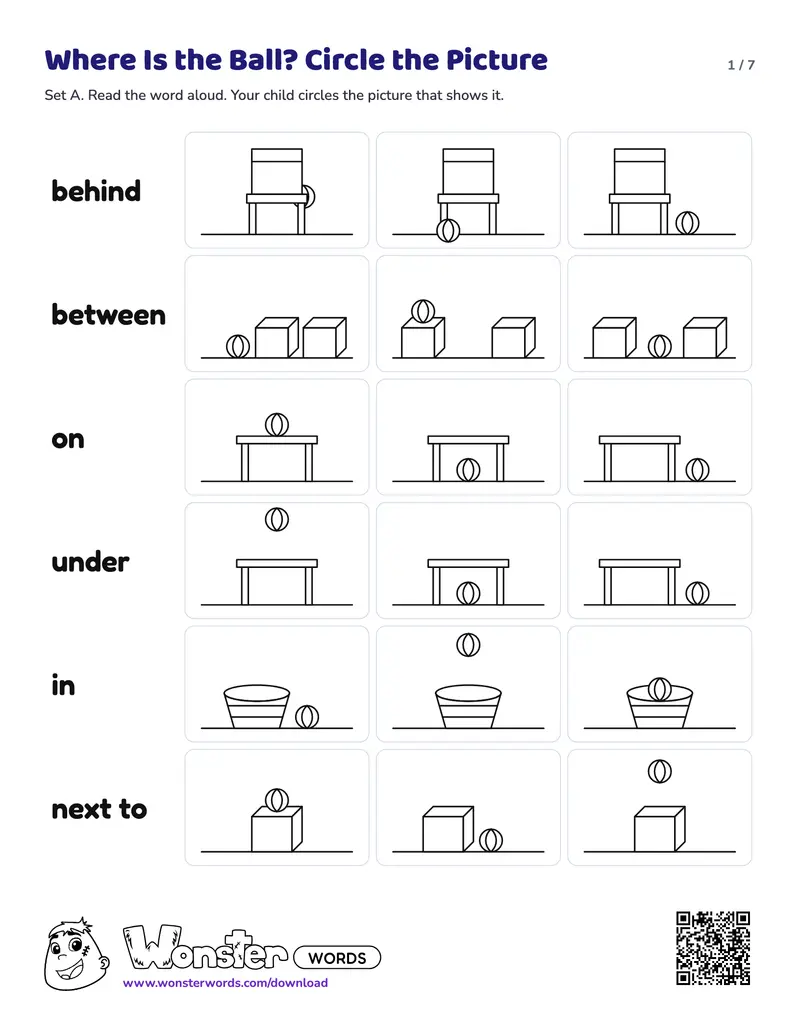
- Where Is the Ball? A grown-up reads a position word, and your child circles the picture that shows it.
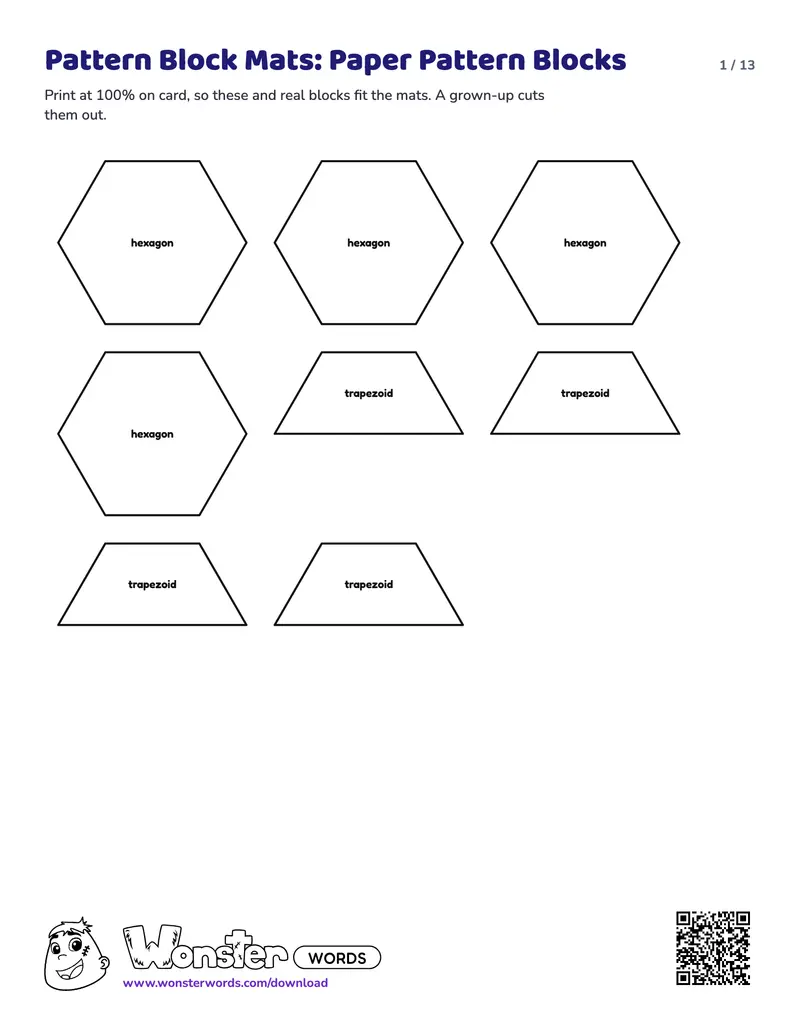
- Pattern Block Mats. Paper pattern blocks and pictures to fill, at the size of real blocks.
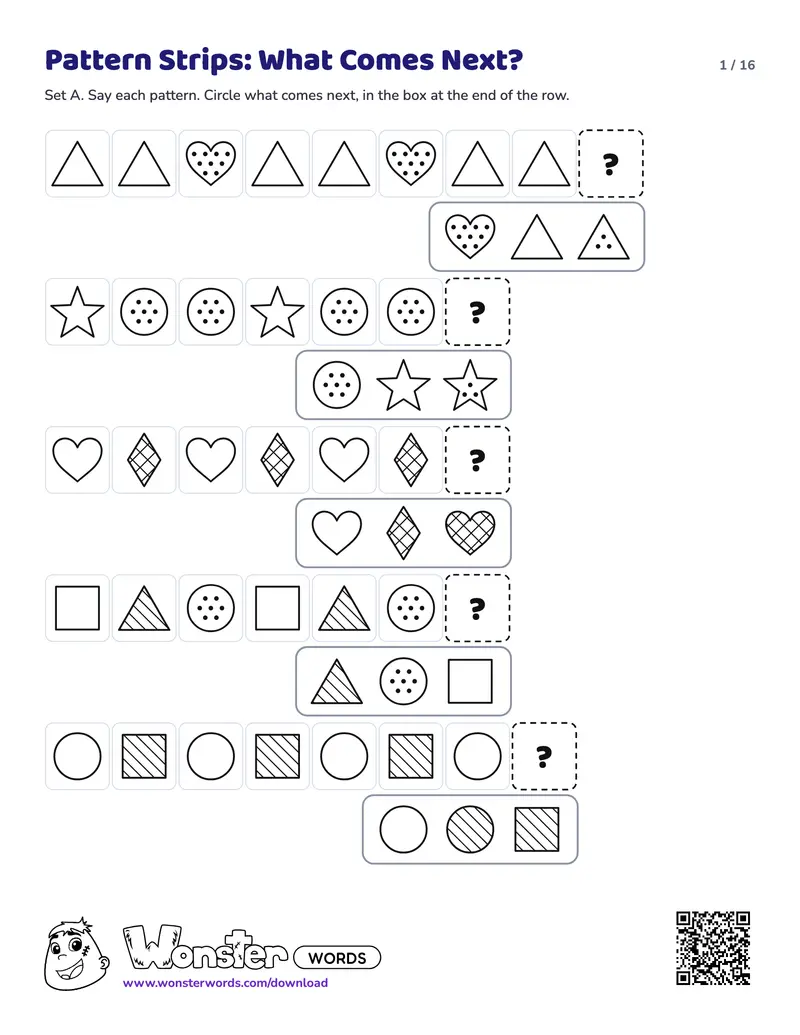
- Pattern Strips: What Comes Next? Your child circles what comes next in AB, AAB, and ABC patterns.
Free PDF · no sign-up
Feedback?Shapes, position words, and patterns
Eight free PDFs in black and white: cards and charts to name shapes, sheets to sort and find them, and position words and patterns. Each download line says whether the sheet has an answer key.
- Shape Cards (PDF)36 cards · 6 pages
Preview page 1Preview
- Shape Sort (PDF)39 shapes to sort · answer key included · 11 pages
Preview page 1Preview
- Shape Hunt (PDF)2 pictures · answer key included · 7 pages
Preview page 1Preview
- 2D Shapes Chart (PDF)19 shapes · 4 pages
Preview page 1Preview
- 3D Shapes Chart (PDF)7 shapes · 3 pages
Preview page 1Preview
- Where Is the Ball? (PDF)14 pictures · answer key included · 7 pages
Preview page 1Preview
- Pattern Block Mats (PDF)8 mats · answer key included · 13 pages
Preview page 1Preview
- Pattern Strips: What Comes Next? (PDF)25 patterns · answer key included · 16 pages
Preview page 1Preview
Two printable games sit on their own pages and in the activities below: Number Bingo 0-20 on the number tracing page, and the 1-100 number path game on math board games.
Is my child on track in kindergarten math?
A kindergartner is on track in math when they are working toward the end-of-year skills, not when they can already do them. The standards describe June, not September: a kindergartner still working toward 100 in the spring is on time, as the counting to 100 page says.
For number sense, use the two-minute number sense check-in. Its kindergarten row asks items 2 to 8, with up to 10 objects and the numerals 0 to 20: counting each thing once, knowing how many, counting out an amount, comparing, naming numerals, one more, and counting on. Start with the first item that was not easy.
Beyond number sense, three things to notice at home show a kindergartner doing well:
- A story problem with fingers or toys. Your child solves “You have 3 cars and get 2 more. How many now?” by counting the toys or fingers, and says 5.
- A shape turned on its point. Your child names a triangle standing on its tip, or a square turned like a diamond, as a triangle or a square.
- More, by matching or counting. Shown two groups, your child says which has more by lining them up or counting, not by which row looks longer.
These are things to notice, not a test, and none of them has a score.
When to talk to the teacher: if one of these, or a check-in item, stays “not yet” after a few weeks of everyday practice, or if the teacher raises it. The teacher sees your child’s math every day and is the first person to ask, and the struggling with math page lists what to ask.
A kindergartner who does the whole year’s work easily can go on to first grade’s work, such as making ten to add within 20, rather than more of the same.
Reading has its own checks: kindergarten readiness for the year before, and is my child on track with reading? for this year.
Kindergarten math activities and games at home
Kindergarten math activities at home work best a few minutes at a time, inside a game or something your family already does. One for each strand of the year:
- Counting to 100. Walk a hundreds chart by tens with a finger, saying “10, 20, 30” down the column.
- Counting on. Play the 1-100 number path game, starting each move from the square you are on, not from 1 (K.CC.A.2).
- Comparing. Play “greater wins” with a deck of cards, the card game on the greater than, less than page.
- Adding and taking away. Act out story problems with toys, then draw them as a picture, the way the addition and subtraction guide shows.
- Making 10. Show 10 on two hands and on a ten frame, then ask how many more make 10 when 7 are showing. Fingers are a fine tool for it.
- Shapes. Hunt for shapes on a walk, then fill a mat with pattern blocks, and sort and hunt at home.
- Measuring and sorting. Line up shoes from shortest to longest, and sort the laundry into piles and count each pile (K.MD.A and K.MD.B.3).
- Coins, in Texas. Sort the coins in a purse into pennies, nickels, dimes, and quarters, and name each one (K.4). The coin chart prints each coin at actual size to lay a real one on.
The best board games for counting, and how to play them so they build number sense, are on math board games. More math games for the early grades sit beside the milestones for every age.
How often should my child practice kindergarten math at home?
A few minutes of kindergarten math practice on most days is a reasonable routine, and a worksheet comes after the same skill with real objects. These five steps work on every practice sheet on this page.
Do it with things first
Count, compare, or act out the story with real objects, such as blocks, spoons, or toy animals, and then hand over the sheet. A worksheet practices a step your child has already met with things.
One sheet, a few minutes
Print one sheet, not a tray. Do a row or a page, and stop while it is still going well.
Do the first row together, out loud
Work the first row side by side and let your child use fingers, counters, or a ten frame. Ask "How did you know?" after an answer, because the answer shows how your child is thinking.
Check it together with the answer key
Check each answer against the key while it is fresh, and let your child fix the ones that are wrong. Charts and cards have nothing to check.
Move on when your child is accurate and calm
Go to the next sheet when your child gets the answers right without strain, not when the page is finished. If a sheet stays hard, go back one sheet and put objects on the table.
No research sets a number of minutes. Stop while it is going well, and count math inside daily routines too. The What Works Clearinghouse practice guide Teaching Math to Young Children recommends that preschool and kindergarten teachers “Dedicate time each day to teaching math”. It rates that recommendation as Minimal evidence, which means the panel’s judgment rather than a tested effect.
Worksheets and objects do different jobs. A worksheet practices one thing and leaves a record you can look back at next week. It does not teach a new skill, and at this age it follows the objects. If a sheet stays hard, go back one sheet and put the blocks back on the table.
Frequently asked questions
What shapes should a kindergartener recognize?
By the end of kindergarten, children name squares, circles, triangles, rectangles, and hexagons, and the solid shapes cubes, cones, cylinders, and spheres, whatever their size or which way they are turned. That list comes from the Common Core's kindergarten introduction. Texas names circles, triangles, rectangles, and squares in kindergarten and leaves the hexagon to first grade.
What common mistakes do kindergarteners make in addition and subtraction?
Three are common: counting the whole group again from 1 instead of counting on, counting one object twice or skipping one, and losing track of which part of a story problem is which. Each is normal at this age. Lining the objects up, touching each one once, and acting the story out with toys help with all three.
At what age do children typically start learning addition and subtraction?
Children start adding to and taking away with real objects at about 4, in preschool, with amounts up to 5. Kindergarten, usually ages 5 to 6, adds and takes away within 10 with objects, fingers, or drawings, and story problems. Written facts from memory come later, over first and second grade.
How do kindergarten math skills compare to first-grade skills?
Kindergartners add and take away within 10 and are fluent within 5; first graders add and subtract within 20 with strategies such as counting on and making ten, and are fluent within 10. Kindergartners count to 100; first graders count, read, and write to 120. First grade also adds tens and ones, the equal sign as "the same as", telling time to the half hour, and halves and fourths of shapes.
How can I tell if my child is ahead in kindergarten math?
A kindergartner who already does the whole end-of-year list easily in the fall, counting to 100, adding and taking away within 10, and seeing 11 to 19 as ten and some more, is ahead of what kindergarten asks. The next step is first grade's work, such as making ten to add within 20 and tens and ones, rather than more of the same kindergarten sheets.
Are there math worksheets specifically designed for teaching fractions to kindergarteners?
No Common Core or Texas standard asks for fractions before first grade, so a kindergartner does not need fraction worksheets. Sharing crackers fairly between two plates, or cutting a sandwich into two matching halves, is the right fraction work at this age.
Do these kindergarten math worksheets have answer keys?
Most do: the practice sheets end with an answer key, with each answer in red in the place where your child writes it. Charts and cards have nothing to answer, and Count and Color has no key because any group of the right number of pictures is right. Each sheet's download line says whether it has an answer key.
What vocabulary should kindergarteners know for math?
Comparing words: more, fewer, and the same. Measuring words: longer, shorter, taller, heavier, and lighter. Position words: above, below, beside, in front of, behind, and next to. And the shape names: circle, square, triangle, rectangle, and hexagon, then cube, cone, cylinder, and sphere.
Is there a standard kindergarten math curriculum?
No single curriculum is used everywhere. The standards name the skills, and each school chooses a program to teach them. Most states use the Common Core's kindergarten standards or standards built on them, and Texas uses its own, and the two share the same core: counting to 100, adding and taking away within 10, and naming shapes.
Related guides
Standards this page teaches: Common Core: K.CC.A.1, K.CC.A.2, K.CC.A.3, K.CC.B.4, K.CC.B.4c, K.CC.B.5, K.CC.C.6, K.CC.C.7, K.OA.A.1, K.OA.A.2, K.OA.A.3, K.OA.A.4, K.OA.A.5, K.NBT.A.1, K.MD.A.1, K.MD.A.2, K.MD.B.3, K.G.A.1, K.G.A.2, K.G.A.3, K.G.B.4, K.G.B.5, K.G.B.6 · Texas: K.2(A), K.2(B), K.2(C), K.2(D), K.2(E), K.2(F), K.2(G), K.2(H), K.2(I), K.3(A), K.3(B), K.3(C), K.4, K.5, K.6(A), K.6(B), K.6(C), K.6(D), K.6(E), K.6(F), K.7(A), K.7(B), K.8(A), K.8(B), K.8(C), K.9(A), K.9(B), K.9(C), K.9(D)
Last updated
Looking for something else?
Looking for something else?